



Here’s a wealth of information about DAYLILY bulbs from our email Gazette and past catalogs, starting with the most recently published. For other topics, please see our main Newsletter Archives page.
To subscribe to our FREE email newsletter, click here.
“Tall Drink of Water” – ‘Autumn Minaret’ Daylily
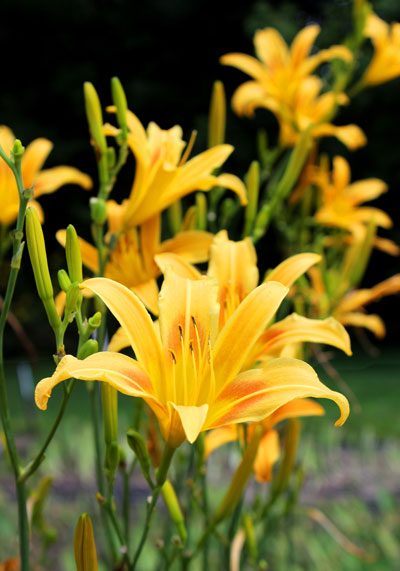
Andrew Keys – author of Why Grow That When You Can Grow This? – had high praise for our towering ‘Autumn Minaret’ in the August 2018 issue of Fine Gardening.
After describing it as a “superstar” that “sends up rockets of flowers,” he goes on to say that “daylilies always make reliable summer bloomers, and this cultivar sends up fragrant scapes of those voluptuous flowers from late summer well into fall. If that’s not enough, each one tops out up to a whopping six feet and sports yellow petals with an orange eye. This tall drink of water makes the perfect companion for meadow plants in full sun. Though daylilies will bloom in shade, more sun equals more flowers, and ‘Autumn Minaret’ is no exception.”
Always in high demand, ‘Autumn Minaret’ is sure to sell out early, even though we’ve already set a limit of five on it – so if you want it, we suggest you take a break from your holiday shopping and order it now. (December 2019)
Heirloom Gardener Magazine Spotlights Our ‘Royal Beauty’ Daylily
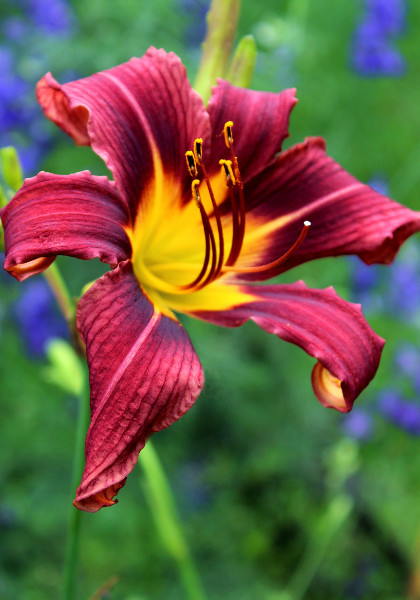
New to our offerings this year, wine-red ‘Royal Beauty’ daylily is making a splash in the spring 2019 issue of Heirloom Gardener where it’s the only flower included in their article “the freshest heirloom releases of the season.”
Published by the same folks as Mother Earth News and Utne Reader, Heirloom Gardener focuses on edible plants, but it always includes something of interest to flower-lovers – including, in this issue, “A Celebration of Lilacs” and “Victorian Plant Women.” See more or subscribe at heirloomgardener.com. (March 2019)
The Virtues of Heirloom Daylilies
In a pioneering article in the May 2007 issue of Horticulture magazine, Betty Gatewood sang the praises of heirloom daylilies.
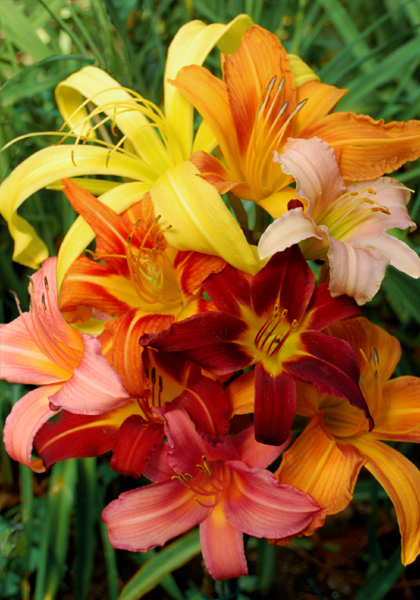
“Daylily fanciers today usually dismiss [heirlooms] as historical curiosities of limited interest,” she wrote. “The oldies, they believe, have been superseded by varieties with larger, showier flowers, sturdier stems, longer blooming periods, or other perceived advantages.”
But heirloom varieties, she points out, have their own special virtues.
First of all, “they retain the classic lily shape that has largely been bred out of modern daylilies. They are supremely beautiful. For this alone they are worth seeking out. . . .
“Many are fragrant.
“Their thinner, smaller flowers mean that deadheads are not very noticeable – in contrast to modern daylilies, which are disfigured by heavy, ugly spent blooms. . . .
“The old varieties range widely in size and in bloom time – daylilies flower in my garden from mid-May until the end of September, sometimes longer.
“Their colors are clear and stable; they combine well, and most suffer little weather damage.
“They are vigorous and naturalize well.”
“Some modern varieties bloom longer,” she adds, “but I would rather have three weeks of a flower I love than months of one that is commonplace.”
You can read the entire article here. Although most of the 35 daylilies she mentions are impossible to find today, we offer eight of them on a rotating basis and we’re building up stock of ‘Libby Finch’ and ‘Neyron Rose’.
Eleven heirlooms and our Classic Daylilies sampler are available now for April delivery. Order any of them and you’ll soon see what Betty (and we!) love about these “plants that should not disappear.” (Feb. 2018)
“Supremely Beautiful” ‘Ophir’ Daylily
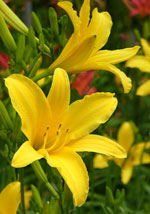
Ten years ago in a pioneering article for Horticulture magazine, Betty Gatewood sang the praises of heirloom daylilies.
“These plants, once treasured by gardeners for their elegance of form, are mostly unknown today,” she wrote. “But they are distinguished by one great quality: they retain the classic lily shape that has largely been bred out of modern daylilies. They are supremely beautiful. For this alone they are worth seeking out.”
Betty’s number one example was the lovely ‘Ophir’. One of the first American-bred daylilies, ‘Ophir’ has “trumpet-shaped flowers (rather like a golden Easter lily) of unmatchable shape,” she wrote. “It is also a robust grower, tall (about four feet), slightly fragrant, and very floriferous. Blooming . . . for almost a month, it is far too fine a plant to be forgotten.”
We completely agree – and though this “supremely beautiful” daylily is sure to sell out soon, you can still order it now for April delivery. If you listen carefully you can probably hear Betty saying, “You won’t regret it.” (Feb. 2017)
What Good is a Historic Daylily?
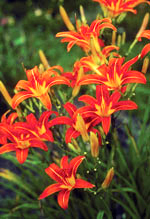
And why should we have historic daylily gardens?
In an excellent article for the American Hemerocallis Society, Linda Sue Barnes offers several answers to those two questions, most of which also apply to the even bigger questions: What good is any historic flower? And why should we grow them today?
1. “Many historic daylilies have beautiful flowers. Many . . . are stars or trumpets, and . . . the simplicity of those flowers can provide a break from all the ruffles, fancy edges, and patterns of the modern daylily.”
2. “Many historic daylilies have spectacular garden habit,” such as ‘Autumn Minaret’ (1951) which “can easily reach 6 feet with as many as 80 blooms on a scape.”
3. “Logically enough, most of the early cultivars that are still in gardens today multiply well and are very hardy.”
4. “Historic daylilies . . . extend the garden season.” In her North Carolina garden, Linda Sue has historic varieties blooming from early April – “a month before more modern cultivars begin” – well into September.
5. “Historic daylilies . . . win flower shows.” Linda Sue says four 1950s classics have “won Best in Show in our region in the last few years” and “many more have won Best in Section.”
6. “Historic daylilies . . . can, even today, be good parents.” Breeders such as Brian Mahieu are using them to create new daylilies with “vigor, clear colors, a lot of unusual forms, and fragrance.”
For photos of 16 historic daylilies (including ‘Poinsettia’, pictured here) and Linda Sue’s reasons for having historic daylily gardens, see the entire article at our website. There you’ll also find a link to the AHS website where 20 historic daylily gardens, each with 50-100 historic varieties, are listed by region.
To see just how good historic daylilies can be, why not grow a few yourself? We’re offering 14 for April delivery – including fragrant lemon lily, spring-blooming ‘Gold Dust’, and 4-6 foot tall ‘Challenger’ – all of which Linda Sue would tell you are great garden plants. (Jan. 2017)
Daylilies in Bouquets? Definitely!
You might not expect it, but daylilies make fine cut-flowers — or at least our graceful heirloom varieties do. Although an individual flower lasts just one day, buds will continue to develop and open for up to a week indoors.
Way back in 1954, two University of Illinois professors wrote in a USDA booklet that “daylilies have become very popular for home flower arrangements.” They recommended cutting stalks with “several perfect full-blown flowers and a number of well-developed buds,” ideally in the morning when they’re “still fresh and undamaged by wind, sun, or insects.”
“With a little practice, almost anyone can display them to advantage,” the professors continued. “They may be used alone or in combination with other garden flowers and a wide variety of green and dried materials. Delphiniums, gaillardias, gladioli, Japanese iris, Shasta daisies, snapdragons, and zinnias are only a few of the many annuals and perennials that work up nicely with daylilies. Endless combinations can be devised that will brighten up the mantel, party table, or altar. Leaves of caladium, canna, hosta, iris, and peony can be used effectively in place of the natural foliage, as can also the graceful branches of various shrubs and evergreens such as huckleberry, magnolia, rhododendron, and yew, [or] the silvery leaves of artemisia.”
For a little extra inspiration, check out the daylily bouquet we put together yesterday with flowers from our micro-farms and home gardens. And to learn more about using other bulbs in bouquets — from snowdrops to dahlias — visit oldhousegardens.com/BulbsAsCutFlowers . (July 2015)
Tips from 1954: Companion Plants for “Up and Coming” Daylilies
“Gaining rapidly in popularity, daylilies are truly one of the most up-and-coming perennials we can choose for our gardens,” wrote G. M. Fosler and J. R. Kamp in a nifty little 1954 booklet titled Daylilies for Every Garden. With its mid-century vibe, the booklet offers these tips for companion plantings:
“Daylilies are often planted with early bulbous stock, such as tulips and daffodils. The daylily foliage does not interfere during the blooming periods of these plants. Later in the season the maturing and unattractive bulbous foliage is hidden by the expanding lush daylily clumps.
“The earliest blooming varieties [such as ‘Gold Dust’, ‘Sovereign’, and ‘Orangeman’] are effectively combined with bearded iris, the whites and the delightful shades of blue and purple in iris contrasting beautifully with the gold and yellow daylilies. The later daylilies . . . also make ideal garden companions for bearded iris and peonies. Daylily foliage does not grow very large until after the iris and peony blooming seasons are past. It is then that the daylily really comes into its own to continue the succession of color in the garden.
“For pleasing effects later in the summer, the artistic gardener will think of endless combinations. Some daylilies work in well with colorful phlox, columbine, and blue delphiniums. Purple liatris is very striking with yellow daylilies. Many daylily colors also harmonize pleasingly with Shasta daisies, floribunda roses, oriental poppies, platycodon [balloon flower], hardy lilies, and even fall chrysanthemums. Highly interesting foliage contrasts are also possible with such plants as canna, coleus, dusty miller, and hosta. . . .
“An all-season perennial border made up of tulips, iris, peonies, daylilies, and chrysanthemums will provide continuous interest from early spring until frost.” (April 2015)
‘Corky’ Daylily “Scores a Perfect 10”
With chocolate buds that open into a seemingly endless profusion of small yellow flowers, ‘Corky’ is one of my favorites daylilies — and I’m not the only one who feels that way. When he owned Loomis Creek Nursery in upstate New York, Portland-based garden designer Bob Hyland sold just a handful of daylilies, including ‘Corky’ which he called a “must-have” plant. His criteria for selecting daylilies were simple, he said:
“1. Great bud count for extended bloom time.
“2. Smaller flower size (2-4” diameter) to fit the look of naturalistic border designs.
“3. Strong flower colors with saturated hues and tint.
“4. Tall, sturdy flower stems (36” and taller) that punctuate borders with aerial theatrics.”
“‘Corky’ scores a perfect 10 in our evaluation system,” Bob wrote. “Its flared, bright lemon yellow, 3-inch flowers are accented by bronzy-brown color bars on the outside of petals. Wiry, purplish flower stems rise 3 feet above the narrow, strappy foliage, and each stem is well-branched with a 40+ bud count, sending wave after wave of flowers your way.”
To see for yourself what Bob and I are so enthusiastic about, order ‘Corky’ now for April delivery. But don’t delay — we have fewer than 60 plants left! (March 2015)
Garden Gate Showcases Two of Our “Out-of-the-Ordinary Daylilies”
“If you think daylilies are overused and passè, think again!” writes Stephanie Petersen in the “Editor’s Picks” column of the December Garden Gate. She spotlights eleven unusual varieties that reflect the vast diversity of colors, shapes, heights, and bloom-times found in daylilies, and two of them are ours.
Wildflowery ‘Corky’ — “The upper part of the scape and flower buds on ‘Corky’ are burgundy-bronze,” Stephanie writes, and since the color persists when the small, yellow flowers open, “it gives a delightful contrast.” What’s more, ‘Corky’ “looks more like a wildflower” than most daylilies, with its “slender grass-like foliage and . . . massive flush of flowers that stand high above on thin, wiry stems.”
Extra-tall ‘Challenger’ — This robust variety will “provide you with lots of flowers” which “stay open . . . longer than many daylilies,” Stephanie writes. What really sets it apart, though, is its height: “With scapes up to 6 feet tall, the brick-red spider flowers are held high and perfect in the middle or back of the border.”
These and all of our other heirloom daylilies can be ordered now for April delivery — or you could add them to your Christmas list! (Dec. 2014)
AHS Seeks Photos of Heirloom Daylilies: Can You Help?
“A treasure hunt is on,” writes Debbie Monbeck in the spring issue of The Daylily Journal. “The hunt is for missing photos of historic cultivars to post with their descriptions” in the Daylily Database at the American Hemerocallis Society website. “Of the nearly 1,200 cultivars registered prior to 1965, only a handful have a photo” there, and Debbie, who chairs the Historic Daylilies Subcommittee, wants to change that. “Your help is needed,” she writes, “before it is too late, and the photos are gone. . . . The photos are crucial to help identify some of these older gems, and to preserve the knowledge base for generations to come.”
We’ve answered the call, and we hope you will, too. Of the 62 daylilies we’re growing, all of which date to the 1950s or before, the Daylily Database lacks photos for almost half of them. We’re currently putting together our best photos of those varieties for Debbie who will then have them vetted by a group of AHS experts before they’re posted online. 1980 is the surprisingly recent cut-off date for this project, so if you’re growing any daylilies introduced before then, why not take a minute and type their names into the Daylily Database. If any of them don’t have a photo, Debbie would love to hear from you at dmonbeck@aol.com. (June 2014)
Meet the Spiderman: The Colorado Father of ‘Kindly Light’ Daylily
With its long, curling, ribbon-like petals, ‘Kindly Light’ is both strikingly beautiful and a ground-breaking daylily. In her fine A Passion for Daylilies (1992), Sydney Eddison tells of its breeder, a man who saw the possibilities for beauty in a form that everyone else at that time was scorning. She writes:
“To daylily people, a spider is a flower style, originated in the early forties by LeMoine J. Bechtold on his Colorado property nine miles south of Denver. He had chosen this location for its beautiful setting with a view of the Rockies and for the stream which would provide water for his numerous horticultural enthusiasms and experiments.
“Bechtold’s Christian name was the inspiration of a plant-loving mother who insisted on calling him after French horticulturist Victor Lemoine. As a boy, young LeMoine may have found the name a burden, but it proved suitable after all. He grew up to love plants and soon became involved in hybridizing. His earliest love affair was with dahlias. Later, he embraced gladioli, peonies, irises, and even lilacs, and then he discovered daylilies. In fact, he found so much pleasure in this new hobby that it often took precedence over his music business, and for this, fanciers of the spider daylily can be grateful. . . . LeMoine Bechtold’s ‘Kindly Light’, registered in 1949 and introduced by the Wilds in 1952, is still the standard for spider daylilies.” (Feb. 2014)
“Pack a Vertical Punch” with Unfloppable ‘Autumn Minaret’ Daylily
In the Jan.-Feb. issue of Fine Gardening, Nashville garden designer Troy Marden praises one of our most distinctive daylilies in his article “Pack a Vertical Punch.”
“Visitors to my garden always ask about ‘Autumn Minaret’ daylily,” Troy writes, “partly because of its late season of bloom in July, August, and early September [and even later further north] but mostly because of its towering height. Its foliage remains in a neat and tidy mound only 2 feet tall and wide, but its bloom stalks rise above almost everything else in the garden, standing at least 6 feet tall. Strong and sturdy, these stalks remain firmly upright and do not flop, bearing a seemingly endless succession of golden flowers for almost two months.” (Jan. 2014)
Who’s Growing in Your Garden: Uncle Theron Returns Home
Every now and then we’re reminded of the very real people in the mostly forgotten past of our heirloom flowers. Recently, for example, first-time customer Amy Turner of Wainscott, NY, added this note to her order for 25 ‘Theron’: “My great grandmother, Martha Prentice Strong, a great gardener and friend of A.B. Stout [the pioneering daylily hybridizer], selected and named this daylily after her husband, Theron Strong. I look forward to a garden of Therons!”
Intrigued, we turned to Google and discovered an obituary for the remarkable Mrs. Strong published in the Journal of the New York Botanical Garden where Stout worked. One paragraph explained that the daylily was actually named for her son rather than her husband: “Another of her absorbing horticultural interests was the daylilies developed by Dr. A. B. Stout. From the first, she was enthusiastic over them, and for more than twenty years she maintained a collection of named varieties at [her home] ‘The Dolphins.’ In 1941, this collection of more than 100 kinds was transplanted to the old Clinton Academy (now a museum) in East Hampton, where it will be maintained by the Garden Club of the town. The name ‘Theron’ in memory of her son, was given by her to the first dark red clone of Hemerocallis developed by Dr. Stout, at his invitation.”
“Oh, Uncle Theron!” Amy said when I called with the news. Her father’s uncle, Theron Roundell Strong was a lawyer, head of Manhattan’s homicide bureau, and a lieutenant in the artillery during World War I. Amy’s family still has the diary he kept during the war, and she especially remembers his entry on Armistice Day, 1918: “The guns are silent. I’m heading to Paris to marry May” — and a week later they were wed. As for Mrs. Strong’s daylily collection, Amy says it survived until recently when the garden club ripped it out to plant wildflowers, a painful example of how historic plants are often lost to whatever’s currently in vogue in the garden.
Here in Ann Arbor this year, ‘Theron’ opened its first flowers on Independence Day, and I think Theron Strong would have appreciated that. Check out our photos here — or order it now for delivery in April and enjoy it in your own garden next summer. (July 2013)
Protect Your Daylilies with Vick’s Vapo-Rub
Got deer? Here’s a tip from our friend Diana Bristol of Bloomingfields Farm, deep in the deer-infested wilds of Connecticut, who swears by it. Put a little Vick’s Vapo-Rub on your thumb and index finger and then touch bud or leaf with it here and there. Diana says touching the smallest buds on a stalk is especially effective because the Vapo-Rub will remain on them for a long time before they get big enough to bloom and drop. (March 2013)
Staff Pick: Josh’s Favorite ‘Caballero’
Josh Myers has earned a reputation here as the hardest-working guy in the history of the world. If you’ve ordered daylilies or iris grown in our micro-farms, Josh not only planted, weeded, and nurtured them, he dug and washed them for shipping, too — often in weather that’s barely above freezing. Yet Josh says he loves daylilies because they’re so easy. “They’re low-maintenance,” he says, “and resilient. They multiply quickly, they’re drought AND flood resistant, pests don’t bother them, their bloom season lasts a long time,” and if that’s not enough, “they’re easy to divide if you want to spread them around or give some to a friend.”
Josh has planted many of our heirloom daylilies in a small park that he’s taken under his wing as part of Ann Arbor’s Adopt-a-Park program. From late May on, he says, something is always blooming there. When pressed to name a favorite, Josh picks one that Kelly, our Micro-Farms Manager, loves too ‘Caballero’. Our photo doesn’t do it justice, he says. (Did we mention Josh also takes photos for us, often sprawled on his belly in the cold, wet mud of spring?) He likes ‘Caballero’s distinctive pattern of narrow yellow petals alternating with wider petals of red-brown marked with a racing stripe down the middle. “It’s beguiling,” Kelly pipes up from across the room, but Josh says simply “it’s just cool.” March 2013)
‘Challenger’ Daylily Proves Its Worth to Arty in Atlanta
Arty Schronce lives in the historic Cabbagetown neighborhood of Atlanta and writes a column called “Arty’s Garden” for the Georgia Department of Agriculture’s 95-year-old Market Bulletin. With a philosophical outlook, a sense of humor, and an appreciation for heirloom plants, Arty is our kind of guy — as you can see in this excerpt about a daylily we’re offering for the first time this spring:
“Sometimes a plant grows on you. Not literally, of course. For example, several years ago I purchased a ‘Challenger’ daylily [Ed. Note: Not from us!] because it was taller and bloomed later than other daylilies. When it bloomed I was disappointed. The flowers were not as intensely red as the photograph in the catalog, and the petals were not as thin and ‘spidery’ as I had hoped.
“It was tall, however, rising to five feet or more, and extended my daylily season by beginning to bloom weeks after my other daylilies. I decided to keep it around a while longer instead of immediately casting it out of my little Eden.
“I am glad I did; ‘Challenger’ has proven its worth. It wasn’t exactly what I expected, but now I am quite fond of it. . . . Have you done this with plants as well, dismissing them without taking the time to learn their virtues? Unfortunately, I’ve also treated people that way. I’m trying to do a better job giving plants and people a fair chance.”
In another column Arty praises “Oxblood/Schoolhouse Lilies,” calling them “as refreshing as a glass of pomegranate juice” and wisely warning gardeners to keep them away from red spider lilies because “the oxblood lily undercuts the drama of the spider lily, and the spider overshadows the shorter, simpler oxblood.” Other columns of his we especially liked are “The Tulip Teacher,” “The Tawny Daylily,” and “The People Who Live in My Garden” — and once you get started, you may find yourself reading them all. (Dec. 2012)
Combining Bulbs with Daylilies, Peonies, and Other Perennials
Mass plantings of tulips or daffodils can be thrilling — be they at Keukenhof or your local mall — but at home few of us plant our bulbs like that. In A Patchwork Garden (1990), Sydney Eddison offers some good advice for integrating bulbs into mixed plantings:
“One of the most valuable lessons I learned from studying the Gills’ spring garden was that by combining bulbs with even a few early-flowering perennials you can have a wonderful display without sacrificing too much precious space. Their use of tulips was particularly striking. Planting them in masses of one color had tremendous impact. The tulips bloomed at the same time as a wealth of herbaceous plants . . . [and] later, their ripening foliage . . . was hidden by their perennial partners and by the emerging foliage of later-blooming perennials. . . .”
“ As I didn’t have that much space, I adopted the idea of pairing bulbs and perennials with a . . . much more limited selection of plants. I began planting tall [Single Late] tulips — cream to white only — in the middle and at the back of the border, always behind or in association with a clump of daylilies or a peony, to provide cover later for the bulbs’ dying foliage. In addition to hiding the ripening tulip leaves, the foliage of the perennials provides an attractive filler among the flowering bulbs. The daylily leaves are fresh and green and the immature peony foliage is dark green to deep red.” (August 2012)
Tasty Beauty: Eating Daylily Buds
In Asia where daylilies grow wild, people have been eating their roots, flowers, and buds for millennia. Today the dried buds known as “golden needles” are often found in the Asian food section of American supermarkets. They’re even tastier, though, when fresh picked from your own garden.
In his award-winning blog Hunter Angler Gardener Cook, Hank Shaw recommends a very simple saute: “Just lily buds, butter and salt. Delicious. Briefly cooked, the buds have a bit of knacken, a German expression meaning a ‘pop’. Yet the insides reminded me of squash blossoms. The taste? Green, with a whiff of radish and a dash of green bean. Honestly, I’d eat this as a side dish any day, any place. It needs nothing else.” Shaw isn’t as enthusiastic about the flowers (“okay”) and leaves (“not terrible”) but calls daylily roots “quite possibly the best tubers I’ve ever eaten.”
For a slightly more complicated recipe, try this Daylily Bud Saute with a hint of nutmeg from Golden Harvest Organics:
24 daylily buds
1 clove garlic, finely minced
olive oil
3 eggs
1/2 cup flour
1/8 tsp salt
1/8 tsp pepper
dash of nutmeg
1 tsp milk, as needed
Cut the base off the buds. Saute the garlic in olive oil. Beat eggs and mix in enough flour to make a thin batter. Add the sauteed garlic, salt, pepper, and nutmeg. If the batter is too thick, add a teaspoon or so of milk. Dip the buds in the batter and saute until golden brown.
Enjoy! (June 2012)
“Slow Gardener” Felder Rushing’s Favorite Daylily
I’ve been reading and savoring Slow Gardening, Felder Rushing’s new book in which he promotes — in his typically humorous, down-to-earth style — a “no-stress philosophy” of gardening that’s meant to help you follow your bliss in the garden and not worry so much about what the experts and your neighbors might say. Felder has always been a big fan of heirloom plants “rescued from the compost heap of fashion,” and in a chapter titled “Plants — The Real Deal” he sings the praises of one of our best-selling daylilies: “My all-time favorite daylily is the old double orange ‘Kwanso’, grown for eons as a nutritious food (more vitamins than broccoli!) and actually mass-planted outside the royal gardens at Kew in London. Though nearly impossible to find in a daylily-society display, it grows for me, you, anybody, anywhere, with absolutely no demands. None.” You don’t have to be a slow gardener to appreciate a plant like that! (Oct. 2011)
‘Luxury Lace’ and Edna Spalding’s Kitchen Knife
Great garden plants come from all sorts of people, including this Louisiana housewife who John Peat and Ted Petit profile in The Daily: A Guide for Gardeners (2004):
“Edna Spalding of Iowa, Louisiana, was an early breeder of daylilies (including ‘Luxury Lace’) who made formidable contributions..... Daylilies shared space in the vegetable garden of this housekeeper..... She had the strong, silent, self-assured appearance of an early pioneer woman in her cloth bonnet..... She had a magnificent eye for quality and beauty as well as a great intuitive breeding sense. Her standards were the highest. She always carried a large kitchen knife as she walked in the garden, and if a new seedling displeased her, out it would go, cut below the crown, never more to plague her with its short-comings.” (2010-11 catalog)
A Master’s Advice for Choosing Daylilies
Christopher Lloyd grew thousands of plants in his world-famous gardens at Great Dixter, and he evaluated them all with the discriminating eye of an artist. For choosing daylilies that look great in your garden — not just in a catalog close-up — he offered this advice in Christopher Lloyd’s Garden Flowers:
“Don’t be carried away by a single bloom seen out of context....
“While being dazzled by large blooms, remember that small-flowered Hemerocallis are the most prolific. Furthermore, their individual flowers tend to die off discreetly, whereas large-flowered kinds really need dead-heading every morning, to prevent the colony from becoming slovenly....
“As with so many ‘improved’ plants, enlarged flowers are often matched by an increase in leaf size and coarseness. Watch out for this. Then again, the naked flowering stem should present its blooms well above the foliage, this being the graceful effect that gives the flowers style....”
To see exactly what he’s recommending, try a couple of our graceful, prolific, Christopher-Lloyd-style daylilies in your garden this spring. (March 2011)
Eating Flowers: “Scrunchy” ‘Kwanso’ Daylily
From Christopher Lloyd’s Garden Flowers (2000), here’s another good reason to plant double orange ‘Kwanso’ daylily this spring:
“H. x fulva, [the common orange daylily, is] a strapping triploid with tawny-coloured flowers and no scent. It naturalizes easily in quite rough places and is a common sight in India, by the roadside. No doubt it was planted in the first instance, because it cannot seed, but once there it spreads by rhizomes to form a colony. The day before the blooms open, the flower buds are habitually gathered to eat raw or stir-fried, and they are even more scrunchy in the double-flowered variety, ‘Kwanso’. A friend, who at one time gardened in Hong Kong, could for a long while not make out why his daylilies seemed always on the point of flowering, but never flowered. His Chinese cook was responsible. I can recommend the flavor, which resembles that of green figs.” (April 2010)
Daylilies Unfazed by Sidewalk Salt
“Sidewalk salt has a way of killing almost everything it touches,” writes Diane Selly of Minnesota’s Earthworks Gardens, and “with the extra snow and ice this year, you may be using more than usual.” Diane recommends switching to sand whenever possible, and adds that “some plants are salt tolerant and work great as edging plants along sidewalks or driveways: most daylilies, some hostas, some roses, some heucheras, and some ornamental grasses.” (Feb. 2010)



