



Here’s a wealth of information about GLADIOLUS from our email Gazette and past catalogs, starting with the most recently published. For other topics, please see our main Newsletter Archives page.
To subscribe to our FREE email newsletter, click here.
Is This the Year You Give Glads a Try?
Joseph Tychonievich doesn’t just love glads. “I freaking adore them,” he writes in the May 2019 issue of Horticulture.
And if you’re not a glad-lover – if you still think of them as “funeral flowers” or “tired old grandma flowers” – he’s out to change your mind.
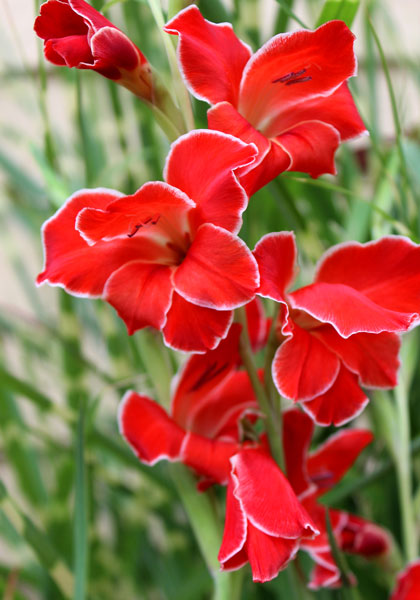
Maybe you prefer “a more graceful, natural look.” If so, Joseph recommends “old-fashioned varieties” such as ‘Atom’. This smaller glad has “graceful hooded blooms” of “rich, saturated scarlet” with “each petal edged with a perfect line of white.” They’re also spaced out along the stem “so you can enjoy the charm of each individual flower.”
“While some modern hybrids look too stiff and artificial to mingle easily with other plants,” Joseph continues, ‘Atom’ has “a wildling grace that looks marvelous either in a bed with other perennials or in an informal flower arrangement.”
Joseph is also a big fan of the Abyssinian glad. It’s “a treasure because right in the hottest part of the summer, when everything is looking tired and worn, this gladiolus starts pumping out crisp white flowers marked with dark maroon at the base of each petal…. The flowers boast a rich, spicy fragrance that gets stronger once dusk begins to fall.”
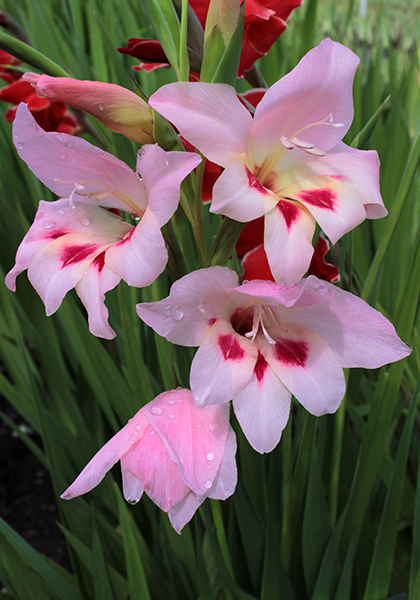
Gladiolus byzantinus, he points out, is one of the few Gladiolus species that hail from Europe instead of Africa, and “unlike the African bulbs that you should plant in the spring, this one is best planted in the fall, like a daffodil. Come spring the swordlike leaves pop out of the ground early, with elegant spikes of brilliant pink, graceful flowers following soon behind them. If they’re happy—and to be happy they need little more than full sun – they’ll quickly clump up and come back year after year.”
Diverse, “blessedly easy to grow,” and often “incredibly inexpensive,” glads are “too delightful a group of plants to let your prejudices stand in the way of enjoying them,” Joseph writes in closing. “Give them a shot in your garden this year. I promise you won’t regret it” – and we couldn’t agree more! (January 2020)
Small-Flowered Glads are “Summer Tulips,” Says UK Head Gardener
If you still aren’t convinced that glads belong in your garden, here’s a bit of advice from head gardener Tom Brown of the celebrated West Dean Gardens in Sussex.
It can be “tricky to associate most gladiolus with other garden flowers,” Brown writes in the August 2019 Gardens Illustrated, because “the exotic blooms scream for attention and dominate their companions.”
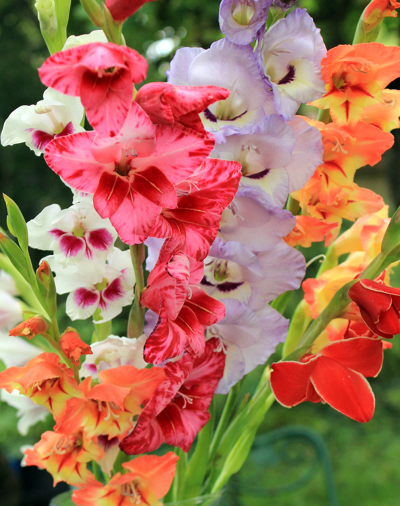
But small-flowered glads are “the exception to this rule.” Brown explains that he uses “these little flowers in clumps throughout my herbaceous borders, providing a colorful pick-me-up through the latter part of the season. I’ve started to view them as a summer tulip. Plant them around 100 days before you want them to flower and enjoy a burst of color when much of the garden is tired from the summer heat.”
‘Atom’ is our customers’ favorite small-flowered glad, and one of the cheapest. (You could easily pay more for a latte than you will for five ‘Atom’.) Others include dainty pink ‘Elvira’ along with two which are newly returned to our website and – as always – in short supply: luminous ‘Green Lace’ and apricot-freckled ‘Starface’.
Although we hope to have more glads to offer in January, if you want ‘Green Lace’ or ‘Starface’ it’s probably best if you to order them now – remembering that you can always add to your order later. (December 2019)
A Head Gardener’s Tips for Growing and Enjoying Glads
I learned something new recently: “When cutting gladiolus, it is always best to remove the top bud, which often results in more flowers in the stem opening to their full potential.”
So says head gardener Tom Brown of Parham House and Gardens in Sussex. Here’s some other helpful advice he offered in an excellent article in the July 2018 Gardens Illustrated.
“Gladiolus are relatively easy to grow,” Brown writes, “and as the corms are so inexpensive you can afford to use them as annuals, meaning you can experiment with different colors and styles from one year to the next.”
If you don’t want to buy new ones every year, they can also be dug and stored or – depending on your hardiness zone – “mulched heavily in sheltered, free-draining areas” To try that, cut the stalks down after frost, “cover the clump with a plastic bin liner [storage tub] to keep the corms dry, and mulch liberally with compost.”
Although Brown notes that many sources recommend planting glads earlier, he prefers “waiting until at least May” – again depending on your hardiness zone – “when the soil has warmed and the chance of frosts faded.” For a longer bloom season, he recommends “staggering your planting through May and June at fortnightly intervals.”
If you’re growing them for cutting, “you should be able to squeeze 60 to 100 corms into a square meter” which means planting them roughly four inches apart. To grow them intermingled with other flowers, Brown removes “a spade’s width and depth of soil” and then sets “five to seven corms at the base of the hole.”
Brown says that planting corms about ten inches deep gives them “consistent moisture and temperature so the flowers need less staking.” Smaller glads like ‘Atom’, ‘Starface’, and the Abyssinian glad often need no staking, while full-size glads “simply need four stakes in the corners of the clump and then string around the perimeter and a few pieces in between.”
Now doesn’t that sound easy? To give these tips a try and “indulge your garden and your vases with bold and beautiful spikes,” why not order a few glads now for April delivery? (March 2019)
Posh UK Magazine Heralds “Modern Era” of “Truly Sophisticated” Glads
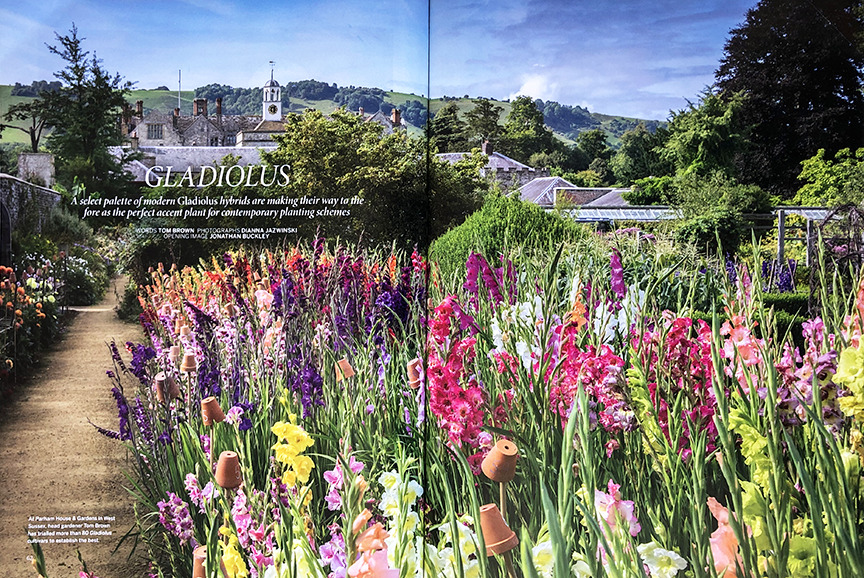
When the classy British magazine Gardens Illustrated devotes eight pages to gladiolus, you know they’re no longer just supermarket flowers.
Indeed, a “modern era of gladioli has arrived” writes Tom Brown, head gardener at Parham House and Gardens where he conducted a major trial of glads in 2017.
Although for some gardeners, he admits, glads will be “forever associated with outrageous taste,” today “subtler and more compact cultivars are beginning to push their way above the crowd.” Many of these are “truly sophisticated, associating beautifully with other late-summer performers” in the garden or bouquets.
Although most of the glads Brown mentions are too new for our catalog, one subtle older beauty he praises is the Abyssinian glad, G. callianthus ‘Murielae’. With “nodding, fragrant flowers that are an absolute delight,” this Award of Garden Merit winner “offers great versatility, and is equally superb in containers, borders or in a vase.”
“Of course, if you’re looking for loud and proud,” he continues, “there are also more traditional-looking, ruffled gladioli cultivars such as ‘Priscilla’. “The challenge when using these in a cut-flower arrangement is finding companions that will stand up to them. In this case look no further than dahlias, zinnias, and sunflowers to complement” your glads.
Glads are also great for “the late-August gap,” Brown says, “that period when late-season perennials are still gathering momentum but summer favorites are starting to struggle. Step up gladioli, igniting fireworks in the front, middle, and rear of our borders and blowing the lid off our creativity.”
“So my advice,” he concludes, “is banish all thoughts of brash and gaudy. Instead, experiment and indulge your garden and your vases with bold and beautiful spikes. In short, allow yourself to be seduced afresh by the vintage glamour and the contemporary charms of gladioli” – which you can order now for April delivery! (Feb. 2019)
Farewell to Paul Cates, Hero of Heirloom Glads

The world of heirloom flowers lost one of its greatest champions recently with the death of our friend Paul Cates.
‘Bibi’, ‘Starface’, ‘Lucky Star’, ‘Dauntless’, ‘Blue Smoke’ – these are just a few of the dozens of great old glads that Paul rescued and then grew for us, treasures that probably would have been lost forever if not for him.
But glads were only one small part of his amazingly full life. Born in the Maine farmhouse where he died 93 years later, Paul was a lifelong Quaker, jailed just out of college as a conscientious objector, and sent to Germany to do relief work. He returned there in 1958 for a PhD and was pressed into service smuggling medications into East Berlin where he met his wife Elisabeth. By the time she managed to escape the country in 1969, their first-born son was two years old.
Back in Maine, Paul went to work as a traveling pastor, taught German and Russian in Quaker schools, and raised cut-flowers to sell to local florists – with glads quickly becoming the most popular. In his spare time he wrote plays that drew sold-out audiences to the local grange hall, served as president of the Maine Gladiolus Society, and at the age of 79 he ran and lost a hard-fought campaign for the Maine House of Representatives.
There’s more – which you can read here – but you get the picture. Paul was an inspiring guy who lived his life joyfully making a difference. We feel lucky to have known him, we’re grateful for the difference he made in our lives, and our hearts are with Elisabeth and the entire Cates family in their loss. (December 2018)
When Fort Meyers was the Gladiolus Capital of the World
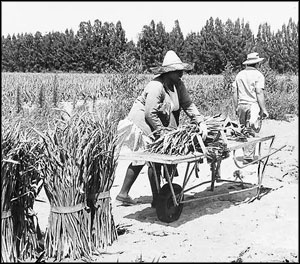
Once upon a time, sunny Fort Myers, Florida, was not just a popular vacation destination, it was also the gladiolus-growing capital of the world, with local farms shipping some 500 million stems a year to florists throughout the US and overseas.
It all started in 1935 when two successive winter freezes in central Florida drove gladiolus growers further south to the Iona area just outside of Fort Myers. Within a decade, 30 growers were cultivating some 2500 acres of glads there.
Gladiolus at the time were hugely popular. Not only were they showy and easy to grow but their long vase life made them the perfect cut-flower. Every year gladiolus societies across the country displayed thousands of spikes in shows that drew tens of thousands of visitors. (See a 1921 glad show here.)
Harvesting the Fort Myers glads started in November and continued into June. According to one grower’s son, “The glads were cut before they bloomed, so a visit to the gladiolus farm was a view of acres and acres of green stalks with workers walking through the fields and cutting stalks with buds soon to bloom. The goal was for the stalks to bloom in the hands of the florist.”
Bundled and packed in hampers, the glads were shipped by air and then delivered by a patchwork of local truckers, all in an era before UPS and FedEx. Sometimes they traveled in the climate-controlled trucks of Purolater Courier whose main business was delivering celluloid film reels – which could burst into flames if they got too warm – to movie theaters.
Even in the Fort Myers area, growers sometimes needed to protect their crops from frost. At first they burned old tires to create heat and a protective blanket of smoke. (Don’t try that at home!) Later they turned to oil-fired heaters along with crop dusters to circulate the air over the fields.
Nothing lasts forever, though, and by the 1970s most glads sold in the US were being flown in from overseas where both land and labor were cheaper. One by one the Fort Myers growers sold their fields to developers, and by 1980 the area’s reign as the gladiolus capital of the world was just a memory.
To learn more, read the recent article in the Fort Myers News-Press.
To make your yard the gladiolus capital of your neighborhood, order now for spring-planting! (April 2018)
Frumpy No More: Glads and Dahlias for Stylish Bouquets
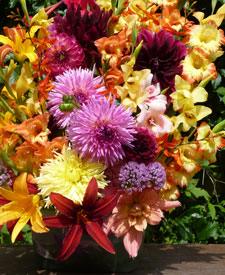
Alstroemeria and gazanias, step aside. According to a leading British newspaper, dahlias and glads are the hot new flowers for bouquets.
Although the news took a while to reach us here in Michigan, The Telegraph reported in September 2016 that “nostalgic Britons have revived an English country garden trend by decorating their homes with ‘frumpy’ British-grown flowers such as gladiolus, dahlias, and delphiniums.”
“Despite once being associated with other ‘undesirable’ stems such as chrysanthemums, experts said . . . more families are choosing these retro-style flowers instead of classics such as roses and lilies.” In fact, one major supermarket chain reported that glad sales were up 30%.
“Although gladiolus are often used in magnificent displays at venues such as Westminster Abbey, they are perfect for the less experienced arranger,” said a spokesperson at the National Association of Flower Arrangement Societies. “Gladiolus make a bold modern statement in a large vase or container on their own.”
For easy, on-trend bouquets from your own backyard, why not order a few of our retro-style glads and dahlias now for spring delivery? (Dec. 2017)
‘Atom’ & 6 Friends in “100 Great Plants for an English Country Garden”
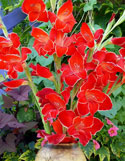
Our signature glad ‘Atom’ has a famous friend in England – and we introduced them!
Garden designer Rosemary Alexander is the founder of The English Gardening School, author of a half-dozen books, and winner of the RHS Veitch Memorial Medal. We met years ago when we lectured for a series of Horticulture magazine seminars. Although OHG usually ships to US addresses only, when Rosemary asked if she could order a few of the bulbs I’d shown in my slides, I happily agreed.
‘Atom’ was one of the first she ordered, and she liked it so much that – ten years later – she recommends it in Gardens Illustrated’s February cover article, “Rosemary Alexander’s 100 Great Plants for an English Country Garden.” Woo-hoo! “Long overlooked as an attractive garden plant,” she writes, “smaller gladioli are now back in fashion.”
Another half-dozen heirlooms we offer also made it into Rosemary’s top 100 plants: ‘Bishop of Llandaff’, dahlia, ‘S. Arnott’ snowdrop (“quickly forming very handsome clumps”), ‘Thalia’ daffodil (“longevity and vigor make this a popular choice for naturalizing”), regal lily (“I plant the bulbs in plastic pots and sink these in their final position in early summer as a glamorous, scented treat”), winter aconite, and sternbergia.
Spring-planted ‘Atom’ and ‘Bishop of Llandaff’ are going fast, but if you order them now you can enjoy their simple, bright blooms this summer – just like Rosemary does. (Mar. 2017)
Try This at Home: Multiplying Glads by Dividing the Corm
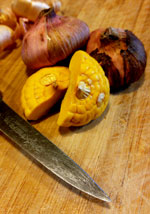
Even if your glad planting season is still months away, here’s a tip from expert Cliff Hartline that you can use whenever that happy time arrives.
Cliff writes my favorite section of the NAGC journal Glad World. It’s a Q & A column titled “Talk Radio,” and a while ago a reader asked, “I heard you can cut corms in two to multiply them. How do you do that?”
First of all, Cliff replied, it’s important to “make sure there are eyes and root nodes on both halves. The eyes go across the corm in only one direction. They are not like potatoes that have eyes everywhere. Peel the husk off before cutting, so you can identify the line of eyes.” Look for small, individual flaps of shiny husk that protect the eyes, or the emerging tips themselves.
Don’t do this too early, though. “Without the husk, the corm will dry out quicker, so you need to do this close to the time of planting.”
“After cutting it, put powdered sulfur [available at garden centers or online] on the open wound. This helps seal the scar and protect the corm when it is planted.”
Before going on to cut another corm, sterilize your knife with alcohol.
If you’re feeling lucky, “you can even cut the corm into three or four pieces,” Cliff says, although “this increases the chance that it may not survive.” Even if you only cut it in half, there’s some risk involved, so we recommend you try it with inexpensive glads first (although not Abyssinian glads).
Good luck, have fun, and please let us know how it goes! (March, 2017)
They’re Back! Survivors ‘Bibi’, ‘Green Lace’, ‘Dauntless’, and ‘Starface’
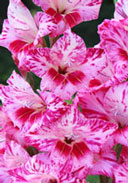
Good news! Despite the extreme drought that afflicted much of Maine this year, all was not lost at our glad growers’ farm. In fact, we recently learned from Paul and Elisabeth that we’ll be getting at least four of their rare beauties this spring –
‘Bibi’, the “pink cheetah” glad (pictured here),
tiny, apricot ‘Starface’,
radiant little ‘Green Lace’, and
one of our most antique-looking glads, the incomparable ‘Dauntless’.
We’re hopeful that more will follow in January – but don’t delay. Supplies are even more limited than usual, so do yourself a favor and order early! (Dec. 2016)
Garden Gate Says “Your Garden Needs This Flower”
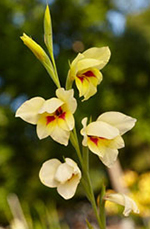
There‘s an unlikely “cover girl” on the front of Garden Gate‘s December issue: gladiolus!
Once scorned as hopelessly out of fashion, glads continue their slow rise back into popularity. Garden Gate‘s headline touts their “Gorgeous Color, Dramatic Shape, Old-Fashioned Charm,” and adds “your garden needs this flower1”
To integrate glads into your garden – instead of just growing them for bouquets – check out the article‘s excellent tips and photos in “Design Your Garden with Glads.” There‘s a great section on non-traditional glads, too, with photos of our small-flowered, surprisingly hardy ‘Carolina Primrose‘ (pictured here) and ‘Atom‘ as well as the fragrant Abyssinian glad.
For a free copy of this issue, click the “Free Preview Issue” tab at gardengatemagazine.com. As long-time subscribers ourselves, we know you‘ll find a lot to like in Garden Gate! (Nov. 2016)
Can Landscape Cloth Turn ALL Glads into Perennials?
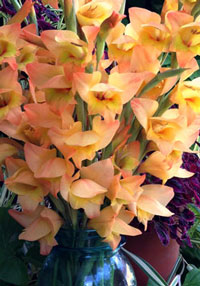
Here in zone-6a Michigan we leave our Byzantine, ‘Boone’ (pictured), and ‘Carolina Primrose’ glads in the ground every winter and they come back and bloom the next year just like any other perennial.
But wouldn’t it be great if ALL glads were that hardy? A recent article in the NAGC journal Glad World makes me think that might just be possible.
In his always excellent “Talk Radio” column, Cliff Hartline says that glad grower Bert Blanton “is noted for NOT digging his glads yearly,” even though he lives in zone-6b Missouri. Bert used to protect his glads in winter with a thick mulch of straw, but he says it “always blew around and I was constantly replacing it.”
So three years ago he tried landscape cloth instead, and it worked so well that he’s been using it ever since.
“I plant my rows six feet apart,” he says, “and cover my aisles and rows with landscape cloth, putting the seams right over the rows.” He pegs it down with wire landscape-cloth pins (also called sod staples), and then rolls it back in the spring.
The only problem? After three years of no digging, “I now have jillions of flowers,” Bert says. “I have about 20 spikes to a foot, and the rows have expanded themselves to 15 inches wide. I am getting so many spikes, it is more than I can sell at the Farmers Market or give away. My spikes are larger than anyone else’s, so I sell them for $2.00 each.”
We’re going to experiment with Bert’s technique this winter, even though our gardens are half a zone colder than his. If you try it, too, please let us know how it works for you and we’ll share our results here. (Oct. 2016)
New at Our Blog: Glads
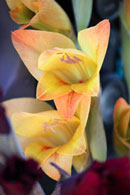
Every week when we post one of our most recent newsletter articles to our blog, we also add a few of the best articles from our archives – including these we added recently, inspired by the gorgeous gladiolus bouquets that Vanessa has been picking for our office:
How Winter-Hardy Are Your Glads? Our Readers Report (Aug. 2010)
No Need to Buy a Monet, Just Garden like Him! (Jan. 2009)
Glads for Free: Growing Cormlets into Big Fat Corms (May 2013)
‘Boone’ Rocks Amy’s Garden – and Fine Gardening (August 2012)
Sickly Glads? The Culprit May be Thrips (Aug. 2013)
Or see ALL of our glad posts here.
Hot, Dry Summer: Is it Bad for Bulbs – or Good?
It’s been a hot, dry summer in much of the US. In fact, it’s been so bad in Maine that we had to drop a whole page of rare glads from our catalog because our grower there is worried he won’t have any corms to share with us!
But how will it affect your bulbs? First some good news:
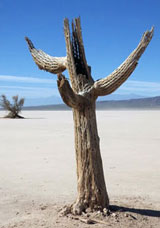
Bulbs are one of Nature’s clever survival strategies. They’re essentially underground bunkers where the plant can stay cool and store moisture. And once the weather improves, bulbs often bounce back better than most plants.
Some bulbs even prefer dry summers. Tulips and hyacinths, for example, evolved in parts of the world with little to no summer rainfall. That means yours may bloom better next spring than they usually do – at least if you’re in the eastern half of the country where normal summers are rainier.
And some bulbs like it hot. As long as you’ve kept them well watered, your tuberoses, rain lilies, crinums, and cannas are probably thriving this summer, and we hope you’re enjoying them!
On the other hand, dahlias often struggle or fail in hot summers. That’s because they’re native to the highlands of Mexico where days can be hot but nights are much cooler. When nights in your garden stay warm, growth will slow or stop and they may even die. If you water them too much when growth has stalled, they may rot underground.
Don’t despair, though! If you can just keep your dahlias limping along until temperatures cool, they’ll kick back into gear and bloom gloriously until frost. And for dahlias that can handle warm nights better, look for “heat-tolerant” in our descriptions – although even these have their limits.
Glads in hot summers can be attacked by tiny, almost invisible sucking insects called thrips. Thrips proliferate when it’s hot and can leave glad leaves and blossoms mottled, or even prevent buds from opening. For tips on control, see oldhousegardens.com/Thrips.
Glads may also develop kinked stems in hot weather, as they sag a bit during the day and then grow upright at night when evaporation slows. To minimize the kinks, keep your glads well-watered and avoid damaging their shallow, wide-spreading roots.
High heat also affects flower colors. Deep-colored lilies such as ‘African Queen’ may be paler, bicolor dahlias such as ‘Deuil du Roi Albert‘ may bloom temporarily as solids, and the rosy tones of ‘Kaiser Wilhelm‘ and others won’t develop fully until the weather cools.
This fall is expected to be warmer and drier than usual, too. Since most spring-blooming bulbs start growing new roots in late summer or early fall, keep their soil reasonably moist then, and be sure to keep the bulbs you plant this fall especially well-watered.
And try not to worry. Bulbs have been dealing with challenging weather for millennia. And there’s always next year – which, as every gardener knows, is one of the great things about gardening. (Aug. 2016)
Rethinking (and Raving About) Glads
“How and why does a flower fall out of fashion?” asks Gardenista blogger Michelle Slatalla in what she calls the first of a new series, Rethinking Flowers, devoted to “old garden favorites that deserve a second chance.”
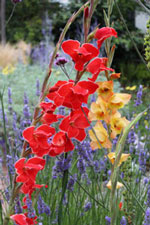
First up – gladiolus! Like many gardeners, Michelle had never grown glads before, but when we sent her a few of our small-flowered and unusual heirlooms (including ‘Atom’ and ‘Boone’, pictured here in her garden), she ended up seeing them in a whole new light.
Glads are “breathtaking,” she writes, and our graceful “heirloom varieties mingle well with other perennials.” In her California garden, for example, Michelle grows them among clumps of lavender whose cool tones perfectly complement the warmer colors of many glads.
For more – including evocative photos from Michelle’s garden and an account of an ultra high-society wedding in 1923 with the bride and her attendants “fairly staggering under the weight of gladiolus” – check out the whole wonderful post at Gardenista.com. (July 2016)
Glad News: Big Honor for Little ‘Green Lace’

Spritely little ‘Green Lace’ was elected recently to the Gladiolus Hall of Fame, one of the glad world’s highest honors. Introduced by Clark Pickell of Rochester, New York, this outstanding “soft green ruffled little glad” is “still vital today,” fifty-five years after its introduction in 1961.
If you hurry you can still order ‘Green Lace’ for planting this spring, along with fellow Hall of Famer and customer-favorite ‘Atom’. (The two of them, by the way, look great together in bouquets.) Among the 112 other glads honored by the Hall since its founding in 1981, we’ve offered ‘Bluebird’, ‘Blue Smoke’, ‘Caribbean’, ‘Friendship’, ‘Isle of Capri’, ‘Lavanesque’, ‘Melodie’, ‘Peter Pears’, ‘Snow Princess’, and ‘Spic and Span’ – and we hope to offer them all again next year. (April 2016)
The Astonishing Gardens (and Bulbs) of Alcatraz
Like most people, I had no idea that flowers ever grew at The Rock – until 2009 when an order for some of our dahlias and glads arrived here from that infamous island in San Francisco Bay.
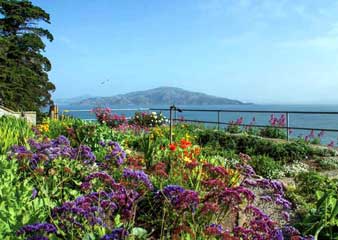
Alcatraz, I soon learned, has a long, complex history, and gardens have been a part of most of it. Some were public plantings tended by prisoners while others were the home gardens of the warden and guards who lived there with their families.
Last month I spent an afternoon walking Alcatraz with Dick Miner, a long-time volunteer who’s been helping to bring its gardens back to life after 40 years of abandonment. Dick talked about the herculean effort to clear decades of weeds and overgrowth and the excitement of rediscovering paths, retaining walls, and a surprising array of garden plants that survived amid the ruins.
“Bulbs were a favorite garden plant of the island’s residents,” Alcatraz’s director of gardens Shelagh Fritz wrote recently in Horticulture magazine. “Many bulbs originate from other Mediterranean regions and therefore find great success here – a happy coincidence since soldiers and guards simply brought their favorite garden plants with them to Alcatraz” including daffodils, freesia, Spanish bluebell, snowflake, and grape hyacinth. “When we cleared the overgrowth from the gardens, these bulbs came back to life after lying dormant for decades.”
Dahlias and glads appear in historic photos of Alcatraz, and Shelagh has ordered many of ours to replant there including ‘Clair de Lune’, ‘Old Gold’, and ‘Thomas Edison’ dahlias and Abyssinian, ‘Bibi’, ‘Dauntless’, ‘Fidelio’, ‘Spic and Span’, and ‘Starface’ glads.
For a look at these fascinating gardens, see Shelagh’s article, “A Hardened Garden.” To learn even more, go to AlcatrazGardens.org. And if you’re one of the 1.5 million people who will visit Alcatraz this year, don’t miss the docent-led tours of the gardens! (April 2016)
“Garden Gate’s Top Picks” Include 3 Heirlooms Blooming Now
In “Garden Gate’s Top Picks: These 9 Plants Add a Touch of Tropical Flair,” Shayna Courtney recommends three of our favorite spring-planted bulbs. The August 2015 article starts with a photo of ‘Atom’, our all-time best-selling glad. “Hummingbirds love the miniature blooms of 3-foot-tall ‘Atom’,” Shayna writes. There’s also a great photo of ‘Mexican Single’ tuberose, and she writes that its fragrance “intensifies in the evening, so choose a spot where you can enjoy its fragrance and the moths that visit its radiant nighttime blooms.” Finally, Shayna praises rain lilies (Zephyranthes), and although here in zone 6 we always grow them in pots, she notes that where they’re hardy they make “a good spreading groundcover.” (Aug. 2015)
Fragrant Glads: Why Aren’t There More Like ‘Lucky Star’?
Bill Seidl of Wisconsin emailed us a while ago looking for a fragrant glad from the 1950s. Although we couldn’t find it for him, he taught us something about why gladiolus fragrance is so elusive:
“From about 1957 through 1967,” Bill wrote, “I hybridized glads with fragrance as a goal. No progress. In 1968, for $200, I imported 20 bulbs of ‘Lucky Star’ from Joan Wright [its New Zealand breeder] and worked at fragrance from that angle. Still no improvement.
“Dr. Robert Griesbach [the famous breeder of lilies and daylilies] worked at it at the same time and gave up after a while. He realized before me what the trouble was: ‘Lucky Star’ has a genetic makeup of AaAa, where A stands for the fragrance gene from Abyssinian glads [which Joan Wright had already discovered were virtually impossible to cross with regular glads]. Unfortunately during meiosis the genes segregate uniformly rather than randomly, which means the pairings are always Aa, never AA or aa. So when you cross them with regular glads, which don’t have any fragrance, the resulting plants are always Aaaa — or in other words, there is always a DECLINE in fragrance.
“At age 83 I do not intend to start over with glads,” Bill added. “But in 1968 I also spent $200 to buy four peonies from Japan, the first intersectional hybrids by Toichi Itoh. That was a better investment. It inspired me to get into peony breeding. Now you can find me on the internet if you type my name and ‘peony’ into any search engine.”
As for ‘Lucky Star’, Bill says he still plants “six corms every year in a pot atop a five-gallon pail, which makes for easy watering,” and he still enjoys its fragrance, which he pointed out is “best sniffed toward evening.” To sniff it yourself, order ‘Lucky Star’ now for spring planting! (Jan. 2016)
Planting Tip: Glads Bloom Facing the Most Sunlight, But . . .
We love the way glads add vertical exclamation points of color to the summer garden. To enjoy them the most, though, it pays to site them carefully, as explained in the NAGC’s journal Glad World:
“Glads, like daffodils, tend to face the direction from which they receive the longest period of direct sunlight. While you might expect this to be south, early morning or late afternoon shade from nearby trees or buildings might cause those glads so shaded to face due east or west, or southeast or southwest, depending upon how the shade pattern moves with the sun during the day. . . . Facing is an important consideration since you would like to view the front of the spike from whatever vantage point you usually view the bed, border, or pot.”
Keep that in mind when deciding where to plant your glads, but don’t worry – you can get your glads to bloom facing any direction you want if you (a) plant them in a pot (say, in your vegetable garden) and then (b) when the first florets open, move the pot into your flower garden or onto your front steps and turn it any way you like. To try this trick yourself, why not order a few glads – such as the graceful, fragrant Abyssinian glad or our customers’ favorite ‘Atom’ – for spring-planting? (April 2015)
Thousands of Glads Bloom Forever in 1921 Saginaw Show
Have you ever seen a flower show devoted entirely to gladiolus? Well, now you can, thanks to a “virtual exhibit” by the Castle Museum of Saginaw County History.
Four photographs at the Michigan museum’s website offer glimpses of a 1921 show sponsored by the Saginaw Woman’s Club, with thousands of glads displayed in wicker baskets and milk bottles. The show included big displays by commercial growers such as the leading glad hybridizer of the era A.E. Kunderd (“Originator of the Ruffled Gladiolus”), Fred Baumgras, and P. Vos (with mood lighting and what looks like wisteria dangling from the ceiling), as well as a room full of glads grown by local amateurs.
The images are part of a larger online exhibit of garden photos by a 1920s club member. Most of the photos show gardens in Saginaw, including a spectacular formal garden by Charles Platt that’s been preserved by the Saginaw Art Museum, but there are also shots of the Michigan gardens of chemical magnate Herbert Dow and popular garden writer Mrs. Francis King. Paging through the nearly 100 photos provides viewers today with an introduction to some of the defining features of early 20th-century gardens –birdbaths, sundials, benches, gates, trellises, pergolas, and summer houses – as well as many of the era’s most popular plants – peonies, iris, phlox, golden glow (Rudbeckia laciniata ‘Hortensia’), Shasta daisies, and, of course, gladiolus. (Jan. 2015)
Six Heirlooms among “18 Stunning and Off-Beat Bulbs”
I’d been waiting for the fall issue of the reborn Garden Design magazine ever since one of my favorite writers, Jenny Andrews, interviewed me this past summer for an article about less-familiar but amazing bulbs. When it arrived last week I was happy to see that six of her “18 Stunning and Offbeat Bulbs” are heirlooms we offer: hardy Byzantine gladiolus (which Jenny says “has kept its graceful, wild look, in contrast to its frou-frou cousins”), Tulipa clusiana (a “perennial tulip” that “requires fewer chilling hours to bloom” than most), red spider lily (with “its sparklers of coral-red . . . in the golden glow of early autumn”, Formosa lily (which, alas, we can’t supply this fall due to crop failure), and two of our spring-planted glads: ‘Boone’ (“a treasured plant I’ve carried with me as I’ve moved”) and ‘Atom’ (“a small glad with giant impact”). To see them all, subscribe at gardendesign.com. (late Sept. 2014)
Another Glad Convert: From Childhood Trauma to Summer Smiles
“In my garden? No way.” That’s what our good customer Susan Stauber of Beacon, NY, had to say about glads — until she took a chance on our small-flowered, best-selling ‘Atom’. She writes:
“I grew up in a part of the country where the huge hybrid gladiolus were grown in fields. Great for funeral arrangements and corporate office lobbies, but in my garden? No way.
“But there was something tantalizing about those little ‘Atom’ glads of yours. So I bought a few. And when they bloomed — wow! They made me chuckle every time I saw them. So last year, I bought a few more ‘Atom’ and some ‘Lucky Star’. This time I planted them in groups here and there, and I planted the groups at different times so I was smiling at blooms all summer long. (I even dug and stored them successfully last fall.)
“I never could have predicted that I’d be ordering more gladiolus for this year, but I am — ‘Boone’, ‘Starface’. I can’t wait for the ground to finally defrost so I can plant them. It is possible to recover from childhood traumas.
“P.S. Everyone who walks by wants to know what those wonderful red flowers are. They can’t believe they’re gladiolus!” (May 2014)
Bulbs in Pots: Our New Page of Tips for Tuberoses, Rain Lilies, and More
Every summer we decorate our front porch with pots of fragrant tuberoses and little pink rain lilies, while out in the back yard we tuck pots of glads in among the perennials to provide exclamation points of color.
You can, too! Most spring-planted bulbs are easy to grow in containers, and you’ll find everything you need to know at our newly expanded “Bulbs in Pots” page. Read it now and get ready for a summer filled with beauty, fragrance, and fun. (March 2014)
Right NOW: For Bigger Corms, Foliar Fertilize Your Cormlets
If you planted gladiolus cormlets this year — the tiny bulbs clustered around the base of mature corms — expert Cliff Hartline has a couple of tips for you this fall. In Glad World, he writes that one year he started harvesting his plants grown from cormlets on September 20, but “after pulling a few out of the ground, I saw that the corms were only the size of a quarter or smaller. I decided to foliar feed them [instead], and I applied fungicide at the same time. We had a frost October 15 so I dug them immediately after that. [By then] many of the corms were jumbos, most were large, and very few were smaller. I would encourage people to wait until frost to dig cormlet stock, and foliar feed late in the year. . . . The September feeding seemed to rejuvenate the growth and the fungicide kept the foliage healthy.” To learn more about growing glads from cormlets, see “Glads for Free” in our Newsletter Archives. (Sept. 2013)
Sickly Glads? The Culprit May be Almost Invisible Thrips
Glads are one of the easiest bulbs to grow, and they last wonderfully long in a vase. Unfortunately thrips are an almost microscopic pest that can attack them, sucking the life out of their leaves and buds. If your glads have brown or silvery streaks on their leaves, if the flowers are mottled with white, or if their buds fail to open, there’s a good chance thrips are the problem. To learn more, check out our “Protecting Your Glads from Thrips.” (Aug. 2013)
Fine Gardening Spotlights Our True Byzantine Glads
One of our favorite garden magazines, Fine Gardening, just published an article they invited Scott to write about our true Byzantine glads. It’s in the August issue, on newstands NOW, or you can read it here. In celebration, we’ve reduced prices on these graceful, hardy, heirloom glads by 5% — for a limited time only. We’re betting we’ll sell out of them earlier than ever this year, so you might want to order yours now! (June 2013)
Glads for Free — Tips for Growing Your Tiny Cormlets into Big Fat Corms
If you dug and stored your gladiolus last fall, you probably found lots of tiny cormlets — aka cormels — clustered around their bases. Plant those this spring and before long you’ll have hundreds of glads for free. Cliff Hartline in the NAGC’s Glad World offers these expert tips:
“Generally speaking, any cormel that falls thru a 1/8-inch screen does not produce well. . . . I only plant cormels the size of a pencil eraser or larger. I pass all my cormels over a 1/4-inch screen and plant those that do not fall through. . . . The larger ones will definitely give you a larger corm to harvest and . . . if they are planted early, they will often bloom in September. . . .
“One year after I finished digging my large corms about September 20, I had the time to dig my glads from cormels. After pulling a few out of the ground, I saw that the corms were the size of a quarter or smaller. I decided to foliar feed them, and I applied fungicide at the same time. We had a frost October 15 so I dug them immediately after that. Many of the corms were jumbos, most were large, and very few were smaller. I would encourage people to wait until frost to dig cormel stock, and foliar feed late in the year. . . . The September feeding seemed to rejuvenate the growth and the fungicide kept the foliage healthy.”
We’ll remind you that cormlets have nearly impenetrable outer shells and they’ll sprout much better if you either nick or gently crack these or simply dissolve them by soaking in full-strength household bleach for a few hours immediately before planting. Plant cormlets in full sun, 1-2 inches deep and 1-2 inches apart, depending on size. Keep the soil moist but not soggy until grass-like foliage emerges and, for optimal growth, throughout the summer. Good luck, have fun, and let us know how they do for you! (May 2013)
Theophrastus, Baking Bread, and Byzantine Glads
Our true, fall-planted Byzantine glads are graceful, brilliant, and winter hardy to zone 6 — but did you ever try baking bread with them? That’s exactly what the ancient Greek scientist Theophrastus recommended 2400 years ago. Theophrastus, who lived from about 371-287 BCE, was a student and successor of Aristotle and the author of the ancient world’s most important botanical works. “All bulbous plants are tenacious of life,” he wrote in his Enquiry into Plants along with tis suprising recommendation: “The root of the plant called corn flag [a common name for G. byzantinus] is sweet and if cooked and pounded up and mixed with flour makes the bread sweet and wholesome. It is round and without ‘bark’ and has small offsets like the long onion. . . . Corn flag, which is called by some xiphos, sword, has a sword-like leaf whence its name.” So now you have another good reason to plant this treasure this fall! (late August 2012)
‘Boone’ Rocks Amy’s Garden — and the Cover of Fine Gardening
A huge bouquet of ‘Boone’ glads from our micro-farms was gracing our office work-table when an email arrived reminding us that even one ‘Boone’ can be a thrill. “I just wanted to pass along a photo of my lovely ‘Boone’ gladiolus,” our good customer Amy Darnell of Columbia, Missouri, wrote. “I am so, so glad I bought it!”
Then the very next day the October issue of one of our favorite magazines, Fine Gardening, arrived with a big beautiful clump of ‘Boone’ on the cover! At first we didn’t recognize it because it looks vivid orange in the photo rather than the soft apricot it is in our gardens, but we know how hard it is to get flower colors just right. And although the accompanying article says it’s hardy in zones 8-10 only and will probably need staking — which is usually true of mainstream glads — ‘Boone’ is a hardy perennial here in our zone-6a gardens, and we never stake it. See Amy’s and FG’s photos — and then maybe grab a few for your own garden? As Amy says, you’ll be so, so glad you did. (August 2012)
Made in Michigan: Gladiolus for All
Although most cut-flowers today come from overseas, the next time you pick up a luscious bundle of glads at the supermarket you’ll probably be supporting a forward-looking Michigan farm family. Here’s their story, as told by Lynn and Jo Mayer when they were inducted into the Michigan Farmer’s Hall of Fame in 2010.
“In 1971, we bought our first farm and still reside there today. As young farmers, we worked full-time raising grain crops with a few acres of gladiolus . . . At that time, gladiolus were known as funeral and wedding flowers and had limited uses.... We knew we would have to develop a new market if we were going to succeed.
“In the 1970s, floral sales in supermarkets were just getting started. That’s when we decided to attempt to mass merchandize gladiolus floral bouquets in supermarkets to be enjoyed as a cash-and-carry item. We knew this would be a challenge but gave it a try anyway . . .
“Today, we are the single largest producer of gladiolus cut flowers in the United States, producing, packaging, shipping and marketing nearly 400,000 glad stems per day from June 20 through October 20 each year. As a result, Michigan is the leading producer of gladiolus cut flowers in this country. We service nearly every major supermarket chain across the U.S. and Canada. We provide employment for approximately 200 people to produce and market nearly 1000 acres of hand-harvested cut flowers . . .
“In 2000, we transferred the farm to our four children . . . We hope they are able to continue this family farm tradition, keeping Michigan on the map as the largest producer of gladiolus cut flowers in the U.S.”
Continuing to innovate, the Mayers are now supplying cut-flower peonies and sunflowers to supermarkets as well, so go ahead and treat yourself to a bundle of those the next time you see them, too — and thanks for helping to rebuild Michigan’s economy! (July 2012)
Easy to Love, Hard to Spell
One of our most popular bulbs is the hardy and amazing Bissentine glad . . . er, Bynzyntine glad . . . no, wait a minute — how do you spell that?? If you’re not sure, you’re not alone. Gardeners searching for Byzantine glads at our website have misspelled it and its Latin name byzantinus 23 different ways. But don’t worry, we’re here to help! Whether you spell it Bisantine, Bisentine, Bissentine, Bizantine, Bynzyntine, Bysantine, bysantinus, Byzanine, byzanticus, Byzantile, byzantinas, byzantinis, byzantinius, Byzantinne, byzantinum, byzantium, Byzatine, byzatinus, Byzentine, Byzintine, byzintinus, Byzntine, or Bzatinne, you’ll find true stock of exactly what you want at oldhousegardens.com. (June 2012)
‘Atom’ to Help Celebrate Monet’s Gladioli, National Public Gardens Day
Inside/Out is a terrific program of the Detroit Institute of the Arts that brings reproductions of masterpieces from the DIA to the streets and parks of metro Detroit. Among the 80 works scattered about this year is one of our favorites, Monet’s Gladioli, which shows Monet’s wife in their home garden admiring a big bed of one of his favorite flowers. It’s on display at the Taylor Conservatory and Botanical Gardens where, to celebrate National Public Gardens Day, they’ll be giving away hundreds of our best-selling glad, ‘Atom’ — which looks a lot like Monet’s glads — at their spring Plant Sale on May 12. We’re proud to be partnering with the DIA and the Taylor Conservatory to celebrate heirloom art with heirloom flowers! Learn more here. (April 2012)
Staff Pick: Mike’s First and Favorite Glad
Mike joined the Navy right out of high school and came home six years later to start work on a degree in computer security. For the past year and a half he’s also been our awesome IT assistant, the guy behind our Facebook page, and a brand-new gardener. Kelly, our Micro-Farms Manager, writes:
“Mike loves glads. He came to us as a non-gardener, but since he’s such a nice guy I managed to rope him into helping me out on our big glad-planting day last year. After we’d planted thousands of corms and cormlets, Mike found an unidentified corm stuck in the cuff of his pants. I told him to take it home and plant it. Wasn’t he surprised to see a big spike of leaves emerge from that small corm. And then came the bloom stalk — ‘Lavanesque!’ It was even better than the picture.
“Mike has very little garden space at his apartment, so he was growing the glad in a pot on the porch. Just as it started to bloom, the wind blew it over. Undaunted, he salvaged the bloom stalk and brought it inside where the buds all opened and impressed the heck out of his girlfriend. Then the corm produced a second bloom stalk just when his mom had to go into the hospital, so he could cheer her up with it — cementing ‘Lavanesque’ as his favorite. This summer Mike plans to plant a purple bed of ‘Lavanesque’, ‘Violet Queen’, and ‘Fidelio’ in front of his mom’s smoky gray house. As he says, ‘It’s gonna look awesome!’” (March 2012)
Byzantines True and False — In 1790 and Today
The puny impostor sold elsewhere as Byzantine glad — at impossibly cheap prices — has been troubling gardeners for centuries, as witnessed by Curtis’s Botanical Magazine in 1790:
“Gladiolus communis, Common Corn Flag: Grows wild in the corn [i.e. grain] fields . . ., varies with white and flesh-coloured blossoms, increases so fast . . . as to become troublesome . . .; hence, having been supplanted by the Greater Corn-Flag, the Byzantinus . . ., whose blossoms are larger, and more shewy, it is not so generally found in gardens as formerly.” (2011-12 catalog)
Heirloom Bulbs for the White House Garden
Gardeners of all political stripes can agree on at least one important issue: the White House vegetable garden is a good thing. This spring, to thank First Lady Obama for inspiring so many gardeners and would-be gardeners, we sent her three of our favorite heirlooms to plant in her garden. “Although they’re not vegetables,” we wrote, “all three have traditionally been grown in vegetable gardens across America. They attract pollinators, they make great cut-flowers, and, as [Scott’s] grandmother used to say, they just look pretty out there.”
All three heirlooms have strong Midwestern roots, too. “The fragrant ‘Mexican Single’ tuberoses,” we continued, “come from a small family farm in Illinois where they’ve been grown since the 1920s. (You may have seen them for sale at farmers markets in Chicago.) The bright red, small-flowered ‘Atom’ gladiolus is grown for us on a family farm in Michigan. And the ‘Wisconsin Red’ dahlia is a family heirloom that’s been handed down from generation to generation since the early 1900s.”
We’ll probably never know whether our bulbs make it into the First Garden, but that’s okay. As with any gift, it’s the thought that counts, and one of gardening’s greatest pleasures is imagining what could be. (May 2011)
Prince Charles Plants Byzantine Glads at Home
True, zone-6 hardy Byzantine glads have gained another fan — His Royal Highness Prince Charles! In the March 2011 English Garden magazine (on newsstands now), Claire Masset reports on the Prince’s innovative, all-organic gardens at Highgrove, his family estate.
“Last autumn, at the Prince’s request,” she writes, his gardeners planted “masses of Gladiolus communis subsp. byzantinus bulbs on either side of the Hornbeam Avenue next to the Wildflower Meadow. In May and June, they will create a spectacle of magenta flowers that will complement dreamy displays of camassias and Allium hollandicum ‘Purple Sensation’. It’s no wonder the Prince tries to spend as much time as possible at Highgrove during these months.”
Masset adds that “increasingly, the focus [at Highgrove] has been on a much more sustainable approach to bulbs.” As head gardener Debs Goodenough explains, “Out of the 40,000 bulbs we planted last year, 95% are an investment in the garden. The crocuses and daffodils will carry on year after year.” (Feb. 2011)
Garden Artist Embraces Heirloom Glads
Like most artists, Atlanta-area garden designer Ryan Gainey has a keen eye for beauty and a creative spirit that won’t be bound by convention. He even likes gladiolus! In fact, he wrote a whole article about them, “So Glad,” for Flower magazine. As he explains, “my great-grandmothers and my Aunt Marie grew gladiolus” and he did too when he started gardening in the 1960s. ‘Spic and Span’ was an early favorite, and when 40 years later he found it in our catalog, he was “swept away by a wave of nostalgia.” Since then he’s added many other heirloom varieties to his garden, including the rare parrot glad, an old Southern form of G. dalenii.
Our readers can receive a special discounted subscription to Flower — four quarterly issues for $14.99 — by going to flowermag.com/subscribe and entering the source code, GLAD. Enjoy! (Feb. 2011)
Bright Spot of the Month: Glad Beauty at Robin’s Library
Like most gardeners, our good customer Robin Leach loves sharing the joys of her garden — but she does it in a really big way. Last summer she emailed us a few photos saying, “I thought you’d like to see how beautiful your glads look at my library. You can see why our patrons LOVE them!” It turns out that, for almost a decade now, she’s been bringing as many as five big bouquets a week to the library where she works — just for the fun of it. Read her inspiring story here. (Jan. 2011)
Amazing ‘Atom’ and Tips for Perennial Glads from Zone-5 Idaho
Our customers are continuing to report success in over-wintering their glads outside. Daniel Ostenberg, for example, emailed us this past August:
“I live near Naples, Idaho, 35 miles south of Canada. It’s zone 5. I forgot an ‘Atom’ glad two winters ago while digging the rest of them and it came up the next spring. We did have good snow cover that winter and it wasn’t cold long before it snowed. I do have a neighbor nearby who mulches her glads every fall with six inches of straw and never digs them and she says they do fine. [Idaho’s relatively dry weather and well-drained, alkaline soils probably play a role in this success, too.]
“Also I saved some little bulblets from my ‘Atom’ last fall and planted them this spring in a container and four out of five of them are blooming. I didn’t think they would bloom the first year.
“One of the best gardeners I know told me that glads love calcium nitrate but she couldn’t find any. I’m an ex-apple farmer from the East Washington apple country, and I always get calcium nitrate from the ag-supply companies in apple country. I use it on my glads and get it for her for the 1000 glads that she grows. Orchardists use a lot of calcium nitrate. Trees love it.
“I’m going to leave one each of a few other kinds of glads in the ground this fall and mulch them heavily with straw and see what happens. I’ll let you know next summer how it turns out.” (Dec. 2010)
High Heat Stresses Your Bulbs, Too
High heat has plagued much of the country this summer. Some bulbs like it, but others suffer. Dahlias, for example, have struggled or failed in many gardens where they usually thrive. That’s because they come originally from the mountain plateaus of Mexico where days are hot but nights are dramatically cooler. When nights are too warm, dahlias just can’t grow well. Some varieties are more sensitive than others and can even die. The good news is that if you can keep them going till temperatures cool (which has to happen sometime, right?), they’ll kick back into gear and bloom gloriously till frost.
Glads may develop kinked stems in unusually hot weather as they sag a bit during the day, unable to fully replenish the water evaporating from them, and then grow upright at night when evaporation slows. This is most often a problem with glads like ‘Atom’ that have thin, wiry stems. To help, keep your glads well-watered and protect their shallow, wide-spreading roots from disturbance. Tiny sucking insects called thrips proliferate when it’s hot, too, and can leave glad leaves and blossoms mottled, or even prevent buds from opening. For tips on control, see oldhousegardens.com/Thrips.asp
Heat affects flower color, too. Deep-colored lilies such as ‘African Queen’; may be paler in high heat, bicolor dahlias such as ‘Deuil du Roi Albert‘ may bloom temporarily as solids, and the rosy tones of ‘Kaiser Wilhelm‘ and others won’t develop fully until the weather cools.
Of course some bulbs love the heat. In many gardens this summer, cannas, tuberoses, and rain lilies have been especially happy — and we hope you’ve been enjoying them. (Aug. 2010)
How Winter-Hardy Are Your Glads? Our Readers Report
Although most experts say gladiolus won’t survive winters north of zone 8, our customers kept telling us that theirs were returning like perennials in zones 7, 6, and even 5. So we asked our readers, “Have your regular glads survived zone-6 or colder winters? And what do you think made that possible?” Many replied (thanks!), and now you can read what they said along with our conclusions at oldhousegardens.com/HardyGlads.
Although warmer, shorter winters are probably the biggest reason why so many glads are surviving in colder zones, other important factors seem to include reliable snow cover, winter mulch, deep planting, good drainage, micro-climates, plenty of sun, and the time-tested vigor of heirlooms. To add your two-cents to the discussion, email help@oldhousegardens.com. And if you’d like to experiment with glads as perennials in your own garden, we suggest starting with the tough little one our readers recommended most: ‘Atom’. (Aug. 2010)
The Frugal Gardener: To Multiply Your Glads, Plant Cormlets
If you dug and stored your glads last fall, you probably noticed lots of tiny cormlets (or cormels) clustered around the bases. Ranging in size from a BB to larger than a pea, these mini-corms will grow to blooming-size in a year or two.
Getting them to sprout, though, can be a challenge, due to their nearly impermeable shells. You can nick or gently crack the shells, but it’s easier to dissolve them by soaking in full-strength household bleach for a few hours just before planting. Plant in full sun, 1-2 inches deep and 1-2 inches apart, depending on size. Keep the soil moist but not soggy till grass-like foliage emerges and, for optimal growth, throughout the summer. With good care, any cormlet larger than a pea will grow to blooming-size by the time you harvest them in the fall, and the smaller ones by the following fall. Good luck and have fun! (May 2010)
Last Chance: ‘Venetie’ Going Commercially Extinct
When the last big, mainstream farmer quits growing a bulb variety, we say it’s gone “commercially extinct.” Although collectors and a small farmer or two may still grow it, once the mainstream trade abandons a bulb, it’s much closer to being lost forever. And that’s what’s just happened to ‘Venetie’. To save it from complete oblivion, we’ll plant 100 corms here, and hopefully in a few years we’ll be able to offer it again, but it will always be in very small quantities and at the much higher prices that come from small-scale production. So if you want it — or want to help save it — order now! (April 2010)
‘Lucky Star’ is Garden Gate’s “Top New Bulb” for 2010
We’re beaming! In its annual “best of the new plants” article, Garden Gate has named our ‘Lucky Star’ gladiolus its “Top New Bulb” for 2010.
Although originally introduced in 1966, ‘Lucky Star’ was virtually lost to gardeners for decades. Its unusual, angular form is eye-catching, but what really sets it apart is . . . it’s fragrant! We’re sure to sell out now that Garden Gate is spreading the word, so if you want to plant a few this spring, you’d be wise to order now. (March 2010)
Tell Bill and Us: How Winter-Hardy Are Your Glads?
Our good customer Bill Killpatrick of Lafayette, NJ, wrote us recently:
“I’d love it if you’d ask your readers about glads. . . . I’m just getting too old and creaky to dig ‘em all up. Find it easier to just buy new every spring. But, much to my surprise, for the past four winters, a good 80% of the corms have wintered over just fine right in the garden. Officially, I’m a zone 6. Due to elevation and exposure, I’m really a zone 5-ish. We’ve NOT had reliable snow cover, I don’t mulch, nuthin’. But come spring, up pop the glads — big, double-corm, monster glads.”
The glads he’s talking about aren’t our zone-6 hardy Byzantine, Boone, or Carolina Primrose, but just regular glads. And we’ve heard similar reports from other customers. Jane Murphy of zone-6 Concord, Massachusetts, for example, wrote that “some of the overlooked gladiolus bulbs I left in the garden last winter flowered, including a lovely salmon-colored one [‘Spic and Span’?] in October,” and Kathi Frank of zone 5/6 Onsted, Michigan, wrote “I just have to tell you my joy when my ‘Atom’ survived the winter and came back this summer as beautiful as ever. What a bonus!”
So we’re asking you: have your regular glads survived zone-6 or colder winters? And what do you think made that possible? Email Charlie@oldhousegardens.com and we’ll share your experiences here. (Feb. 2010)
Community Gardener Brightens Queens with Our Glads
A month ago, our new customer Alia Ganaposki emailed us this heart-warming report on the glads she planted at Two Coves Community Garden in Queens:
“The ‘Atoms’ were the standout winners, but all of the varieties have been brilliant. Because my plot is far from my house, I planted them for cut flowers, mostly— but very few made it home. My first blooms went to Auntie Luscious, who wanted a bouquet for a friend’s birthday — I believe the gentlewoman was turning 94? The next blooms went to Arcadio (Junior), who had given me pink pepper seeds in the spring.
“Big white blooms [‘White Friendship’] went to Millie, who lets the kids play in front of her patch and doesn’t lose her temper when the play sometimes tumbles into her plot. My next batch of blooms will probably go to Louis and Tim, who built a wonderful shelter and painted it with Bob Marley lyrics. But don’t think I’m not getting any harvest. I wasn’t willing to share the ‘Elvira’. My charity only extends so far.
“Anyway, I wanted you to know that the bulbs you sent me have brightened many lives, not just my own. Thanks so much for your work! I look forward to ordering (many) more bulbs from you in the future.” (Sept. 2009)
Boone Gladiolus: Small But Mighty
The baby ‘Boone’ plants we’ve been shipping this spring are babies, but give them a sunny spot and good care and they should bloom by late summer.
If not, that could be a blessing in disguise — to judge from the experience of our good friend (and garden writer) Russell Studebaker of Tulsa. The ONE we sent him a couple of years ago didn’t bloom its first year, but the next year he had five bloom stalks from that one plant. Yes, FIVE! As Russell said, “Not bad. And who knows what it will do next year!” (Apr. 2009)
Andy Says “Get Back to Basics” with Fiery Little ‘Atom’
Andy Cabe, botanical garden director at Riverbanks Zoo in Columbia, SC, wrote recently in The State:
“While driving in to work . . . , the old Waylon Jennings and Willie Nelson song, ‘Luckenbach, Texas’ popped into my head. There is a line that goes, ‘Maybe it’s time we got back to the basics of love.’ Well, it dawned on me that this line may apply to gardening as well; sometimes we need to get back to those basic plants that we’ve loved for years. Gladiolus is one of those plants.
“. . . One of my favorite varieties of late has to be gladiolus ‘Atom’ . . . with amazing, fiery red blooms outlined with a hint of pure white. ‘Atom’ is shorter than many other varieties . . . [so it’s] easy to integrate into the landscape. . . . I find that they are most effective in masses of 10 bulbs or more (this will allow you to cut several stems to take into the house and still leave plenty of blooms to liven up the garden). . . .
“New plants are always fun and interesting, but we should never forget the forefathers. Sometimes, it’s good to get back to the basics.” (Apr. 2009)
Is That Jasmine I Smell, or Abyssinian Glads?
The delightful but hard-to-define fragrance of Abyssinian glads continues to inspire email from our customers. “A delicate jasmine” is how Grace Barella of Fort Lauderdale describes it, and what could be better than that?
Doug Whitman of Marcellus, NY, is equally appreciative but he says “They smell only like Abyssinian glads! I know of no other fragrance quite like theirs. I have about 50 of them this year, all planted together, and they have been prolific bloomers (5-10 blooms/stalk), to say nothing of their exquisite beauty and magnificent fragrance. All I need do is step out of my front door and their scent reaches me from 50 feet away.”
On the other hand, Doug notes that some visitors to his garden “can’t detect their fragrance at all, even with their noses buried in the blooms.” Alas! (Mar. 2009)
No Need to Buy a Monet, Just Garden Like Him!
For the last twenty years of his life, Monet painted only one subject: his gardens in Giverny. Many bulbs played a leading role in those gardens, and it seems his taste for bulbs was shaped, at least in part, by financial difficulties in his early years.
In Monet: The Gardener (2002), Sidney Eddison writes: “Today, water lilies continue to float on the pond at Giverny. In May, irises in every imaginable shade of blue and violet bloom in their long, narrow beds; in June, roses smother the metal arches along the front walk. By midsummer, gladioli stand tall among the nasturtiums, which have begun their headlong rush toward the middle of the path. And in the fall, dahlias lavish their rich colors on the beds. The gardens, now open to the public, are the property of the Academie des Beaux-Arts. But Claude Monet still owns them.”
In the same book, Robert Gordon writes of Monet’s early career: “Given his precarious finances and the temporary nature of his abodes, many of the plants he chose were annuals . . . or corms, such as gladiolus, which can be dug up in the fall and saved from year to year. At Argenteuil, Monet planted gladiolus corms by the hundreds. In a painting simply titled Gladioli of 1876, . . . [Monet’s wife] Camille . . . gazes wistfully at cheerful ranks of pink, red, and bicolor flowers. . . . Two years later, in a work depicting Monet’s new garden at Vetheuil, gladioli appear again, but this time growing in decorative blue-and-white ceramic containers — a reminder of the impermanent nature of these early gardens. The same containers ultimately found a home at Giverny.” (Jan. 2009)
Another Sniff of Abyssinian Glads
Our friend Jonathan Lubar of Gainesville, Florida adds this to our ongoing discussion of the fragrance of Abyssinian glad: “I think they smell like four o’clocks (somewhat citrus flower-scented).” (Nov. 2008)
What Do Abyssinians Smell Like, Part 3
Here’s another contribution to our ongoing discussion, from our good customers Elizabeth and Sarah Heeren: “We think the Abyssinian glads smell like Easter lilies.” (late Oct. 2008)
North or South, Fall is for Planting Byzantine Glads
More and more gardeners across the country are singing the praises of our true, hardy Byzantine gladiolus.
In Long Island’s Newsday, for example, Irene Virag wrote “I’m adding more Byzantine gladiolus from . . . Scott Kunst, the Indiana Jones of the bulb world. Scott saves heirloom bulbs on the verge of extinction and propagates them. Some go back as far as the 15th century. Byzantine gladiolus — a 2- to 3-foot-tall perennial with deep magenta flowers that look like orchids — was spectacular in my garden last spring.”
And a thousand miles away, Ruth Geraci of Summerdale, Alabama, wrote: “My Byzantine glads are so beautiful. The first year’s glads multiplied, adding to the new ones I planted last fall. Everyone admires them! Thanks for having such beautiful and unusual plants for my hot southern Alabama climate.” (Sept. 2008)
What Do Abyssinian Glads Smell Like? Part 2
Our good friend Larry Rettig of the Amana Colonies in Iowa writes:
“I just read your latest newsletter and had to run right out to smell the Abyssinian glads I ordered from you this spring. Definitely an angel-trumpet-type fragrance (Datura), perhaps tending a bit toward its relative, Brugmansia. All three are blooming at the moment, so it was easy to make a comparison.”
Does your nose agree? Email us your fragrance-description!
What Do Abyssinian Glads Smell Like?
When our Abyssinian glads started blooming here in August, the debate to describe their subtle fragrance began.
“Perfumey,” Alexa said, “Like lilac, with a touch of . . . ?”
“Honeysuckle,” Renee suggested, “lilac and honeysuckle . . . and maybe forsythia?”
“Forsythia? What does forsythia smell like?” everyone asked.
“I love this scent,” Jessica said, “but I can’t describe it.”
“I can’t even smell it,” Scott lamented.
So help us out. What do Abyssinian glads smell like to you? (Sept. 2008)
Customer Raves: Another Glad-Hater Converted by Our Heirlooms
Last summer, Kerry Hoffman of Clara’s Meadow Flower & Herb Farm in Watsontown, Pennsylvania, wrote us in excitement:
“Just wanted to tell you how absolutely GORGEOUS the glads are that I planted this spring. I’m a cut-flower market grower, and I stayed away from gladiolus because they were just too big for my bouquets and, truthfully, rather gaudy looking to me. But your heirloom varieties are stunning! They’re an absolute hit with my customers, too. ‘Atom’ was the first to bloom last week, and everyone wanted to know its name. I love you guys. I will buy from you faithfully forever and ever and ever.” (Apr. 2008)
Tip of the Month: Storing Glads in Egg Cartons
Here’s a creative and earth-friendly suggestion for storing gladiolus bulbs from Lena Hart of Bayfield, WI, writing in Fine Gardening magazine:
“I have discovered an excellent storage container [for glads]: an egg carton. I simply fill it with a dozen cleaned bulbs and write the variety name with a permanent marker in the corresponding spot on the cover, the way candies are labeled in a box. The individual cells keep mold and diseases from spreading, and the carton takes up just a little space on a basement shelf.” We’d only add that, if you’re using styrofoam egg cartons, be sure your bulbs are good and dry before storing them.
For more advice on winter storage, see our “Planting and Care”. (Nov. 2007)
Scott and Old House Glads Featured in Garden Gate Magazine
“Scott Kunst on Growing Spectacular Glads” — that’s the title of the article that kicks off the Jan.-Feb. issue of Garden Gate magazine. It’s part of an on-going series that features nationally-known experts talking about topics of growing interest. With the help of editor Jim Childs (one of our favorite garden writers), Scott shares his tips for growing glads in pots, perennial borders, and throughout your garden, and recommends five of his favorite heirloom glads. (Jan. 2007)
She’s Awed by Our TRUE Byzantine Glads
Our fall-planted Bulb of the Year is NOT your ordinary glad. For a start, it’s perennial through zone 6, and we have true stock! Our good customer Tamara Bastone of Chesapeake, Virginia, writes:
“Yes, without a doubt your Byzantine glad is the real thing and worth every penny to boot! I ordered one last fall and when it bloomed alongside of the other Byzantines I had grown for years (of course thinking they were the ‘real’ thing but wondering why they didn’t look like the ones in English gardens), I was in awe of its beauty. The color is a deep magenta and it is taller and sturdier. Plus, it’s a good investment for it will multiply over the years. Trust me, you are the only ones offering the ‘real’ thing. Thank you!” (Sept. 2006)
Gladiolus Bonus: Hummingbirds
A self-described “glad lover for over 50 years,” our good customer Margaret Kwitek of Maribel, Wisconsin, says if you don’t have glads blooming in your garden this summer, you’re missing more than flowers:
“Oh my goodness, your pictures of glads are wonderful! As for any ‘glad haters,’ all they have to do is put a comfy chair in the garden when the glads are in their glory. Sit quietly and enjoy the show of hummingbirds. They seem to know when you relax and feel quite comfortable coming in to those lovely flowers. I’ve even had them come to flowers I had cut and was bringing into the house. I’m never disappointed when I need a lift. I ALWAYS have glads if for no other reason. Who would fail to be delighted?” (Aug. 2006)
Japanese Gardeners Prize Butterfly-like ‘Atom’ Glads
Here’s an interesting tidbit about our current Spring-Planted Heirloom Bulb of the Year from Growing Gladioli (1989) by Anderton and Park:
“In Japan, where it was a huge success years ago, ‘Atom’ was known as Beni Kochi (Little Butterflies).” (April 2006)
Read Scott’s “Glads for Glad-Haters” at BBG.org
When the Brooklyn Botanic Garden newsletter asked Scott to write an article about small-flowered glads (the next big thing?) for their “Plants with Pizzazz” column, of course he said yes! Now you can read the entire article online at the BBG website at v1.bbg.org/gar2/topics/plants/2006sp_glads.html. (March 2006)
Newsletter Special: Parrot Glads, Rare African Wildflower
Don’t delay! It’s been years since we’ve had enough of this rare glad to offer it, and we expect the handful of corms we have will sell out in a flash.
The parrot gladiolus was the first African glad to reach American gardens way back in the early 1800s, and though it has long disappeared from commerce it can still be found in old Southern cottage gardens. Small-flowered and bright, this rare wildflower will add an exotic touch to any garden, and it’s hardy through zone 7 at least. (Feb. 2006)
Monet and Parrot Glads
While thumbing through a book about Monet recently, I was excited to see what I’m convinced are parrot glads blooming in one of his best known paintings, “Garden at Sainte-Adresse.” Painted in 1867, it shows a sunny, waterside garden with tall, narrow, red and yellow glads that must be parrots. See if you agree: nga.gov.au/MonetJapan/Detail.cfm?WorkID=W95 (click on the painting to enlarge it).
Monet also painted a large bed of glads in his own garden with Mme. Monet standing in back admiring them, a painting I have enjoyed at the Detroit Institute of Arts for years. (see dia.org/the_collection/overview/full.asp?objectID=54805&image=1). So there’s no need to plant a pond full of waterlilies to garden à la Monet. Just plant a few of our old glads and you’ll be all set! (Feb. 2006)
We Say Byzantine Glads, They Say Whistling Jacks
Our friend Greg Grant sent us this tidbit by the illustrious Roy Lancaster from a BBC website:
“I recommend a wild species, the Gladiolus byzantinus, which is very common in the Isles of Scilly where they call it Whistling Jacks. It’s perennial and the flowers are quite outstanding with a rich purplish-rose color.” (Oct. 2005)
Our True Byzantine Glads Flourish in Ireland, Too
Our Texas friend Cynthia Mueller emailed us in June saying:
“I’m happy to report that our old friend, Gladiolus byzantinus, is alive and well in southern Ireland. A few weeks ago I saw them blooming proudly in Helen Dillon’s Dublin garden, Glasnevin Botanical Garden, Powerscourt, Muckross Castle, at Mount Juliet estate, and here and there along the way in cottage gardens. . . . The winters there are fairly warm but the summers are never as hot as here in Texas where they thrive. The glads were growing happily with Oriental poppies, columbine, tradescantia, knautia, bronze fennel, bearded iris, true geraniums, Russell lupines, foxgloves, and so on.” (Sept. 2005)
A Glad Worth Stealing: ‘Atom’ Snatched in Seattle
This just in from our Seattle friend Gail Chapman whose shop A Garden of Distinction is a treasure-box of antique and modern garden furnishings:
“Can you believe this? A woman came along in front of our showroom and dug up your ‘Atom’ gladiolus bulbs which have been blooming gloriously for us since 2001. Our building courtyard was also robbed twice in the last month, and a friend who owns a water garden nursery has had her very expensive Koi stolen. Ah, such times. And I thought gardening was so pure and peaceful!” (July 2005)
Glads in Pots
We often plant glads in black plastic nursery pots and then when they bloom we set them into the border wherever a fresh burst of color is needed. As a bonus, the rigid sides of pots help keep glads standing upright better than they often do when planted directly in the garden. (2005-06 catalog)
We Say Byzantine Glads, They Say Whistling Jacks
Our friend Greg Grant sent us this tidbit by the illustrious Roy Lancaster from a BBC website:
“I recommend a wild species, the Gladiolus byzantinus, which is very common in the Isles of Scilly where they call it Whistling Jacks. It’s perennial and the flowers are quite outstanding with a rich purplish-rose color.” (Oct. 2005)
Our Fall-Planted, True Byzantine Glads Flourish in Ireland, Too
Our Texas friend Cynthia Mueller emailed us in June saying:
“I’m happy to report that our old friend, Gladiolus byzantinus, is alive and well in southern Ireland. A few weeks ago I saw them blooming proudly in Helen Dillon’s Dublin garden, Glasnevin Botanical Garden, Powerscourt, Muckross Castle, at Mount Juliet estate, and here and there along the way in cottage gardens. . . . The winters there are fairly warm but the summers are never as hot as here in Texas where they thrive. The glads were growing happily with Oriental poppies, columbine, tradescantia, knautia, bronze fennel, bearded iris, true geraniums, Russell lupines, foxgloves, and so on.” (Sept. 2005)
We Shop the Competition: 25-Cent Byzantine Glads Unmasked
Are our Byzantine glads really worth what we charge, when some of our competitors offer them for less than a quarter? One of our resident Master Gardeners had to see for herself. She writes: “Last fall, one of our more gullible, adventurous, and fiscally responsible staff members finally succumbed to the siren song of the ‘Cheap Byzantine Glad.’ She ordered 25 corms for $5.75 from one of our best-known competitors, planted them as instructed, and waited hopefully. What emerged from the soil this spring was surprising, even shocking.” To read more and see exactly what she means, take a look at our Byzantine glad comparison photo page. (June 2005)
Gladiolus “Best of All” in 1890
Glads were one of the most popular flowers of the late 1800s, as attested to by Eben Rexford of Wisconsin in his Home Floriculture of 1890:
“The gladiolus is the best of all the summer-flowering bulbs, all things considered. . . . It is a flower anybody can grow, and it is lovely enough to satisfy the most exacting. . . .
“Of late . . . the size of the flower has been increased, its colors intensified, and new markings and combinations of colors of wonderful beauty have rewarded the skillful hybridizer. It deserves a place in every collection. . . .
“There is nothing coarse about the Gladiolus. It has all the delicacy of the Lily combined with the magnificence of color peculiar to the most brilliant and showy tropical plants. Nothing is finer for cutting for vases. . . .
“The bulb increases rapidly. If you invest a dollar or two in bulbs this season you will have quite a stock of them in fall, when you come to dig them, and from these, planted next spring, you will obtain all you care to use, and very likely more. If so, it will afford you a great deal of pleasure, doubtless, to share them with your flower loving friends who may not be so fortunate as you are.” (2004-05 catalog)
Style Alert from Garden Design: Glads and Dahlias Are Cool Again!
In its March issue, chic Garden Design magazine offers a full-page “Guide to Plant Snobbery.” Good news: glads and dahlias are in again! ‘Bishop of Llandaff’, they write, “put dahlias on the comeback trail,” and now “the stylometer has swung 180 degrees: not only do bunches of dahlias grace the most sophisticated interiors, it is okay to own up to a weakness for panty-pink cactus forms” like our ‘Miss Rose Fletcher’. As for glads, they write that “tastemakers such as Beth Chatto, English plantswoman, returned to the long-neglected species . . . and rehabilitated the genus.” They praise Gladiolus byzantinus with its “elegantly arching stems with cerise pink flowers” and add that “even the Doris Day types are trendy again.”
So, be cool! Order some great old glads and dahlias for spring planting! (March 2004)
Tough Little ‘Atom’ Survives Two Years in Storage
Sandra Pickett of New Castle, Indiana, writes of our best-selling glad:
“Two years ago, I dug up my gladiolus bulbs and put them in a crawl space to store. Last year, I completely forgot about them. This year, when I discovered them again, they were dried up, and not so healthy looking. I decided nothing ventured, nothing gained, so I planted them. Imagine my surprise when my ‘Atom’ appeared, the first glad of the season. Talk about a survivor!!! Your bulbs are wonderful.” (Dec. 2003)
Fine Gardening Spotlights Our “Antique Beauties”
The May/June issue of Fine Gardening magazine features a great article (if we do say so ourselves) by our own Scott Kunst. It’s titled “Antique Beauties: Heirloom Dahlias, Gladiolus, and Cannas,” and it includes dramatic photos of a baker’s dozen of our very best. Check it out! (June 2003)
Hummingbirds Put Differences Aside for ‘Atom’
Our good customer Elizabeth Newsom of El Cerrito, CA, writes:
“The hummingbirds loved my ‘Atom’ glads. Sometimes there’d be two birds drinking at the same time, and they are determinedly territorial! Thanks for the great show.” (2003-04 catalog)
Two Customers Say “Yes” to Glads
Last month, we asked you to tell us why you do or don’t plant spring-planted bulbs. To all of you who responded, thank you! Here are two “glad” responses:
“I always plant a few glads because they are foolproof,” says Leslie Swartz from Hollister, California. “No feeding, no extra watering, planted in unamended adobe clay soil.” Kae McDonald of Glenwood Springs, Colorado, adds, “We lived in a condo, and I found that glads did very well in containers.” (Jan. 2003)
For Gazette Readers Only: Extra-Rare ‘Grey Wing’ Glad
Still too rare for our catalog, ‘Grey Wing’ is available this spring to our newsletter subscribers only — and we can spare just 50 corms! One of the oldest and most unusual glads we’ve ever grown, this exotic beauty really is gray — a silvery, smoky, pewtery, pearly, luminous gray that’s both unique and gorgeous. Introduced from Australia in 1934, it hasn’t been offered in the US for decades. We’ve been slowly building up stock from a few corms that we got from the Old-Timers Guild of the North American Gladiolus Council. Be one of the first to enjoy the rare fruits of our glad labors. (Jan. 2003)
True Byzantines Take Jim Back to the Fifties
Our good customer Jim Massey of Moncure, NC, writes:
“Your Gladiolus byzantinus were spectacular this spring — just like being in my grandmother’s garden in Mart, Texas, in the 1950s. I had bought this plant a dozen times from as many sources searching for the true old variety. They are worth the price and more!” (2003-04 catalog)
High Heat and Glads
Glads may grow with kinked stems in extra-hot weather as they sag a bit during the heat of the day — unable to keep their cells full of water — and then grow upright at night.
Thrips (tiny sucking insects) may attack your glads when it’s extra hot, too. Insecticidal soap is one mild control.
And heat affects gladiolus colors, too. ‘Green Woodpecker’ glads in many areas were more yellow this year due to abnormally high temperatures. (Sept. 2002)



