




Here’s a wealth of interesting LINKS from our email Gazette and past catalogs, starting with the most recently published. For other topics, please see our main Newsletter Archives page.
To subscribe to our FREE email newsletter, click here.
Dahlia Tips from Longwood Gardens
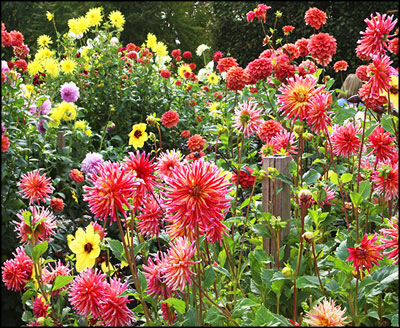
Fall is dahlia season, and the parking lot at Longwood Gardens was overflowing recently as thousands of visitors thronged to the national show of the American Dahlia Society.
Longwood is one of the country’s grandest public gardens, and dahlias have been grown there ever since it was the private home of Pierre S. du Pont. Between 1909 and 1934 du Pont purchased “around 500 batches of dahlia tubers,” according to the Longwood archives, probably for planting in his 600-foot Flower Garden Walk where they’re still grown today in a sumptuous mix of annuals, perennials, and grasses.
In a recent interview with blogger Margaret Roach, Longwood horticulturist Roger Davis shares his tips for growing and (if you want to) storing dahlias. Two of the three varieties they discuss are heirlooms – dark-leaved ‘Bishop of Llandaff’ and creamy ‘Café au Lait’ – and fellow oldie ‘Thomas Edison’ is also blooming gloriously at Longwood this fall.
Read the complete interview here, and if it leaves you feeling inspired, here’s a tip from us – you can order your own dahlias now for delivery at planting time next spring. (October 2018)
Fabulous Facebook Page for Historic Iris
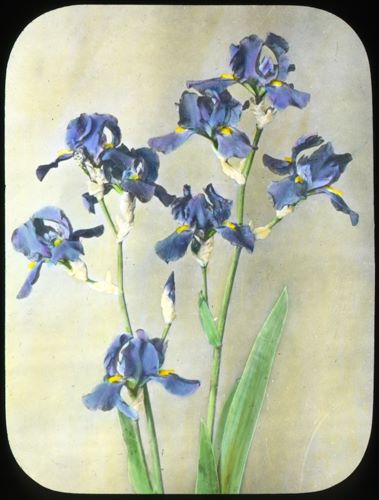
If you’re a fan of heirloom iris, and you’re on Facebook, we think you’ll enjoy the Facebook page of the Historic Iris Preservation Society.
Launched in 2011, it includes antique images and modern photos along with helpful tips and occasional links to other online resources. It has over 3000 followers, including us, and you could be next! Check it out at facebook.com/HISTORICIRIS/. And bravo, HIPS! (Mar. 2018)
Heirloom Gardener Spotlights the “Noah of Hyacinths”

Our good friend Alan Shipp and his ark of hyacinths are featured in the fall 2017 issue of Heirloom Gardener magazine. Editor Rebecca Martin tells the inspiring story of how Alan, a third-generation vegetable farmer, became the world’s leading expert on historic hyacinths and guardian of some 250 rare varieties.
Nine of Alan’s treasures are pictured in the article, and if some of the photos look familiar it’s because you’ve seen them at our website. As Rebecca writes, shortly after Alan sold his first hyacinths he started exporting bulbs to “Scott Kunst, founder of Old House Gardens, who’s also passionate about saving old cultivars. OldHouseGardens.com is a Michigan mail-order company specializing in heirloom flower bulbs, and the exclusive U.S. dealer for Alan’s hyacinths. ‘There’s nothing like a phone call from Alan, out of the blue, telling me about some exciting new hyacinth he’s found,’ Scott says. ‘It’s like the sun suddenly bursting out of the clouds on a beautiful spring day. He’s truly an inspiration and a world treasure.’”
You can read the entire article – and explore Heirloom Gardener magazine – at heirloomgardener.com/profiles/people/heirloom-bulbs-zm0z17fzmar. Although all of Alan’s hyacinths are sold out this fall, seven other fabulous, fragrant heirloom hyacinths are still available – if you order now! (Oct. 2017)
‘Little Beeswing’ Stars at Hampton Court Flower Show
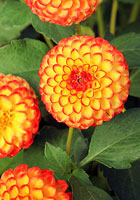
No, that’s not a typo in the title above. We recently learned that the dahlia we’ve always known as ‘Little Beeswings’ – with an “s” at the end – is actually ‘Little Beeswing’ – without the “s.”
Whatever you call it, this cheery little pompon dahlia has been a favorite of our customers ever since we first offered it in 2003. And this past July it was a hit at the RHS Hampton Court Flower Show where it was part of a display by Plant Heritage, the world’s leading non-profit devoted to preserving garden plants.
As Lucy Pitman explains at the Plant Heritage blog, “‘Little Beeswing’ has been offered in the Plant Exchange for several years by a National Collection Holder in Cambridgeshire, he having obtained his original plants from Scott Kunst of Old House Gardens in Michigan. Because this bright Dahlia was flowering so beautifully in perfect time for the RHS Hampton Court Flower Show, it became the star of the show in the Plant Guardian display.”
The National Collection Holder she credits is our good friend Alan Shipp, the Noah of hyacinths, who’s been growing ‘Little Beeswing’ ever since we sent it to him years ago. When Lucy asked Alan about its history, he sent her to us, and after several hours of research in the OHG library and online, here’s what we think we know.
‘Little Beeswing’ (the earliest spelling of its name) was introduced in 1909 (not 1886 or 1938, as some sources indicate) by Keynes, Williams, and Co. (not J.K Alexander), a celebrated nursery in Salisbury, England (not Australia) that introduced dahlias from at least 1863 to 1938. It apparently made its way to the US soon after (not in 1938 as Lucy believed when she wrote her blog). By 1916 it was noted as “new” in a list of “best dahlias” published by the New York Agricultural Experiment Station, and in 1917 it was mentioned in the Bulletin of the Dahlia Society of California.
Learn more at Lucy’s blog post, or simply order ‘Little Beeswing’ now for spring planting. If it can shine at the Hampton Court Flower Show, just think what it can do in your garden! (Sept. 2017)
The Queen of Garden Antiques
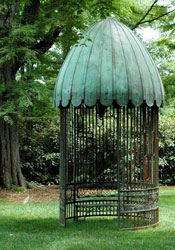
Garden antiques are increasingly popular – and I’m not just talking about “shabby chic” garage sale finds.
No one knows this better than Barbara Israel, the country’s leading source for high-end garden antiques. With customers ranging from Yoko Ono to the Smithsonian Institution, Israel currently offers such choice items as a terra-cotta Art Moderne greyhound for $3500, a Victorian fern-patterned cast-iron bench for $8500, and – at the top of my wish list – a 15-foot-tall copper-roofed garden pavilion for $55,000.
Israel has been selling garden antiques for over 30 years from her home in Westchester County, NY. There, as Therese Ciesinski writes in the winter 2017 issue of Garden Design, her lush gardens are filled with “a frozen menagerie of more than 200 maidens, warriors, animals, fountains and birdbaths, urns and obelisks, gates, finials, and follies. They are a reminder that strolling one’s garden to contemplate nature, history, and art is still a worthwhile pastime.”
Israel has written two fascinating and highly regarded books: the ground-breaking Antique Garden Ornament: Two Centuries of American Taste (1999) and the very helpful Guide to Buying Antique Garden Ornament (2012).
Her quarterly newsletter “Focal Points” is also excellent, with articles on “different types of garden ornament, specific makers, design suggestions, conservation,” and remarkable gardens, or for something lighter you can follow her on Facebook.
To browse her current inventory – which is much more than what’s pictured at her website – go to decaso.com/shop/xn5iii. Even if you can only dream of spending thousands of dollars on garden antiques, I think you’ll find it richly rewarding. (July 2017)
MaryJanesFarm “Romances” Our Dahlias and Daffodils

The pink, over-stuffed blossoms of our ‘Rosemary Webb’ dahlia fill an old yellow pitcher on the cover of the April-May 2017 issue of MaryJanesFarm under a heading that reads “Romancing the Garden: Heirloom Dahlias.”
Inside, MaryJane writes, “I bought my tubers from Old House Gardens. A new generation of sustainable farmers, they cultivate heirloom bulbs on five ‘micro farms’ on vacant lots and other scraps of land within a few blocks of downtown Ann Arbor. Mine were, if I must say so myself, stunning!”
Idaho farmer MaryJane Butters launched her “organic-focused lifestyle magazine” is 2001. With a circulation of 135,000, it’s sold today at stores all across the country including Whole Foods, Barnes & Noble, and Walmart.
MaryJane showcases our daffodils on page 5 of the May-June issue, too, with photos from our catalog of eleven heirlooms she planted at her farm last fall. Stay tuned for a follow-up article on them sometime later this year – and subscribe or learn more at www.maryjanesfarm.org/. (April 2017)
Cover Your Walls with Mural-Sized Botanical Images
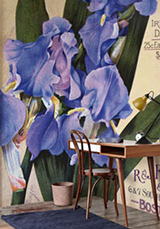
Imagine an entire wall in your home or office covered with a huge image of a Dutch flower painting from the 1700s, or a bulb catalog cover from the 1800s.
For less than you might expect, a British company called Surface View offers custom-sized murals of thousands of images ranging from antique maps and vintage comic books to abstract patterns and modern photography. Any good wallpaper hanger can install them for you, and shipping on most orders is free.
To see the 600-plus botanical images they offer, go to surfaceview.co.uk/shop/walls/mural/t/floral . There you‘ll find 18th-century paintings of broken tulips, Victorian chromolithographs of daffodils, floral wallpaper by William Morris, close-up photos of ‘Snowbunting‘ and ‘Rip van Winkle‘, and antique catalog covers such as the one pictured here of ‘Pallida Dalmatica‘. That image as well as several of our other favorites are part of a recently added New York Botanical Garden collection that you won‘t want to miss.
Even if you don‘t end up ordering any, it‘s fun browsing through the wonderland of images. Enjoy! (Nov. 2016)
Garden Gate Says “Your Garden Needs This Flower”
There‘s an unlikely “cover girl” on the front of Garden Gate‘s December issue: gladiolus!
Once scorned as hopelessly out of fashion, glads continue their slow rise back into popularity. Garden Gate‘s headline touts their “Gorgeous Color, Dramatic Shape, Old-Fashioned Charm,” and adds “your garden needs this flower1”
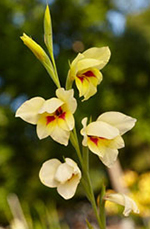
To integrate glads into your garden – instead of just growing them for bouquets – check out the article‘s excellent tips and photos in “Design Your Garden with Glads.” There‘s a great section on non-traditional glads, too, with photos of our small-flowered, surprisingly hardy ‘Carolina Primrose‘ (pictured here) and ‘Atom‘ as well as the fragrant Abyssinian glad.
For a free copy of this issue, click the “Free Preview Issue” tab at gardengatemagazine.com. As long-time subscribers ourselves, we know you‘ll find a lot to like in Garden Gate! (Nov. 2016)
Revamped Website Offers Historic Plant and Garden Riches
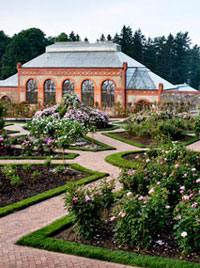
You don’t have to be a Southerner to appreciate the Southern Garden History Society, and a recent makeover has made its website better than ever.
The site is now filled with photos and antique images, and it’s user-friendly on all devices. Back issues of its excellent journal Magnolia are now searchable, and there’s an events calendar, dozens of book reviews, and links to historic sites and organizations.
Maybe best of all is the “Plant Lists” section, a fully searchable PDF of 50 Southern plant lists spanning two centuries, from a 1734 list of plants in the correspondence of John Custis of Williamsburg to a 1922-41 list of plants Beatrix Farrand specified for Dumbarton Oaks (including winter aconite, trillium, and lemon lily).
One of my favorite lists is a 1786 newspaper advertisement for Philadelphia’s “Peter Crouwells and Co., Gardeners and Florists” announcing that “they have for sale here” – in Alexandria, Virginia – “an extensive variety of the most rare bulbous flowers, roots and seed,” including 600 hyacinths, 400 tulips, 40 double narcissus, and 26 jonquils. “Those ladies and gentlemen who want any of the above articles,” the ad continues, “will please to apply immediately at his lodgings at Mr. John Gretter’s, King Street, as he intends to set off for Baltimore in a few days.”
Even if you can’t make it to King Street in time, there’s still a lot to enjoy at southerngardenhistory.org. (Oct. 2016)
Expert’s Top 100 Plants Include 3 Heirloom Bulbs
Once a year, Gardens Illustrated asks a horticultural superstar to write an article recommending “100 Plants Every Gardener Should Grow.”
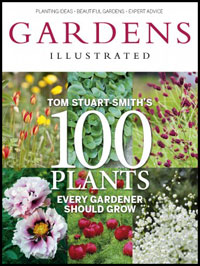
This year they turned to Tom Stuart-Smith, the internationally acclaimed British designer and winner of eight gold medals at the Chelsea Flower Show. His wide-ranging list includes trees, shrubs, vines, perennials, annuals, and grasses, along with bulbs – three of which, we’re happy to say, are heirlooms:
Traditional snowdrop (G. nivalis) – “I know there are many excellent cultivars,” Stuart-Smith writes, “but I’m very happy with this. I began at home 25 years ago with a bucketful from my mother’s garden and now there are tens of thousands thanks to regular dividing.”
Pheasant’s-eye narcissus (N. poeticus var. recurvus) – “I saw this familiar pheasant’s eye last spring growing [wild] in the Apennines and my heart missed a beat – and another when I bent to smell the sweet perfume. . . . Very tough and increases gradually even in rough grass.”
‘Black Beauty’ lily – “Magnificent Lilium speciosum hybrid of astounding vigor. Flowers from August to September. Exotic, stylish, and easy.”
The article inspired a wonderful post by our good customer Linda Brazil at her blog Each Little World. In it she mentions that years ago she compiled her own much shorter list of plants she’d never want to be without, and when she looked at it again recently, “I saw that everything on it was still growing in my garden and was a plant I would put on my list again.”
So what plants would be on your list? Would it include snowdrops, pheasant’s-eyes, and ‘Black Beauty’? And if you’re not growing them, why not take an internationally-acclaimed expert’s advice and give them a try? (July 2016)
Find Peonies in Bloom Near You with This Online Guide
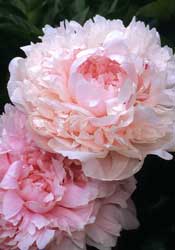
Just in time for peony season, the website of the American Peony Society has added a finder’s guide to 77 peony-rich public gardens in 30 states from Maine to California.
The gardens range from well-known sites to fascinating smaller gardens such as Sisson’s Peony Gardens in Wisconsin and the Shacksboro Schoolhouse Museum in New York with its collection of nearly 200 heritage varieties. Some sites make it surprisingly hard to find information about their peonies, but if a search for “peony” or “paeonia” returns no results, you can always call the garden and talk to a human being.
The guide also lists 28 peony gardens in other countries, including many in China where peonies have been revered for centuries. Altogether there’s a total of 105 gardens waiting for you to explore at americanpeonysociety.org/links/peony-gardens.
(And if you’re really in the mood for peonies, check out the four you can order now for fall planting at oldhousegardens.com/Peonies.) (April 2016)
Wall Street Journal Features Heirloom Flowers — and Us
“Rather than planting big-box-store flowers this spring, why not raise storied heirloom varieties that yield bragging rights as well as beauty?” So asks Bart Ziegler of the Wall Street Journal in a Feb. 20-21 article titled “Petals with Provenance.”
“Heirloom vegetables have been the rage for more than a decade,” Ziegler continues, “with foodies cooing over zebra-striped tomatoes and blue potatoes. But a lesser-known category of historic plants has its own devoted following: heirloom flowers.”
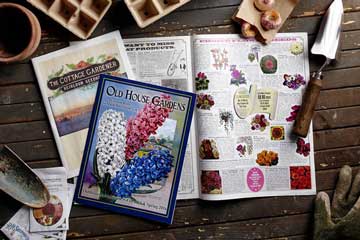
Illustrated with a big color photo that includes our catalog and even a few of our gladiolus corms, the article quotes experts from Monticello, Old Sturbridge Village, and Longwood Gardens, along with yours truly and our good customer Alicia Guy.
“Cooking-school manager Alicia Guy, who grows antique dahlias at her home outside Seattle, said of doing so, ‘It makes me feel like I have a connection with gardeners from 100 years ago that transcends technological change,’” Ziegler writes. Alicia “likes knowing her great-great grandmother might have cared for the same flowers,” including ‘Bishop of Llandaff’, a “summer showstopper.”
“The bragging rights historic plants give gardeners are well-founded,” Ziegler continues. “You can grow the same tulips planted in the White House Rose Garden when it was redesigned for President John F. Kennedy, in 1962; the variety of tuberoses Louis XIV enjoyed at Versailles; or the diminutive Silver Bells daffodils that author Eudora Welty tended in her Mississippi yard in the 1930s. All are available through Old House Gardens.”
“Raising heirloom plants,” he adds, “yields more than beauty: You ensure their survival. Catalogs from the . . . early 1800s offered hundreds of varieties of hyacinths, said Scott Kunst, founder and founder of Old House Gardens,” while today “most purveyors sell a half-dozen or so.”
The article ends with a call to action that you’ve probably heard from me before: “Heirloom flowers can’t be conserved in a museum like historic documents or antique furniture. ‘The only way to save them is to grow them,’ Mr. Kunst said.”
You can read the entire article here, but to do that you may have to pay $1 for a three-month subscription. Consider it an easy way to thank Bart and the Journal for shining a light on the flowers we love. (March 2016)
Take a Peek at Our Brand New Blog!
“Why don’t you do a blog?” Our newsletter has 24,000 subscribers, and our Facebook page has 13,000 likes, but a lot of people kept asking us this — so this morning we launched one!
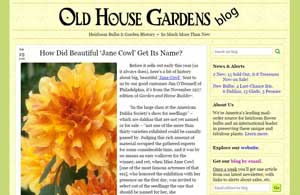
Instead of being filled with all new information, our blog will be simply an alternative way to enjoy what we’re already delivering in our newsletter. Here’s how they’ll differ:
NEWSLETTER — As you know, we email this once every month or so. It usually includes 3-5 informational articles along with alerts about newly available bulbs, special offers, and sales. Starting with this issue we’re also going to display one photograph in most articles. If you want to see more photos you’ll have to click links — or subscribe to our blog!
BLOG — Once a week, we’ll post one or two of the informational articles from our most recent newsletter, with all photos displayed right in the post. You’ll need to click links, though, to see our alerts about sales and so on, as well as our monthly garden quotation.
Basically the decision comes down to whether you prefer to get weekly, bite-sized bits or a monthly buffet of good stuff to read. The choice is yours, and we hope one of our options will suit you perfectly.
Please give our blog a look at oldhousegardens.com/blog, tell us what you think at help@oldhousegardens.com, and — whatever you decide — thank you and enjoy! (March 2016)
Blog-Goddess Reports “Virtually 100% Success” with Our Winter Aconites
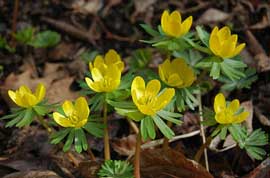
Always the first bulb to bloom here in our garden, winter aconites are thrilling, cheery, and carefree — so why aren’t more people growing them?
Although their tiny tubers can be hard to get established, our good friend Margaret Roach writes this week at her wildly popular A Way to Garden blog, “Good news: Buying waxed tubers from a vendor like Old House Gardens helps. I had virtually 100 percent success with their waxed tubers — a dramatic difference from any other time I’d tried to establish a new colony.”
Read more tips and see Margaret’s inspiring photos of these easy beauties in her garden at awaytogarden.com/hot-plants-winter-aconite/. (March 2016)
Online Now for Your Viewing Pleasure: 14,000 Antique Garden Catalogs
Here’s some exciting news for all of you who enjoy the antique images we use in our print catalogs. Last week the Biodiversity Heritage Library celebrated their amazing online collection of over 14,000 historic garden catalogs with a week-long social media event called “Garden Stories.” Even if you missed our Facebook alert about it, you can still:
1. Read the Library’s 12 blog posts about the history of garden catalogs, including ones on Shaker seeds, catalog art, and “Leading Ladies.” Click the “Older Posts” link at the bottom of each set of articles to see them all.
2. Enjoy the thousands of antique catalog images the Library has posted at Flickr. Be sure to click on your favorite images to see others from the same catalog — and if you find one you think would be perfect for our next catalog, let us know!
3. Explore some of the Library’s thousands of digitized catalogs dating from 1782 to 1969. Leaf through the 1825 catalog of the William Prince nursery, for example, and you’ll find 22 pages of fall-planted bulbs — including several whose names you’ll recognize from our catalog — and almost two pages of dahlias which at the time were so new to cultivation they were placed in the section labeled “Green-House Plants.”
The Biodiversity Heritage Library is a consortium of natural history and botanical libraries working together to digitize “the legacy literature of biodiversity” and make it more widely available in a global “biodiversity commons.” The BHL’s garden catalogs were digitized mainly from the collections of the National Agriculture Library (which holds some 200,000 catalogs), the New York Botanical Garden, the Missouri Botanical Garden, and Cornell University. We applaud the BHL’s work and we’re glad they recognize the value of historic garden catalogs! (April 2015)
Margaret Roach Talks Heirlooms with Scott
If you’re not reading Margaret Roach’s A Way to Garden, you’re missing something special. Margaret’s combination of what she calls “horticultural how-to and woo-woo” have made hers one of the most popular garden blogs. And Margaret appreciates the pleasures of the past. In 2007 she left her job as Editorial Director of Martha Stewart Living and moved to an old farmhouse in rural New York that she’s been restoring and filling with all sorts of beautiful things, from antique typewriters to pressed seaweed. (Take a peek at apartmenttherapy.com.)
So naturally I was thrilled when Margaret asked me to talk with her recently about heirloom bulbs, especially dahlias. You can listen to the podcast of our 24-minute chat anytime you want, or read the condensed version of it at her blog. She starts by calling me “Mr. Heirloom Bulb himself” — which I’m pretty sure she meant as a compliment — and then asks me to explain my “anthropological passion for these exceptional plants,” how my definition of heirlooms has changed over the past 30 years, why I like growing dahlias, and more. In the course of our talk I learned that she “particularly loves” dark-leaved dahlias such as ‘Bishop of Llandaff’ and that her favorite antique iris is ‘Gracchus’.
There’s a lot of excellent how-to at Margaret’s blog, and unusual plants, and recipes, and even frogs, but her greatest strength, I’d say, is that she enjoys exploring the deeper connections and meaning in gardening, nature, and life. One recent example is her heart-felt remembrance of Jack, the cat who walked out of the woods and into her life on 9/11. If you’re an animal lover, especially, you won’t want to miss it. (March 2014)
2013 Garden Bloggers Hall of Fame Winners
Congratulations to the winners of the Garden Bloggers Hall of Fame awards! Twenty nominees were announced in August — congratulations to all! — and winners were determined by online voting and a panel of experts. Last week at the first annual Garden Bloggers Conference in Atlanta, these four were honored as the best of the best:
Best Overall Blog: Margaret Roach, A Way to Garden,
Best Writing: Elizabeth Licata, Amy Stewart, Michele Owen, and Susan Harris, Garden Rant,
Best Design and Photography: David Corscadden, Beyond the Wild Garden,
Best New Blog: Paul Dysinger, Born To Grow.
A couple of our favorites among the other nominees were Dee Nash’s Red Dirt Ramblings and Matt Mattus’s Growing with Plants, but all are well worth a look. For brief reviews and links to all, visit Jennifer Ebeling’s 6ftmama.com. And happy reading! (Oct. 2013)
Historic Peony Garden Launches New Website
Our friends at the University of Michigan Peony Garden — the country’s largest collection of historic peonies — are beaming. In February the North American Plant Collections Consortium awarded the Garden “full status accreditation.” On June 1 their efforts to restore, catalog, expand, and bring the Garden online will be showcased at the American Peony Society’s national convention in a presentation titled “How a National Treasure Just Got Better.” And the Garden’s impressive new website is now online at mbgna.umich.edu/peony/. Although the staff is still polishing it and there are big plans for future expansion, it’s already a great resource for anyone who loves peonies. You can search the Garden’s 315 cultivars by color, form, breeder, etc., learn how to divide peonies, explore the peony’s Asian connections, find other peony collections near you, check the Bloom Countdown, and more. Give it a look — and have fun! (May 2013)
Dark-Leaved ‘Bishop’ Leads Oklahoma Blogger to Our Dahlias
In her popular blog, Red Dirt Ramblings, Oklahoma gardener Dee Nash recently wrote about the pleasures of spring-planted bulbs, especially dahlias:
“I’ve always grown dahlias, but they were hit and miss until I planted ‘Bishop of Llandaff’ on a whim. This Anglican bishop likes Oklahoma weather as much as he seems to like England. Each year I now add more [single dahlias with dark leaves like the ‘Bishop’]. Plant them against a large, lime green coleus like ‘Electric Lime’ or ColorBlaze Lifelime and watch them sing. Their leaves are a color echo for dark grasses, cannas, and pineapple lilies, too. . . .
“I’ve been planning even bolder scenes after reading The Bold and Brilliant Garden by Sarah Raven. I love this book. . . . Her interesting combinations of dark and light made my heart skip a beat. So much so that I went over to Old House Gardens and bought a few more dahlias, including ‘Clair de Lune’ and ‘Prince Noir’. With plants there never really is too much of a good thing.” Read the rest and see Dee’s photos at RedDirtRamblings.com. (April 2013)
On Trend for 2013: Romantic, High-Value, and Heirloom
In a recent post at his thought-provoking blog Grounded Design, landscape architect and passionate gardener Thomas Rainer predicts seven major trends that will impact gardening in 2013. “Trend predicting is, of course, utterly obnoxious,” he writes, “but I love trying to articulate the zeitgeist,” the spirit of the time. Two of his trends resonate especially strongly with us here at Old House Gardens:
“1. The New Romanticism, Simplified. . . . The romantic mood that has swept over garden design will persist in 2013. As Western states teeter on the brink of bankruptcy, and we increasingly experience the world through our smartphones, people will turn to their gardens for a spiritually authentic, but emotionally-soothing experience. We crave something real from our gardens, but not too edgy. . . . Historic revivalism (a la Downton Abbey [see below]) will continue to influence designers, particularly Victorian gardens (check out Cleve West’s Best in Show Chelsea garden last year for an example), but these styles will manifest themselves in simpler, sleeker ways. The elegance of the past gardens is stimulating, yet comforting. . . .
“6. Nursery Trends: High Value Acquisitions. While the lethargic economy will continue to affect nursery demand, people will continue to buy plants, even expensive plants. Garden consumers want value, not just cheap. Sales of rare specimens, heirloom plants, sculptural shrubs, and unusual multi-stem trees will increase this year even as the general demand for more generic specimens will be sluggish. Nurseries that cut back selection due to hard economic times may miss out on an emerging niche market.”
Is he right? We hope so! Read about all seven of Rainer’s 2013 trends here. (Feb. 2013)
‘Challenger’ Daylily Proves Its Worth to Arty in Atlanta
Arty Schronce lives in the historic Cabbagetown neighborhood of Atlanta and writes a column called “Arty’s Garden” for the Georgia Department of Agriculture’s 95-year-old Market Bulletin. With a philosophical outlook, a sense of humor, and an appreciation for heirloom plants, Arty is our kind of guy — as you can see in this excerpt about a daylily we’re offering for the first time this spring:
“Sometimes a plant grows on you. Not literally, of course. For example, several years ago I purchased a ‘Challenger’ daylily [Ed. Note: Not from us!] because it was taller and bloomed later than other daylilies. When it bloomed I was disappointed. The flowers were not as intensely red as the photograph in the catalog, and the petals were not as thin and ‘spidery’ as I had hoped.
“It was tall, however, rising to five feet or more, and extended my daylily season by beginning to bloom weeks after my other daylilies. I decided to keep it around a while longer instead of immediately casting it out of my little Eden.
“I am glad I did; ‘Challenger’ has proven its worth. It wasn’t exactly what I expected, but now I am quite fond of it. . . . Have you done this with plants as well, dismissing them without taking the time to learn their virtues? Unfortunately, I’ve also treated people that way. I’m trying to do a better job giving plants and people a fair chance.”
In another column Arty praises “Oxblood/Schoolhouse Lilies,” calling them “as refreshing as a glass of pomegranate juice” and wisely warning gardeners to keep them away from red spider lilies because “the oxblood lily undercuts the drama of the spider lily, and the spider overshadows the shorter, simpler oxblood.” Other columns of his we especially liked are “The Tulip Teacher,” “The Tawny Daylily,” and “The People Who Live in My Garden” — and once you get started, you may find yourself reading them all. (Dec. 2012)
Link of the Month: A World-Class Garden Library and PlantInfo.umn.edu
Although relatively unknown, the Andersen Horticultural Library of the University of Minnesota (see article above) is one of the country’s richest resources for gardeners. Its collection of seed and nursery catalogs is especially impressive, with nearly 60,000 catalogs dating from 2012 all the way back to 1828. (If you’ve ever tried to buy an antique catalog on eBay, there’s a good chance you’ve been outbid by the library — as we well know!) The Andersen also holds 20,000 books (including rare herbals and works by Linnaeus, Redoute, and Repton) and 300 periodicals (including two centuries of Curtis’s Botanical Magazine), all housed in a beautiful building with furnishings by George Nakashima and windows overlooking the grounds of the Minnesota Landscape Arboretum.
Even gardeners who can’t visit the library can use its award-winning Plant Information Online to search for articles, links, and North American sources for close to 100,000 garden plants. A search for Narcissus, for example, returns a list of 1092 daffodils with at least one source for each. (We’re proud to be the only source for 19 of these daffodils, plus six new to our catalog this fall and our Web-Only Rarests). For gardeners searching for hard-to-find plants, plantinfo.umn.edu is an invaluable aid. (Sept. 2012)
Link of the Month: Bulbs, Veggies, and Garden History from Monticello
Thomas Jefferson was an avid gardener and his restored gardens at Monticello are a national treasure. Since 1987, Monticello’s Thomas Jefferson Center for Historic Plants has been preserving and promoting historic fruits, vegetables, and flowers. Although the Center no longer publishes its annual journal, Twinleaf, dozens of its fascinating articles are free for the reading at the Monticello website. Our favorite (no surprise here) is “Thomas Jefferson’s ‘Belles of the Day’” which explores the great man’s love of bulbs.
There’s a lot more for gardeners to enjoy at the Monticello site, too. You can take a video tour of the grounds; check out the TJCHP’s collections of historic iris, roses, and pinks; and read about “A Rich Spot of Earth”: Thomas Jefferson’s Revolutionary Garden at Monticello, the brand-new book about Jefferson’s vegetable gardening by Peter Hatch, Monticello’s Director of Gardens and Grounds — who, by the way, is retiring this year after 35 years at the helm. Congratulations, Peter, and thank you! (June 2012)
Link of the Month: Check Out Your Brand New Hardiness Zone
Big news! The new hardiness zones map that the USDA has been working on for over a decade has finally been released. It’s based on newer and much more extensive data as well as sophisticated mapping algorithms. Although the USDA claims that the new zones aren’t much different than the old ones, we think you’ll find that they’re similar to the zones on the Arbor Day map which we’ve been using for years. In other words, a lot of people are going to find that their gardens are a half-zone warmer than they used to be — and that means they can grow a lot of plants they never thought they could.
To check out your new zone, simply enter your zip code (and the site’s case-sensitive security code) at http://planthardiness.ars.usda.gov/PHZMWeb/. Then for a list of all the exciting bulbs you can grow in your new zone, use our easy, awesome Heirloom Bulb Search. (Feb. 2012)
Link of the Month: Google Gives New Life to Scott’s Old-House Journal Articles
I love Google Books, and not just because it’s made all of the articles I’ve written for The Old-House Journal instantly available online. The first one, about carpet bedding, dates to 1985 when I was still teaching school and just getting started as a landscape historian. I remember how thrilled I was to get that acceptance letter! Next came “Victorian Vegetables” and then others on antique apples, outdoor furniture, historic paving, herb gardens, post-Victorian landscapes, and of course heirloom bulbs.
My first bulb article was “Victorian Tulips” in 1988 when ‘Prince of Austria’ and ‘Clara Butt’ were still being offered in several catalogs. Then came “Daffodils: The Glory of the Post-Victorian Garden” and “Antique Hyacinths.” Sadly, six of the twelve hyacinths I recommended in that 1990 article are now commercially extinct, and three of the four sources for them have disappeared as well. Next came “Antique Iris” and then “Antique Peonies” in 1993 (the year we mailed our first catalog) and finally “Savoring Dahlias” in 2008. Heirloom daylilies will be next, if I can find the time to write it — and you’ll be the first to know. (Sept. 2011)
Our New Facebook Page is Jumping
In the past month, our followers on Facebook have more than quintupled from 70 to 383. Woo-hoo! Mike and Vanessa are posting weekly photos of what’s in bloom here, and a few public-spirited customers have joined in with photos of our bulbs blooming in their gardens. Please come take a look — and “like” us. Our goal is to have 2000 followers by the end of the year, and there’s no way we can do it without you! (Aug. 2011)
Now You Can “Like” Us on Facebook!
You kept telling us we ought to join Facebook, and we wanted to, but we never quite found the time to do it. Finally our eager IT assistant, Mike, just couldn’t wait any longer so he launched an unofficial Old House Gardens page. When the boss found out, he gave him a good chewing out — and then applauded Mike’s initiative, took a deep breath, and put him in charge of our official page. It’s VERY simple so far, and Mike is a very new gardener, but we hope you’ll give it a look, “like” us, share it with your friends, and give us some suggestions for making it everything you’d like it to be. (July 2011)
Link of the Month: Studying Dahlias at Stanford
We recently stumbled upon the website of the Stanford Dahlia Project. This fascinating site supports “Biology 137: Dahlias in Plant Genetics” taught by Stanford University professor Virginia Walbot. As you may have guessed from their amazing diversity, dahlias have a rich genetic inheritance. Even Darwin himself was impressed, citing both dahlias and hyacinths in The Variation of Animals and Plants under Domestication (1868) as examples of plants that had been diversified from a single wild species (or so he thought) into thousands of different varieties.
Noticing a photo of ‘Union Jack’ at her website, we asked Dr. Walbot if she’d like any of our dahlias to use in her research, and this spring D. atropurpurea, ‘Nellie Broomhead’, ‘Tommy Keith’, and ‘York and Lancaster’ joined ‘Union Jack’ at the Stanford Stock Farm. We were flattered when she asked us, “What are your thoughts on the color diversity in ‘York and Lancaster’?” But we soon realized that “it’s awesome” wasn’t the kind of answer she was looking for, and we had a LOT to learn about dahlias. “It looks like a very early acting transposable element,” she continued, “or it could be somatic recombination in a heterozygote (red//white after recombination some red//red and white//white zones are generated). . . .”
But don’t let that scare you! Dr. Walbot’s site is fun to explore. There’s a great page on dahlia history with a link to a timeline of dahlias in cultivation since 1300, an excellent section on dahlia forms and terminology, and even a couple of videos. Before you know it you’ll be bragging, “I studied dahlias at Stanford!” (May 2011)
Site of the Month: “Wild Lakota” Iris and Other Legacy Bulbs
“My favorite old homestead flower is a bearded iris that I’ve nicknamed ‘Wild Lakota’. It has a lovely lemony scent.” So wrote Dennis Kramb of southwest Ohio in the Pacific Bulb Society’s email discussion group. “The roadside places where I’ve found it are nowhere near any existing home,” he continued, “so I can’t imagine how many decades they’ve been able to persist there, untended. I collected a few pieces years ago and now have a big patch of it in my front garden.” That sounded like an iris we ought to offer, but when we looked at Dennis’s photo of it, we discovered we already do. It’s 200-year-old, primrose-yellow ‘Flavescens’.
From roses to daffodils to asparagus, some garden plants are so tough that they can persist in the wild without care for many, many years. Some are so commonly found there that they’ve made it into wildflower guide books where they’re typically marked as “alien” or “garden escape.” Although the Pacific Bulb Society focuses on truly wild bulbs, they’ve included a long list of “Legacy Bulbs” — “bulbs that outlast their owners” — in the Wiki section of their excellent website. You’ll find ‘Flavescens’ and ‘Crimson King’ iris there, along with descriptions and photos of bulbs from almost every genus we sell, from Allium to Zephyranthes. It’s fun to explore, it may help you identify bulbs you’ve found in the wild, and it’s convincing testimony to the staying power of heirlooms. (April 2011)
Blog of the Month: Each Little World Says “Go Big Red!”
“An artist by training, a journalist by trade, and a gardener by choice,” Linda Brazill left 28 years of newspaper work in 2008 and, since she “couldn’t imagine a life without writing,” she launched Each Little World, a blog devoted to the things she likes best: “food, art, books, history, textiles, a bit of politics, and mainly gardening.” Linda gardens in the frozen wilds of Madison, Wisconsin, but her writing will interest gardeners throughout the upper half of the country at least. (A gardener is a gardener, right?) She’s a big fan of Old House Gardens, too, and other small, specialist nurseries. In a recent blog she spotlights our family-heirloom “Wisconsin Red” dahlia and ends by saying “I can picture a big bouquet of these beauties adorning [University of Wisconsin] tail-gate parties all over the state next fall. Go Big Red! Go OHG!” Martagon lilies and double tulips are featured in other recent blogs, and don’t miss “Great-grandmother’s Bloom Day” for an inspiring family photo of her husband Mark’s great-grandmother standing in the snow in front of her log cabin with a beautiful pot of daffodils she forced in full bloom. Now that’s garden history! (April 2010)
Southern Living’s Steve Bender Keeps Us Laughing (and Blushing)
Southern Living’s long-time garden editor is one of the funniest guys we know. Last month, he praised us so profusely in his “Grumpy Gardener” blog that we were blushing and muttering “aw, shucks” — until we got to the part where he wrote that our hometown, Ann Arbor, is “the home of the Michigan State Spartans” and “Scott is a die-hard Spartans fan.” If you follow college sports, you know he’s got that exactly backwards — and it’s nothing to laugh about! But of course we did. Thanks, Steve, and Go BLUE! (March 2010)
Link of the Month: Well-Loved Books from Heiko
Winter is for reading, and for 20 years now we’ve been turning to Calendula Horticultural Books to help us learn more about antique flowers and gardening. In his December catalog, owner Heiko Miles (who by day works in a small accounting office) wrote that “the hard economic conditions that caused a significant drop in book sales made me decide to scale back somewhat with the book business this year.” But, he adds, “I would rather sell old and rare books than do any other work. I love the wonder books create, the dreams they ignite, and the pleasure they provide. Books are my friends that smile to me from the shelf, full of memories of time shared together. They beckon me to read them again and start the adventure afresh. . . They provide me with a sense of belonging.” And Heiko feels the same way about plants. “Our books and our gardens,” he writes, “both fill an almost primal need within.”
For hundreds of old, soul-satisfying garden books priced from $5 to over $1000, visit Heiko at calendulabooks.com. And please tell him we said hello. (Jan. 2010)
Site of the Month: For Those Who Love Hyacinth Vases
Julie Berk has fallen in love with forcing vases, and she’s sharing her enthusiasm in a brand-new website, hyacinthvases.org.uk. There you’ll find colorful photos of all sorts of vases, images from antique books and catalogs (don’t miss the Etruscan Revival vases), reports on her latest bulb-shopping forays, and a “Collectors Community” for email discussions with fellow enthusiasts. Though far from slick, the site is well worth exploring, and Julie has big plans for developing it as an educational resource. She’s already posted an illuminating, 10-page article from the Glass Association Journal that’s a must-read for serious fans. (Click on each page till you get it to readable size.) (Nov. 2009)
Laughing with Bulbs: Doonesbury’s Zonker
Even Doonesbury’s Zonker Harris is planting bulbs this fall. For six days of laughs, go to doonesbury.com/strip/dailydose/index.html?uc_full_date=20090928. Click the “Next” tab at the top of each comic to see them all. There’s also a link just above that to “Latest FAQ: Why do bulbs keep coming up in Doonesbury?”
We bet you’ll recognize a bit of yourself — and us — in the strips. Happy laughing! (Oct. 2009)
Blog of the Month: Early American Gardens
“A museum in a blog,” that’s how Barbara Sarudy describes her entertaining blog devoted to American gardens of the 1700s and early 1800s. Much as I love her landmark book, Gardens and Gardening in the Chesapeake, 1700-1805, Sarudy’s blog is more fun to read because it’s so personal and meandering, filled with, as she says, “snippets of garden history and images that fascinate me.” Though she’s clearly enjoying herself, Sarudy is a serious and expert historian. As in a museum, she presents us with authentic artifacts, both written and visual, giving us the opportunity to enjoy and draw our own conclusions from them.
A few of my favorite entries are the ones about arbors, bee-hives, and slave gardens. Be sure to check out the “boring assumptions, introductions, and housekeeping rules” in the left-hand column, too. This is some of Sarudy’s most interesting writing, and spot-on. (June 2009)
Site of the Month: Have You Discovered the Joy of Google Books?
We love to learn, and we’re constantly searching for more information about the history and care of the bulbs we sell. Although we have a good-sized collection of antique garden books, we discovered not too long ago that Google has a much, much better one. And it’s staffed by an amazing librarian called Search who can find the exact few words you’re looking for in millions of books.
Try it yourself. Go to Google, click on the word “more” at the top of the screen, and then on the drop-down list that appears, click “Books.” Enter anything you like in the Books search box — say, Madame Chereau iris, or heirloom dahlias, or growing bulbs in Texas — and see what turns up. Access to the results varies from book to book, from “full view” to the pretty much useless “snippet view,” but you almost always get something worthwhile and interesting. Have fun, but be careful — it can become addicting! (Apr. 2009)
Blog of the Month: Ranting About Real Gardens
Don’t be scared off by its name. GardenRant.com is one of the most popular of all the thousands of garden blogs, and for good reason. It’s the collective work of four terrific writers including Elizabeth Licata, who seems to grow and love bulbs almost as much as we do, and Amy Stewart, whose Flower Confidential is one of my all-time favorite garden books. To quote from their “manifesto,” they’re “Convinced that gardening MATTERS. . . In love with real, rambling, chaotic, dirty, bug-ridden gardens,” and “Delighted by people with a passion for plants.” That’s my kind of gardeners, and I urge you to give them a read.
Why not start with Elizabeth’s recent blog about us? Be sure to check out the nice comments from fellow blog-readers at the end of it, too, and maybe add one yourself! Elizabeth has many other entries about bulbs, including recent ones about forcing and bulb FAQs, but just about anywhere you wander at GardenRant, you’ll find something well worth reading. (Nov. 2008)
Blog of the Month: Southern Living’s Grumpy Gardener
“An outstanding mail-order nursery,” that’s what Southern Living garden editor Steve Bender calls us in a recent posting at his blog. Steve calls himself the Grumpy Gardener, but that’s because he can’t call himself the Really Funny and Also Expert Gardener. Though he tends to tone down his humor in his magazine writing, in his blog you’ll see more of the Steve who cracked us up in the modern classic, Passalong Plants.
His praise-filled review of “the Old House Gardens difference” spotlights several of our best bulbs for warmer gardens including our true Byzantine glad which he describes as both “gaudier than Liberace at the Moulin Rouge” and “a single-malt Scotch for your garden.” Don’t miss his blogs titled “Squirrel Problem? Fire Away!” and, right in time for Halloween, the “Toilet Paper Miracle.” Like gardening, laughing is good for you. (late Oct. 2008)
Blog of the Month: The Undaunted Heirloom Gardener
Despite deer, shade, clay soil, and five kids, the Heirloom Gardener of Chatham, NJ, grows beautiful roses, tulips, dahlias, and more — and finds time to blog about it! Don’t miss her “What I’ve Learned about Growing Tulips in New Jersey: Protecting from Squirrels and Deer, Planting in Clay Soil, and Creating Colorful Combinations.” Heirloom tulips, she writes, are “much more tolerant of my less-than-ideal clay soil,” and she includes multiple photos of her lovely tulip combos (and more here) with names of the varieties in case you get inspired to try something similar.
In January she blogged about our heirloom dahlias (“my favorite cut flower and . . . super easy to grow”), in February she praised our wax-dipped winter aconites, and just last month she wrote, “My two favorite new lilies this year were . . . both from Old House Gardens.” Our double tiger lily she says is “far more attractive” than our catalog photo (we agree!), and the fragrance of ‘Excelsior’ is “phenomenal . . . unlike any other.” Of course she writes about plenty of other things besides our bulbs (gardening with kids, for example), but we’ll let you discover those pleasures yourself. Enjoy! (Sept. 2008)
Blog of the Month: “Delirious About Bulbs” (and ‘Hyperion’ Daylily)
First up is a recent blog by Pomona Belvedere at tulipsinthewoods.com. “OHG bulbs are the top of the top of the bulb world,” she writes, “big, fat, healthy, and bursting with (often) multiple blooms.” She calls our catalog “fun” and “clearly written by people who are delirious about bulbs, and don’t care who knows it.” (She’s right!) And “for those who enjoy diversity,” she adds, “shopping at Old House Gardens is a way to support people who preserve it — and to do a little preserving ourselves.”
Don’t miss Pomona’s blog about ‘Hyperion’ daylily, too, in which she praises its graceful shape, fragrance, and willingness to bloom with just a few hours of sun. Then take a look at her “Heirloom Plants” and “Bulbs” categories, and if you’re like us you’ll find yourself reading on and on! (Aug. 2008)
Link of the Month: America’s Liveliest Old Cemetery
Cemeteries don’t often show up on lists of favorite vacation spots, but if more cemeteries were like the Old City Cemetery in Lynchburg, Virginia, that could change. I spent last weekend there — speaking at a sold-out garden symposium — and loved it!
Laid out in 1806, the cemetery has been revived as a multi-faceted community resource by an eager and ever-growing group of volunteers. There are guided tours year-round on everything from historic daffodils to “Lynchburg’s Early Bawdy Ladies.” There’s a chapel that’s popular for weddings as well as funerals, and four small, reconstructed buildings that house archives and museum displays. Larger-scale artifacts rescued from local sites ornament the grounds, including antique fencing, marble columns, and a huge iron pitcher that once poured water into the Lynchburg reservoir. Perhaps more surprising, there are bee-hives (with honey sold as “Died and Gone to Heaven”), goats (helping to clear invasive plants from a steep ravine), a composting education center, and an award-winning cookbook. To learn more and get inspired, visit gravegarden.org . (March 2008)
Link of the Month: Historic Sewers
We’re not kidding. Sewers are essential to modern life and critical to the health of our waterways, wildlife, and all of Nature. They can be pretty darn interesting, too – as we think you’ll agree once you take a look at garden writer Adam Levine’s website The History of Philadelphia’s Watersheds and Sewers at phillyH2o.org/index.htm.
Adam is a smart, funny guy, an avid gardener, and an award-winning author. In 1998 he hired on as a part-time “historical consultant” for the Philadelphia Water Department, and soon he was hooked. Adam’s site is rich with historic photos and maps, compelling data, and plenty of laughs. The best place to start may be his article “Down Under!” which is subtitled “Tales from the city sewer system, or why I should have worn a raincoat.” Once you start, we bet you’ll read more, and before long you’ll have a whole new perspective on your own local watershed and sewers. It’s enlightening! (Feb. 2008)
Link of the Month: Elegant Vases, Our Dahlias, and Martha Stewart
We’re always looking for interesting vases, and sometimes they find us. Last month our good customer Frances Palmer of Weston, Connecticut, emailed us a few photos of our dahlias “in the garden and in my pots” — and wow! It turns out Frances is a renowned potter whose classic yet quirky tableware and vases are being featured in the February Martha Stewart Living, on newsstands now.
“Thank you for such incredible flowers,” Frances wrote us. You can see her photos at oldhousegardens.com//FrancesPalmer and more of our dahlias and her pottery at francespalmerpottery.com/FP_about.htm . Don’t miss her “whimsical pots,” including two filled with our ‘Thomas Edison’ and ‘Deuil du Roi Albert’.
Thanks, Frances! We want one of everything you make! (Jan. 2008)
Link of the Month: Slow Food USA
If traditional foods are an important part of your holidays, you may be a “slow food” lover! The opposite of fast food, slow food is everything “from the spice of Cajun cooking to the delicious simplicity of produce at a farmers’ market; from heirloom varieties of fruits and vegetables to handcrafted cheeses and other artisanal products.” Slow Food USA is a “non-profit educational organization dedicated to supporting and celebrating the food traditions of North America.” It believes that “pleasure and quality in everyday life can be achieved by slowing down, respecting the convivial traditions of the table, and celebrating the diversity of the earth’s bounty.” If that sounds good to you, check out their website at slowfoodusa.org/index.html . (Nov. 2007)
Link of the Month: Preserving Historic Landscapes
Wow! The website of the Cultural Landscape Foundation — the country’s leading non-profit dedicated to preserving all sorts of historic landscapes — has recently been upgraded and it’s a gem. Rich with information, resources, and beautiful images, it features major sections on Landscapes at Risk, Pioneers of Landscape Design, Outreach & Education, Stewardship Stories, and In the News. You’ll also find a definition of cultural landscapes, a term that’s still unfamiliar to many people but which embraces “public parks, historic sites, gardens, scenic highways, college campuses, farmland, cemeteries,” and other historic landscapes that both express our shared culture and enrich our daily lives. (Aug. 2007)
Link of the Month: Vintage Garden Books
Reading old garden books is one of our favorite ways to learn about plants and gardens of the past. While shopping recently at AbeBooks.com, a terrific internet source for used and rare books, we stumbled upon “In the Garden: Let Your Collection Bloom.” This brief essay on collecting old garden books includes links to an assortment of classics ranging from a paperback edition of A Southern Garden for $3 to a hand-colored 1794 copy of Repton’s Landscape Gardening for $25,000. (June 2007)
Link of the Month: Heirlooms and Murder
Regan Culver is the prime suspect in the poisoning death of her father. But don’t worry, it’s just for fun. She’s the herb-farming, plant-loving main character in Rosemary for Remembrance, one of an entertaining series of garden-themed mystery novels by Audrey Stallsmith.
Audrey is a great fan of heirloom plants, too, and at her website thymewilltell.com you’ll find, along with excerpts and reviews of her novels, a score of articles about heirlooms ranging from fritillaries to maize. Be sure to scroll down the text of her homepage and click on both the “heirloom plants” and the “historical plants” links. Happy reading! (Sept. 2006)
Link of the Month: Historic Garden Photos
Now you can view hundreds of great old photos of American yards and gardens at memory.loc.gov/ammem/award97/mhsdhtml/aladhome.html. They’re part of a collection of nearly 3000 historic lantern slides from 1850-1920 recently digitized for the Library of Congress’s “American Memories” project. There are views of cities, buildings, parks, estates, and gardens, and you can easily search the collection by terms such as arbors, carpet beds, and even “plants-bulbs.”
I especially liked an image that I happened upon of an urban working family’s backyard from 1902 with nothing but a fence, clothes lines, a wooden walk, and a little kid standing on the flat bare dirt. But there are plenty of lavish gardens pictured, too, and simply browsing through the collection is both educational and inspiring. (March 2006)
Link of the Month: Collecting Antique Hyacinth Vases
Gardeners in the 19th century loved forcing hyacinths in special vases for winter bloom. The practice dates back to the mid-1700s when Madame Pompadour, influential mistress of Louis XV, had hundreds of hyacinths forced in vases at Versailles.
Today, antique hyacinth glasses are collected worldwide. For a glimpse of the immense collection of Dutch enthusiast Wim Granneman, visit kennemerend.nl/bollenglazen. Wim’s homespun site includes forcing-vase history, tips for finding them today, and even a section on crocus pots. Best of all is the “Vases Worldwide” section which features hundreds of Wim’s vases, old and new.
[For even more on forcing vases, see the wesite and blog of British enthusiast Julie Berk at hyacinthvases.org.uk and gardenwithindoors.org.uk.]. (Dec. 2005)
Link of the Month: ‘Beauty of Bath’ — A Tulip Mystery Story
With primrose petals flamed purple, the ‘Beauty of Bath’ tulip is stunning. But how did it get its name? One of our favorite garden writers, Betsy Ginsburg, put on her detective cap and journeyed back to Edwardian England to investigate. Her quest, which involves antique apples and a hit musical, makes for an evocative story that I bet you’ll love.
But don’t stop there. Betsy’s site, GardenersApprentice.com, is full of other great garden articles, tips, book reviews, and more. I especially liked her piece titled “Rose of Sharon: Still Fashionable After All These Years,” but like a good book, Betsy’s whole site is hard to quit reading. Enjoy! (Nov. 2005)
Link of the Month: An 18th-Century Flower Album
One of the greatest florilegiums of the 1700s, the Hortus Nitidissimus, is also one of the rarest. Featuring hand-colored prints of hundreds of garden flowers, it was published in parts over the course of 36 years and few complete copies survive. But now through the wonders of modern technology a virtually perfect copy is on reserve for you at rbgkew.org.uk/data/trew/home.do. In it you’ll find dozens of hyacinths (including some astonishing doubles) and tulips (with several parrots much like our Hortus Bulborum rarities) along with lilies, daffodils, ranunculus, and many other bulbs. Enjoy a glimpse of what spring looked like 250 years ago! (Sept. 2005)
Link of the Month: Ukraine Protects Valley of the Narcissus
Since the beginning of time, millions of wild pheasant’s-eye narcissus (much like our N. poeticus recurvus and ‘Ornatus’) have been blooming every spring in a valley in Ukraine. As farming and other development encroached on this vast paradise, more and more of these richly fragrant flowers were plowed under or paved over. Eventually local conservationists mounted a “Save the Narcissus” campaign and now 643 acres are protected as part of a national park. We hear it’s an awesome sight in bloom, but if you go, be careful: the accumulated fragrance can be literally dizzying. For photos and more, visit http://www.wumag.kiev.ua/index2.php?param=pgs20051/104. (July 2005)
Get Ken Druse’s Brand-New Newsletter
Our friend Ken Druse, author of The Natural Garden, The Passion for Gardening, and other classics, is one of America’s most inspiring garden writers and photographers. Now he’s launching an email newsletter, and you can be one of the first to subscribe! Here’s the skinny, direct from Ken:
“By popular demand (really) I am going to have a free, semi-regular e-newsletter where I can share timely thoughts: trends, cool tools, wonderful plants, interesting people, complaints, the latest dirt nature has dished out to me here in the island garden, etc. I hope you will sign up, and pass this note along to friends who you think would be interested, as well.” To subscribe, click here. (June 2005)
Link of the Month: London Pride and Sarah Orne Jewett
The garden in Maine once tended by Victorian author Sarah Orne Jewett (The Country of the Pointed Firs, etc.) lives on today under the good care of museum gardener Nancy Mayer Wetzel. In 1883, Jewett wrote a short story about a pre-dawn ramble through her garden, and in it she mentions a flower she calls London pride. Wetzel wanted to replant this flower in Jewett’s garden, but Jewett’s description of it didn’t fit what’s most commonly known as London pride today, Saxifraga umbrosa. So Wetzel had to do some heirloom-flower sleuthing. To read Jewett’s story and, even better, the results of Wetzel’s investigation, go to public.coe.edu/~theller/soj/mod/housebkr.htm and scroll all the way down the page. (June 2005)
Link of the Month: Wild Tulips
Here’s a fascinating, home-made site devoted to the wild ancestors of our garden tulips, many of which are great garden plants in their own right: tulipessauvages.org/english_version/index.htm. Though it’s a French-language site and its English translations are sometimes a bit clunky, that only adds to its considerable charm. (March 2005)
Link of the Month: History of Gardening Timeline
Anyone with an interest in gardening and the past could easily spend hours wandering through this huge, multi-faceted website. Compiled by retired librarian Michael Garofalo of California, it’s a simple, rambling site full of all sorts of interesting facts, publications, links, and even gardening quotations. Its subtitle offers a glimpse of its riches: “Noteworthy Gardens, Events, Persons, Publications, and Facts in the History of Gardening with References and Web Links Organized by Time Periods and Some Information about Agriculture, Farming, Culinary Arts, Botany, Horticulture, Technology, Arts and Crafts.” To start wandering, go to gardendigest.com/timegl.htm. (Jan. 2005)
Link of the Month: Preserving Antique Lawn Mowers
When the first lawn mowers arrived in America in the mid-1800s, garden writers extolled their charms. Really! For a glimpse of some of these Victorian relics and other charmers from the early 20th century, visit the fascinating Reel Lawn Mower History and Preservation Project at users.crocker.com/~jricci/. And be sure to click on the Document link to see an idyllic Victorian lawn scene with a pattern-bed of cannas. (Dec. 2004)
Link of the Month: Nationwide Guide to Expert Local Advice
A great local resource for gardeners is your Cooperative Extension Office. Every county has one; there’s even one in Manhattan! Most have a help line staffed by Master Gardeners who can identify plants and pests for you and answer many, many gardening questions. For the phone number of your county’s, go to the new csrees.usda.gov/Extension/index.html and click on your state. (Dec. 2004)



