




Here’s a wealth of information about SPRING-PLANTED DIVERSE bulbs from our email Gazette and past catalogs, starting with the most recently published. For other topics, please see our main Newsletter Archives page.
To subscribe to our FREE email newsletter, click here.
For articles about the many CANNAS we formerly offered, see our Canna Archives.
Fragrant and Long-Loved: Tuberoses from 1530 to 1893
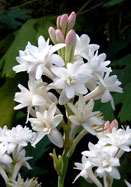
“Everyone who has a garden, or a taste for flowers, knows the tuberose,” wrote C.L. Allen in his 1893 Bulbs and Tuberous-Rooted Plants.
“Its history, however, may not be known,” he continued. “The earliest account we have of [it] is in L’Ecluse’s History of Plants, from which we learn it was brought from the Indies by Father Theophilus Minuti, a Christian missionary, about the year 1530….”
“In Parkinson’s quaint old book, The Garden of Pleasant Flowers, published in 1629, we find the following description of it under its then known name of hyacinth with which it was classed: ‘Hyacinthus Indicus major tuberosa radice, the greater Indian knobbed jacinth…. The tops of the stalks are garnished with many fair, large, white flowers … composed of six leaves [petals] lying spread open as the flowers of the white daffodil … and of a very sweet scent, or rather strong and heady.’
“The double flowering variety was a seedling raised by Mons. Le Cour, of Leyden, in Holland, who for many years would not, under any circumstances, part with a root of it … in order to be the only possessor of so valuable a plant, and which he considered the finest flower in the world.”
Other than that the tuberose has changed little, Allen says, and “the only change worthy a varietal name was a ‘sport’ discovered by John Henderson, of Flushing, N.Y., growing in his field, about 1870.” This was a double “of dwarf habit, and much larger flowers [which] he at once named the ‘Pearl’.”
Although “the cultivation of the tuberose bulb was for many years confined principally to the Italian nurseries,” Allen writes, “for the past twenty-five years they have been largely grown in the United States” and currently “the markets of the world are largely supplied with American-grown bulbs.” (Today a handful of American farmers still grow tuberoses. Our ‘Mexican Single’ bulbs, for example, come to us from an Illinois family farm where they’ve been grown for almost a century now.)
“For field culture, prepare the ground as if for a crop of potatoes,” Allen recommends, and plant the bulbs “just below the soil surface; if covered too deep they are not as likely to flower.”
In greenhouses, “tuberoses can be had in bloom, with a little care, nearly the whole year,” Allen writes, but he cautions against “the too common practice of filling up every vacant place in the greenhouse with tuberoses” – an indication, I suspect, of their great popularity.
As for the home garden, he explains that “the tuberose is a gross feeder, and succeeds best in a light loam, but will grow in any soil, providing it is moist and rich. Rich it must be, without regard to other conditions. Its complete requisites are heat, water, and manure. If these are proportionate, it matters not how much there may be, the plants will consume it, and by their growth show its importance.”
Today tuberoses are just as fragrant and easy to grow as they’ve ever been – and you can order our big, sure-to-bloom bulbs now for delivery in April. (February 2020)
Garden Gate’s Top Picks – Summer-Blooming Heirloom Bulbs
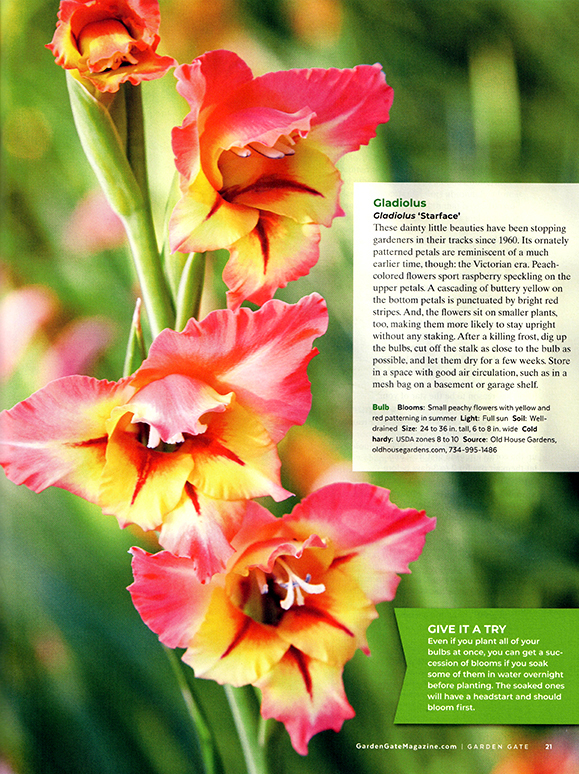
While leafing through the August issue of Garden Gate magazine I was happily surprised to see this full-page photo of my favorite small-flowered glad, ‘Starface’. It’s one of seven summer-blooming classics featured in “Top Picks: Heirloom Summer Bulbs.”
“You know a plant is well-loved, timeless, and a good addition to any garden,” writes author Chloe Deike, “when it has been zealously passed on and preserved from generation to generation.” And summer-blooming bulbs are great, she adds, for their “vivid presence, splash of color, and sudden appearance when other plants are starting to whimper and fade.”
Deike describes ‘Starface’ as a “dainty little beauty” whose “ornately patterned petals” have been “stopping gardeners in their tracks since 1960.” Other summer bulbs she praises include:
‘Star of the East’ crocosmia – With its “stouter stems” and “much larger flowers,” this 107-year-old crocosmia “won all kinds of garden awards when it was introduced” and “still has reason to be the star of your garden today.”
‘African Queen’ lily – “Voluminous and voluptuous, this apricot-colored beauty from 1958 sings out like a Broadway diva.”
red spider lily – With its “long, ‘spider-leg’ stamens that curve upward from a cluster of star-shaped flowers,” this dramatic perennial “definitely makes a tropical statement in the late summer garden.”
milk and wine crinum – A “classic pass-along plant in Southern gardens,” milk-and-wine lily “grows happily and blooms off and on throughout the summer without much fuss,” even in pots where it’s not hardy.
‘Café au Lait’ dahlia – Like ‘Starface’, this 1967 beauty also rates a full-page photo in Deike’s article. Its “enormous plush blooms” and “creamy, champagne tone” make it “one of the trendiest flowers for brides” and a “wonderfully celebratory cut flower.”
More than just pretty faces, “heirloom plants are rooted in story,” Deike writes, “embellished by a history that connects you to the past and spurs you toward the future.” And since so many are disappearing from mainstream sources, “growing heirlooms can make you an important link in the chain that keeps these plants thriving.”
You can order two of these treasures – ‘African Queen’ and red spider lily – right now for delivery this fall. The others are spring-planted, though, so they won’t be for sale again until later this summer. For an email alert then, simply click the link in each bulb’s description. (June 2019)
Dahlias and Cannas for Prince Albert
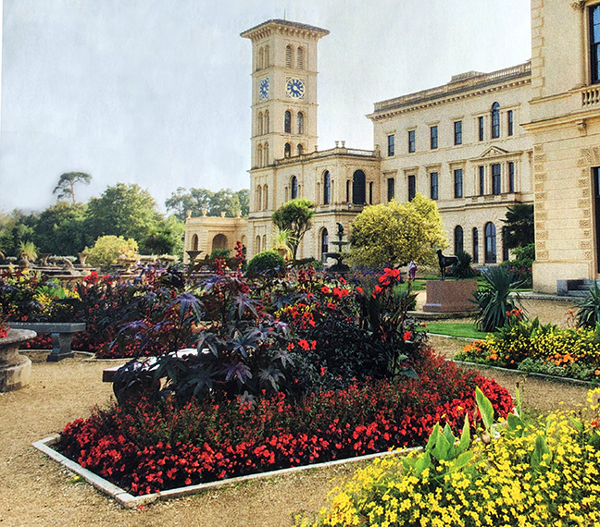
Dahlias and cannas were both wildly popular in the Victorian era, so it’s no surprise that two of our favorites grow today at Osborne House, the lavish country home of Queen Victoria and her garden-loving husband Prince Albert.
In 1845, according to an August 2017 article in The English Garden, “Queen Victoria and Prince Albert, then both in their twenties, bought an estate on the Isle of Wight as a seaside retreat for their growing family.” After building a grand new house, Albert redesigned the grounds, and today, thanks to extensive restoration by English Heritage, they once again reflect his vision.
“Rather endearingly, Albert is reputed to have directed work on the Osborne landscape by semaphore from the Pavilion flag tower. Victoria seems to have been less enthusiastic, complaining in her diary of the time he spent planting and pruning. In 1848, at the height of the planting operations, she spent a record 123 days on the estate so as to see as much of him as possible.”
Today “the intricate design of the parterres which was lost when the terraces were grassed over has been recreated.” ‘Bishop of Llandaff’ dahlia stars there in a dramatically dark composition with bronze-leaved castor beans, red salvia, and red-and-bronze-leaved begonias.
The lovely ‘Ehemanii’ canna with its dangling bells of deep rose-pink is also featured at Osborne House where a long row of it flowers exuberantly in the former kitchen garden. (See it at our blog.)
Even if you don’t have 200-acre estate, you can garden with a touch of royal style by planting ‘Bishop of Llandaff’ this spring (and save 20%!) or by signing up for an email alert when ‘Ehemanii’ – which sold out last month in just three days – is available again.
Cheerio! (April, 2019)
Van Gogh’s Tuberoses
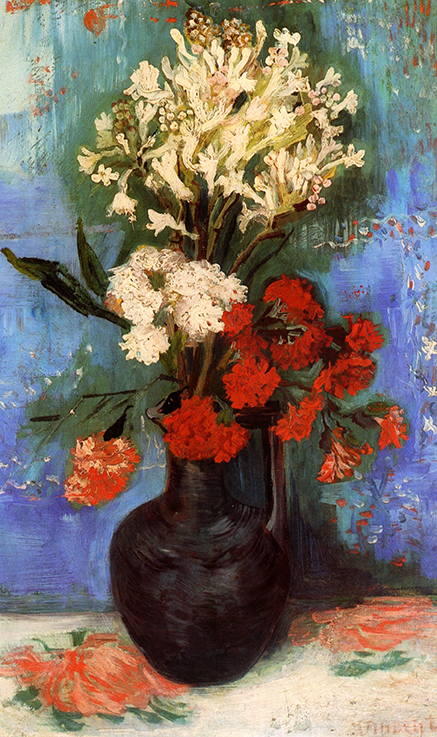
Van Gogh was a flower-lover, to judge by the many paintings he made of them. His sunflowers, of course, have become iconic, and his magnificent Irises sold in 1987 for a record-breaking $54 million. But there are scores of his lesser-known flower paintings in museums around the world.
Leafing through a Van Gogh book the other day, I came upon this painting titled Vase of Carnations and Other Flowers. Taking a closer look, I noticed that the starry white flowers at the top are tuberoses! In fact, to my eye they’re such a dramatic and important part of the painting that it might better be called Vase of Tuberoses and Other Flowers.
Van Gogh painted it in 1886, shortly after moving to Paris and beginning to favor the brighter colors and bolder brushwork of the Impressionists. At that time tuberoses were so popular that a Boston writer wrote that “everyone who has a garden knows the tuberose” – and their fragrance today is just as wonderful as it’s always been.
You can view this painting in person at the Kreeger Museum in Washington, DC, and you can enjoy the same flowers that inspired Van Gogh by ordering your own tuberoses now for planting this spring. (December 2018)
Transylvania Celebrates the Tuberose

Tourists poured into the Romanian village of Hoghilag this past weekend for the annual Tuberose Festival.
“Just as France has the lavender fields, Romania has the fields of tuberoses,” explains festival director Claudia-Romana Rista. “With a tradition of over 100 years in growing tuberoses, Hoghilag is called today the Land of Tuberoses.”
Located in the historic Transylvania Highlands, “the largest eco-touristic destination in Romania,” Hoghilag’s tuberose fields produce upwards of 150,000 bloom-stalks per acre. Some are sold as cut-flowers, but most are harvested for use in perfumes where, according to fragrantica.com, “no note is more surprisingly carnal, creamier, or contradicting.”
Festival activities include perfume workshops, flower cooking and jewelry-making classes, films, concerts, traditional foods, and a bicycle tour of the tuberose fields. Learn more at Romania-Insider.com and the Hoghilag Facebook page – and to enjoy your own Backyard Tuberose Festival, order a few bulbs now for spring planting! (Aug. 2017)
Brighten Your Summer with “House-Pot Lilies”
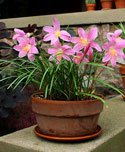
We recently learned an old name for pink rain lilies.
Our good friend and Tulsa garden writer Russell Studebaker wrote that he’d seen a pot of them in full bloom at a garden club meeting. “The owner told me she ‘never knew their actual name.’ She had gotten them long ago from her family in Missouri. They called them ‘house pot lilies’ because they were always grown in an old pot that no longer served for cooking – probably enamelware, agateware, or graniteware that had developed a hole. Can’t you just imagine how nice those little pink flowers would look blooming in a blue enamelware pot?”
Rain lilies bloom when rain drenches their roots, so it makes sense that they’d thrive metal pots – although ours bloom just fine in regular terra cotta, as you can see here.
Summer is coming, so why not order a few to try yourself in any kind of pot you want? (April 2017)
Misspellings Can Be Fun: Turboroses

If you’re not sure how to spell tuberose, you’re in good company. Misspellings – or alternative spellings? – have been common for hundreds of years.
In 1664, for example, the great John Evelyn in his Kalendarium Hortense spelled it tuber-rose – which makes a certain sense because it grows from a tuber (actually a rhizome, but whatever) and smells as good as a rose.
Many of the misspellings entered into our website’s search-box are mundane ones such as tube rose, tuberosas, tuberrosa, tuperose, toberose, and tuberus.
Others are more entertaining, though, such as tubarose (with really big flowers?), tiberose (a Roman form?), tubrose (best in containers?), tuberoe (less expensive than tubecaviar?), and my favorite, turborose, which perfectly expresses the flower’s high-powered fragrance.
However you spell it, you can still order a few right now and enjoy its fabulous fragrance this summer – but don’t delay, because they’re going faste, phast, fast! (April 2017)
Colette’s Gardenia: “I Bow Down Before the Tuberose”
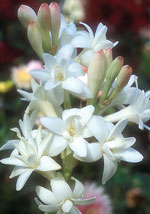
Although little known today, Colette was the highly acclaimed French author of some 50 novels, many of them scandalously sensual. In “The Gardenia’s Monologue,” which is one of the essays in her 1948 book For an Herbarium, that famously fragrant flower scorns all of her scented rivals, except one:
“I put up with all of these humbler bearers of nocturnal balms, certain that I have no rivals, save one, I confess . . . before whom at times I do worse than confess: I abdicate. On certain meridional nights heavy with the promise of rain, certain afternoons rumbling with casual thunder, then my ineffable rival need only show herself, and for all the gardenia in me, I weaken, I bow down before the tuberose.”
To savor the sublime fragrance that inspired Colette, order your single or double tuberoses now for April delivery. (And thanks to Toni Russo of Solon, Iowa, for sharing this essay with us!) (Jan. 2017)
“Garden Gate’s Top Picks” Include 3 Heirlooms Blooming Now
In “Garden Gate’s Top Picks: These 9 Plants Add a Touch of Tropical Flair,” Shayna Courtney recommends three of our favorite spring-planted bulbs. The August 2015 article starts with a photo of ‘Atom’, our all-time best-selling glad. “Hummingbirds love the miniature blooms of 3-foot-tall ‘Atom’,” Shayna writes. There’s also a great photo of ‘Mexican Single’ tuberose, and she writes that its fragrance “intensifies in the evening, so choose a spot where you can enjoy its fragrance and the moths that visit its radiant nighttime blooms.” Finally, Shayna praises rain lilies (Zephyranthes), and although here in zone 6 we always grow them in pots, she notes that where they’re hardy they make “a good spreading groundcover.” (Aug. 2015)
Grow Your Own Ryan Gainey Bouquet: Tiger Lilies and Crocosmia
Ryan Gainey, the celebrated Atlanta-area garden designer, has a special affection for heirloom flowers, including many of our bulbs. A while ago he sent us photos of a bouquet he’d made in a quirky old jug with tiger lilies — the iconic pass-along plant — combined with yellow ‘George Davison’ crocosmia, antique montbretia (which is also a crocosmia), and the berried stalks of Arum italicum. See Ryan’s bouquet here, and if you like it we’d be glad to send you everything you need to recreate it at home — except, unfortunately, for the Arum and the jug. (Please note: Since tiger lilies are fall-shipped but the crocosmia are spring-shipped, you’ll have to place two separate orders for them.) (Aug. 2014)
Bulbs in Pots: Our New Page of Tips for Tuberoses, Rain Lilies, and More
Every summer we decorate our front porch with pots of fragrant tuberoses and little pink rain lilies, while out in the back yard we tuck pots of glads in among the perennials to provide exclamation points of color.
You can, too! Most spring-planted bulbs are easy to grow in containers, and you’ll find everything you need to know at our newly expanded “Bulbs in Pots” page. Read it now and get ready for a summer filled with beauty, fragrance, and fun. (March 2014)
Crinum’s “Sticky Candy Aroma” Brings Back Memories of Grasshopper Sticks
“The sticky candy aroma of Crinum x powellii ‘Album’ makes me wistful for a youthful memory I never quite conjure up, so deep is it buried,” North Carolina garden writer Pam Baggett wrote in Horticulture a while back. “Vague images of my childhood Methodist church haunt my mind when I smell crinums, making me wonder if perhaps they grew there. But then so does the dark, cramped interior of Sessom’s Grocery, and a lime green hard candy they sold, grasshopper sticks. Did someone, a gardener herself, once manage to distill the essence of crinum, making it into candy sure to tantalize the taste buds of children? Was she hoping to make gardeners of us later, we who might strive to recapture an instant of childhood by nestling our noses deep in to the crinum’s candied heart? And most important, did she leave behind her recipe book?” (Jan. 2014)
‘Ehemanii’ Wowed Them in 1892, Too
We sell just one canna, but it’s a spectacular one: ‘Ehemanii’. In 1892, our colleagues at Philadelphia’s Johnson and Stokes mail-order nursery were pretty excited about it, too. “A beauty in every sense,” they wrote. “The massive, deep green, Musa-like leaves alone would make it a valuable acquisition, but when we see its magnificent crimson flowers” — which we’d call deep rose, but look at our photo and decide for yourself — “suspended from its whip-like flower stalks, it is difficult to find words to express our admiration.” To make yourself tongue-tied with admiration this summer, order yours now! (April 2013)
Growing Crinums in the North
Crinums are fabulous in Southern and warm West gardens, but what if you live in a colder zone? Although they’re not the easiest bulbs to grow in pots — partly because they keep getting bigger and bigger every year — plenty of our customers are doing it and enjoying the results. As for what to do with them in the winter, here are some tips from two New England enthusiasts:
From zone-7a Falmouth, Massachusetts, our good customer Alison Arrouet writes: “I have two crinums that I winter over in my exercise room with my agapanthus and fuchsias. I water them once a month and then in mid-February start watering and fertilizing regularly. They never lose their leaves, they just hang in there, and of course they love being pot-bound. They bloom here in late summer and fall, and their fragrance is marvelous.”
Further north in zone-5a Brattleboro, Vermont, our good customer Mary Lou Buchanan writes: “After the first frost, I place them in my cellar which stays about 40 degrees F. I do not do anything with them while they are down there. About mid April I bring them upstairs into warmth and gradually expose them to more light. I trim off dead leaves and, if there is room in the pot, I add a little fresh potting soil with a spoonful of slow release fertilizer. If they have out-grown the pot, I separate and replant them. I keep them in the house until warm enough to place outside, acclimating them gradually. I put them in full sun in my yard all summer. My three bulbs have grown to about twelve now. I tried wintering them over as house plants but found they got pale and floppy. The cellar method works for me.” (April 2013)
“An Incomparable Flower”: Growing Tuberoses in 1683
Best known today for his diary chronicling life in London from 1641 to 1706, John Evelyn was a wide-ranging author who published books on everything from politics and theology to vegetarianism and gardening. In his 1683 Kalendarium Hortense or the Gardener’s Almanac, Directing What He is to Do Monthly Throughout the Year he offered this advice on growing tuberoses. Although it’s more complicated than our simple how-to, the basics are the same: pot them, put them in a hot, sunny spot, water well, and enjoy.
“April: Now take out your Indian Tuberoses, parting the off-sets (but with care, lest you break their fangs), then pot them in natural (not forced) earth with a layer of rich mould [compost] beneath . . . to nourish the fibres [roots] but not so as to touch the bulbs. Then plunge your pots in a hot-bed temperately warm, and give them no water till they spring, and then set them under a south wall. In dry weather water them freely, and expect an incomparable flower in August.”
Evelyn’s 300-year-old advice for winter storage isn’t much different from ours to store them pot and all in a dry, dark space: “September: Your Tuberoses will not endure the wet of this season, therefore set the pots into your conserve, and keep them very dry. It is best to take them out of the pots, about the beginning of this month, and either to preserve them in dry sand, or to wrap them up in papers, and so put them in a box near the chimney.” (March 2013)
Crocosmia: Bright Stars in the Garden and a Great Natural Dye, Too
We love the way montbretia and other crocosmia light up the summer garden with their constellations of tiny star-like flowers. But beauty, grace, and a long bloom season aren’t their only virtues. In her blog, British textile artist Carolyn Saxby shows how you can use montbretia flowers to make a beautiful dye. Scroll down the page when you get there, and note that when she says montbretia “grows prolifically here in the South West,” she means the southwest of England. (March 2013)
Don’t Like Cannas? Give ‘Ehemanii’ a Look!
So unusual and beautiful that even canna-haters love it, ‘Ehemanii’ is one of the most exciting plants we’ve ever offered. But don’t take our word for it. Our friend Greg Grant (Heirloom Gardening in the South) has spent a lifetime growing and promoting exceptional plants, and he’s a big fan, too:
“Cannas happen to be coarse and gaudy (i.e. striking and bold) so the weak of heart are often afraid to stand up and be seen with them. But there’s no reason to be afraid of ‘smash mouth’ plants. To me, cannas are like living garden sculpture. My FAVORITE of all is Canna x iridiflora ‘Ehemanii’, an old, French, iris-flowered hybrid. It’s like a cross between a banana and a fuchsia. And for gardeners who won’t grow cannas because of leaf rollers, remember that they’re the larva of the Brazilian skipper butterfly (butterfly haters!) and easy to control with organic Bt, if you want.” (Jan. 2013)
Staff Pick of the Month: Cheap, Stunning Crocosmia
Rita, our VP for Customers (and unofficial mother hen of the office), writes:
“I love crocosmia. It’s cheap, doesn’t take up much space, grows well in crummy soil, and its flowers are stunning. Crocosmia colors are very saturated so they seem to glow, even from a distance. The dog-walkers in my neighborhood have commented on mine even though none grow anywhere near the sidewalk.
The blooms are simple and widely-spaced on the stem, something like forsythia’s. That makes a single sprig striking all by itself in a vase, or it can add a lot of variation and excitement to a bouquet of other flowers.
The crocosmias we offer tend to bloom late, when most summer color is over, and that’s another thing I like about them. They also have the added advantage of being small enough to tuck in almost anywhere. I have a clump of just five bulbs that I planted in heavy clay soil among the roots of a shrub, and it makes a big splash. Not bad for $4.75! (Feb. 2012)
Tuberoses: Enjoying Indonesia’s “Sweet Nights” in South Dakota
On a “miserably cold” day recently, our friend Cathie Draine of Black Hawk, South Dakota, emailed us happily: “I was doing really well on self-discipline until I leafed through your catalog and found the tuberoses. When we lived in Indonesia, we could (and did!) buy these by the armful from the flower vendors. The perfume was truly heaven. There they were called sedap malam which translates as “sweet night” or “fragrant evening.” As I swooned over the catalog, I was wrapped in warm memories of many happy years in Indonesia . . . and the thought that I could grow these lovelies in pots right here on our deck.” (Feb. 2012)
‘Ehemanii’ in Winter: Don’t Store It Dry, Keep It Growing Inside
Unlike most cannas, our spectacular ‘Ehemanii’ often fails when stored as dormant rhizomes. But no problem! When frost threatens, dig the entire clump and split it into smaller divisions to pot up and bring inside. Make sure each division has at least one stalk that’s just starting to grow. Shorten the other stalks somewhat to help make the plant more manageable and compensate for the loss of feeder roots. Put each plant in your warmest, sunniest window, and keep the soil moist but never soggy. Bottom heat is VERY helpful, especially when it’s first recovering from being transplanted. A seed-starting heat-mat is perfect for this, but you can also put a 100-light string of Christmas mini-lights in a shallow plastic storage box with the pot on top, or improvise. Our ‘Ehemanii’, for example, makes it through the winter on a broad shelf a few inches above a window radiator. Your goal is simply to keep it alive until you can plant it outside again, so don’t expect a magnificent house-plant. If you’re lucky, though, you may be surprised by some beautiful blooms when summer is still far, far away. (Oct. 2011)
Heirloom Bulbs for the White House Garden
Gardeners of all political stripes can agree on at least one important issue: the White House vegetable garden is a good thing. This spring, to thank First Lady Obama for inspiring so many gardeners and would-be gardeners, we sent her three of our favorite heirlooms to plant in her garden. “Although they’re not vegetables,” we wrote, “all three have traditionally been grown in vegetable gardens across America. They attract pollinators, they make great cut-flowers, and, as [Scott’s] grandmother used to say, they just look pretty out there.”
All three heirlooms have strong Midwestern roots, too. “The fragrant ‘Mexican Single’ tuberoses,” we continued, “come from a small family farm in Illinois where they’ve been grown since the 1920s. (You may have seen them for sale at farmers markets in Chicago.) The bright red, small-flowered ‘Atom’ gladiolus is grown for us on a family farm in Michigan. And the ‘Wisconsin Red’ dahlia is a family heirloom that’s been handed down from generation to generation since the early 1900s.”
We’ll probably never know whether our bulbs make it into the First Garden, but that’s okay. As with any gift, it’s the thought that counts, and one of gardening’s greatest pleasures is imagining what could be. (May 2011)
Tuberoses in Williamsburg, from 1736 to 2011
Wesley Greene, Williamsburg’s lead-interpreter for heirloom plants, wrote us a while ago in praise of one of our most popular heirlooms, tuberoses:
“What is amazing to me is how well known the tuberose is in the 18th century, and how little known in the 21st. It is mentioned frequently in the correspondence between John Custis of Williamsburg and Peter Collinson of London. A 1736 letter from Collinson reads: ‘It gives Mee great pleasure that the Tuberoses proved a new Acquisition to your Garden. I [am surprised] you had them not, when they are on both sides of you in south Carolina & Pensilvania. My friend [colonial botanist John Bartram] from Last place writt Mee he had last yeare 149 flowers on one single Flower Stalk which is very Extriordinary, but I have heard the Like from Carolina where they Stand in the Ground and Increase amazeingly.’”
Wesley went on to say, “I did not realize at first how much more fragrant they were in the evening, because I am home by then. One of our visitors from Mexico told me, so one night when I had to stay late I walked back to the garden about 7:30 and the fragrance was nearly over-powering!” To enjoy that lush fragrance yourself, order a few to plant this spring. (April 2011)
Canna ‘Ehemanii’ is Blooming in the Snow
Well, not exactly IN the snow, but it’s bleak here in Michigan (weeks of short, gray days and highs in the 20s) and yet the ‘Ehemanii’ we potted up last fall to carry over the winter inside — and which, like all cannas, needs lots of sun and heat to thrive — surprised us by starting to bloom a few days ago. Plants are amazing, aren’t they? (Jan. 2011)
Better Blooming Rain Lilies in Pots
“How can we get our rain lilies in pots to bloom en masse instead of a few at a time?” we asked our good customer and rain lily breeder John Hubstenberger of Jonesboro, Arkansas.
“Almost all rain lilies bloom well in pots,” John told us, “and most varieties will bloom repeatedly if the growing season is long enough. By stressing the bulbs, it is possible to synchronize their bloom cycles — and 50 Zephyranthes in full bloom in a 10-inch pot are really a sight to see. However, in my experience maximum bloom occurs when the plants get lots of TLC, regular watering, and fertilizing when in active growth. I like to use Carl Pool’s BR-61 with trace minerals for fertilizer. I think warm temperatures, lots of sun, and regular watering give more flowers in the long run than drought and flood. (Some varieties seem to benefit from a bit of chilling when dry and dormant, too.) Of course Mother Nature gives them drought and flood, but in a pot maximum bloom comes from consistent care.” (March 2011)
Childhood Joy Regained: Crinum in Colorado
Sometimes you can go home again, at least in the garden. With “Hooray!!!” as her subject line, our good customer Betty Yahn of Aurora, Colorado, emailed us in late July:
“Despite your warnings that it wouldn’t be easy to grow the milk-and-wine lily here [since it’s not hardy in Aurora], I took a chance and ordered a bulb. This was a duplicate of a crinum that grew behind my grandmother’s bedroom in my Arkansas home. As a child I had loved the fragrance of those blossoms, and the beauty of the trumpet-covered stalks that bloomed all summer. When our family there passed away I desperately tried to coax a bulb out of the ground, but the dirt was hard as a rock, and there was no way I could dig even one out.
“Years passed and I tried to find out the name of that bulb. I was so excited when its photo showed up in your online catalog. There were dire warnings of no blooms the first year and it would be challenging to grow in a pot, but there have been two stalks covered with trumpets so far, and the fragrance is just as I remembered from 50 years ago. Thank you! I hope there are many who will plant this bulb and enjoy it as much as I do.” (Sept. 2010)
Where Have All Our Cannas Gone?
Although we love them, and we’ve worked hard to preserve and share the best of them with you, we’ve decided to stop selling cannas — at least temporarily.
A new virus has been attacking cannas worldwide in recent years, and despite herculean efforts by our expert American growers, we’ve become troubled by what we’ve started seeing in our trial gardens and hearing from our customers.
You come to us for great bulbs, and that’s exactly what we want to send you. When we can once again be sure that every canna we ship is superbly healthy, we’ll return them to our catalog — and celebrate! But right now that’s beyond our reach.
There is one canna we’re still offering — ‘Ehemanii’. It’s the only one grown for us in a tiny nursery in Texas, and it’s still as healthy as can be.
And we’re not abandoning our other rare cannas altogether. With an eye to the future — and the possibilities that tissue-culture offers — our indomitable Missouri grower will continue growing the best of them as scientists, farmers, and enthusiasts around the globe search for solutions.
Coming to this decision has been a painful process. Our mission, after all, is to “Save the Bulbs,” and we feel for our growers. But we’re convinced it’s the right decision. If any of the cannas we’ve sent you developed streaked, mottled, or twisted leaves, we recommend that you destroy them and please let us know so we can give you a credit or refund. Then together we’ll look forward to brighter days ahead for cannas and those who grow and love them. (July 2010)
Arctic Crinum: One Customer’s Success Story
We love stories like this. Crinums are usually found in the South — or indoors — and most experts recommend them only for zones 7 and warmer. But don’t we all dream of growing plants that really shouldn’t survive in our gardens? And experimenting is one of the great pleasures of gardening. So we weren’t entirely surprised by this email from our good customer Lynn Falls of zone-5/6 Grand Rapids, Michigan:
“Received your January newsletter and read about the ‘milk and wine’ crinum. I know the zone says 7b, but I just wanted to let you know I have one that has lived quite happily in Grand Rapids for three years. I cut it down in fall but it doesn’t really die down. The first year it didn’t bloom. The second year I had one flower stalk, and last year I had two stalks of beautiful blooms.
“It looks exactly like the picture of the one you have for sale, pink and white striped. My sister in northwest Arkansas sent it to me. She received it from her mother-in-law who is in her 90s. This is from a VERY old plant.
“I have it on the east side of my house near the foundation. These guys are tough, just plant in a protected area. I don’t do anything special to protect it for winter. But I am the wood chip queen, so it has about three inches of wood chips on it.” (June 2010)
New This Month: Milk-and-Wine Crinum
Crinums are big, fragrant, lily-like perennials that, to quote Steve Bender of Southern Living, “take sun or light shade, like wet or dry soil, bloom repeatedly from spring to fall, and live longer than Adam.” The ones with striped flowers are called milk-and-wine lilies, and when our Louisiana grower (an heirloom himself) offered us an especially lovely variety from his wife’s family farm, we jumped at the chance. If you like tough, exuberant, old-fashioned flowers and you’ve got a sunny spot in zones 7b-9bS, take a look at it here. But be prepared to jump. It’s gorgeous, and our small supply won’t last long. (Jan. 2010)
Saving Tuberoses and Learning from an 11-Year-Old
“There’s nothing I love more than the way tuberoses smell on an August night,” writes NPR commentator Julie Zickefoose. And so, with an early snowfall swirling about her, she set out to dig her two rows of tuberose bulbs and store them safely in the basement for the winter. Of course things don’t always go as planned, in the garden or life, and what happens next will ring familiar to many gardeners — and parents. Read her story at npr.org/templates/story/story.php?storyId=17654817&ps=rs. (Dec. 2009)
How’s Your ‘Ehemanii’ Canna Doing?
Though it’s rare and fabulous, ‘Ehemanii’ is also a bit of a diva. It grows happily, but its congested rhizomes are hard to divide and they quickly fail in storage. We thought we’d figured out how to handle it successfully this spring, but apparently even our best efforts weren’t always enough.
If your ‘Ehemanii’ failed, please email help@oldhousegardens.com so we can make amends. And if it’s thriving, please tell us what you did with it so we can share your tips. Nature can be humbling, but we’re not giving up! We’re just redoubling our efforts to figure out how to share this amazing canna with gardeners across the country. (May 2009)
View ‘Ehemanii’ in Greg Grant’s Texas Garden, and Order Yours ASAP!
Expert and hilarious, Greg Grant is one of our favorite horticulturists. Recently he emailed us photos of our Canna ‘Ehemanii’ growing at his place in Texas. One shows a nice big clump in his front garden (artistically balanced by an especially fine bottle tree), and the other is a close-up of its rosy, bell-like flowers.
If you decide you need one yourself, you’ll need to move fast. We still have 10-15 available, but since they don’t hold up well in storage we’re shipping them through Monday only. They may not be cheap, but they are extraordinary. (Apr. 2009)
Tuberoses at Versailles and Around the Globe
Our good friend Wesley Greene is a garden historian and the lead interpreter at Williamsburg’s Colonial Garden. He writes:
“The single tuberoses that I got from you have been magnificent. One of the joys of working at Colonial Williamsburg is that I get to meet gardeners from all over the world. I’ve met people from Mexico who tell me, ‘Oh yes, tuberoses grow all around our village,’ and the other day I met a couple girls from Iran who tell me it is a very popular plant where they live, commonly used at weddings and funerals.
“Then I ran across this bit of information from 17th century France: Saint Simon, a critic of much that went on in the court of Louis XIV, observed that when the tuberoses were in bloom at the Grand Trianon at Versailles, the fragrance was so overpowering the entire court was obliged to retreat indoors. That must have been quite some show!” (Dec. 2008)
What Do You Plant at an Icon of Mid-Century Modernism?
In a recent article in Preservation magazine celebrating Richard Neutra’s Kaufmann House, a sleek, glass-walled icon of Modernism set in the desert near Palm Springs, California, my eyes were drawn to the minimalist planting outside one of the famous floor-to-ceiling glass panels. Looking more closely at the tufts of low, grassy foliage arrayed in geometric precision, I could see a few small, white, crocus-like flowers. You guessed it, white rain lilies. (Aug. 2008)
“Little Pots on the Front Porch” — Rain Lilies in the Early 1900s
The revered Elizabeth Lawrence in her classic A Southern Garden of 1942 writes with enthusiasm about pink rain lily, Zephyranthes grandiflora:
“It is one of the hardiest species and is said to winter safely in Philadelphia. As a child I thought of the little rose-colored lilies as the sign and seal of summer. My grandmother in Georgia grew them in her garden, and my grandmother in West Virginia grew them in little pots on the front porch.
“Those in my garden [in Raleigh] came from Georgia. They have been with me so long and have increased so much that their bloom makes a sea of pink. The season is in June, but there is scattered bloom in the late summer and even to the end of September. The flowers are large, to over three inches long, on ten-inch stems. They open out flat at midday and close in the afternoon; this is a characteristic of the genus. The shimmering leaves are grass green.” (March 2008)
Fragrance Fit for a President: Thomas Jefferson and Tuberoses
If you still haven’t tried our fabulous, spring-planted tuberose bulbs, maybe Thomas Jefferson can sway you. Allen Lacy, in his inspiring 1998 book The Inviting Garden, writes:
“Jefferson evidently loved Mexican tuberoses, recording in his garden notebook on April 18, 1806, that he had planted twenty-four double ones from M’Mahon [a famous Philadelphia nurseryman]. They started flowering on August 12, and the following January Jefferson placed a larger order with M’Mahon, who wrote back on February 25 that the shipment would be delayed: ‘When the weather becomes more mild I will send you some double Tuberose roots, but as they are extremely impatient of frost, it would be hazardous to send them at present.’” (Nov. 2007)
They’re Also Great in Pots!
Most of our spring-planted bulbs are as easy and fun to grow in pots as they are in the garden.
We always advise growing tuberoses in pots in the North to give them maximum heat and sun. They’re often especially happy on decks and paving where pots can get too hot for other plants. When they bloom, set pots wherever you can best enjoy their fragrance – even nestled among the plants out in your garden wherever you need a bit of added interest. In winter, simply store pots dry inside. Then when spring returns, bring them back outside to bloom for a second year. (After that they‛ll be so crowded you‛ll need to repot them.)
We grow all of our elephant ears in pots, too, so we can soak them daily without wasting water and drenching their neighbors. ‘Illustris’ and ‘Fontanesii’ thrive when their saucers are constantly full of water, or grow them in glazed pots without drainage holes.
Rain lilies can be great in pots, too, even in the North. See oldhousegardens.com/PinkRainLily for one Wisconsin gardener’s 100-year-long success story with the pink ones.
Tempted? Got pots? To get started, order a few bulbs now! (2005-06 catalog)
Our Tuberoses Bloom at Mount Vernon and National Arboretum
Our ravishingly fragrant 2004 Spring-Planted Heirloom Bulb of the Year continues to gain converts. This spring we delivered bulbs of ‘Mexican Single’ tuberose to both Mount Vernon, where it is historically appropriate, having been grown in America since colonial days, and the US National Arboretum in Washington, DC. We’re honored! (April 2005)
Erna Says, “Plant Some Tuberoses This Spring!”
Our good customer Erna Hassebrock of Hot Springs, Arkansas, writes:
“I was very pleased with your ‘Mexican Single’ tuberoses. Wouldn’t it be wonderful if the folks who produce those fabric softener sheets could copy this delightful fragrance? I smelled it every time I went to the back of the yard and again when I returned. Thanks, thanks, thanks! I am old enough not to get very excited about plants but this one really surprised me and fulfilled its description.” (March 2005)
Did You Know Fragrant Tuberoses Make Great Cut Flowers?
Our good customer Judy Sanders of Montgomery, Texas, writes:
“I cut several stems of tuberose and they lasted a full two weeks in the house. Every few days I’d trim a bit off the stems and refresh the water. And, as outside, the fragrance was stronger in the early evenings. We really enjoy this bulb!”
Big bunches of freshly-cut tuberoses are sold today in Mexican street markets, as they probably were in Aztec street markets long ago. Plant your own this spring and you can enjoy a fragrance prized by gardeners for a thousand years. (Jan. 2005)
“It’s Hard to Believe They’ve Been Overlooked So Long!”
Our good customer Marilyn Sydow of Columbus, OH, writes:
“Your ‘Mexican Single’ tuberoses’ fragrance is incredible. They have bloomed for at least a month now, and the fragrance at night has been so intense that I could smell them in the front yard though the pot is in the back. It’s hard to believe that these bulbs have been overlooked for so long. Thanks for bringing them back!” (2004-05 catalog)
Celebrate Our Aztec Tuberoses with Antique Chocolate
The tuberose, our 2004 Spring-Planted Heirloom Bulb of the Year, is one of the Aztecs’ great gifts to the world. Chocolate is another. And now you can taste chocolate the way it was enjoyed back in the days of the Aztecs!
A sign at Zingerman’s, our local, world-class deli, caught my eye: “Antique Chocolate.” I picked up a bar and read the label: “Xocoatl . . . was introduced to Europe by the Spanish in the 16th century, who had learned the process from the marvelous Meso-American people. Since 1880, the Antica Dolceria Bonajuto continues to make this chocolate with the same ingredients and methodology that was passed on from the ancient Aztec civilization.”
I had never tasted chocolate like this before! Enraptured, I sampled another old-style chocolate from Oaxaca, Mexico. Zingerman’s description fits both well: “The texture is coarse, with little sugar crystals exploding in your mouth and a dark, subtle, cinnamon and smoke flavor.”
For your own taste, visit our friends at zingermans.com and enter either Bonajuto or Oaxacan in their search box. Tell them we sent you, and enjoy! (April 2004)
Tender Rain Lilies Thrive for a Century in Zone-4 Wisconsin
Although pink rain lilies, Zephyranthes grandiflora, aren’t hardy beyond zone 8, Julie Monroe and her family have been enjoying them in zone-4 Wisconsin for a century or so. Her bulbs came originally from her Great-Aunt Irene and before that from Irene’s mother. “They thrive on neglect,” Julie says. “The only thing I am careful about is to take the pots inside before the first freeze.” She stores them dry in pots in the basement all winter, brings them back outside in the spring, and they just get better every year. For the whole story and Julie’s tips, or to try a few rain lilies yourself, click here. (Jan. 2004)
Reblooming Tuberoses
Our good customer Donna Boyles of Pownal, Maine, writes:
“I have one of last year’s double ‘Pearl’ tuberoses in bloom in my living room and cannot believe the beautiful fragrance that pervades the house! It bloomed last fall, I left it to rest and repotted all three bulbs with many bulblets attached in February, watered and fertilized heavily and now have at least 30 buds.” (2000-01 catalog)
No Need to Wait for a Tuberose Revival
Regarding tuberoses and fashion, I couldn’t have said it better than F.F. Rockwell did in his 1927 Book of Bulbs:
“It is hard to understand why this really excellent summer-flowering bulb, with its permeating fragrance . . . should have fallen off, as it has, in its popularity. Possibly some day it will meet with a ‘revival,’ as have so many of the other flowers of ‘Grandmother’s garden;’ but those who grow things for their intrinsic value, rather than because they may happen to be ‘in style,’ need not wait for that day.” (1996 catalog)



