



Heres a wealth of information about TULIPS from our email Gazette and past catalogs, starting with the most recently published. For other topics, please see our main Newsletter Archives page.
To subscribe to our FREE email newsletter, click here.
Tulips, Dahlias, and the Silk Weavers of London
Three hundred years ago the “arty cool” East London neighborhood known as Spitalfields was the center of England’s booming silk industry.
According to an 1840 article in the Manchester Guardian, Spitalfields got its start in 1685 when France revoked the rights of Protestants and “at least 50,000 refugees, most of them weavers and other craftsmen, arrived from France and threw themselves upon the charity of the English nation.” Known as the Huguenots, these refugees were soon “very flourishing” and by 1713 the silk trade they established “had attained such importance that upwards of 300,000 persons were maintained by it.”
By 1840 Spitalfields was “in a greatly fallen-off condition” but it still retained “a remnant of the love of gardening among the weavers.” A six-acre plot had been divided into 170 small gardens, all separated by picket fences, and “in almost every garden is a neat summerhouse, where the weaver and his family may enjoy themselves on Sundays and holidays, and where they usually dine and take tea.” (Doesn’t that sound lovely?)
Although some weavers grew “cabbages, lettuces, and peas,” most had “a far loftier ambition” – flowers. “Many had tulip beds, in which the proprietors not a little gloried, and over which they had screens which protected them from the sun and from the storm” – to keep the blooms in prize-winning shape for the competitive tulip shows – “and it was expected that the show of dahlias for that season would not fail to bring glory to Spitalfields.”
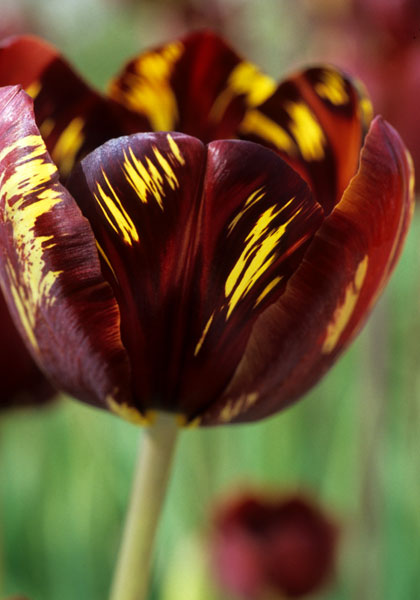
Although all of the dahlias from that era are now extinct, you can still grow some of the very same tulips that were popular in 1840 such as ‘Absalon’ (pictured here), ‘Keizerskroon’, and ‘Zomerschoon’ – and you don’t have to be a silk weaver to enjoy them.
(You might also enjoy the book this article is drawn from, Notes from the Garden: A Collection of the Best Garden Writing from the Guardian (2010), edited by Ruth Petrie.) (July 2019)
“Old Flames” – Broken Tulips Showcased in Gardens Illustrated
Interest in the exquisite flowers known as broken tulips continues to grow.
The British magazine Gardens Illustrated, for example, recently published a gorgeously illustrated article about them and their devotees in the 184-year-old Wakefield and North of England Tulip Society.
Broken tulips – or English florists’ tulips, as the British varieties are known – are richly feathered or flamed in red, purple, or mahogany. These are the tulips that sold for mind-boggling sums during Tulipomania in the 1620s.
“There was a time,” writes Anna Pavord (who you may know from her monumental Bulb, The Tulip, and other books), “when almost every town of importance in the north of England had its own tulip society.” Today only the Wakefield group survives, nurturing its rare beauties and exhibiting them in competitive shows as they have every spring since 1835.
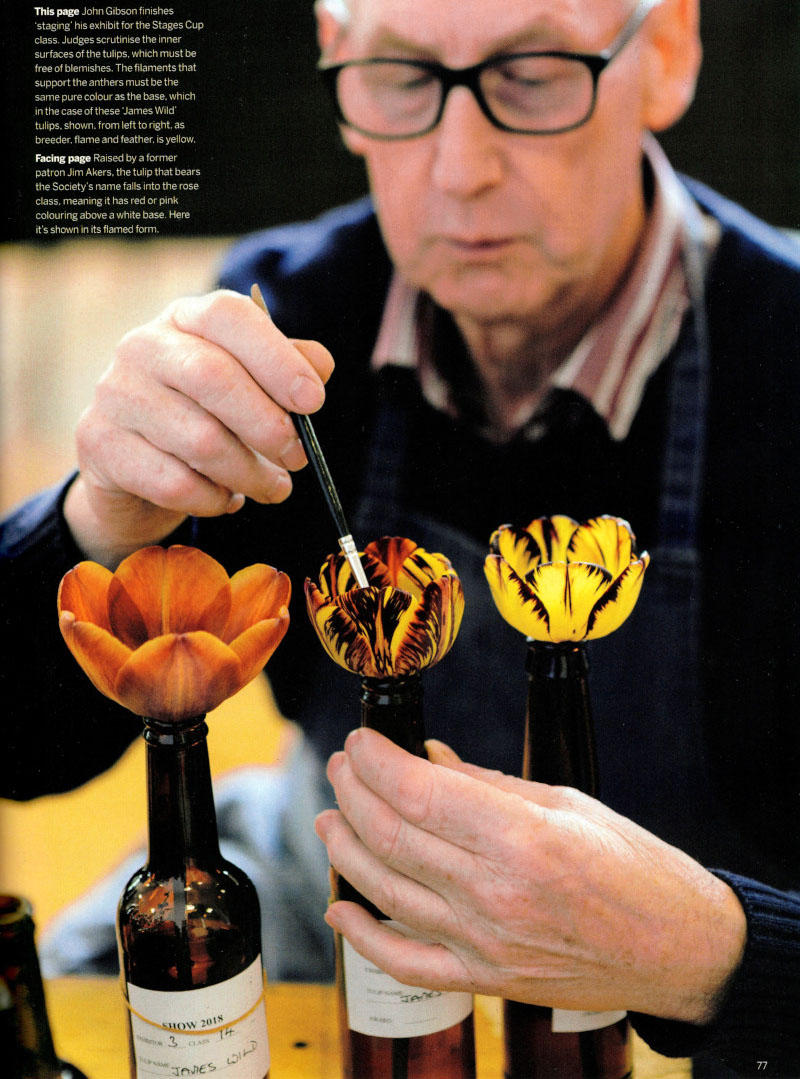
The shows are no longer held in pubs as they once were, but the flowers are still displayed in beer bottles. This is as it should be, Pavord says, because “nothing could better set off these gorgeously complex, finely textured blooms than the utilitarian containers of plain brown glass.”
Although the Society was once an all-male bastion, today it includes many women who “regularly win top prizes,” including Teresa Clements who is enthusiastically helping to lead it into the future. “These are tulips that just demand your attention,” she says. “They have an incredible quality. Each is a living antique. They are irresistible.”
As a long-time member, I couldn’t agree more! Learn more about these incredible tulips and – if you want to see for yourself how exciting they can be – check out this complete list of the ones we’re currently offering. (June 2019)
What’s Blooming at Madoo?
Located in the Hamptons at the far end of Long Island, Madoo was the home of artist Robert Dash until his death in 2013. Today, under the care of the Madoo Conservancy, it’s “a magical oasis” with historic buildings – including a 1740s barn that Dash repurposed as his studio – set amid “an enchanting 2-acre landscape” that reflects Dash’s creative spirit and painterly eye.
Dash, we’re proud to say, was a customer of ours, and many of our heirloom bulbs still bloom in his gardens today, including three classic tulips that Madoo’s executive director Alejandro Saralegui mentioned recently in the Conservancy newsletter:
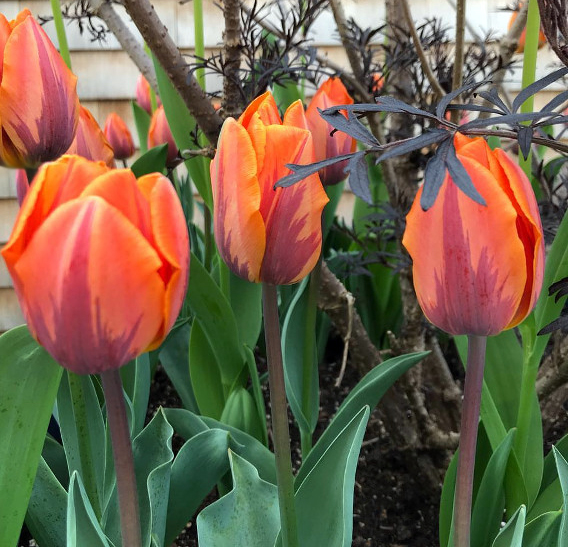
“Soon enough, the tulips that were planted throughout the garden will pop up. . . . “‘Princess Irene’ [pictured here at Madoo] – with its orange bloom, smoky purple flames, and saffron-like scent – is in the large planters. ‘Kingsblood’ and ‘Bleu Aimable’ are in the quincunx beds.”
For a peek at the gardens at Madoo, see “A Trip to the Madoo Conservancy” or visit madoo.org. (March 2019)
Love in Bloom: What Do Your Valentine’s Day Flowers Say about You?
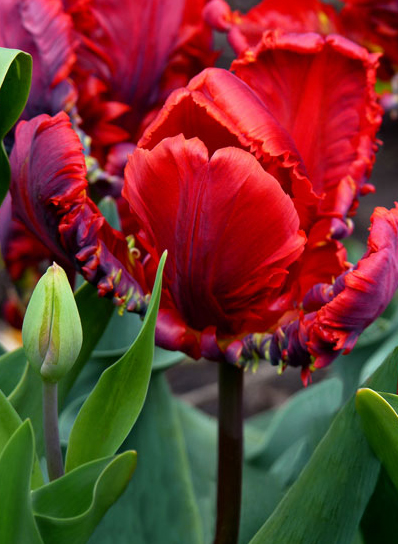
“Does the kind of flower you send say anything about you as a lover? I think it does.”
So says Anna Pavord, superstar garden writer and bulb-lover, in The Curious Gardener. Here’s her modern take on the language of flowers, including her favorite Valentine’s Day flower – tulips!
Roses – “From a lover who feels safest as one of the herd and for whom imagination will never be a strong point.”
Carnations – “Acceptable only if they overpower you with their smell. If they don’t, then your lover too must be under suspicion of being unable to deliver what the outside appearance promises.”
Daffodils – “I’d trust a man who gave me daffodils. . . . Daffodils fit the bill seasonally, and in love as in life, you like to feel you are getting the right things at the right time. . . . There’s hope in daffodils. That’s a dangerously fragile commodity at the best of times, but now is the season to indulge it.”
Lilies – “Fine if you can live up to the theatrical aura they throw around them. Lilies will come from people who care very much about their appearance. . . . Let the stamens be the deciding factor. If your Valentine insists on cutting them off, on the grounds that the pollen will stain the Armani suit, then get free of the relationship as soon as you can. Just think how such a suitor would hog the bathroom. Impossible.”
Tulips – “As far as I’m concerned, these are the best, indeed the only flowers to send or receive on Valentine’s Day. Wild, irrepressible, wayward, unpredictable, strange, subtle, generous, elegant, tulips are everything you would wish for in a lover. Best of all are the crazy parrot tulips such as ‘Rococo’ [pictured here] with red and pink petals feathered and flamed in crinkly lime-green. ‘When a young man presents a tulip to his mistress,’ wrote Sir John Chardin (Travels in Persia, 1686), ‘he gives her to understand by the general red color of the flower that he is on fire with her beauty, and by the black base that his heart is burned to coal.’ That’s the way to do it.”
If you’re a daffodil, lily, or tulip kind of lover, we’re here for you! Order any of our luscious, romantic, fall-planted treasures now for delivery at planting time in October. (Feb. 2019)
Out with the Old? Is Sustainability a Threat to Historic Gardens?
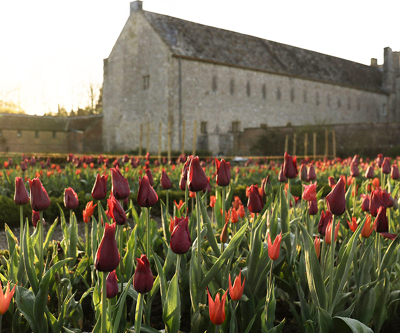
Like many young people, Joshua Sparkes is full of new ideas. But he also has a deep appreciation for the past, which is a good thing since he’s the new head gardener at England’s 900-year-old Forde Abbey.
Originally built as a monastery, the Abbey has been a private home since the mid-1500s. Sparkes arrived there recently after five years in the Royal Air Force followed by hort school and four years at one of the world’s most famous gardens, Sissinghurst.
Interviewed in last month’s Gardens Illustrated, Sparkes was asked what he thought was the “biggest challenge facing gardeners today.”
“I worry about the future of historic gardens,” he said, “as the trend moves towards ‘sustainable’ and ‘ecological’ gardening, which seems only to include one esthetic. Sustainability needs to be considered in a sympathetic way that maintains the unique character of a garden, retaining its history without branding certain practices and designs as wrong. We can manage all gardens in a sustainable way, whatever their style.”
Amen! Like native plants, sustainability is critically important, but it can’t be the only priority in our gardens. Balance is essential in all aspects of our lives, and extremism – even in the service of worthy goals – often leads to more problems than it solves.
Learn more about Forde Abbey (and see a great photo of it with thousands of crocus blooming in the lawn), its magnificent gardens, and Sparkes’ plan for gardening more sustainably with tulips. (January 2019)
World-Class Korean Tulip Festival and Bulb Symposium

Have you ever seen a garden with a million tulips? If you visit the spectacular Taean World Tulip Festival in Seoul, you will.
Named one of the world’s top five tulip festivals, the April-May event features 1.2 million tulips of 300 different varieties. And although different kinds of tulips normally bloom at different times over a span of 6-8 weeks, at Taean – thanks to sophisticated horticultural management techniques – they pretty much bloom all together. As they say in Korea, “Wa!”
While most visitors will just be gazing blissfully at the tulips, some very serious flower-lovers will be gathering May 1-3 at the XIII International Symposium on Flower Bulbs and Herbaceous Perennials. Along with presentations ranging from “Evaluation of Hybrid Lilium for the Landscape” to “Breeding of Blue Flowers by Genetic Engineering,” the symposium includes tours of some of Korea’s top nurseries and public gardens.
Enjoy more photos of the festival here, and then start making your travel plans. Spring is already on its way!
Wildflowery Tulips Charm Famous Southern Gardeners

Two of the most unusual tulips we offer are the peppermint-striped T. clusiana, and stiletto-petalled T. acuminata – both of which have been grown and loved by a couple of unusually creative Southern gardeners.
In his 1993 classic The Well-Placed Weed, the celebrated Atlanta-area garden designer Ryan Gainey featured a masterfully harmonious planting combination: T. acuminata alongside American columbine (Aquilegia canadensis) in an informal cottage garden display where the red-and-yellow colors and wispy shapes of the two flowers echo one another perfectly.
A half-century earlier, the great American author Eudora Welty wrote to a friend from her home in Jackson, Mississippi (as quoted in One Writer’s Garden), “Species tulips are hard to get now, but I love them best. You know, the little wild tulips that still have lightness and grace and perfume and the clear delicate colors that I guess all original flowers had. One is clusiana, that you know, the white and red striped tulip with violet blotch. . . . They are all small and sort of bow in the wind and flare up.” (June 2018)
Huge Tulip Genome is Mapped to Help Breed “Greener” Varieties
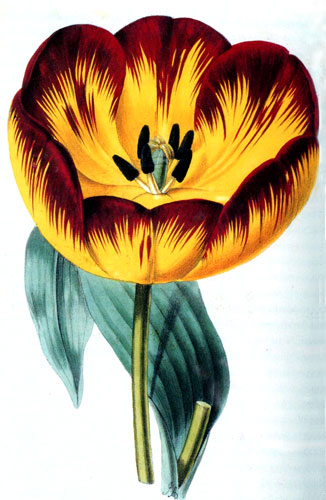
Here’s some cutting-edge news from the 182-year-old Wakefield and North of England Tulip Society’s latest newsletter:
“A consortium of three Dutch companies . . . have sequenced tulip DNA using Oxford Nanopore Technologies and the TULIP algorithm (The Uncorrected Long-read Integration Process).
“It seems the tulip has the biggest genome that has ever been sequenced. Its size is estimated to be nearly 11 times larger than that of humans.
“Far more work lies ahead to analyze the data but the intention is to link gene sequences to particular characteristics that can be manipulated to ‘transform tulip breeding, making it faster, more predictive, and above all “greener” because we will focus on varieties that can be grown sustainably,’ according to Hans van den Heuvel of Dümmen Orange [one of the largest Dutch flower breeders and growers]. This would mean using genetic engineering to raise tulips with in-built resistance to pests and diseases, thus reducing the use of chemicals, for ecological and financial benefits.”
At Dümmen Orange’s website, van den Heuvel goes on to say that “the tulip genome makes the human genome look tiny: the entire human genome fits into one tulip chromosome.” Bas Reichert, CEO of the lab that sequenced the genome, says the project “proves that this technology is now feasible and affordable” and will “further accelerate developments in the ornamental sector.”
So are fragrant, deer-proof tulips that return and bloom for decades just around the corner? Maybe not, but it looks like our centuries’ old quest to develop better and better tulips is about to enter a momentous new stage. (Jan. 2018)
How Bulbs Plant Themselves

Nature is amazing, as any gardener knows.
For example, you’ve probably noticed that seed pods can form on your tulips, lilies, and other bulbs if you don’t deadhead them after flowering – but how do those seeds end up as bulbs six or eight inches underground, without a gardener to plant them there?
The answer involves contractile roots, blue light, and – for tulips – the evolutionary pressure of marmots. Canadian blogger Larry Hodgson explains it all at LaidBackGardener.blog/2017/09/20/how-bulbs-plant-themselves/.
One caution, though: In an accompanying article, Larry recommends planting tulips a foot deep and says Darwin Hybrid and Viridiflora tulips often return best – but that’s not been our experience. For our tips on how to get your tulips to return and bloom year after year, visit oldhousegardens.com/HowToFall#Tulipa. (Nov. 2017)
Martha Loves Tulips – and Us!
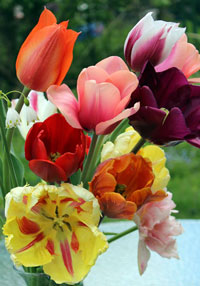
We’re proud to have made the short list of Martha Stewart’s “top bulb sources” in the September 2017 issue of Martha Stewart Living.
“My excitement for tulips,” Martha writes, “is a bit like what occurred in 17th-century Holland during the time of Tulipomania.” She reminds her readers to check tulip bulbs as soon as they arrive to be sure they’re “firm, with no soft spots, rot, or cracking,” but wait to plant them until “nighttime temperatures are consistently in the 40s.”
Although spring may be a long way off, tulips are “more than worth the wait,” she adds. ”It’s always pure joy to see those first shoots appear after a long winter.”
For your own boxful of tulip joy, order now at oldhousegardens.com/Tulips. (Oct. 2017)
Two Great Tulips Overcome Deer, March Planting
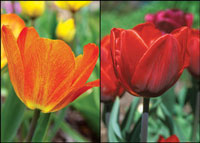
Heirloom bulbs are survivors, but even we were surprised by these two reports:
Here’s what our good customer Marianne Schmidt of zone-5b Stuyvesant, NY, had to say about one of our most fragrant tulips – although please note that we can’t guarantee it will work for you:
“Last spring the deer devoured all of my tulips EXCEPT ‘Generaal de Wet’. I don’t know if it was the fragrance or color that turned them off, but this year I’m pinning all of my tulip hopes and expectations on this beautiful tulip!”
And though we’d never recommend planting tulips THIS late, we were happy to get this news about one of our oldest tulips from our long-time customer Tara Fitzpatrick of zone-6a South Hadley, MA:
“Testimony for your ‘Couleur Cardinal’ – I forgot a bag I had intended to force inside in the basement fridge all winter. I found and planted them in the garden in March during a thaw, and they bloomed perfectly in May!” (Sept. 2017)
Toasting Spring with Black Tulip Ale

We love bulbs, and I love beer, so when I saw a beer called Black Tulip at the grocery store recently, I felt duty-bound to drink a few and give you a full report.
Black Tulip is a tripel ale brewed by Michigan’s New Holland Brewing Company and named for a novel by Alexander Dumas (author of The Three Musketeers) set in 17th-century Holland.
Tripels are “similar to Belgian-style golden strong ales,” I learned at craftbeer.com, except they’re “generally darker and have a more noticeable malt sweetness.” Popular in Belgium and the Netherlands, they’re best enjoyed in a goblet-shaped “tulip glass,” and New Holland claims theirs is actually “dusted with tulip petals.”
Online, fellow beer drinkers have described Black Tulip as “a big, full-flavored, complex, easy to drink beer” that’s “very creamy and smooth,” with “lots of fruit and spice” and “a reasonable dose of hop bitterness.” I’d agree with all of that, and I liked Black Tulip a lot. Tripels have a higher alcohol content than most beers, though, so please drink it with care.
Black Tulip is available in 26 states. To find it near you, enter your zip code at beermenus.com/beers/5675-new-holland-black-tulip – and as our Dutch friends say, Proost! (Mar. 2017)
What is David Culp Growing? Heirloom Tulips at Brandywine Cottage
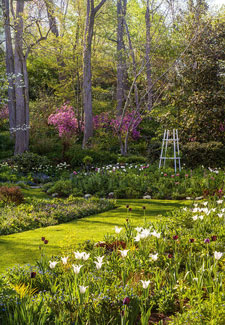
You may know David Culp as the best-selling author of The Layered Garden and an acclaimed landscape designer, but to us he’s a customer and fellow fan of heirloom bulbs, especially graceful old daffodils and unusual tulips.
David lives in a 1790s farmhouse known as Brandywine Cottage just outside of Philadelphia. His plantings there are especially beautiful in the spring – as an article by Janet Loughrey in a recent issue of Garden Design made abundantly clear.
Although “renowned for his masterful successive plantings and naturalistic style,” Laughrey writes, David is also “an avid collector of rare and unusual plants, including antique and specialty tulips. ‘I plant my favorite varieties near the house, in the rock or gravel gardens, or along the road, where they can be displayed more prominently and I can enjoy them up close,’ he says. Unusual patterns, colors, and shapes such as these striped, multicolored, or lily forms get top billing.”
Among the tulips pictured are three of our heirlooms: lily-flowered ‘White Triumphator’, stiletto-petalled Tulipa acuminata, and ‘The Lizard’, “a highly prized Rembrandt broken form with swirling patterns of rose and creamy yellow.”
Thanks, David, for giving our bulbs such a beautiful home! (Nov. 2016)
Tour the Instanbul Tulip Festival – from Home
The spectacular bulb plantings at Holland’s Keukenhof Gardens are internationally famous, but have you ever heard of the Instanbul Tulip Festival – where four times as many bulbs will burst into bloom this month?

“Istanbul sparkles in April,” wrote Frazer Henderson in a recent newsletter of the Wakefield and North of England Tulip Society. “Brilliant splashes of color decorate public parks, streets, road verges, and traffic islands . . . as millions of tulips exuberantly announce the arrival of spring. Started in 2005, the city’s Tulip Festival seeks to revive the flower’s popularity and celebrate its contribution to Turkish culture. This year over 30 million bulbs – all propagated in Turkey – were planted.
One highlight of last year’s Festival was the world’s largest floral carpet blooming in front of Hagia Sophia, the spectacular Ottoman cathedral built in 543. “Over 500,000 bulbs in . . . deep purple, red, bright yellow, and burnt orange were planted in a highly geometric design covering 1262 square meters. . . . A babel of exaltations . . . confirmed the carpet’s awesomeness.”
If you can’t get to the Festival in person this spring, treat yourself to a virtual visit at http://howtoistanbul.com/en/istanbul-tulip-festival/5911#prettyPhoto. Click any of the tiny photos at the bottom of the article for a slideshow of many, many more. Enjoy! (April 2016)
JFK’s Tulips — More History and a Brand New Sampler
We knew that ‘Blue Parrot’ tulips were featured in the redesign of the White House Rose Garden initiated by President Kennedy in 1962 (see “JFK’s Garden”), but thanks to a tip from a friend, we’ve now learned a lot more about that iconic garden — and we’re celebrating with a brand new sampler of five fabulous tulips that bloomed for Kennedy there.
Located just outside the Oval Office, the Rose Garden has a long history, but by Kennedy’s time it was woefully neglected. He re-envisioned it as a flower-filled ceremonial space for welcoming foreign dignitaries, hosting major press conferences, and so on, and he enlisted the remarkable Bunny Mellon to turn his vision into reality.
Mellon was a philanthropist, art collector, and avid amateur gardener. Her redesign featured an open lawn surrounded by boxwood-edged flower beds and four great saucer magnolias transplanted from the Tidal Basin. Kennedy was intimately involved in the development of the garden and, having read Thomas Jefferson’s garden diary, urged Mellon to include plants in it that Jefferson grew. “It was truly President Kennedy’s garden,” Mellon said later. “His concern for its growth and well-being was never ending.”
See photos and learn more about the Rose Garden’s long history at the White House Historical Association’s website or — for even more — treat yourself to a copy of the summer 2015 issue of White House History which is devoted to the topic.
And now with our brand-new “Springtime in Camelot” sampler, you can enjoy five of the tulips that bloomed in Kennedy’s garden. We’ll send you three bulbs each of lavender ‘Blue Parrot’, dark maroon ‘Black Parrot’, flamingo-pink ‘Fantasy’, rose-pink ‘Mariette’, and ‘White Triumphator’, all for just $25. No matter what your politics, this beautiful sampler deserves your vote! (Oct. 2015)
Tulips Gone Wild: Florentines in Yorkshire and Sweden
Although it’s a graceful wildflower with a long history in gardens, the Florentine tulip (T. sylvestris) is also a bit weedy, spreading by underground stolons to produce new plants that can take years to bloom. Two articles in the Wakefield and North of England Tulip Society newsletter gave me a deeper appreciation for both its history and its vigor.
Linda Chapman explains that the Florentine is “a tetraploid (having double the number of chromosomes) which may account for its vigor. It is not native to the UK but is naturalized here, though how it arrived is not known. It could have come with the Romans” or much later with “Flemish, Walloon, or French refugees from 1540 onwards.”
When Linda went searching for Florentines where they’d been reported in the past, she found almost none — until she visited a protected “Site of Special Scientific Interest” in Yorkshire. There along the banks of the River Nidd “there were tulips as far as we could see, literally hundreds of them. It was a truly remarkable sight.”
In a second article, Anita Irehoim writes about the Florentine in Sweden. “Olof Rudbeck the Elder (1630-1702) established the first botanical garden in Sweden at Uppsala and grew the ‘yellow tulip from Bologna’” — an early name for the Florentine tulip. (Florence and Bologna are 50 miles apart.) By 1744 it was naturalized in Sweden, and today it’s still found “especially in grass areas in old gardens and parks but also in forest edges and along [roadside] verges.” Anita says “the best way of getting flowers is to disturb the soil. Dig and turn the soil upside down! It makes some sense since it is . . . a weed of the vineyards.”
Olof Rudbeck’s son was also a botanist, and “one of his best known students was Carl Linnaeus, the man who devised our system of plant nomenclature.” Today Linnaeus’s summer house is a museum and “sanctuary for surviving Linnaean plants. Of the 900 varieties he may have had in the garden, only about 40 remain today — one of which is T. sylvestris.” (Sept. 2015)
JFK’s Garden and ‘Blue Parrot’ Tulips
‘Blue Parrot’ — one of the seven tulips we’re offering for the first time this fall — once played a leading role in the White House Rose Garden. According to a 1963 LIFE magazine article titled “JFK’s New Garden,” the “once rundown” space outside the Oval Office was bulldozed and replanted as a “traditional 18th-century garden” with a lawn for presidential receptions.
“And the master gardener is none other than urban oriented J.F.K. himself,” the article continues. “While Jackie toils at renovation in the White House, the President happily shows visitors around the great outdoors of the flower beds. ‘Isn’t this garden terrific?’ he glows. ‘And you know, you’re only allowed to stand in one spot on the grass for two minutes.’”
The garden was designed by Bunny (Mrs. Paul) Mellon, a good friend of the First Lady who went on to spend the rest of her long life — she died last year at the age of 103 — gardening, designing gardens, and collecting rare garden books at her Virginia estate, Oak Spring Farms.
The article includes color photos and a partial plan of the garden where “visitors now parade amid a panoply of Blue Parrots, santolina, Oriental Splendor, Queen of Sheba, Yellow Cheerfulness, periwinkle, and Shot Silk nourished by seven gardeners working diligently under the President’s very eye.” See it all here. (Aug. 2015)
Sissinghurst Gardener Blogs about Top 5 Tulips — and Us
We got a nice email last month from a gardener at England’s famous Sissinghurst Castle Garden. “I thought you might like to know that your nursery was mentioned in our Gardeners’ Blog this week,” wrote Helen Champion. “Thank you for creating such an interesting website. I find your in-depth information about heritage bulbs an excellent reference.”
In her post titled “My Top 5 . . . Tulips,” Helen ranks pink ‘Clara Butt’ #1. Introduced in 1889 and named for a world famous singer, “it flowers in the Rose Garden and is reliably perennial, having grown at Sissinghurst for many years,” she writes. “It’s hard to imagine a singer in today’s world putting up with a name like Clara Butt when she could be Madonna, Beyonce, or Lady Gaga but . . . Clara was immensely popular.”
Clara’s tulip was, too, “but fashions move on,” Helen writes, and “by 2007 only one grower produced ‘Clara Butt’ commercially and it is likely that the tulip would have been lost forever were it not for the efforts of Scott Kunst from Old House Gardens in the USA. He bought the remaining stock of ‘Clara Butt’ and sent 100 bulbs to Holland to be propagated. Now the future of this bulb is secure.”
Tulip #3 on Helen’s list is another wonderful old heirloom we offer, ‘Prinses Irene’, which she says has “historically been grown in the copper pot in the Cottage Garden, where the flame colored flowers sit in perfect contrast to the blue-green patina of the copper.”
Going enthusiastically beyond her Top 5, Helen recommends 20 other great tulips such as ‘Greuze’ which is grown today in Sissinghurst’s Purple Border. Read about them all. And thank you, Helen! (June 2015)
See Our 20,000 Tulips in Colonial Williamsburg Journal
Since 2009 we’ve been proudly supplying all of the bulbs that Colonial Williamsburg plants throughout the 300 acres of its world-famous historic village. If you haven’t seen them blooming there, we highly recommend you add “visit Williamsburg in spring” to your bucket list. It’s really something.
This spring our tulips also graced the cover and a four-page photo spread in Colonial Williamsburg: The Journal of the Colonial Williamsburg Foundation. “The tulips arrive from Old House Gardens, a supplier of heirloom flower bulbs, during October’s first week,” the article begins. “They are planted anew each season to ensure that the displays in Historic Area gardens are spectacular. More than 20,000 tulips are planted, usually around November 1. More than 14,000 bulbs of other kinds – narcissus, anemones, alliums, hyacinths, and others – go into the ground as well.”
To enjoy the photos, start at the cover (which may load slowly) and then enter 28 in the page-number box at the bottom of the screen. Although we don’t offer most of the tulips in the photos to home gardeners, you can order the stiletto-petalled Tulipa acuminata (on page 31) and all the rest of our fabulous tulips NOW at last fall’s prices – and enjoy a bit of Colonial Williamsburg in your own back yard next spring. (May 2015)
Old Masters Remixed: The Floral Still Lifes of Bas Meeuws
If you’d love to own one of those sumptuous flower paintings from Rembrandt’s era filled with striped tulips, cabbage roses, and other exquisite blooms, but their multi-million dollar price tag is beyond your budget, take a look at the astonishing art of Dutch photographer Bas Meeuws.
With his digital camera and hours of painstaking work in Photoshop, Meeuws creates images that both mimic the centuries-old masterpieces and yet are strikingly new. Like the original artists, he starts by creating images of individual flowers — and insects, snails, and so on — and then later draws from this digital stockpile to assemble his bouquets. By the time he’s done composing, manipulating shadows, erasing cut lines, and so on, he may spend as much as 60 to 100 hours on a single work.
Meeuws’ bouquets feature many of the spectacular broken tulips we offer from the Hortus Bulborum. When the original paintings were created in the 1600s, these tulips — and many of the other flowers depicted in them — were so new and rare that it was actually cheaper to buy a painting of them than the flowers themselves. In his photographs, Meeuws says he tries to evoke the feelings that “people looking at the picture then would have had, the awe that they must have felt for all the expensive and exotic flowers.” Take a look and I think you’ll agree that he’s accomplished that remarkably well. (March 2015)
Spectacular Photos of Our Tulips Win Grand Prize in Moscow
Here’s another holiday gift suggestion: a spectacular, 4 x 4-foot photo of purple-flamed ‘Insulinde’ tulip in hyper-detail by our good customer David Leaser. If $4200 is more than you were planning to spend (or ask for), no problem. David offers the same incredible image in other sizes for as little as $100.
With their bee’s-eye view of flowers, David’s photos allow you to appreciate details that you’d miss from even a foot away. As he explained to me in a recent email, “I use a special macro technique I developed that marries Nikon to NASA to achieve extreme detail. I am literally layering dozens of photos in a focus stack so the entire flower is focused from front to back, and you can see nearly microscopic detail.”
David’s photos can be found in museums and galleries around the globe, and a collection of eight of his favorites — including ‘Insulinde’ and ‘Estella Rijnveld’ — recently won the Grand Prize for nature photography at the prestigious Moscow International Foto Awards competition.
See his photos of ‘Insulinde’, ‘Estella Rijnveld’, and ‘Bridesmaid’, and learn more at DavidLeaser.com. (Dec. 2014)
Organic Bulbs: Dutch Farmers Growing Greener
I was surprised to see tulips instead of something edible on the cover of this month’s Organic Gardening. Inside, our friend Marty Ross explores the growing movement to adopt greener practices in the Dutch bulb fields - with several comments from our long-time Dutch friend and supplier Carlos van der Veek.
“Tulips represent 50% of the billions of flower bulbs grown every year in the Netherlands,” Marty writes. “At present, only a small percentage of them are grown organically. . . . But in Holland, attitudes and practices have begun to change.” Wilbrord Braakman, a leader in the movement, “has been growing bulbs organically for about 25 years. In the best years, his harvest exceeds that of conventional growing methods, he says. Braakman also teaches classes for growers who are interested in limiting their use of pesticides and in improving their soil.”
“Conventional growers are following the organic trend with considerable interest,” Marty adds, quoting our friend Carlos van der Veek. “‘I have open eyes to use as few chemicals as possible,’ and most growers feel the same way, Van der Veek says. The growers who follow completely organic practices ‘are true pioneers, and hopefully they will find ways of better growing which can be used by the whole industry.’”
As Braakman says at the end of the article, “We, the farmers, have it in our hands.” Read the whole article here at the internet archives. (Oct. 2014)
Six Heirlooms among “18 Stunning and Off-Beat Bulbs”
I’d been waiting for the fall issue of the reborn Garden Design magazine ever since one of my favorite writers, Jenny Andrews, interviewed me this past summer for an article about less-familiar but amazing bulbs. When it arrived last week I was happy to see that six of her “18 Stunning and Offbeat Bulbs” are heirlooms we offer: hardy Byzantine gladiolus (which Jenny says “has kept its graceful, wild look, in contrast to its frou-frou cousins”), Tulipa clusiana (a “perennial tulip” that “requires fewer chilling hours to bloom” than most), red spider lily (with “its sparklers of coral-red . . . in the golden glow of early autumn”, Formosa lily (which, alas, we can’t supply this fall due to crop failure), and two of our spring-planted glads: ‘Boone’ (“a treasured plant I’ve carried with me as I’ve moved”) and ‘Atom’ (“a small glad with giant impact”). To see them all, subscribe at gardendesign.com. (late Sept. 2014)
Fragrant Tulips
“Did you know some tulips have a fragrance?” garden writer Jean Starr asked at her blog petaltalk-jean.com. “I discovered this a few years ago when I was perusing the Old House Gardens catalog. I ordered ‘Prinses Irene’ first, [and now] it’s one of my favorites. Introduced in 1949, its flower is subtle from a distance, but up close, it’s like a Southwestern sunset. Its deep orange petals feature a bold purple freestyle streak at the center and edges that fade a bit to glowing peachy-gold.”
Last fall Jean planted orange ‘Generaal de Wet’, but she says “orange isn’t enough to describe the color of this tulip. It starts out pale — more of a peach than orange, but just as fragrant as ‘Prinses Irene’. As I went in for a sniff I was rewarded by the sight of delicate striations of shades belonging to the peach family. It’s as if a brush laden with coral, salmon, and the palest apricot were drawn in an outward motion from the center of each petal to its edge.”
Jean also planted fragrant ‘Orange Favorite’, but it was still in bud when she wrote her blog. She wrapped up by saying, “It’s rare to find flowers both beautiful and fragrant. Even half a dozen fragrant tulips planted close at hand (or nose) is well worth enjoying in April.” Take a look at all of our fragrant tulips here — and happy sniffing! (late Sept. 2014)
From 1912: Growing Parrot Tulips in Hanging Baskets
Until ‘Fantasy’ was introduced in 1910, parrot tulips tended to be a bit wobbly because their stems weren’t quite strong enough to hold their enlarged flowers upright. The Reverend Joseph Jacob in his 1912 book Tulips had this clever suggestion for taking advantage of that weakness:
“An effective and rather uncommon way of growing [parrot tulips] is in hanging baskets of wire or wood. Thickly moss all round the exterior of the receptacle, and fill the inside with a retentive soil of half leaf-mould [ie. compost] and half good fibrous loam and sand. Place the bulbs so that some will grow through the sides and some out of the top. The basket can be started as an ordinary pot, care being taken to stand it on something so as not to flatten the bottom too much. A flower pot does well for the purpose. When a few inches of growth have been made, it must be suspended in a greenhouse or winter garden and kept well watered, especially in hot, windy weather. So treated, each one will make a very pleasing object, the great uncouth and ragged blooms hanging down in charming confusion and displaying their quaint coloring and weird shapes.” (Sept. 2014)
Plant a “Small Extravagance” — “Technicolor Tulips” as Annuals
William Cullina, the highly-regarded author of three books about native plants, is one of the last people you’d expect to hear praising tulips. That’s why we were so pleased to read this recommendation he made in the January 2014 Horticulture magazine:
“After a long, gray winter the burst of Technicolor tulips in our spring gardens provides me the same sensation moviegoers must have experienced in 1939 when Dorothy spiraled down into Oz. Our annual display of tulips at the [Coastal Maine Botanical Gardens] brings throngs of winter-weary families out on warm weekends to soak up the life-giving color, and school groups have begun scheduling their annual trips around the peak display. Though it may seem excessive to some, we purchase tens of thousands of bulbs from Holland each October and plant them in soil recently vacated by frost-slain summer annuals. With a few weeks of gentle weather left, the bulbs quickly sprout a nest of white roots to anchor them against the heaving frosts. Once their blooms have been spent the following spring, we dig them up to make way for summer displays. . . . On a smaller scale at home, even a hundred bulbs can make for an attention-getting display, and . . . this small extravagance will not break the bank.”
Heck, even 10 or 25 tulips can bring a thrilling splash of color to your spring garden. You probably don’t want to try this with our rarest ones, though, so we’ve put together a list of our 19 most affordable tulips here. We hope it inspires you to plant your own little bit of Technicolor magic this fall! (Aug. 2014)
A Squirrel-Proof Tulip???
As any chipmunk or deer will tell you, tulips are one of the tastiest bulbs. That’s why we were surprised to get this email from our good customer Jane Baldwin (who you may remember from “Jane’s Easy Daffodil Baskets” at our Bulbs in Pots page):
“I had a quite a bit of loss with the bulbs I grew in pots this year. The extreme cold made it very difficult to keep them from deep-freezing, even in my garage, and I lost several pots that I had not protected well enough. So this spring I had just a few blooming on my patio, and then there were all these hungry red squirrels constantly rummaging in them. A curious thing happened, though, with the pot of ‘Prinses Irene’ tulip — no damage during the month or so it was on the patio. It was the only pot that wasn’t’ disturbed by the critters! I remember the basket I had them in last year was never touched either. I think I may be on to something, so I am going to give it a try again this fall. I may just have found a squirrel-proof tulip, at least in pots on the patio. Have you ever heard of anything like this before?”
No, Jane, we haven’t — but maybe one of our newsletter readers has? Although it’s probably nothing more than a happy coincidence, we’re definitely keeping our fingers crossed. (June 2014)
Keepers? What Do You Think of 3 Tulips We’re Trialing?
Last fall, as part of our never-ending search for great bulbs to save from oblivion, we trialed three tulips that are disappearing from mainstream sources: ‘Blondine’, ‘Brilliant Star’, and ‘Gerbrand Kieft’. Now we need to decide whether they’re worthy of a permanent place on our ark of bulbs. So, if they’re blooming in your garden, what do you think?
‘Blondine’ is already a fan-favorite at our Facebook page, and Grey Hautaluoma of Chesapeake Beach, Maryland, emailed us this feedback: “‘Blondine’ is doing great in my garden! Please keep offering her! She opens with a nice creamy yellow, streaked with green, a little parroty, a little fringey, and then red streaks come in as she matures. Wonderful!” (May 2013)
200,000 Tulips Free for the Picking at Amsterdam’s Tulip Day
Dutch bulb-growers celebrated their second annual Tulip Day recently by filling a town square in Amsterdam with 200,000 tulips in full bloom and inviting the public to pick as many as they wanted for free. Although it’s much too early for tulips to be blooming outdoors in the Netherlands, Tulip Day marks the beginning of the season for bulbs as cut flowers and in pots, and by the end of April this year 1.7 billion tulips will be sold worldwide.
Tulip Day dawned unseasonably cold with a wind chill of 5 degrees F, but dozens of large heaters helped warm the square and people started lining up three hours early. The tulips were grown and trucked to the site in shallow crates filled with a planting mix so light that people pulled the tulips up roots and all. Within a few happy hours, all were gone — but you can enjoy your own foretaste of spring with this short video of the colorful frenzy. (Feb. 2013)
Tulips for a Dutch-Canadian Father: Preserving Bulbs and Memories
Although we rarely ship outside the country, we’re making an exception this fall for Marion Huysmans of Salmon Arm, British Columbia.
“I found your site while searching for three tulips that my grandfather used to grow in Holland for the Hortus Bulborum,” Marion emailed us. “My father (now 83) didn’t think they existed anymore: ‘Brilliant Star’, ‘Yellow Prince’, and ‘Generaal de Wet’. To keep these varieties alive during the war, their landlord planted the bulbs in their yard, so my dad’s family of twelve had almost no space to grow much needed food for themselves. While it’s not a totally happy memory for him, I thought that growing these tulips would be a fitting tribute to my dad and my Opa, a cherubic little man I only got to meet once.
“My love of flowers and getting dirt under my nails comes from years of following my dad around when I was little, ‘helping’ as much as I could. A year ago we found out that his prostate cancer is incurable and he may only have another year or two left. Since then, I’ve been doing my best to learn as much as I can from him and he’s been giving me seeds and cuttings from his favorite plants, so he will always live on in my garden.
“When I asked my dad to help me choose some tulips to plant, he told me about my grandfather and the Hortus Bulborum bulbs. He also remembers being taught by Mr. Boschman [the teacher and tulip collector who founded the Hortus]. My parents are both from Limmen [where the Hortus is located], and my mother told me about being paid twenty-five cents per bed for de-heading tulips after school. Later she worked in the bulb company’s office and remembers serving tea to Mr. de Mol [a hyacinth collector] and Mr. Blokker [the bulb grower who provided the land where Boschman and de Mol combined their collections into what became the Hortus Bulborum]. “Sorry for the epic,” Marion ended, “but I wanted you to understand how much it meant to me that you would even consider helping me in my ‘quest’.” Of course we were glad to help! The richly fragrant ‘Generaal de Wet’ is still in our catalog; we were able to special-order ‘Brilliant Star’; and although the Hortus couldn’t spare any ‘Yellow Prince’ this fall, they’ve promised to send some next year. Thanks, Marion, for sharing your family’s story with us — and for reminding us that the bulbs we sell are much more than “just flowers.” (late August 2012)
Why is Such a Beautiful Tulip Named ‘The Lizard’?
We learn a lot from our customers. ‘The Lizard’, for example, is one of our most beautiful broken tulips, but “weird” was all we could say about its name — until we heard from Christie McCann of Northfield, Vermont. “I think ‘The Lizard’ might be named after the peninsula in Cornwall, England,” she emailed us, and after a few minutes of Googling we knew she was right.
It turns out the tiny Lizard peninsula — whose name comes from the Cornish word lezou or headland — is the southernmost point on the British mainland, jutting out into the sea off the coast of Cornwall. With its rocky cliffs, ancient fishing villages, and large areas of protected land, it’s an unusually beautiful place. (Learn more at lizard-peninsula.co.uk.) But wait, there’s more. Thanks to the Gulf Stream, greater Cornwall is the warmest, sunniest part of England and this, along with its well-drained soils, has made it a major bulb-producing region for over a century. In fact, we discovered, ‘Saint Keverne’ daffodil has a Lizard peninsula connection, too: it’s named for a village there with “whitewashed cottages, a beautiful church, and two pubs.” (August 2012)
It’s Official: Spring was Hot
“Call it spring’s fever,” wrote Seth Borenstein in a recent Associated Press article that confirmed what many gardeners already suspected. “Federal records show the US just finished its hottest spring on record. March, April, and May in the lower 48 states beat the coldest spring temperature record by a full 2 degrees. The three months averaged 57.1 degrees, more than 5 degrees above average. That’s the most above normal for any US season on record. . . . The National Oceanic and Atmospheric Administration also reported that it was the second warmest May since records began in 1895. May averaged 64.3 degrees, just behind 1934.”
And it wasn’t only spring. “The first five months of 2012 were the hottest start to a year in US weather record history. The 12-month period starting last June is also the hottest on record.” Whew!
It’s hard to predict all of the ways that this extreme weather will affect plants. Our good friend Art Tucker of the University of Delaware, for example, wrote us in surprise: “This spring was one of the driest and hottest on record for Delaware. About 50% of my established peonies refused to emerge and those that have emerged have prolific botrytis, which I have only occasionally noticed here and there in the past. Why botrytis now, after the driest spring on record? I thought botrytis was fostered by moist weather???”
TULIPS have also been impacted, especially in zone-7 gardens in the East and Southeast where temperatures last winter were more like those of zone 8. Tulips and many other spring-blooming bulbs need a certain number of hours below about 48 degrees F to develop the gibberellic acid that allows their bloom-stems to lengthen and emerge from the soil — which is why gardeners in zone 8 typically pre-chill tulips for 8-12 weeks before planting. Without that, tulips will bloom on very short stems or even attempt to open their flowers underground.
Gardeners should expect to see long-term effects, too. In many areas, for example, the warm, dry spring pushed bulbs into dormancy earlier than usual, giving the plants less time to photosynthesize and bulk up — which could mean diminished bloom next spring. So stay tuned, and keep your green thumbs crossed. (June 2012)
No Digging Required — Just “Top Plant” Your Tulips
Although planting bulbs is great exercise, if you’re looking for an easier way to do it, Cornell’s Flower Bulb Research Program has a new idea: “top planting” your tulips. As horticulture professor Bill Miller explains, “In our trials in Ithaca, N.Y. — a very cold-winter climate — we found very good results from shallow roto-tilling of a planting area, placing the bulbs on the soil, then covering with 2 to 4 inches of good mulch.” Not only did every tulip bloom the first spring, the bulbs produced even more flowers the next two years. The researchers used “double-ground bark mulch” but Miller says “any good garden mulch should work equally well.” Another important factor in the tulips’ success was that the planting areas were left bare and received NO watering through the summer. Although most gardeners will have a tough time replicating those conditions at home — to say nothing of the challenges of roto-tilling among established plantings — we’re intrigued enough that we’re going to try adapting the technique in our own garden. If you’re inspired to try it, too, please keep us posted. Who knows, top-planting may be the wave of the future! Learn more here. (Oct. 2011)
Bomb-Sniffing Tulips: Coming Soon to a Garden Near You?
“Could airport security gardens be the wave of the future?” asked a recent article in the New York Times. “How about a defensive line of bomb-sniffing tulips in Central Park … or lining the streets of Baghdad?” Though it may sound far-fetched, researchers at Colorado State University report that they’ve “created the platform for just such a plant-kingdom early warning system: plants that subtly change color” by draining chlorophyll from their leaves when exposed to air-borne particles of TNT. “Plants are uniquely suited by evolution to chemical analysis of their environment, in detecting pests, for example,” the article explains. “When modified to sense TNT, the most commonly used explosive, [plants in the lab] reacted to levels one one-hundredth of anything a bomb-sniffing dog could muster.” There’s still work to be done “to make sure the plant’s signal is clear enough and fast enough to be of use,” but researchers hope to have response time down from hours to minutes within three years. Read more here. (March 2011)
A Tulip for Houston: T. clusiana “Officially a Success!”
Our good customer Dawn Anderson of zone-8/9 Missouri City, Texas, emailed us recently:
“Thank you, thank you, thank you for recommending T. clusiana! We usually grow tulips as annuals down here [southwest of Houston] by putting them in the fridge for a few weeks before we plant them. But these beautiful plants do not need to be babied here. They bloomed for a second time this spring, so I am officially calling them a success, especially since each bulb had doubled. Their cheerful blooms were simply joyous. I’m wondering, can I wait for them to multiply more to share with my mom, or will I have to give in and order some especially for her? (I’m not sure I want to share what I have!)” (Sept. 2010)
Scott’s “Tulips with a Past” Now Online
Way back in February 2002, Horticulture magazine featured on its cover a sumptuous close-up of ‘Black Parrot’ along with an invitation to “Touch the Past with Antique Tulips.” Inside was Scott’s six-page article, “Tulips with a Past.” For those who missed it, we recently posted it at our website. Enjoy! (April 2010)
Heirloom Tulips Hit Prime-Time TV
Amid football games and desperate housewives, heirloom tulips made a prime-time appearance recently in a PBS special based on Michael Pollan’s best-selling The Botany of Desire. If you missed it, no problem. Check for rebroadcasts or watch full streaming video of it (along with multiple extras) at pbs.org/thebotanyofdesire/.
In the show, Pollan explores four plants that humans have loved and manipulated for centuries — apples, tulips, potatoes, and marijuana — and argues that we’re essentially over-sized bees, lured by the plants to help spread their progeny far and wide. In the half-hour devoted to tulips, you’ll catch glimpses of T. acuminata, ‘Estella Rijnveld’, the Hortus Bulborum, Aalsmeer’s billion-dollar flower auction, and even Amy Stewart. At one point a bulb-industry scientist claims that broken tulips are so debilitated by virus that “in a few years you will not have a tulip left” but — since dozens of broken varieties from the past 400 years survive today — we figure he meant “if you want to produce millions of bulbs as inexpensively as possible for the mass-market, broken tulips aren’t a great choice.” But let’s not quibble. All in all this is a fascinating, thought-provoking show. Bravo, PBS! (Nov. 2009)
Sherlock Holmes and the Case of the Dark Purple Tulip
Mystery lovers have another reason to grow one of our favorite tulips, ‘Greuze’. Our good customer Iris Robertson tipped us off to the following scene in The Valley of Fear where a painting by the French artist Greuze becomes an important clue for Sherlock Holmes as he pursues his nemesis, Professor Moriarty:
“Did you happen to observe a picture over the professor’s head?” [Holmes asked.]
“I don’t miss much, Mr. Holmes. Maybe I learned that from you. Yes, I saw the picture — a young woman with her head on her hands, peeping at you sideways.”
“That painting was by Jean Baptiste Greuze.”
The inspector endeavoured to look interested.
“Jean Baptiste Greuze,” Holmes continued, joining his finger tips and leaning well back in his chair, “was a French artist who flourished between the years 1750 and 1800. . . .”
The inspector’s eyes grew abstracted. “Hadn’t we better —” he said.
“We are doing so,” Holmes interrupted. “All that I am saying has a very direct and vital bearing upon what you have called the Birlstone Mystery. In fact, it may in a sense be called the very centre of it.”
MacDonald smiled feebly, and looked appealingly to me. “Your thoughts move a bit too quick for me, Mr. Holmes. . . . What in the whole wide world can be the connection between this dead painting man and the affair at Birlstone?”
“All knowledge comes useful to the detective,” remarked Holmes. “Even the trivial fact that in the year 1865 a picture by Greuze entitled La Jeune Fille a l’Agneau fetched one million two hundred thousand francs . . . at the Portalis sale may start a train of reflection in your mind.”
It was clear that it did. The inspector looked honestly interested.
“I may remind you,” Holmes continued, “that the professor’s salary can be ascertained in several trustworthy books of reference. It is seven hundred a year.”
“Then how could he buy —”
“Quite so! How could he?”
“Ay, that’s remarkable,” said the inspector thoughtfully. “Talk away, Mr. Holmes. I’m just loving it. It’s fine!”
Holmes smiled. He was always warmed by genuine admiration — the characteristic of the real artist.
To read the complete story, click here. To see our deep, dark purple ‘Greuze’ tulip, click here. (July 2009)
Celebrating 400 Years of Gardening in New Netherlands
In September 1609, Henry Hudson sailed up what we now call the Hudson River and opened the door for Dutch settlement in the New World. To celebrate the quarto-centennial of that momentous voyage, a variety of events are planned this year, including a special planting of 16th-century ‘Duc van Tol Red and Yellow’ tulips at the New York Botanical Garden. To learn more, visit henryhudson400.com/hh400_foundation.php.
Dutch gardens in the New World were first described in a 1653 book by Adriaen Van der Donck titled A Description of the New Netherlands. Though experts today are still arguing over what some of the names he used mean, he wrote:
“The flowers in general which the Netherlanders have introduced there are the white and red roses of different kinds, the cornelian roses, and stock roses; and those of which there were none before in the country, such as eglantine, several kinds of gillyflowers [pinks], jenoffelins, different varieties of fine tulips, crown imperials, white lilies [Madonna lily], the lily frutularia, anemones, baredames, violets, marigolds [Calendula], summer sots, &c. The clove tree has also been introduced; and there are various indigenous trees that bear handsome flowers, which are unknown in the Netherlands. We also find there some flowers of native growth, as for instance, sun flowers, red and yellow lilies [probably including Lilium superbum], mountain lilies, morning stars, red, white, and yellow maritoffles (a very sweet flower), several species of bell flowers, &c.; to which I have not given particular attention, but amateurs would hold them in high estimation, and make them widely known.”
Other sections of the book are devoted to “healing herbs,” fruit trees, grape vines, and agriculture, including interesting descriptions of how to grow “Turkey wheat or maize,” and descriptions of the amazing fertility of the soil — a paradise lost. Read it at http://en.wikisource.org/wiki/Description_of_the_New_Netherlands/Part_2. (May 2009)
When Groundhogs Are a Good Thing
In one of our favorite recent books, Animal, Vegetable, Miracle, Barbara Kingsolver writes of an unusual birthday gift:
“One friend had given me fifty tulip bulbs, one for each of my years, which we planted in a long trail down the driveway. Now they were popping up with flaming red heads on slender stalks like candles on a birthday cake. The groundhog that dug up some bulbs over the winter had taken a few years off. I would try to remain grateful to the groundhog later on, when he was eating my beans.” (Apr. 2009)
Blog of the Month: The Undaunted Heirloom Gardener
Despite deer, shade, clay soil, and five kids, the Heirloom Gardener of Chatham, NJ, grows beautiful roses, tulips, dahlias, and more — and finds time to blog about it! Don’t miss her “What I’ve Learned about Growing Tulips in New Jersey: Protecting from Squirrels and Deer, Planting in Clay Soil, and Creating Colorful Combinations.” Heirloom tulips, she writes, are “much more tolerant of my less-than-ideal clay soil,” and she includes multiple photos of her lovely tulip combos (and more here) with names of the varieties in case you get inspired to try something similar.
In January she blogged about our heirloom dahlias (“my favorite cut flower and . . . super easy to grow”), in February she praised our wax-dipped winter aconites, and just last month she wrote, “My two favorite new lilies this year were . . . both from Old House Gardens.” Our double tiger lily she says is “far more attractive” than our catalog photo (we agree!), and the fragrance of ‘Excelsior’ is “phenomenal . . . unlike any other.” Of course she writes about plenty of other things besides our bulbs (gardening with kids, for example), but we’ll let you discover those pleasures yourself. Enjoy! (Sept. 2008)
Tulipa clusiana Returns Happily for Mississippi Gardener
Our good friend Felder Rushing shared this email with us from one of his Mississippi Public Radio show listeners, Karen Lee:
“A few years ago you had a fella on the show from Old House Gardens with news about his having procured some clusiana tulip bulbs from an old farm in the Netherlands. Well, I contacted that guy and bought some. This is their second spring here in my [zone 7b-8a] Alcorn County garden. I think they love it. My neighbor and I say they look like a raspberry parfait.” (Sept. 2008)
Wisconsin Garden Writer Falls in Love with ‘Schoonoord’
Although she “shied away from bulbs” and had never planted a single tulip before, garden writer Linda Brazill of Madison, Wisconsin, finally “took the plunge” and ordered several dozen from us last fall. She planted them “willy-nilly, purely as experiments,” and the results were “so fragrant and so stunningly beautiful” that she’s already ordered more.
Writing in the Capital Times she raves about our ‘Willem van Oranje’, T. acuminata, and ‘Generaal de Wet’ (“I could smell it almost as soon as I stepped out the door”). “But the showstopper,” she writes, “was ‘Schoonoord’. . . . It’s a flower that I never want to be without now that I’ve grown it. The green- and yellow-striped buds opened into lushly double white flowers touched with gold. Anyone who saw them in a vase thought they were peonies. ‘Schoonoord’ drew me out into the garden day after day in every light and weather to enjoy its changing beauty. Luckily, I ordered enough bulbs that I felt free to cut as many as I wanted to bring indoors.”
To read Linda’s entire column, click here. She may inspire you to “take the plunge,” too! (Sept. 2008)
‘Clara Butt’: Grow the Tulip, Listen to the CD
‘Clara Butt’ is not just one of the most famous tulips of all time, she was also a legendary contralto and Dame of the British Empire who, according to one reviewer, “was loved by her countrymen like no other singer before or since.” Thanks to a tip from our good customer Ronald Jackson of Bellbrook, Ohio, we found a half-dozen CDs of Clara for sale at Amazon, eBay, and cduniverse.com, often with audio clips that you can listen to online. They range in price from $5 to over $100 — and might make a nice gift for a gardener you know! (Aug. 2007)
Dutch Embassy Celebrates with Our ‘Zomerschoon’
To celebrate Dutch American Heritage Day on November 16, the Dutch ambassador in Washington hosted an intimate VIP luncheon. A curator from the National Gallery lectured on Rembrandt and then each guest was presented with a very special gift from the days of Rembrandt — a ‘Zomerschoon’ tulip bulb [no longer available] from Old House Gardens!
Julia Koppius of the ambassador’s staff reports that the bulbs were “a hit” and the guests “delighted” with this “unique, beautiful, and memorable gift.” Needless to say all of us here at Old House Gardens were thrilled to be included in the festivities! (Dec. 2006)
Spice Up Your Herb Garden with Odd, Elegant Tulipa acuminata
With its almost thread-like petals, Tulipa acuminata is so unusual that some gardeners may be afraid to try it. So here’s a simple but inspired suggestion from one of our favorite garden writers, Vicki Johnson, writing in the New Jersey Herald:
“A couple of years ago . . . I became infected with [Old House Gardens’] enthusiasm for rare and endangered heirlooms and smitten with one in particular, Tulipa acuminata. Acuminata . . . does look like a wildflower, and I delight in imagining myself living then, hiking on the mountain slopes of The East and discovering the flaming yellow and red petals swaying in the breeze. I planted three of the bulbs in my herb garden last year, and this past spring the thyme and oreganos provided a dusty green backdrop to the colorful, spidery and long-blooming petals.” (Sept. 2006)
Expert Surprised: Heirloom Tulip Thrives in Steamy Mobile
Bill Finch, Mobile’s garden guru and environmental editor of the Press-Register, reported recently:
“I had given up on any form of tulips for Mobile, until Scott beat me over the head with Old House Gardens’ selection of the old-fashioned ‘candy-striped’ species tulip, Tulipa clusiana. I’d tried various strains of this tulip before, without much success, and so gratuitously threw a few of Scott’s candy-stripers into some poor dry soil at the corner of my yard. I figured maybe my wife would get a brief kick out of them. Now I’m kicking myself that I didn’t start planting candy-stripe tulips years ago. They’ve come bursting out of the ground three springs in a row, each year better than the last.
In an email to us, Bill added: “Yes, I really do think your clusianas are pretty solid for sharply drained, humus-poor, sandy soil in at least upper zone 9A south. And they really have had a trial by fire here: much warmer than normal winters, hot springs, and (until this year) wetter than normal summers. In the past, I believe I must have trialed one or more of the chrysantha types, perhaps ‘Cynthia’. [Ed. note: These are clusiana cousins with yellow or cream and red blooms.] I don’t believe I ever had one survive the second summer, and lost most the first.” (Aug. 2006)
Take a Peek at the 171st Annual Wakefield Tulip Show
What do beer bottles and exquisitely beautiful tulips have in common? Every spring since 1836, tulip lovers in Yorkshire have exhibited their best feathers, flames, and breeders at the Annual Show of the Wakefield and North of England Tulip Society. For snapshots and a brief report on this year’s particularly good show, visit oldhousegardens.com/TulipShow. (June 2006)
Vita of Sissinghurst Loved Clusiana
In her 1937 book Some Flowers, Vita Sackville-West — the famous author and creator of Sissinghurst gardens — described 25 of her favorite flowers, including Tulipa clusiana:
“The lady tulip [T. clusiana] . . . reminds one most of a regiment of little red and white soldiers. Seen growing wild on Mediterranean . . . slopes, you can imagine a Lilliputian army deployed at its spring maneuvers. I suppose her alleged femininity is due to her elegance and neatness, with her little white shirt so simply tucked into her striped jacket, but she is really more like a slender boy, a slim little officer dressed in a parti-colored uniform of the Renaissance.” (2006-07 catalog)
Classic Tulip Combos from 1918
In her 1918 classic Color in the Garden, Louise Beebe Wilder suggests:
late yellow tulips (try ‘Golden Harvest’) “interspersed with patches of soft lavender and deep purple aubretia,” candytuft (Iberis), sandwort (Arenaria montana), and early purple iris;
late red and white tulips (‘Alabaster’ and ‘Lincolnshire’ backed by wisteria;
late, light to dark purple tulips (choose at our Tulips Comparison Chart) with “silvery” creeping phlox, woodland phlox, pink thrift (Armeria), white and lavender horned violets (Viola cornuta), lambs-ear, snow-in-summer, white flax, and Nepeta mussini under redbuds or dogwoods. (2006-07 catalog)
Garden Design’s “Way Hot 100” Includes Three of Our Bulbs
Every year in March, Garden Design magazine names their “Way Hot 100.” These are, editor Jenny Andrews says, “insiders’ top picks . . . what designers and avid gardeners are wild about this spring.” Many are brand new, but of the eleven bulbs listed this year we’re proud that three are heirlooms we offer:
Formosa lily: “This heirloom bulb is back in vogue,” Jenny notes, and she praises its rich fragrance.
Red spider lily, Lycoris radiata: Its “sea-urchin-like flowers” are showcased in a full-page photo. (Please note that we recommend it for zones 7-10 only).
Tulipa clusiana: “One of the few tulips that will perennialize (especially in the South), thriving in dry soils.” (We offer the hard-to-find, original, red-and-white T. clusiana.) (Mar. 2006)
‘Beauty of Bath’ Revealed — A Tulip Mystery Story
With primrose petals flamed purple, our ‘Beauty of Bath’ tulip is stunning. But how did it get its name? One of our favorite garden writers, Betsy Ginsburg, put on her detective cap and journeyed back to Edwardian England to investigate. Her quest, which involves antique apples and a hit musical, makes for an evocative story that I bet you’ll love.
But don’t stop there. Betsy’s site, GardenersApprentice.com, is full of other great garden articles, tips, book reviews, and more. I especially liked her piece titled “Rose of Sharon: Still Fashionable After All These Years,” but like a good book, Betsy’s whole site is hard to quit reading. Enjoy! (Nov. 2005)
Boxer Puppies and Fragrant ‘Elegans Alba’
Our good customer Jeananne Forgey of Swayzee, Indiana, wrote us last spring:
“Elegans Alba just bloomed in my garden and it is the most elegant tulip I have ever seen. I rarely sniff tulips but I picked this one because we have a new boxer puppy who loves the taste of tulips, and I kept wondering after I got in the house where the wonderful smell was coming from and it is that tulip. Wow! I am always thrilled by the wonderful bulbs I order from you, but looking at this particular tulip is like looking at something that is too perfect to be real. Thanks!” (Oct. 2005)
Celebrate Rembrandt’s 400th with Our “Feathered, Flamed, Fabulous” Tulips
Rembrandt’s 400th birthday is coming up soon, and garden writer Linda Brazill of the Capital Times in Madison, Wisconsin, suggests planting some of “Old House Gardens’ feathered, flamed and fabulous tulips” to create “a birthday tribute worthy of the great artist.” To read Linda’s whole wonderful article about us and our “cream of the crop,” true broken tulips, click here. (Sept. 2005)
So Happy Together: Tulips and Moss Rose
Our good customer Romualda Bielskus in zone-5 Palos Hills, Illinois, writes:
“For a perfect cover for tulips, just scatter the seeds of moss rose, Portulaca grandiflora, after you plant your bulbs. The seeds come up by themselves, and moss rose needs little water.”
Scott adds: That’s exactly what tulips like in the summer, “little water.” (Sept. 2005)
Back in Fashion: Fragrant Tulips and Other Scented Plants
In a New York Times article June 9, garden guru and our friend Ken Druse writes:
“Many of our best-loved flowers have lost their fragrance over the last half-century as hybridizers pursued traits like brighter colors, bigger flowers, compact growth or long stems. . . . But as the gardening community grows more sophisticated, and therefore more appreciative of the sensual and the subtle, smell . . . is returning to garden fashion.”
Hooray! Many heirloom plants, of course, are richly fragrant. Start with any of our hyacinths and then check out our handy Daffodil Comparison Chart and Lily Comparison Chart for those we’ve marked as especially fragrant. Or choose “Fragrant” in our easy Advanced Bulb Search.
Believe it or not, some heirloom tulips are deliciously scented, too. Our favorites include ‘Prince of Austria’ (best of all!), its sports ‘Generaal de Wet’ and ‘Prinses Irene’, ‘Dillenburg’ (try it in a bouquet with early iris), ruffled ‘Orange Favorite’, double ‘Willem van Oranje’, pristine ‘Alabaster’, extra-rare ‘Elegans Alba’, and wildflowery Florentine. Have we missed any of your favorites? Please let us know! (July 2005)
Weird Old Tulips: Laughing about Our Rarest Jewels
For a funny and informative look at our broken tulips, the Hortus Bulborum, and tulip-breaking virus, check out Amy Stewart’s May 26 column in California’s North Coast Journal at northcoastjournal.com/052605/dirt0526.html. After visiting the Hortus and falling in love with broken tulips, Amy called us to learn more about the virus that makes these tulips so beautiful. Her article will both keep you chuckling and make you a smarter gardener. (June 2005)
[And don’t miss Amy’s fascinating 2007 book, Flower Confidential.]
From 1620: “Small, Bold” ‘Lac van Rijn’
Our good customer Rachel Ashley of Vashon, Washington, writes:
“I got many wonderful bulbs from you last time, but the most exquisite, stunning, and surprising was the tulip ‘Lac van Rijn’. Small, bold, and commanding. I love it! I tell all my gardening friends about it and Old House Gardens. Thank you for saving old-style bulbs for us!” (2005-06 catalog)
Increase Your Rarest Tulips by Growing Them in Pots
Our good customer Rimmer de Vries has had great success in multiplying some of our oldest and rarest tulips in his zone-5b garden in Saline, Michigan. He says he learned his technique from Martha Stewart and that he’s had best success with early-blooming tulips. We can’t vouch for it ourselves, but it’s definitely working for him! Rimmer writes:
“I use dirty builders sand (poorly sorted material) mixed with a small amount of peat/pinebark-based potting soil. Builders sand is typically found in gravel pits and used as engineered fill for foundations, etc. I don’t like the “play sand” sold at hardware stores as it is filtered to a uniform size that seems too fine.
“Last year I added some Turface (hot fired clay used for baseball diamonds, $14 for 50 pounds which fills about a 20 gallon container) and growers grit that the bonsai people like so much (crushed granite used for hens, available at any feed store, $4 for a 50-pound bag which fills about a 5 gallon container) mixed in with the sand to improve drainage. Be careful not to make the mix too dense or heavy.
“I place 1-2 inches of gravel on the bottom of the 2 to 5 gallon plastic pots (clay pots might work even better), add 3-4 inches of the sandy grit, mix in a healthy portion of ground bone meal (not the granular stuff), plant the bulbs, cover them with a few inches of sandy grit with bone meal, and top it off with sandy grit without bone meal to avoid attracting animals. The pots are plunged in the fall in a raised portion of the garden between perennials and mulched with shredded oak leaves in very late fall. Don’t leave the pots on top of the soil as temperatures there will be too extreme.
“In the spring when it rains a lot, I pull the pots up and place them inside decorative pots on my front steps so they won’t act as sumps and get water-logged in my heavy clay-soil garden. They bloom there and look great.
“In June after the foliage withers, I place the undisturbed pots (with soil and bulbs intact) on a shelf in my garage (dry and hot) until fall planting time when I replant the bulbs. Even though the pots are in the garage a long time, they retain some moisture. Turning them on their sides can help or, since tulips like to be as dry as possible when they’re dormant, it might be better to remove the bulbs from the pots after the foliage withers and hang them in mesh onion bags to avoid rot. But even leaving them in the pots, I harvest more bulbs for fall planting every year.” (Oct. 2004)
Hortus Bulborum Book Spotlights 2500 Heirloom Tulips
Read the whole inspiring story of the Hortus and get a complete list of their vast bulb collection — including 2500 heirloom tulips &mdash in the brand-new Hortus Bulborum: Treasury of Historical Flower Bulbs, imported from Holland and available exclusively here in the US from us! [Although we no longer sell any books, you may find a used copy of this at AbeBooks.com or Alibris.com.] (Aug. 2004)
Love That ‘Lincolnshire’ Tulip!
Our good customer Bill Howe of San Francisco emailed us in April:
“‘Lincolnshire’ is stunning: thin, silky, deep-red petals that when the sun hit them seemed transformed into stained glass. And their sturdiness belies their delicate looks. Here they’ve endured a heat wave followed by a cold snap, and several rainstorms, and they’re still blooming now, after three weeks. Indestructible? Maybe. Wonderful? Definitely.”(Oct. 2003)
Our Readers Write: A ‘Zomerschoon’ Short Story
“Peter van Hausem stared at his ‘Zomerschoon’ as one might examine a rare diamond, or a precious ruby.” So starts a wonderful short story about Tulipomania, gardening, and misguided passion by our good customer Diane Dees of New Orleans. Read it all at oldhousegardens.com/ZomerschoonStory. (Sept. 2003)
Too Dry? Tulips Like That!
If you haven’t seen rain in way too long, one bit of good news is that bulbs are built for drought and most of yours should be fine. Some, like tulips and hyacinths, may even perform better than ever next spring, since they prefer dry summers — as in their ancestral homelands.
Even tulips and hyacinths, though, need good moisture while in growth — from fall till six weeks after bloom — so be sure they get that or their performance will suffer. Newly-planted bulbs are especially vulnerable. (Sept. 2002)
Rachel’s Favorite Tulip
Rachel Murphy, our terrific [former] VP for Customers, has a front yard filled with tulips. She writes:
“‘Bleu Aimable’ surprised me by being the latest and longest-blooming tulip in my garden this spring. Long after my neighbors’ tulips had faded away, ‘Bleu Aimable’ was still going strong, blooming for over two weeks. Its unusual periwinkle color stood out in my borders and caused quite a few people to stop and comment on its beauty. In the catalog we say it’s 24 inches tall, but I swear that each of mine was over 30 inches. So if you enjoy hardy, uniquely-colored, late-blooming, tall tulips which will stand proudly in your garden, join me in planting ‘Bleu Aimable’ this fall!” (Sept. 2002)
Memories of ‘Clara Butt’
Our good customer Dillon Jones of Salem, OR, writes:
“In the mid 1920s (I am almost 86) I remember I had a small garden on an 80-acre farm, no running water or electricity. I bought some ‘Clara Butt’ tulips and was very proud of the bouquet that I gave to my mother. I remember them as the finest flowers that I ever raised.” (2002-03 catalog)
“Ancient Tulips”: Reflections from The New York Times
In the spring of 2001, hundreds of our oldest tulips bloomed in a small display set amid block after block of massed tulips on New York’s Park Avenue. Sponsored by the Daughters of Holland Dames and the Fund for Park Avenue, this tiny living history lesson inspired Verlyn Klinkenborg, editorial-page writer for The New York Times, to devote his “In the Country” column for April 11, 2001, to these musings:
“I know a horse trainer who says that if you could just carry square one with you, you’d never have to go back to square one. I heard that at a county fairground in eastern Wyoming, but it came back to me on Park Avenue yesterday. I was standing in the median crosswalk north of 63rd Street and there, in a small raised plot, were the first two tulips I’ve seen blooming this spring. They are a species of tulips called Tulipa schrenkii, discovered by Europeans in 1585 but native, as tulip historian Anna Pavord writes, to the steppes and low mountains of Crimea and Transcaucasia. Their presence this spring on Park Avenue indicates the growing importance of gardening with heirloom and antique plants — the botanical equivalent of carrying square one with you.
“T. schrenkii is not a dominating tulip. It has none of the height, none of the stiffness or prominence of the hybrid tulips that surround it, and which are still only in leaf. But T. schrenkii may be one of the important progenitors of the familiar monochromatic tulips, that in another week or two will display a certain unanimity all over the city. By comparison, T. schrenkii seems almost to crouch, to withdraw. It lacks the foghorn colors of modern tulips. Its sharp-tipped petals, wine-dark but edged with yellow, resemble deep, subtle flames, and it looks as though it were meant to cover entire hillsides, not to compete with the overpowering effects of Park Avenue.
“But back to square one. The variations that humans have wrought upon domesticated plants and animals are almost infinite. Inevitably, as time passes and fashions change, the origins that lie behind those variations grow dim and often forgotten, as do earlier variations themselves. Just as there is a necrology of long-gone buildings, so there is a necrology — a substantial one — of plant varieties and animal breeds that have been sacrificed as values and tastes have changed. With luck, the current fashion for heirloom and antique plants, embodied by T. schrenkii, will turn out not to be a fashion at all, but a continuing expression of the need for genetic conservation, for keeping the past alive in the most literal sense possible.”
For more of Verlyn’s poetic and thought-provoking writing, click here. (2001-02 catalog)
Changing Fashions, “Conservative Instincts,” and Rediscovering Great Bulbs
In the early 1900s, the past was all the rage. People built Colonial Revival houses and planted “grandmother’s gardens” filled with old-fashioned plants — including Darwin and Cottage tulips — rediscovered in old and often humble gardens. In his 1915 My Garden in Fall and Winter, E.A. Bowles writes:
“We owe a vast debt of gratitude to the conservative instincts of our peasantry. Just think, for instance, how often it has happened that the weathercock of fashion has turned out the Chippendale chairs from the dining room of the Hall first to some stable loft, and then to the cottages [workers houses] on the estate to be discovered and bought back half a century later.
“The same change of taste, or lapse and abeyance of good taste we might say, turned out the old roses and herbaceous plants to make way for showier bedding sorts. Again, Cottage Tulips, rescued from cottage gardens, are clearly the throw-outs of various tulip fanciers who discarded . . . those that would not behave just as they wished and their self-imposed rules decreed. Many a laborer in the gardens of such autocrats has [appreciated these rejected tulips and brought them home], . . . and perhaps fifty years later a Barr or a Hartland has spotted a clump of some glowing and graceful tulip, and gladly purchased the stock from the surprised tenant of the old cottage for what seemed to him untold wealth. . . .
“Anyone with a keen eye for a good plant might do good work by keeping that eye open on cottage plots [or yards today in poorer areas both rural and urban!]. A really hardy, reliable plant of good habit is what the cottage gardener wants, and it is after all not a bad standard to set up for the larger garden, and a plant that has thriven and been found worth growing for fifty years in a cottage garden is certain to have many good qualities in it.” (2001-02 catalog)
Parrot Tulip Poetry from Sissinghurst’s Vita Sackville-West
In her book-length 1946 poem The Garden, Vita Sackville-West writes:
. . . the Parrot, better called the Dragon,
Ah, that’s a pranking feat of fantasy,
Swirling as crazy plumes of the macaw,
Green flounced with pink, and fringed, and topple-heavy,
A tipsy flower, lurching with the fun
Of its vagary. Has it strayed and fallen
Out of the prodigal urn, the Dutchman’s canvas
Crammed to absurdity? Or truly grown
From a brown bulb in brown and sober soil?
Did you catch the “fantasy” pun? Vita grew the pink and green parrot tulip ‘Fantasy’ — a sport of ‘Clara Butt’ — in her world famous gardens at Sissinghurst. (2000-01 catalog)
The English Florists’ Tulip
The feathered and flamed tulips of Renaissance paintings live today in the gardens and shows of the Wakefield and North of English Tulip Society, founded in 1836. In this 44-page booklet, the Society offers lots of hard-to-find information about these gorgeous living relics, from their history to show standards to growing them yourself. It’s a rare tulip-lovers dream book! (1999-2000 catalog)
[In 2002 the Society published an updated edition of this booklet under the name English Florists’ Tulips: Into the 21st Century.]
The Tulip: The Story of a Flower That Has Made Men Mad
What a combination: sumptuous illustrations, serious history that’s actually fun to read, and a surprisingly low price. From the tulip’s early glory in the Ottoman Empire through its many incarnations in the West, Pavord tells its fascinating story with flair. With 120 full-page, antique, color illustrations, and an encyclopedia of 80 wild species and hundreds of cultivars, The Tulip is a book for every tulip lover! (1999-2000 catalog)
History’s Greatest Tulip Party?
Tulips grow wild in Turkey, and during the early 1700s they became so prized that one modern Turkish historian has called this period “the Tulip Era.” Anna Pavord in her magnificent 1999 book The Tulip describes a party from that time I would have loved to have been invited to:
“Under Sultan Ahmed III [who reigned 1703-1730], Turkey became a hotbed of floriculture. . . .
“At tulip time, . . . one of the courtyards of the Grand Seraglio was turned into an open-air theatre; thousands of tulip flowers were mounted on pyramids and towers, with lanterns and cages of singing birds hung between them. Tulips filled the flower beds, each variety marked with a label of filigree silver. At the signal from a cannon, the doors of the harem were opened and the Sultan’s mistresses were led out into the garden by eunuchs carrying torches. Guests had to dress in clothes that matched the tulips (and avoid setting themselves on fire by brushing against candles carried on the backs of hundreds of tortoises that ambled around the grounds).
“One of these tulip extravaganzas was described by . . . the French Ambassador . . . in the early 18th century. ‘The Grand Vizier. . . and others of the court have a great taste for flowers, and above all the Tulips,’ he wrote. . . ‘There are 500,000 bulbs in the Grand Vizier’s garden. When the Tulips are in flower and the Grand Vizier wants to show them off . . ., they take care to fill in any spaces with Tulips picked from other gardens and put in bottles. At every fourth flower, candles are set into the ground at the same height as the tulips, and the pathways are decorated with cages of all sorts of birds.
“‘All the trellis-work is bordered with flowers in vases, and lit up by a vast number of crystal lamps of various colours. Greenery is brought in from the woods roundabout and used as a background behind the trellises. The colours and reflections of the lights in mirrors makes a marvelous effect. The illuminations are accompanied by noisy music and Turkish music lasts through all the nights that the tulips are in flower.’” (1999-2000 catalog)
Reducing Bulb Diversity — and Garden Worthiness
“Forcing tulips for the cut-flower trade is now a more lucrative business than providing bulbs,” writes Anna Pavord in her masterful The Tulip, “and half the bulb fields in the Netherlands are planted with the same twenty cultivars, all of which are used to provide forced cut flowers. In fact half the cut-flower market in tulips is dominated by just ten cultivars, a hideous reductio ad absurdum for a flower that nature equipped with more than a thousand tricks.”
And we’ll add this: As greenhouse-forced tulips have become more lucrative, the bulbs of many of these same varieties are being sold to home gardeners. The problem is that though these bulbs are great for commercial production, many are mediocre for home gardens where our conditions, needs, and desires are quite different.
It’s the supermarket tomatoes story all over again: when plants are bred for one priority — such as long-distance shipping or greenhouse forcing — other virtues such as taste or garden-worthiness are often lost. (1999-2000 catalog)
Florentine Tulips: Living Relics in Pennsylvania-Dutch Country
Our good customer Doris Goldman of Waynesboro, Pennsylvania, writes of the graceful little yellow Forentine tulip which has been in gardens since 1597 if not before:
“At Renfrew Park in Waynesboro, Pennsylvania . . . Tulipa sylvestris grows naturalized around the 1806 Fahnestoch house. . . . This is a typical area for it to naturalize in. . . . The soil is limestone, very loose and humusy in the top 6-8 inches — typical leaf-mould woodland soil, but with heavy clay underneath. The bulbs are . . . typically a foot deep in rocky, clay soil. . . .
“The plants do not survive in dry woods or dry sites around here. The plants at Jenkins Arboretum in Berwyn, near Philadelphia, are in such deep moist shade that no other plants grow around them. However, they also grow in some open meadows in the Philadelphia area. . . .
“In Pennsylvania German, they’re called Dullebaune or Wildi Dullebaune, supposedly from the Persian for ‘turban.’ The petals were used to dye Easter eggs.” (1998-99 catalog)
Diary of a Tulip Lover: A.H. Ladd’s Garden Book, 1888-1895
Alexander Ladd of Portsmouth, New Hampshire, loved tulips and planted them by the thousands. In this fascinating garden diary Ladd recorded with affection the mundane details of seven years in his Victorian garden which survives today under the care of the Moffat-Ladd House Museum. Many of his entries deal with tulips — including our ‘Duc van Tols’ and ‘Prince of Austria’ — which he dug and stored for the summer in baskets in his basement. Supplementary essays and a complete plant list add to the value of this rare document published by the Moffatt-Ladd House Museum. (1997 catalog)
Tulips in Elizabeth’s 1898 Garden: Sprightly and Enjoying Life
One of the most popular books of the late-Victorian age was Elizabeth von Arnim’s Elizabeth and Her German Garden, first published in 1898 and recently re-issued in paperback. In it she writes of tulips — and herself:
“I love tulips better than . . . any other spring flower; they are the embodiment of alert cheerfulness and tidy grace . . . like a wholesome, freshly tubbed young girl. . . . Their faint, delicate scent is refinement itself; and is there anything in the world more charming than the sprightly way they hold up their little faces to the sun? I have heard them called bold and flaunting, but to me they seem modest grace itself, only always on the alert to enjoy life as much as they can and not afraid of looking the sun or anything else above them in the face.” (1996 catalog)
In Praise and Defense of Early Tulips
Louise Beebe Wilder was one of America’s most popular garden writers in the early twentieth century. In What Happens in My Garden, published in 1935, she writes in defense of Single Early tulips. (See our Tulip Comparison Chart to find some for your garden today!)
“The Tulips known as ‘Early’ do not by any means receive the recognition that their special comeliness and usefulness merit. So many, so marvelous . . . are the Darwins, Breeders, and the Cottage varieties of the later season [which today are all lumped together as Single Lates] that too often the early-flowering kinds are quite overlooked. . . .
“They suffer too . . . by association in our minds with pots and geometrical bedding, for which they are indeed ideally adapted. But these are not the only roles they are capable of filling with grace and distinction . . . There is a pleasant surprise awaiting those who cast precedent aside and allow this type of Tulip to play a more gracious and less formal part in the spring scene. . . .
“I have found too, that several years of good service may be had of these early Tulips without lifting and with only a slight diminution of size, if the soil in which they are planted has not been too heavily and freshly manured. This slight falling off in size indeed seems to me no drawback, for just as I like Hyacinths best when a few years of border life have reduced their obese opulence, so I like Tulips (this is rank heresy, I know) when they have lost something of their self-conscious hugeness and take their places a bit more simply in the garden scene.” (1995 catalog)



