Though preservation is our mission, bulbs drop out of our catalog every year.
Sometimes it’s because the harvest was too small. Sometimes it’s because they’re widely available elsewhere and don’t need our help. And sometimes it’s because we’ve lost our only known source due to severe weather (cold, drought, etc.), health problems (a debilitating stroke), or economic woes (small farmers are always at risk).
The good news is that, in time, we’re often able to return these bulbs to our catalog. So here’s a list of many we’ve offered in the past. For an alert the moment they’re available again, subscribe to our free email newsletter. Or to find a similar bulb, try our easy Advanced Bulb Search.
|
|
|
|
|
|
|
Red-headed ‘Annette’ is a spunky little World War II daylily with curling, ribbon-like petals and a wide-open heart of pure sunshine. At just 20 inches tall, it’s perfect for small gardens or the front of a perennial border. It’s one of the most enduring legacies of Texan H.M. Russell who at one point was growing more daylilies than anyone else in America. Early-mid summer, zones 4a-8b(10bWC), from our own micro-farm.
Last offered in 2025. If you’d like to be notified the next time we offer this treasure, click to sign up for an email alert.
|
|
|
|
Our longest blooming daylily, ‘August Pioneer’ opens its bright, graceful trumpets for up to eight weeks. Its color is something special, too, a softly glowing orange with hints of apricot that blends in harmoniously yet will draw you across the garden. And it multiplies quickly. All in all, it’s a masterpiece from A.B. Stout, the patriarch of daylilies. 34”, mid-late, deciduous, 3-4 fans, zones 4a-8b(9bWC), from our own micro-farm.
Last offered in 2025. If you’d like to be notified the next time we offer this treasure, click to sign up for an email alert.
|
|
|
|
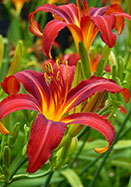
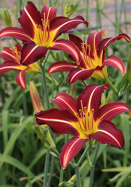
True stock! Like that energetic rabbit, ‘Autumn Red’ keeps going and going and going, blooming for weeks on end from mid-summer on. Its slender, gracefully curling petals are cherry red with sunny yellow midribs for a look that’s exuberant but never too much. You’ll wish it bloomed even longer! 36-40”, deciduous, zones 4a-8b(9bWC), from Ann Arbor.
Last offered in 2014. We offer a rotating selection of daylilies. If you’d like to be notified the next time we offer this treasure, click to sign up for an email alert.
|
|
|
|
Cute as a button, this Texas-bred heirloom combines petals of cool, pale, lemon yellow with lightly ruffled petals of old-rose-to-burgundy brightened by a wide yellow midrib-line. Its extended blooming habit means its profuse flowers stay open longer than most, giving you more time to enjoy them. AHS Award of Merit winner, 32-36”, mid-season, deciduous, 3-4 fans, zones 4a-8b(10aWC), from Missouri & our own micro-farm.
Last offered in 2024. If you’d like to be notified the next time we offer this treasure, click to sign up for an email alert.
|
|
|
|
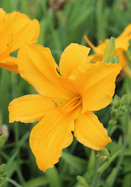
Excellent bloomer ‘Bette Russell’ brings rich lemony-yellow accents to the summer garden. Unusually for a daylily, her flowers are open in the evenings, welcoming you home at the end of your day! 36”, early-mid, 3-4 fans, 4a-8b(10bWC), from Missouri.
Last offered in 2023. If you’d like to be notified the next time we offer this treasure, click to sign up for an email alert.
|
|
|
|
With its velvety, wine-dark petals, chartreuse throat, and graceful, lily-like form, ‘Black Friar’ is one of the best of the mid-century “black” daylilies. Tall and vigorous, it was bred by the first woman to win the AHS’s top award for hybridizing, “Sun-Proof” Mary Lester of Georgia. 32-38”, mid-to-late, deciduous, 2 fans, zones 4a-8b(10aWC), from our own micro-farm.
Last offered in 2025. If you’d like to be notified the next time we offer this treasure, click to sign up for an email alert.
|
|
|
|
This great little daylily has a lot of famous friends. Ken Druse first urged us to offer it, Christopher Lloyd called it a “first-rate AGM winner,” and Pamela Harper in Time-Tested Plants writes, “I doubt that any daylily will ever please me more than ‘Corky’.” Its small, wildflowery blooms are shaded with bronze on the outside, and since every wiry stem holds up to 40 buds, they open for a long time. 34”, mid-season, deciduous, zones 5a-8b(10bWC), from our own micro-farm.
Last offered in 2025. If you’d like to be notified the next time we offer this treasure, click to sign up for an email alert.
|
|
|
|
With up to 30 buds per stem, this Nebraska-bred classic will brighten your mid-summer garden with six weeks of star-like, jewel-toned blossoms that are as graceful as wildflowers. Named for a hit movie that later inspired Pirates of the Caribbean, it’s another masterpiece from the great Henry Sass whose family introduced so many enduringly popular iris and peonies. 30-32”, mid-season, deciduous, zones 4a-8b(10aWC), from our own micro-farm.
Last offered in 2025. If you’d like to be notified the next time we offer this treasure, click to sign up for an email alert.
|
|
|
|
|
|
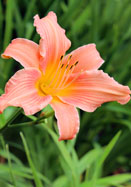
One of the best of the ground-breaking mid-century pinks, ‘Evelyn’ is a warm, peachy-pink highlighted by a glowing, golden throat. Free-flowering and vigorous, it was bred by University of Chicago botany professor Ezra Kraus – who clearly knew what he was doing. 24-30”, early-mid, deciduous, 3-4 fans, zones 4a-8b(10aWC), from Missouri.
Last offered in 2023. If you’d like to be notified the next time we offer this treasure, click to sign up for an email alert.
|
|
|
|
Golden-orange ‘Gertrude’ is as refreshing as an orangesicle or a cool slice of cantaloupe with 5” blossoms that positively glow even on cloudy days! 28”, early-mid, 3-4 fans, zones 4a-8b(10bWC), from Missouri.
Last offered in 2023. If you’d like to be notified the next time we offer this treasure, click to sign up for an email alert.
|
|
|
|
Exceptionally early-blooming, this cheery little daylily opens its fragrant, cinnamon-shaded flowers just as spring is turning into summer (and when it’s happy, it often reblooms). It’s also one of the oldest daylilies, by the very first person to breed them, English schoolteacher George Yeld, who crossed the classic lemon lily with the Japanese H. dumortieri to get this enduring charmer. Just 24-26”, very early, deciduous, 3-4 fans, zones 5a-8b(10bWC), Missouri.
Last offered in 2024. If you’d like to be notified the next time we offer this treasure, click to sign up for an email alert.
|
|
|
|
Thousands of yellow daylilies have come and gone, but ‘Hyperion’ endures. Its fragrance, carefree vigor, and classic, lily-like flowers make it the only daylily from the early 1900s that’s still widely grown today. Indiana-bred and winner of an RHS AGM, it’s named for the Titan father of the sun god. 4 feet, zones 4a-8b(10bWC), Missouri. Last offered in spring 2009.
If you’d like to be notified the next time we offer this treasure, click to sign up for an email alert.
|
|
|
|
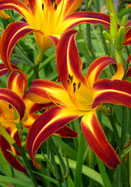
“Did you see that?” everyone asked when this unusual daylily first bloomed here in our trial garden. With its long, thin, curling petals, a clump in bloom may remind you of fireworks bursting in the summer sky. A landmark daylily, it was the first “spider,” a form that’s now in vogue after decades of scorn. 24-36”, mid-summer blooming, deciduous, zones 4a-8b(10bWC), from our own micro-farm. .
Last offered in 2025. If you’d like to be notified the next time we offer this treasure, click to sign up for an email alert.
|
|
|
|
With three sets of petals tucked neatly inside one another, this opulent daylily is quirky enough to appeal to Victorian gardeners yet “handsome” enough (to quote taste-maker Louise Beebe Wilder in 1916) to earn it a leading role in the sumptuous Red Borders at England’s famous Hidcote Gardens. 36-40”, early summer blooming, deciduous, 3-4 fans, zones 4a-8b(10bWC), from Missouri.
Last offered in 2024. If you’d like to be notified the next time we offer this treasure, click to sign up for an email alert.
|
|
|
|
The “rich, lustrous, velvety black cherry color” of this old daylily (in the words of the 1949 Schreiner’s catalog) would be great no matter what, but it’s the creamy white line down the center of each petal that makes it so striking and unforgettable. You’ll find yourself drawn to it from across the garden – and looking forward to it every summer. 34-36”, mid-season, dormant, 2 fans, zones 4a-8a(10aWC), from our own micro-farm.
Last offered in 2025. If you’d like to be notified the next time we offer this treasure, click to sign up for an email alert.
|
|
|
|
At just two feet tall, this abundantly blooming, mid-century pink is perfect for small gardens or the front of the border. It’s a soft peachy pink with a lemon yellow throat, as cool and summery as pink lemonade pie. 18-24”, mid to late-mid, deciduous, zones 4a-8a(10aWC), from Missouri.
Last offered in 2016. We offer a rotating selection of daylilies. If you’d like to be notified the next time we offer this treasure, click to sign up for an email alert.
|
|
|
|
This exuberant daylily is one of our favorite reds. We like its long, pointed petals, its big, bright, star-like center, and that breeder Hooper Connell of Baton Rouge named it for his grandfather. 34-38”, mid-season, evergreen, 3-4 fans, zones 4a-8b(10bWC), from Missouri.
Last offered in 2023. If you’d like to be notified the next time we offer this treasure, click to sign up for an email alert.
|
|
|
|
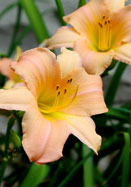
With a name that’s pure 1950s, this luscious daylily looks like a cool, refreshing cantaloupe and ice cream smoothie. It was bred by Orville Fay of Illinois whose day job was working as a chemist in a candy factory. Just 30” tall, mid-summer blooming, deciduous, 3-4 fans, zones 5a-8b(10aWC), from Missouri & our own micro-farm.
Last offered in 2024. If you’d like to be notified the next time we offer this treasure, click to sign up for an email alert.
|
|
|
|
Much more than just another yellow daylily, ‘Ophir’ has unusually long, trumpet-shaped flowers – almost like an Easter lily – making it one of the most graceful and distinctive daylilies we’ve ever seen. It’s also one of the first American-bred daylilies, by Bertrand Farr, and the great Elizabeth Lawrence grew it, writing in 1943 that it was “more beautiful than ever this season, and the only attention it has ever had is a mulch of cow manure each fall.” 38-46”, mid-season, semi-evergreen, 2-3 fans, zones 4a-8b(10aWC), from our own micro-farm.
Last offered in 2025. If you’d like to be notified the next time we offer this treasure, click to sign up for an email alert.
|
|
|
|
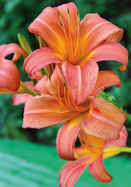
“I may be old-fashioned,” writes daylily connoisseur Sydney Eddison, but this “big handsome daylily with flowers the color of orange marmalade is still a striking plant.” Others call its abundant flowers “bronze orange” or even “cinnamon,” but everyone seems to agree that this vigorous, drought-tolerant, Stout Medal winner is far from ordinary. 36” mid-summer blooming, evergreen in warm zones, 3-4 fans, zones 5a-8b(10bWC), from Missouri.
Last offered in 2024. If you’d like to be notified the next time we offer this treasure, click to sign up for an email alert.
|
|
|
|
Named after the 1964 movie of the same name, or perhaps after the nursery rhyme that inspired it, ‘Pumpkin Eater’ has sturdy stems supporting a feast of 5” blossoms in pastel shades of melon and apricot: We've counted as many as 39 flower buds on one stem! 30”, mid-late, zones 4a-8b(10bWC), from our own micro-farm.
Last offered in 2025. If you’d like to be notified the next time we offer this treasure, click to sign up for an email alert.
|
|
|
|
Winner of the Stout Medal, the AHS’s highest honor, this sophisticated beauty is a subtle, peachy-orange and copper-tinted color highlighted by a glowing, golden throat and midrib-lines. We love its unusual form, too, which combines three narrow, curling petals with three broader petals that are pinched at the tips for an angular, asymmetrical look. Often reblooms if cut back, 30-36”, early-mid, evergreen, zones 4a-9b(10aWC), from Missouri.
Last offered in 2022. If you’d like to be notified the next time we offer this treasure, click to sign up for an email alert.
|
|
|
|
Small-flowered, early blooming, and one of the oldest daylilies of all, this cheery little queen is lemon yellow lightly shaded with chestnut on back. It was bred from the wild lemon lily and H. dumortierii by George Yeld, the founding father of daylilies, and it blooms today – as it has for decades – in the restored garden of Mississippi author Eudora Welty. Yellower and taller than its sibling ‘Gold Dust’, 28-30”, deciduous, zones 4a-8a(10aWC), from our Ann Arbor micro-farm.
Last offered in 2016. We’re building up stock and plan to offer it again in the future. If you’d like to be notified the next time we offer this treasure, click to sign up for an email alert.
|
|
|
|
Unlike most daylilies that wane as night approaches, this pale yellow beauty opens late in the day and then stays fresh and beautiful all evening — when you’re home to enjoy it — and the following day. It was bred by the remarkable Elizabeth Nesmith who hybridized hundreds of daylilies, iris, and other perennials and sold them by mail, in an era when ladies just didn’t do things like that. Often reblooms, 34-38”, early-mid, zones 4a-8a(10aWC), from our Ann Arbor micro-farm. Last offered in spring 2015.
If you’d like to be notified the next time we offer this treasure, click to sign up for an email alert.
|
|
|
|
A fetching blush pink with a green throat, ‘Winsome Lady’ was voted by the American Daylily Society in 1974 the best performer over a wide geographic area. Her subtle fragrance only adds to her appeal! 24”, early, 3-4 fans, zones 4a-8b(10bWC), from Missouri.
Last offered in 2023. If you’d like to be notified the next time we offer this treasure, click to sign up for an email alert.
|
|
|
|
What sets this mighty classic apart — and why should you give it a try? It’s more fragrant than its famous parent ‘Hyperion’. Its Chicago breeding makes it extra tough. And its lily-like, moonlight-yellow flowers stay open longer than most, making it especially beautiful in the evening garden — when you’ll be home to enjoy it. 36” mid-summer blooming, deciduous, zones 4a-8b(9aWC), from our own micro-farm.
Last offered in 2025. If you’d like to be notified the next time we offer this treasure, click to sign up for an email alert.
|
|