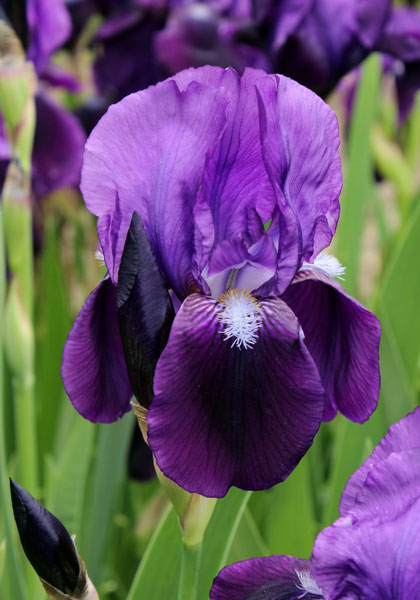

$50! At an ADS auction a couple of years ago, that was the winning bid for three bulbs of this vivid, sun-proof, blue-ribbon charmer that E.A. Bowles praised as the epitome of “brilliancy, gaiety, and refinement.” Though it’s definitely worth that much, you’ll note that we’re charging a LOT less. We really want you to grow it! 2 W-O, 18-20”, zones 5-7bS/9WC, from Pennsylvania. Last offered in 2010. We may offer it again periodically, or we could special order it for you.
GOLDEN SCEPTRE, 1914
Sublimely fragrant, this tough, free-flowering jonquil “has settled into Southern life,” says Scott Ogden in Garden Bulbs for the South. In 1930, Philadelphia master horticulturist John Wister praised its toughness, saying it “stays in bloom sometimes for two to three weeks in spite of storms or hot weather.” 7 Y-Y, 18-20” early/mid-season blooming, zones 6-8bS/10WC, from Holland. Last offered in 2006. We may offer it again periodically, or we could special order it for you.
GRAND MONARQUE, 1798
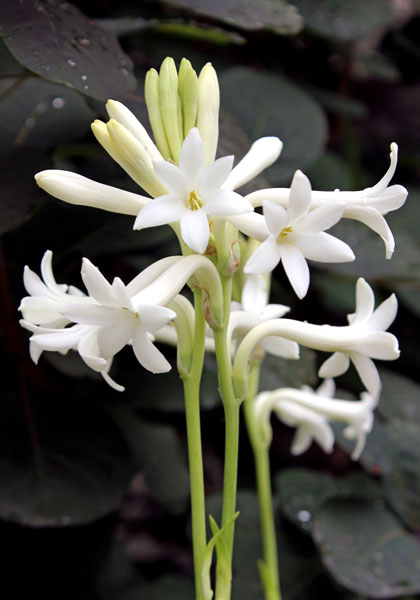
Prized since the days of Napoleon, ‘Grand Monarque’ blooms in clusters of small, sweetly fragrant, white and yellow flowers. It’s “magnificent as grown on the Riviera and in Algiers,” E.A. Bowles reported in the early 1900s, and it’s especially favored today in the Mediterranean climates of the West Coast. 8 W-Y, 18-20”, zones 7b-9S/11WC, from California. Last offered in 2005. We may offer it again periodically.
HENRY IRVING, 1885
Every spring in the quaint old parterre garden at Keukenhof, Holland’s wonderland of bulbs, this charming antique trumpet launches the show. And who was Henry Irving? Visit www.theirvingsociety.org.uk to learn more about the Victorian actor who still has a fan club 100 years after his death. 1 Y-Y, 15-16”, zones 4-8aS/10WC, from Holland. Last offered in 2004. We may offer it again periodically, or we could special order it for you.
N. bulbocodium bulbocodium, HOOP PETTICOATS, 1629
These odd little cuties are the true Southern heirloom, not Dutch look-alikes. With funnel-shaped cups and exclamation-point petals, they may remind you of cartoon characters. Short and early, they’re not easy to please but seem to do best in gritty acid soil that bakes in summer. 13 Y-Y, 8-10”, zones 6b-8bS/10WC, from Texas. Last offered in 2009. We may offer it again periodically, or we could special order it for you.
HORACE, 1894
Named for the Roman poet who celebrated country life and carpe diem, ‘Horace’ was for decades the standard of excellence that all other poet’s narcissus were judged against. With a jewel-like eye aglow with orange and red, it’s been called George Engleheart’s “greatest triumph.” Fragrant, 9 W-GOR, 18-20”, zones 4-7aS/9WC, from Holland. Last offered in 2008. We hope to offer it again soon. For an alert, sign up for our email newsletter.
KIDLING, 1951
“Even more fragrant than most jonquils,” wrote ADS president George Lee of this unusually late-blooming miniature that’s as cute as, well, a baby goat. With rounded petals and an oversized cup like a hungry baby’s mouth, it was bred by Alec Gray, the 20th century’s pioneering master of miniature daffodils. 1-2 flowers per stem, 7Y-Y, 10-12”, zones 6-8bS/10WC, from Holland’s greatest daffodil collector. Last offered in 2009. We may offer it again periodically, or we could special order it for you.
KING ALFRED, 1899
True stock! You may think you’ve grown this icon, but since the 1950s, most bulbs sold in the US as ‘King Alfred’ have been newer, over-sized impostors that were easier to mass-produce in the mild, moist Dutch climate. We waited years to get the real ‘King’ from Holland’s greatest daffodil collector, and now – trumpets, please – here it is, gold, bold, and everything a world famous icon should be. 1Y-Y, 21-23”, zones 4-7bS/9WC, from Holland. Last offered in 2010. We expect to offer it again periodically. For updates, please subscribe to our free email newsletter.
LAURENS KOSTER, 1906
Our good customer Catherine Yaden of Charleston reports that six of our ‘LK’ produced “over 80 flowers on multiple stems – amazing!” A vigorous, cluster-flowered beauty, it has creamy petals, little golden yellow-orange cups, and a superb fragrance. It’s also one of the oldest poetazes, a group launched in 1890 by crossing N. poeticus and N. tazetta. 8-Y, 16-18”, zones 6-8S/10WC, from Holland. Last offered in 2004. Widely available elsewhere.
N. pseudonarcissus, LENT LILY, EASTER FLOWER, 1200
This sublimely simple wildflower has graced English gardens since medieval days and inspired Wordsworth’s famous poem. It grows without care from Maine to California but is best loved in the Upper South, thriving in pastures and woods where homes once stood. Traditionally called “Easter flower” in the US, it’s very early blooming, with a narrow trumpet and lighter petals that sweep gracefully forward. 13 Y-Y, 10-12”, zones 5-8bS/10WC, from Mississippi. Last offered in 2011. We hope to offer it again soon. For an alert, sign up for our email newsletter.
For our print catalog click here or
send $2.00 to
Old House Gardens
536 Third St., Ann Arbor, MI 48103.
phone: 734-995-1486
fax: 734-995-1687
charlie@oldhousegardens.com
For our free email newsletter,
“The Friends of Old Bulbs Gazette”
with tips, news, history, &
special offers,
send us an email with
“subscribe” in the subject line to
newsletter@oldhousegardens.com.