
Old House Gardens
From America’s Expert Source for Heirloom Flower Bulbs
My Basket
My Basket
TOMMY KEITH, 1892        Rarest
This 117-year-old granddaddy is a pompon-like “fancy” dahlia of deep burgundy-red irregularly splashed with bits of white – like a sparkling garnet brooch or maybe a tiny, antique velvet sofa with lacy antimacassars. Reintroduced by us from the British National Collection of Dahlias. 1-2 inches, 3 feet, Oregon-grown. Chart to compare.
SD34Add to basket:1/$7.753/$215/$33.5010/$6225/$140
TSUKI YORI NO SHISHA, 1953
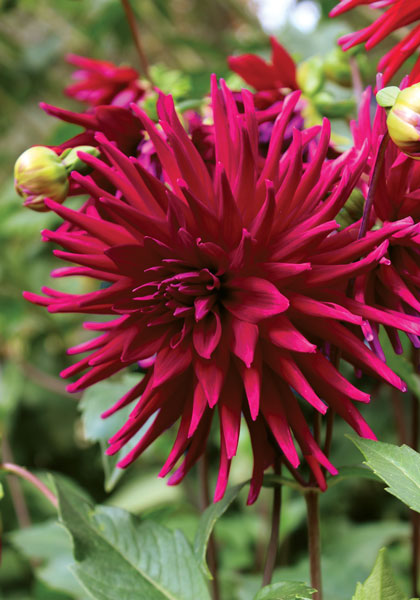
The deeply fringed petals of this spectacular dahlia give it an otherworldly air, which is fitting since its name means “Messenger from the Moon” (the title of a wildly popular Japanese novel). When we look at it, though, we see Fourth of July sparklers and big shaggy dogs. What will you — or your kids or grandkids — see? Free-blooming, laciniated, 5-8 inches, 3-4 feet, from Holland. Chart to compare.
SD62Add to basket:1/$6.503/$185/$2810/$5225/$117
UNION JACK, 1882
This candy-cane striped dahlia is one of the world’s oldest, according to the late Gerry Weland of the ADS who compiled a database of 50,000 dahlias dating back to the early 1800s. Also known as ‘Star of Denmark’, it’s bright and cheery, with pinwheel-like flowers of red and white. One caveat, though: its stems, like those of its wild ancestors, are lax. 3 inches, 2-3 feet, from Oregon. Chart to compare.
SD30Add to basket:1/$7.503/$20.505/$32.5010/$6025/$135
WHITE ASTER, 1879        Rarest
This is the world’s oldest surviving garden dahlia – do you need to know more? With fresh green foliage and hundreds of small, ivory globes – each touched in the center with a bit of honey, or sunshine? – it has all the pristine, elemental beauty of a newborn baby. Preserved by a venerable German nursery that has specialized in dahlias for close to a century, it’s truly timeless. 1-2 inches, 3-4 feet, from Oregon. Chart to compare.
SD10Add to basket:1/$8.753/$245/$37.5010/$7025/$158
WHITE FAWN, 1942
Like white hydrangeas by a lakeside porch, ‘White Fawn’ is cool and refreshing. If Vita didn’t grow it in her celebrated White Garden at Sissinghurst, she should have! 3-4 inches, formal decorative, 3-4 feet, from Oregon. Chart to compare.
SD11Add to basket:1/$73/$195/$3010/$5625/$126
WINSOME, 1940
Winsome? No way! This stunner is as vividly colored as the most brilliant tropical fish. Its palm-sized, waterlily-like flowers are a deep, vibrant rose blending into a center of rich yellow, almost orange, as if the sun itself were throbbing deep inside. It redefines “antique beauty” and will leave you breathless! Ever since we reintroduced it from the UK National Collection it’s been a customer favorite, and last year we honored it as our Spring 2010 Heirloom Bulb of the Year! 4-5 inches, 4-5 feet, from Oregon. Chart to compare.
SD35Add to basket:1/$9.753/$26.505/$4210/$7825/$176
WISCONSIN RED, 1910?        Rarest
This striking family heirloom with ruby flowers and dark stems is SO easy to grow and store that it’s been a pass-along plant in Wisconsin since the early 1900s. We got our start from our friend Vytas Virkau who got it from Catherine Becker of Wausaukee who’d been growing it since the 1940s. Then we heard from Vicki Dirst who lead us to Brenda and John Hagman whose family has been passing it on since 1910 or before — or so it seems. And the story doesn’t stop there. Learn more here, or just plant it and join the tradition! Ball, 3 inches, 4-5 feet, grown for us in Oregon. Chart to compare.
SD63Add to basket:1/$83/$225/$34.5010/$6425/$144
YELLOW GEM, 1914        Web-Only
Exquisite in its symmetry, this perfect little pompon dahlia seems to have been shaped by a jeweler from Middle Earth. Or maybe it will remind you of your childhood backyard twinkling with lightning bugs. Either way, it’s one of our oldest and rarest dahlias, excellent in bouquets, and a delight. 1-2 inch pompon, 3 feet tall, from Oregon. Chart to compare.
SD12Add to basket:1/$7.503/$20.505/$32.5010/$6025/$135
YORK AND LANCASTER, 1915?        Rarest
The history of this intriguing dahlia is a mystery. One British expert told us it was rediscovered in a chateau garden and dated to 1915. Another said he saw it growing in a rural hamlet near Lyon and it dated to the 1850s. We’ll keep researching its past, but one thing for certain is its garden appeal. Every flower is different. A few open deep red, a few pearly white, but most are an unpredictable mix of both colors — très intéressant! Ball, 3 inches, 4-5 feet, grown for us in Oregon. Chart to compare.
SD61Add to basket:1/$9.753/$26.505/$4210/$7825/$176

WHY GROW DAHLIAS? They keep getting better and better in late summer and autumn when many plants are fading. They offer opulent flowers with lush colors and astonishing forms. And the more you cut them for bouquets, the more they bloom.

DAHLIAS AS CUT FLOWERS – For tips for longer lasting dahlias in bouquets, see our Bulbs as Cut Flowers page.

DAHLIA ARCHIVES – For customer tips and raves, the stories behind the bulbs, links and books, history, news, and more, see our Dahlia Newsletter Archives.

HISTORY – Dahlias were brought into gardens by the Aztecs, arrived in Europe in 1789, and by the 1840s garden writers in America were hailing scores of new varieties every year. Exciting new cactus forms were introduced in the 1870s, and in 1927 F. F. Rockwell reported that dahlias ranked in “the leading position of all bulbs grown in America.”

TIPS FOR SUCCESS – Dahlias prefer full sun and rich soil. Blazing hot summers are hard on them, but see our tips for the Deep South, below. Yes, you’ll need to stake them, but it’s easy. No, you don’t HAVE to dig and store them – it’s not a law in any state! When they freeze dead, just add them to the compost pile. We send complete instructions with all of our bulbs.

PLANTING & CARE – DON’T plant outside too early! Wait till after all danger of frost is past – when you’d plant tomatoes or later. Or you can start them inside 4-6 weeks early and transplant them outside when it warms up, which is what we do here at Old House Gardens.

Dahlias thrive in light, fertile, well-drained soil. If your soil is heavy (clay), add organic material or plant in raised beds. Full sun is best, but eight hours will do. Dahlias do NOT like extreme heat, so avoid hot spots such as near south or west walls.

If you garden in the Deep South or other areas with long hot summers, check out our special advice at http://www.oldhousegardens.com/Dahlias-For-The-South.asp .

Space your dahlias 18-24 inches apart. Dig a hole a foot deep and wide; enrich the soil and return some to the hole. Pound a sturdy stake into the ground near the center of the hole so that 4-6 feet of it remain above ground level (depending on the ultimate height of the dahlia). In front of this, lay the tuber horizontally with the eye, if visible, pointing up – or set the entire pot-root cluster with the stem facing up – about 6 inches below ground level. Cover with 2-3 inches of soil. If your soil is moist, DON’T WATER tubers until they sprout. In soggy soil, un-sprouted tubers are prone to rot. If your soil is dry or the weather is hot, you will need to water, but don’t overdo it – till sprouts emerge.

As shoots grow, gradually add soil till the hole is filled. For bushier plants, “top” them after they get three sets of leaves by pinching or cutting out the center shoot. If slugs or snails are a big problem for you, consider bait.

Water regularly during the growing season, and fertilize lightly every 3-4 weeks until early fall. Don’t over-feed! AVOID HIGH NITROGEN FERTILIZERS such as lawn fertilizer. Use rose, tomato, or general garden fertilizer instead. Hand-weed; avoid ALL herbicides. Tie stalks to the stake as they lengthen. Double strands of garden twine work well. Dead-head by cutting spent blooms to encourage more vigorous flowering – or simply pick lots of bouquets! Dahlias like cool conditions (they are native to the mountain plateaus of Mexico), so growth and flowering peak as temperatures cool in late summer and early fall.

FOR EVEN MORE INFORMATION on growing dahlias, including how to store tubers over the winter (IF you decide to do that), click here for our spring Planting and Care page.

To return to the beginning of Dahlias, click here.

Page 5 of Heirloom Dahlia Bulbs       << Previous 1 2 3 4 5
For our print catalog click here or
send $2.00 to
Old House Gardens
536 Third St., Ann Arbor, MI 48103.
phone: 734-995-1486
fax: 734-995-1687
charlie@oldhousegardens.com
OHG Catalog Cover
For our free email newsletter,
“The Friends of Old Bulbs Gazette”
with tips, news, history, &
special offers,
send us an email with
“subscribe” in the subject line to
newsletter@oldhousegardens.com.