

|
Order these fall-planted bulbs NOW for delivery in October. |
||
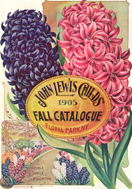
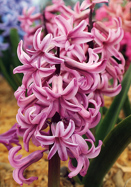
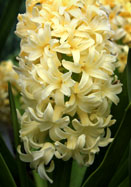
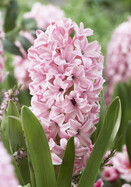
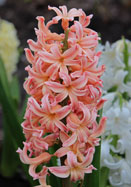
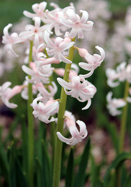
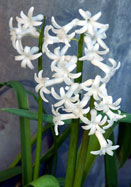
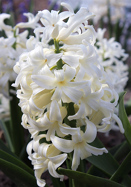
SAVE THE HYACINTHS! — Hyacinths are the most endangered garden bulbs. In 1886, D. M. Ferry offered 135 — twice the number of tulips and ten times the number of daffodils. But today you’ll find very few in most catalogs and gardens. What a loss! Fragrant and quaint, hyacinths bring a rainbow of color into the garden well before tulip time. Wind a drift through your perennial border or force a few indoors and see if you don’t agree that they’re just too wonderful to let go extinct. |
||
|
Even Rarer Hyacinths — Every year we get a handful of spectacular bulbs that are so rare we offer them Web-Only. For an alert the moment they go on sale, subscribe to our free, monthly email newsletter.
|
||
|
||
|
||
|
||
|
||
|
||
|
||
|
HISTORY — Hyacinths came to Europe from Turkey in the mid-1500s, and by 1730 some 2000 varieties were reported. From about 1780-1880 they were more popular than tulips. First grown as mixed collections of choice specimens, they later starred in the 1800s rage for forcing and were planted en masse in Victorian pattern-beds. For the whole fascinating story, from their wild beginnings to the Ottoman Empire, Mme. de Pompadour, and beyond, see our Hyacinth History page. HYACINTH ARCHIVES — For customer tips and raves, the stories behind the bulbs, links and books, history, news, and more, see our Hyacinth Newsletter Archives. HYACINTHS AS CUT FLOWERS — Hyacinths are fabulous in bouquets. For tips on making them last, see our Bulbs as Cut Flowers page. EASY FORCING — Forcing hyacinths into winter bloom became a great rage in the 1800s, and it’s a pleasure you can easily enjoy today. For simple instructions, see our Forcing Bulbs page. TIPS FOR SUCCESS OUTDOORS — Hyacinths like rich, well-drained soil that’s dry in summer and full sun. Best in zones 5-7, they can succeed in zones 4 (well-mulched) and 8, too. Most grow 10-12 inches tall. We send 15-17 cm bulbs, the best size for gardens. Some people are allergic to hyacinth bulbs, developing a localized itch, so you may want to handle them with gloves. Plant in mid-fall. If necessary, store till then in open bags in a cool, dry spot. Hyacinths do best when DRY (but not hot) in summer. Choose a sunny site with well-drained soil, avoiding or improving clay or damp soil, or plant in raised beds. Plant bulbs with base 6-8 inches deep and 5-7 inches apart on center (or closer for a lush look). Scratch a tablespoon of bulb fertilizer into the surface soil (slow-release 10-10-10 is ideal). Water. A light, airy winter mulch such as straw, oak leaves, or pine boughs is helpful in colder zones to minimize root damage from soil repeatedly freezing and thawing. For best results, re-fertilize lightly spring and fall, and assure even moisture then. After bloom, strip off spent florets but allow foliage to yellow (to feed the bulbs for next year’s bloom) before removing. Close the hole left in the soil by the withering foliage to deter pests. And keep those bulbs dry! Five-Second Staking — All hyacinths — even wild ones — topple eventually. Usually it’s no big deal, but if the weather is unseasonably warm it can be disappointingly premature. To counter this, take a thin green bamboo stake about 12 inches long and run it along right next to the stem from the top of the bloom-spike down into the soil a few inches (but not so deep that you hit the bulb). The florets will clasp the stake and you’re done! |

|
SPRING
|
· |
SUMMER
|
· |
FALL
|
· |
LEARN MORE
|
· |
ORDERING
|
|