




Here’s a wealth of information about GARDEN HISTORY and HEIRLOOMS from our email Gazette and past catalogs, starting with the most recently published. For other topics, please see our main Newsletter Archives page.
To subscribe to our FREE email newsletter, click here.
You’ll also find many books about garden history and heirlooms in the Books section of our Newsletter Archives.
Blooming Now: The National Collection of Hyacinths on YouTube
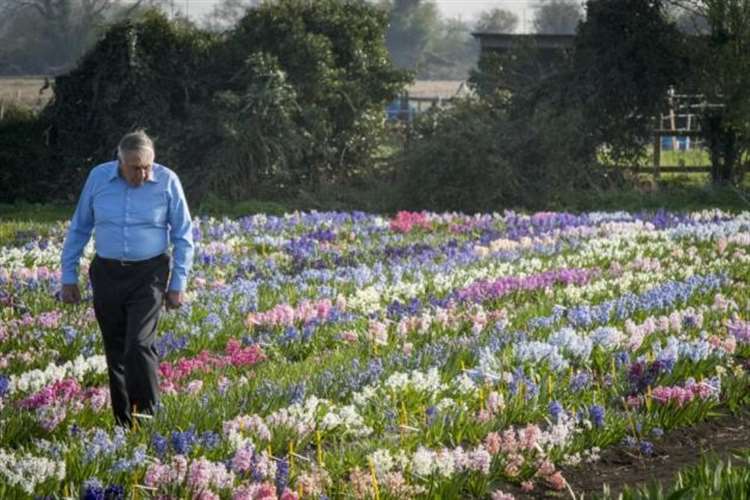
With his April open house cancelled due to Covid-19, our good friend Alan Shipp has posted a short video-tour of his hyacinth fields on YouTube.
Although the eight-and-a-half-minute clip is more of a home-movie than a polished production, it’s a treat to see Alan – who’s been called the Noah of hyacinths – walking through his endless rows of hyacinths and chatting about this variety and that almost as if they were his grandchildren.
You can walk with him here – and then if you’re feeling inspired, check out the 14 hyacinths we’re offering now for delivery this fall, and stay tuned for more to follow this summer from Noah himself. (April 2020)
New Again: AP on Grandmothers’ Gardens and Heirlooms
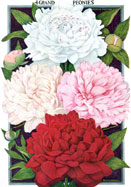
“Even before the coronavirus crisis sparked renewed interest in vegetable gardens,” writes our good friend Dean Fosdick in last week’s column for the Associated Press, there was “a movement toward more traditional gardening aesthetics,” including grandmother’s gardens and heirloom flowers.
“Grandmother’s gardens” were the informal, mixed flower gardens that arose in the late 1800s as a reaction against Victorian carpet bedding. Today, says Leonard Perry of the University of Vermont, most people are so busy they “strive for simpler gardens,” but as some gardeners “add more flowers for pollinators, or combine flowers with edible herbs and vegetables, they are beginning to recreate gardens” that hearken back to this old-fashioned garden style.
Old-fashioned plants were an essential part of grandmother’s gardens, too. As Dean quotes me saying, “Slowly but surely, gardeners turned away from the brightly colored exotic annuals of the Victorian era in favor of flowers that had a long history in gardens, especially perennials such as peonies and iris, self-sowing annuals such as larkspur and poppies, and bulbs that would return and multiply year after year such as daffodils and snowdrops.”
When Dean asked me to explain the appeal of these gardens and plants today, I told him that grandmother’s gardens “emphasized an appreciation for plants as plants, not just blobs of color,” and they offered “a connection with the real world, which I think is an important part of gardening for many of us today. Hardscaping and backyard kitchens do little to connect us with nature, but working with plants does – which is something I learned from my grandmother.” (April 2020)
Just in Time for Valentine’s Day: Dutchman’s Breeches
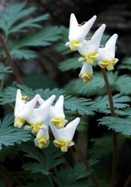
Dutchman’s breeches is a delightful little North American wildflower – and maybe something more.
In an article titled “Menominee Love Charms” posted at the website of Macalaster College’s Ordway Field Station near Minneapolis, Michaela Koller writes, “The main plant is Dicentra cucullaria, more commonly known as Dutchman’s breeches. The Menominee called this plant ‘a’nimau kapotise’sa’ which is translated into: ‘the one that looks like little pants, with his hands in his pockets’” – which is remarkably like the English name for it.
“The Menominee believed that Dutchman’s breeches could be used in two ways by a man to attain the love of his desire. The first way was … by throwing a piece of the plant at her. The second way … was by chewing a piece of this plant, so that the scent would be released…. In order to insure the girl smelled this plant, the man would circle around her, until she would ‘follow him wherever he goes.’”
Learn more here and order your own little charmers now for delivery this fall. (February 2020)
Fragrant and Long-Loved: Tuberoses from 1530 to 1893
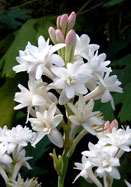
“Everyone who has a garden, or a taste for flowers, knows the tuberose,” wrote C.L. Allen in his 1893 Bulbs and Tuberous-Rooted Plants.
“Its history, however, may not be known,” he continued. “The earliest account we have of [it] is in L’Ecluse’s History of Plants, from which we learn it was brought from the Indies by Father Theophilus Minuti, a Christian missionary, about the year 1530….”
“In Parkinson’s quaint old book, The Garden of Pleasant Flowers, published in 1629, we find the following description of it under its then known name of hyacinth with which it was classed: ‘Hyacinthus Indicus major tuberosa radice, the greater Indian knobbed jacinth…. The tops of the stalks are garnished with many fair, large, white flowers … composed of six leaves [petals] lying spread open as the flowers of the white daffodil … and of a very sweet scent, or rather strong and heady.’
“The double flowering variety was a seedling raised by Mons. Le Cour, of Leyden, in Holland, who for many years would not, under any circumstances, part with a root of it … in order to be the only possessor of so valuable a plant, and which he considered the finest flower in the world.”
Other than that the tuberose has changed little, Allen says, and “the only change worthy a varietal name was a ‘sport’ discovered by John Henderson, of Flushing, N.Y., growing in his field, about 1870.” This was a double “of dwarf habit, and much larger flowers [which] he at once named the ‘Pearl’.”
Although “the cultivation of the tuberose bulb was for many years confined principally to the Italian nurseries,” Allen writes, “for the past twenty-five years they have been largely grown in the United States” and currently “the markets of the world are largely supplied with American-grown bulbs.” (Today a handful of American farmers still grow tuberoses. Our ‘Mexican Single’ bulbs, for example, come to us from an Illinois family farm where they’ve been grown for almost a century now.)
“For field culture, prepare the ground as if for a crop of potatoes,” Allen recommends, and plant the bulbs “just below the soil surface; if covered too deep they are not as likely to flower.”
In greenhouses, “tuberoses can be had in bloom, with a little care, nearly the whole year,” Allen writes, but he cautions against “the too common practice of filling up every vacant place in the greenhouse with tuberoses” – an indication, I suspect, of their great popularity.
As for the home garden, he explains that “the tuberose is a gross feeder, and succeeds best in a light loam, but will grow in any soil, providing it is moist and rich. Rich it must be, without regard to other conditions. Its complete requisites are heat, water, and manure. If these are proportionate, it matters not how much there may be, the plants will consume it, and by their growth show its importance.”
Today tuberoses are just as fragrant and easy to grow as they’ve ever been – and you can order our big, sure-to-bloom bulbs now for delivery in April. (February 2020)
2624-Year-Old Bald Cypress Discovered in North Carolina

Now that’s an historic plant!
According to scientists from the University of Arkansas, a bald cypress (Taxodium distichum) growing in North Carolina is 2624 years old, making it the oldest living thing east of the Rocky Mountains and one of the oldest trees in the world.
And it isn’t alone. “There are hundreds of 1,000-year-old trees throughout the Black River swamp forest,” says scientist David Stahle who used core samples and radiocarbon to date the cypresses. “We think there are older trees out there still.”
Awe-inspiring in their own right, these ancient trees also offer a precipitation record in their tree rings that’s “amazingly accurate and detailed.” It not only shows modern droughts, says Stahle, but also “the severe multi-year droughts of 1587-1589 associated with the disappearance of the Lost Colony of Roanoke Island, and the drought of 1606-1612 concurrent with the hardships suffered during the early years of the Jamestown Colony.”
To read more or watch a short video about these remarkable heirlooms, visit newsweek.com/2624-tree-north-carolina-swamp-oldest-planet-1421844. (December 2019)
Kids Love Eating Purslane, Too

Last month’s article about delicious, historic purslane apparently struck a chord with many of you, including Letty Savage of Sewickley, Pennsylvania, who emailed us to say:
“Loved the article on purslane. We run a kids’ garden club during the summer at our local Fern Hollow Nature Center. Each meeting features a snack, preferably something we have harvested from the garden. One week there were no vegetables ready to harvest so we picked purslane. We made a casserole using an old recipe from Euell Gibbons’ Stalking the Wild Asparagus and the kids just loved it. They also liked it raw. It makes a great snack to forage while weeding.”
In case you’d like to try that casserole, here’s the recipe from Gibbons’ classic 1962 book:
“Boil the tips ten minutes, drain, and chop fine. Stir one beaten egg into the purslane, then stir in as many dry bread crumbs as the mixture will dampen. Season to taste with salt and pepper, then bake in a moderate oven until the top is nicely browned.”
And here’s another of Gibbons’ purslane recipes, which sounds even tastier to me:
“Cut several slices of bacon in small pieces and fry them in a large skillet. When the bacon is done, dump in about one quart of the tender tips of purslane. Stir until evenly coated with the bacon drippings, then cover and let it cook 6 or 7 minutes. Season with salt and a little vinegar.”
Mmm-mmm, purslane! (September 2019)
Tulips, Dahlias, and the Silk Weavers of London
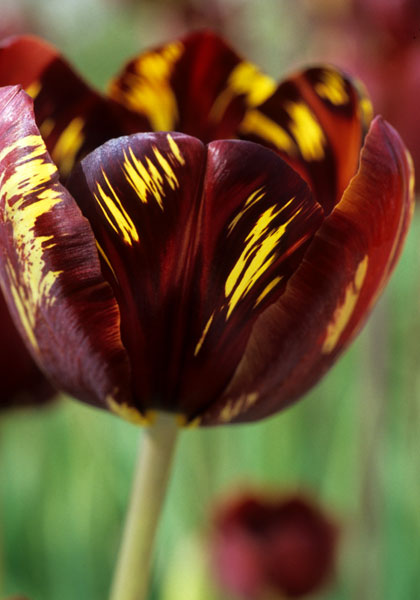
Three hundred years ago the “arty cool” East London neighborhood known as Spitalfields was the center of England’s booming silk industry.
According to an 1840 article in the Manchester Guardian, Spitalfields got its start in 1685 when France revoked the rights of Protestants and “at least 50,000 refugees, most of them weavers and other craftsmen, arrived from France and threw themselves upon the charity of the English nation.” Known as the Huguenots, these refugees were soon “very flourishing” and by 1713 the silk trade they established “had attained such importance that upwards of 300,000 persons were maintained by it.”
By 1840 Spitalfields was “in a greatly fallen-off condition” but it still retained “a remnant of the love of gardening among the weavers.” A six-acre plot had been divided into 170 small gardens, all separated by picket fences, and “in almost every garden is a neat summerhouse, where the weaver and his family may enjoy themselves on Sundays and holidays, and where they usually dine and take tea.” (Doesn’t that sound lovely?)
Although some weavers grew “cabbages, lettuces, and peas,” most had “a far loftier ambition” – flowers. “Many had tulip beds, in which the proprietors not a little gloried, and over which they had screens which protected them from the sun and from the storm” – to keep the blooms in prize-winning shape for the competitive tulip shows – “and it was expected that the show of dahlias for that season would not fail to bring glory to Spitalfields.”
Although all of the dahlias from that era are now extinct, you can still grow some of the very same tulips that were popular in 1840 such as ‘Absalon’ (pictured here), ‘Keizerskroon’, and ‘Zomerschoon’ – and you don’t have to be a silk weaver to enjoy them.
(You might also enjoy the book this article is drawn from, Notes from the Garden: A Collection of the Best Garden Writing from the Guardian (2010), edited by Ruth Petrie.) (July 2019)
Garden Gate’s Top Picks – Summer-Blooming Heirloom Bulbs
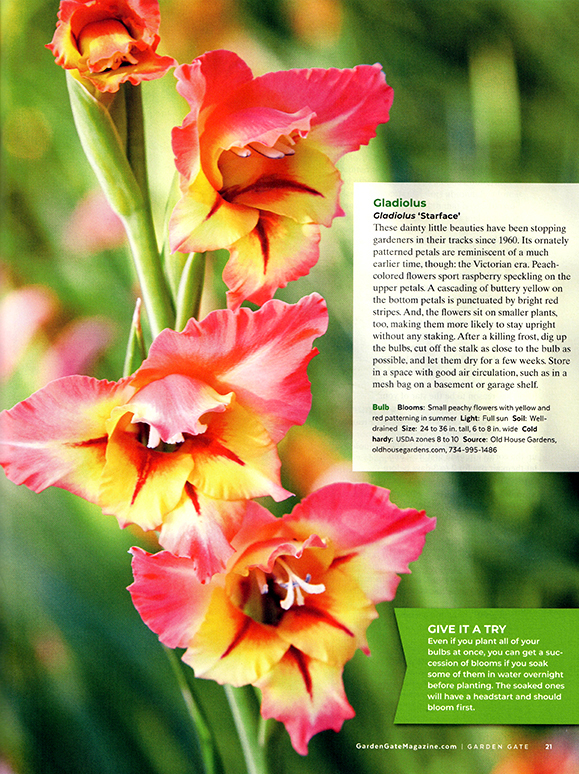
While leafing through the August issue of Garden Gate magazine I was happily surprised to see this full-page photo of my favorite small-flowered glad, ‘Starface’. It’s one of seven summer-blooming classics featured in “Top Picks: Heirloom Summer Bulbs.”
“You know a plant is well-loved, timeless, and a good addition to any garden,” writes author Chloe Deike, “when it has been zealously passed on and preserved from generation to generation.” And summer-blooming bulbs are great, she adds, for their “vivid presence, splash of color, and sudden appearance when other plants are starting to whimper and fade.”
Deike describes ‘Starface’ as a “dainty little beauty” whose “ornately patterned petals” have been “stopping gardeners in their tracks since 1960.” Other summer bulbs she praises include:
‘Star of the East’ crocosmia – With its “stouter stems” and “much larger flowers,” this 107-year-old crocosmia “won all kinds of garden awards when it was introduced” and “still has reason to be the star of your garden today.”
‘African Queen’ lily – “Voluminous and voluptuous, this apricot-colored beauty from 1958 sings out like a Broadway diva.”
red spider lily – With its “long, ‘spider-leg’ stamens that curve upward from a cluster of star-shaped flowers,” this dramatic perennial “definitely makes a tropical statement in the late summer garden.”
milk and wine crinum – A “classic pass-along plant in Southern gardens,” milk-and-wine lily “grows happily and blooms off and on throughout the summer without much fuss,” even in pots where it’s not hardy.
‘Café au Lait’ dahlia – Like ‘Starface’, this 1967 beauty also rates a full-page photo in Deike’s article. Its “enormous plush blooms” and “creamy, champagne tone” make it “one of the trendiest flowers for brides” and a “wonderfully celebratory cut flower.”
More than just pretty faces, “heirloom plants are rooted in story,” Deike writes, “embellished by a history that connects you to the past and spurs you toward the future.” And since so many are disappearing from mainstream sources, “growing heirlooms can make you an important link in the chain that keeps these plants thriving.”
You can order two of these treasures – ‘African Queen’ and red spider lily – right now for delivery this fall. The others are spring-planted, though, so they won’t be for sale again until later this summer. For an email alert then, simply click the link in each bulb’s description. (June 2019)
“Old Flames” – Broken Tulips Showcased in Gardens Illustrated
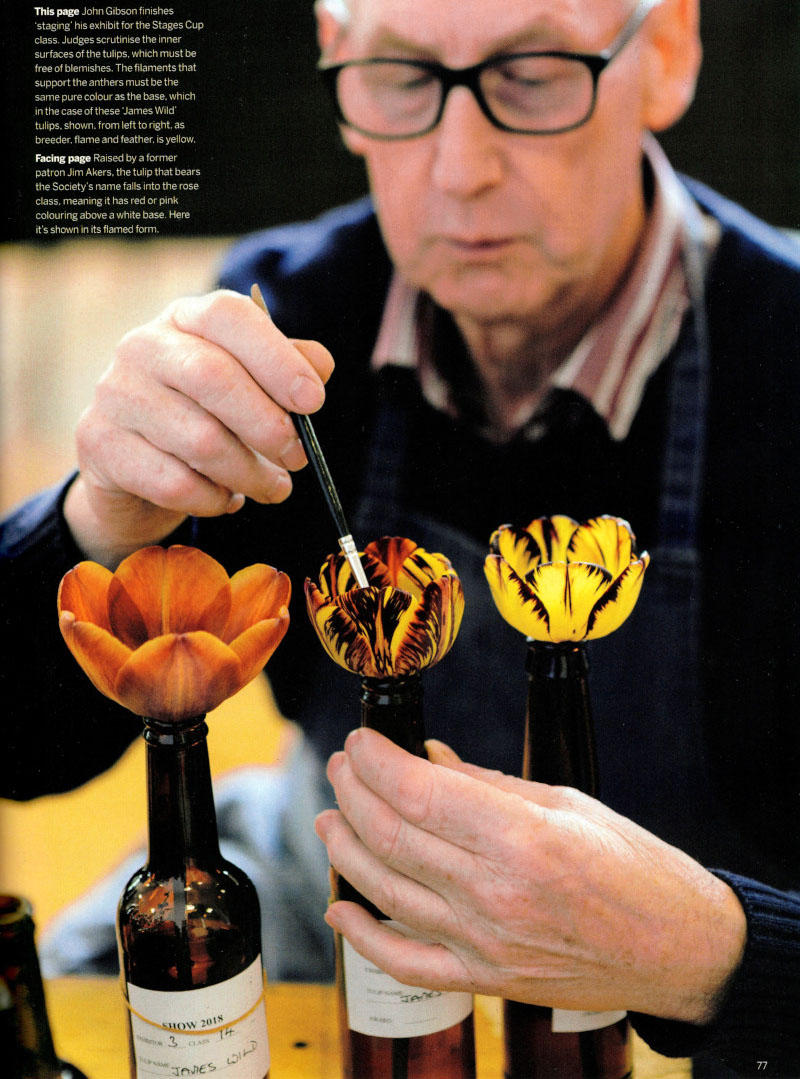
Interest in the exquisite flowers known as broken tulips continues to grow.
The British magazine Gardens Illustrated, for example, recently published a gorgeously illustrated article about them and their devotees in the 184-year-old Wakefield and North of England Tulip Society.
Broken tulips – or English florists’ tulips, as the British varieties are known – are richly feathered or flamed in red, purple, or mahogany. These are the tulips that sold for mind-boggling sums during Tulipomania in the 1620s.
“There was a time,” writes Anna Pavord (who you may know from her monumental Bulb, The Tulip, and other books), “when almost every town of importance in the north of England had its own tulip society.” Today only the Wakefield group survives, nurturing its rare beauties and exhibiting them in competitive shows as they have every spring since 1835.
The shows are no longer held in pubs as they once were, but the flowers are still displayed in beer bottles. This is as it should be, Pavord says, because “nothing could better set off these gorgeously complex, finely textured blooms than the utilitarian containers of plain brown glass.”
Although the Society was once an all-male bastion, today it includes many women who “regularly win top prizes,” including Teresa Clements who is enthusiastically helping to lead it into the future. “These are tulips that just demand your attention,” she says. “They have an incredible quality. Each is a living antique. They are irresistible.”
As a long-time member, I couldn’t agree more! Learn more about these incredible tulips and – if you want to see for yourself how exciting they can be – check out this complete list of the ones we’re currently offering. (June 2019)
What’s That Iris? Get ID Help from Experts Online
Like many gardeners, you may have some beloved plants in your garden that have lost their names. Calling them “Great-Grandma’s rose” or “that daffodil we found in the woods” doesn’t make them any less wonderful, but sometimes you may wish you knew their real name.
If it’s an iris you’re wondering about, you can now ask the Historic Iris Preservation Society about it. On the HIPS homepage, there’s a green box that says “Need help with iris ID? Click here.” Do that and you’ll be taken to their ID Central.
Don’t be daunted by the long introduction and instructions for filling out the application. All you need to know is that it’s hard to identify nameless iris – roughly 70,000 have been introduced, many look a lot alike, and colors often vary depending on climate and soils – and that “I don’t know” is an acceptable answer to any of the questions.
Do read the “Photo Request” section which explains how and when to take the three required close-ups of your nameless iris. Then enter its height, bloom size, fragrance, and so on, upload your photos, and send it.
If you’d prefer, you can mail in your information and photos. Either way, you’ll get a response from the HIPS experts, and – although identifying an iris is always a longshot – there’s at least a chance that your nameless iris will no longer be nameless. Good luck! (May, 2019)
Get Outside and Celebrate Preservation Month!
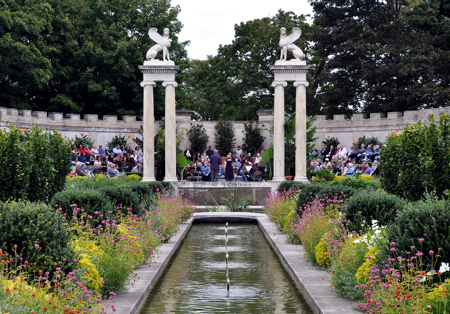
May is Preservation Month and a wonderful time to explore historic gardens and landscapes near you.
If you don’t know where those are, The Cultural Landscape Foundation can help. “Cultural landscapes” are historic places ranging from gardens and parks to farmland and ethnographic landscapes. Enter your zip code at tclf.org/advanced-search and you’ll get a list of some of the most important ones within 100 miles of your home.
Another great resource is the National Trust for Historic Preservation. Although traditionally focused on buildings, the Trust has a new motto, “This Place Matters,” and a broadened vision that includes landscapes. For 45 landscape-related articles from its Preservation magazine – including ones about Brooklyn’s 175-year-old Green-Wood Cemetery, historic orchards in California, and “What Type of Historic Landscape Fits You?” – check out “Landscape Stories.”
Of course you could also go for a walk in any old neighborhood near you and look for how the plants and the way things are arranged differ from what you’d see in newer neighborhoods. The past is out there, all around us – and Preservation Month is a great time to enjoy it! (May, 2019)
Dahlias and Cannas for Prince Albert
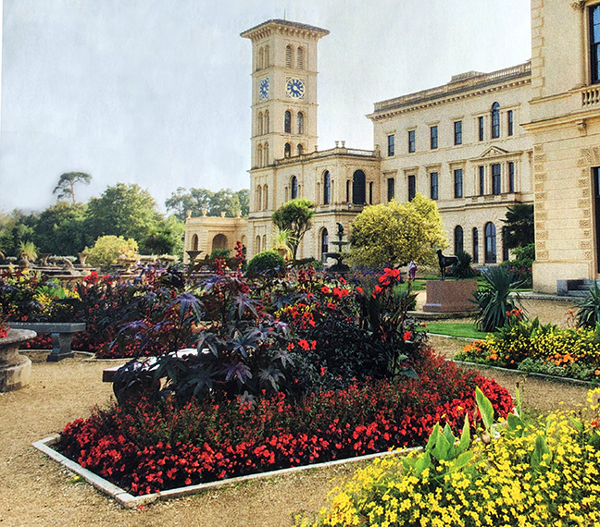
Dahlias and cannas were both wildly popular in the Victorian era, so it’s no surprise that two of our favorites grow today at Osborne House, the lavish country home of Queen Victoria and her garden-loving husband Prince Albert.
In 1845, according to an August 2017 article in The English Garden, “Queen Victoria and Prince Albert, then both in their twenties, bought an estate on the Isle of Wight as a seaside retreat for their growing family.” After building a grand new house, Albert redesigned the grounds, and today, thanks to extensive restoration by English Heritage, they once again reflect his vision.
“Rather endearingly, Albert is reputed to have directed work on the Osborne landscape by semaphore from the Pavilion flag tower. Victoria seems to have been less enthusiastic, complaining in her diary of the time he spent planting and pruning. In 1848, at the height of the planting operations, she spent a record 123 days on the estate so as to see as much of him as possible.”
Today “the intricate design of the parterres which was lost when the terraces were grassed over has been recreated.” ‘Bishop of Llandaff’ dahlia stars there in a dramatically dark composition with bronze-leaved castor beans, red salvia, and red-and-bronze-leaved begonias.
The lovely ‘Ehemanii’ canna with its dangling bells of deep rose-pink is also featured at Osborne House where a long row of it flowers exuberantly in the former kitchen garden. (See it at our blog.)
Even if you don’t have 200-acre estate, you can garden with a touch of royal style by planting ‘Bishop of Llandaff’ this spring (and save 20%!) or by signing up for an email alert when ‘Ehemanii’ – which sold out last month in just three days – is available again.
Cheerio! (April, 2019)
BMOC – Big Yellow Mystery Daffodil Thrives in Zone 8b/9a Louisiana
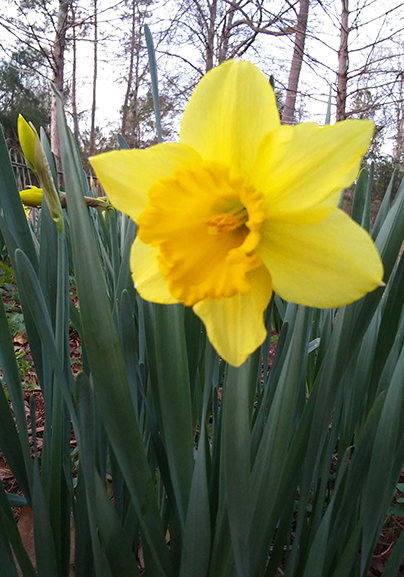
“These big yellow daffodils have multiplied and bloomed prolifically for us here,” wrote our good customer Carlos Doolittle, landscape manager at Southeastern Louisiana University, “and I’m hoping you can help me learn their true identity.”
The photos Carlos attached – including the one here – showed a Division 2/large-cup daffodil with petals a shade lighter than the cup, and he told me they usually started blooming in early February.
Since very few “big yellow daffodils” do well in climates that are as hot and wet as it is at SLU – which is 45 miles northwest of New Orleans, right on the border of zone 8b and 9a – I was intrigued.
“About a decade ago,” Carlos wrote, “an elderly lady, Mrs. Vertalie Blaylock, of Loranger, Louisiana, shared daffodils with my grandmother. They multiplied rapidly, and I transplanted some to my home and eventually to campus. Everywhere I have planted them, they have multiplied rapidly.”
Since there are literally thousands of varieties of big yellow daffodils, at first I worried that identifying this one would be a hopeless task. But after Carlos sent me measurements of its petals, cup, and foliage, and then described its scent as honey-like, I began to feel more optimistic.
I asked him to send his photos and information to a couple of friends who know a lot more about Southern daffodils than I do – Sara Van Beck of Georgia (and formerly Florida) and Greg Grant of Texas – and I’m happy to say we all came to the same conclusion: Mrs. Blaylock’s daffodil is probably ‘Carlton’.
“That’s what it looks like to me,” Greg said, adding that ‘Carlton’ is “the most dependable yellow daffodil here” in north-east Texas.
Sara agreed, and in her book Daffodils in Florida, she says ‘Carlton’ “should be the backbone of any daffodil bed” in the Deep South, partly because it’s “the most resistant (of the large yellows) to basal rot” which can wreak havoc on daffodils in hot, wet soils.
Carlos was happy to finally have a name for Mrs. Blaylock’s daffodil, especially since he’s planning “to eventually have masses of daffodils as a signature of our campus landscapes.” Daffodils, he says, are the perfect choice because “not only do their bright yellow blooms bring cheer during the dreary days of winter, but our campus colors here at Southeastern are green and gold.” (March 2019)
Watch New Ryan Gainey Film in Atlanta Feb. 27 – or the Trailer Now
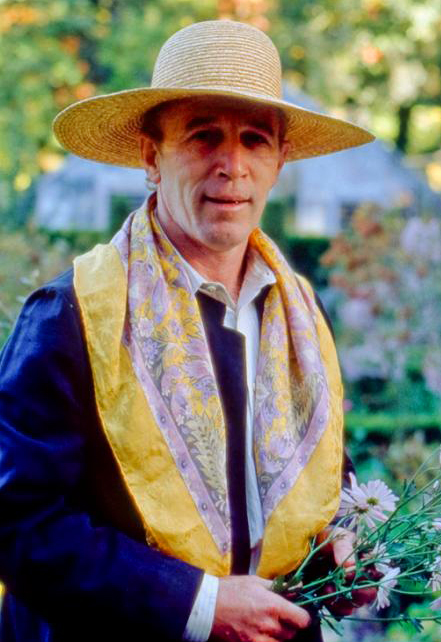
Fans of Ryan Gainey, the revered Southern garden designer and heirloom-plants lover, have been giving two thumbs up to The Well-Placed Weed: The Bountiful Life of Ryan Gainey.
The 2018 documentary interweaves shots of Gainey’s romantic, heirloom-filled garden with excerpts gleaned from a series of interviews that ended just a month before Gainey died in a house fire in 2016.
As the Cherokee Garden Library noted in a recent press release, this film is the first to “examine the complexities” of Gainey’s life. “He was a contradictory character, both off-putting and tender, self-absorbed and generous, artificial and authentic.” His home garden which was his masterpiece was, “as he often said, a ‘garden of remembrance’ where his old friends and family lived on in the overlapping blooms of heirloom plants.”
You can watch a 90-second trailer of the film, or a four-minute excerpt (accompanied by an excellent article), or buy the DVD, or – best of all – you can watch it at a special screening followed by a Q&A with the filmmakers on Wednesday, Feb. 27, at the Atlanta History Center. (Feb. 2019)
Posh UK Magazine Heralds “Modern Era” of “Truly Sophisticated” Glads
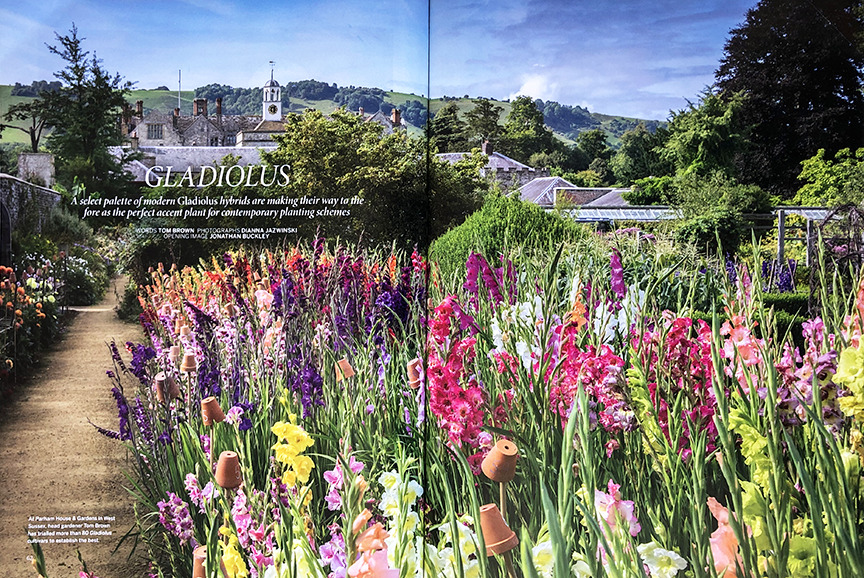
When the classy British magazine Gardens Illustrated devotes eight pages to gladiolus, you know they’re no longer just supermarket flowers.
Indeed, a “modern era of gladioli has arrived” writes Tom Brown, head gardener at Parham House and Gardens where he conducted a major trial of glads in 2017.
Although for some gardeners, he admits, glads will be “forever associated with outrageous taste,” today “subtler and more compact cultivars are beginning to push their way above the crowd.” Many of these are “truly sophisticated, associating beautifully with other late-summer performers” in the garden or bouquets.
Although most of the glads Brown mentions are too new for our catalog, one subtle older beauty he praises is the Abyssinian glad, G. callianthus ‘Murielae’. With “nodding, fragrant flowers that are an absolute delight,” this Award of Garden Merit winner “offers great versatility, and is equally superb in containers, borders or in a vase.”
“Of course, if you’re looking for loud and proud,” he continues, “there are also more traditional-looking, ruffled gladioli cultivars such as ‘Priscilla’. “The challenge when using these in a cut-flower arrangement is finding companions that will stand up to them. In this case look no further than dahlias, zinnias, and sunflowers to complement” your glads.
Glads are also great for “the late-August gap,” Brown says, “that period when late-season perennials are still gathering momentum but summer favorites are starting to struggle. Step up gladioli, igniting fireworks in the front, middle, and rear of our borders and blowing the lid off our creativity.”
“So my advice,” he concludes, “is banish all thoughts of brash and gaudy. Instead, experiment and indulge your garden and your vases with bold and beautiful spikes. In short, allow yourself to be seduced afresh by the vintage glamour and the contemporary charms of gladioli” – which you can order now for April delivery! (Feb.
Out with the Old? Is Sustainability a Threat to Historic Gardens?
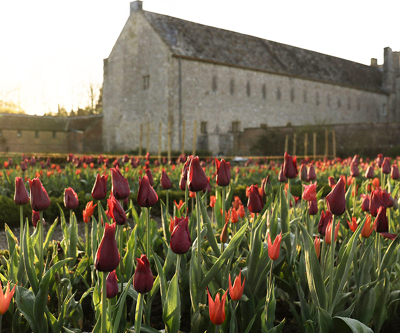
Like many young people, Joshua Sparkes is full of new ideas. But he also has a deep appreciation for the past, which is a good thing since he’s the new head gardener at England’s 900-year-old Forde Abbey.
Originally built as a monastery, the Abbey has been a private home since the mid-1500s. Sparkes arrived there recently after five years in the Royal Air Force followed by hort school and four years at one of the world’s most famous gardens, Sissinghurst.
Interviewed in last month’s Gardens Illustrated, Sparkes was asked what he thought was the “biggest challenge facing gardeners today.”
“I worry about the future of historic gardens,” he said, “as the trend moves towards ‘sustainable’ and ‘ecological’ gardening, which seems only to include one esthetic. Sustainability needs to be considered in a sympathetic way that maintains the unique character of a garden, retaining its history without branding certain practices and designs as wrong. We can manage all gardens in a sustainable way, whatever their style.”
Amen! Like native plants, sustainability is critically important, but it can’t be the only priority in our gardens. Balance is essential in all aspects of our lives, and extremism – even in the service of worthy goals – often leads to more problems than it solves.
Learn more about Forde Abbey (and see a great photo of it with thousands of crocus blooming in the lawn), its magnificent gardens, and Sparkes’ plan for gardening more sustainably with tulips. (January 2019)
Van Gogh’s Tuberoses
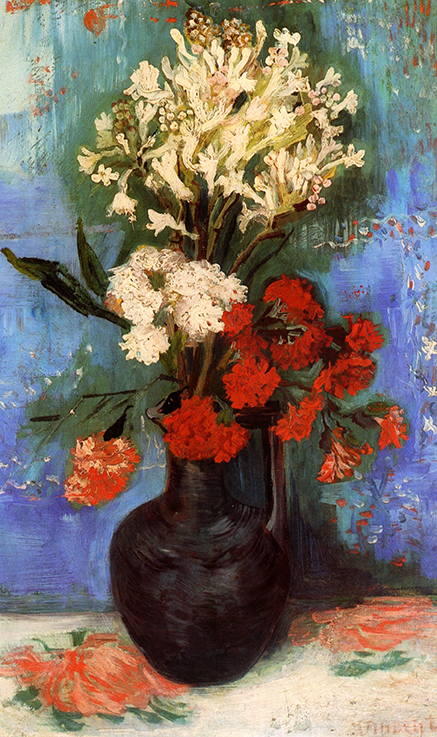
Van Gogh was a flower-lover, to judge by the many paintings he made of them. His sunflowers, of course, have become iconic, and his magnificent Irises sold in 1987 for a record-breaking $54 million. But there are scores of his lesser-known flower paintings in museums around the world.
Leafing through a Van Gogh book the other day, I came upon this painting titled Vase of Carnations and Other Flowers. Taking a closer look, I noticed that the starry white flowers at the top are tuberoses! In fact, to my eye they’re such a dramatic and important part of the painting that it might better be called Vase of Tuberoses and Other Flowers.
Van Gogh painted it in 1886, shortly after moving to Paris and beginning to favor the brighter colors and bolder brushwork of the Impressionists. At that time tuberoses were so popular that a Boston writer wrote that “everyone who has a garden knows the tuberose” – and their fragrance today is just as wonderful as it’s always been.
You can view this painting in person at the Kreeger Museum in Washington, DC, and you can enjoy the same flowers that inspired Van Gogh by ordering your own tuberoses now for planting this spring. (December 2018)
How Old is That Lawn Mower? Part 1
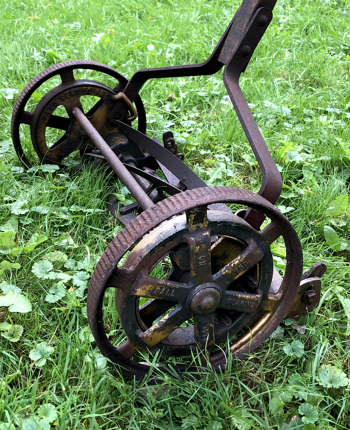
My neighbor Mark was cleaning out his garage when an old lawn mower caught my eye. “That’s cool,” I said. “Do you want it?” he asked and – me being a fan of all things garden-historic – of course I said yes.
But how old was it? With its cast-iron wheels (image #1; for larger versions of all images, see our blog) and smooth wooden hand-grips, I figured it dated to maybe the 1930s or ’40s, but I soon found out that I had a lot to learn about mowers.
The first lawn mower (image #2) was invented in 1830 by Englishman Edwin Budding who was inspired by a machine that trimmed the nap off cloth. Before that, most lawns were cut with scythes – if they were cut at all – which was time-consuming and expensive.

Budding’s mower was a hit. “It promises to be one of the greatest boons that science has conferred on gardeners in our time,” wrote the era’s leading horticulturist, John Claudius Loudon, adding that wealthier land-owners could now “indulge in a garden luxury which, if they had to procure it by manual labor, would probably long remain beyond their reach.”
The first mower to reach the US arrived in 1850, imported by a wealthy garden-lover for his Hudson River estate. Five years later his enterprising mechanic was building and selling the first American-made mowers.
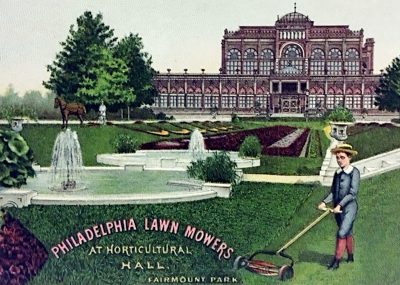
“Side-wheel” mowers like mine (image #3) were patented in Philadelphia in 1869, and the design has changed little since then. Unlike earlier mowers which used a roller in back to turn a large wheel on one side which then spun the cutting blades, these simpler new mowers used a pair of smaller wheels set on the sides to power the blades. Since they were lighter and had fewer moving parts that could go wrong, they soon became the most popular style. By the 1890s, they were being produced by scores of small factories throughout New England and the Midwest.
A paper label glued to the handle of my mower reads “Van Camp Hardware & Iron Company, Indianapolis,” so at first I figured that’s who made it. Then I discovered a patent date cast into one of the wheels – Sept. 12, 1899 – and traces of red and gold paint on the wheels and iron arms.
Those clues led me to the former Lawn Mower Capital of America and helped me learn a lot more about my mower’s history – which I’ll share with you in our next newsletter. (December 2018)
Garden like the Queen

An old friend of ours has been hanging out with Queen Elizabeth.
“Hey, that looks like ‘Deuil du Roi Albert’,” I said to myself while paging through the October 2017 issue of The English Garden – and sure enough it was, growing at Sandringham, the Queen’s 20,000-acre estate in the Norfolk countryside.
Sandringham, I learned, has been the private home of four generations of British monarchs. It’s where – as fans of the TV show The Crown may recall – Elizabeth’s father loved to hunt and where the royal family spends most Christmases.
Sandringham’s gardens are “peppered with tender exotics and a vibrant display of late summer dahlias” in a “distinctively Edwardian approach” that hearkens back to the first decade of the 20th century when Victorian flamboyance was giving way to Arts and Crafts naturalism.
“The same dahlias have been grown at Sandringham for 30 years,” the article explains, “but the names they are known by come from their original labels, which can suffer from ‘gardeners’ spelling’ and slightly idiosyncratic ideas about naming.” That’s certainly true of ‘Deuil du Roi Albert’ – “Mourning for King Albert” – which at Sandringham goes by the much livelier name of ‘Duel du Roy’.
Whatever you call it, ‘Deuil/Duel’ is truly a dahlia fit for a queen, and – although our stock this year is limited – you can order yours now for April delivery.
The Heirloom Daffodil Orchard at England’s Felley Priory
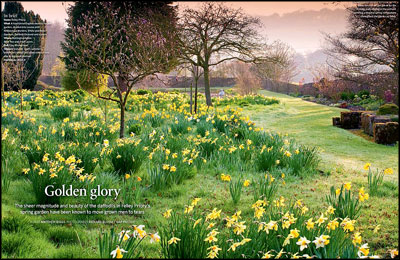
Featured on the cover of Gardens Illustrated, Felley Priory’s Daffodil Orchard is the “crowning glory” of its “renowned gardens” – and filled with nothing but heirlooms.
The Priory has been in the Chaworth-Musters family since 1822, but most of the daffodils were planted in the 1940s. Since then, many of their names had been lost, so the Priory asked three experts – including our friend Ron Scamp – to help identify them.
Among those they recognized were ‘Beersheba’, ‘Mrs. R.O. Backhouse’, ‘Trevithian’, ‘Van Sion’, and ‘W.P. Milner’, but many others “were deemed to be natural hybrids . . . or old cultivars whose names have been lost.” Nameless or not, the Priory’s daffodils were so impressive that the experts “were spotted standing under an old pear tree, dabbing their eyes with their handkerchiefs, overwhelmed by the magnitude and beauty of the display.”
The article also includes photos of “12 Great Cultivars for Naturalizing,” which you can view at our blog. We offer eight of them: ‘Bath’s Flame’, ‘Beersheba’ (“attracts the notice of all by its glittering whiteness,” said the great E.A. Bowles), ‘Croesus’, ‘Lucifer’, ‘Mrs. R.O. Backhouse’ (named by breeder Robert Backhouse in memory of his wife), ‘Sulphur Phoenix’ (“double flowers of bright lemon and pale cream with good weather resistance”), ‘Van Sion’, and ‘W.P. Milner’ (named by breeder Henry Backhouse for his brother-in-law).
Even if – alas! – you don’t have an old orchard, you can start your own magnificent display of long-lived heirloom daffodils by ordering now for October delivery. (Sept. 2018)
The Best Water for Your Garden – in 1686
Water is an essential part of life – especially the life of gardeners. If you spent too much time this past summer dragging the hose around like we did, this excerpt from John Evelyn’s 1686 Directions for the Gardener at Says Court is for you.
“The best water,” Evelyn wrote, “is from rivers and running streams [rather than from a well or spring] so it be not too lean and cold.
“That which is always standing or shaded corrupts and is not good, but the water of ponds, and wherein cattle soil, is excellent, [and] rain water has no fellow.
“If water be too thin and poor, enrich it with the dung of sheep or pigeons by hanging a basket full of it into the water and letting it steep. Cow dung is also profitable. [However] water over-dunged brings a black smut on orange leaves, etc.
“If you be necessitated to use cold raw spring water, let it stand a while in the sun, and therefore keep always ready an infusing tub or vessel. Four gallons of heated water qualifies 20 gallons to milk-warm.”
Who knew water could be so complicated, eh? But as you may have already discovered – and Evelyn’s gardener probably wanted to tell him – you don’t have to do everything perfectly to have a wonderful garden. Hopefully yours made it through the summer just fine, even if you didn’t water it with milk-warm, dung-enriched river water. (Sept. 2018)
Our Immigrant Gardens
With the national debate on immigration raging, and Independence Day just past, We’ve been thinking a lot lately about the plants in our gardens that have come from other countries.
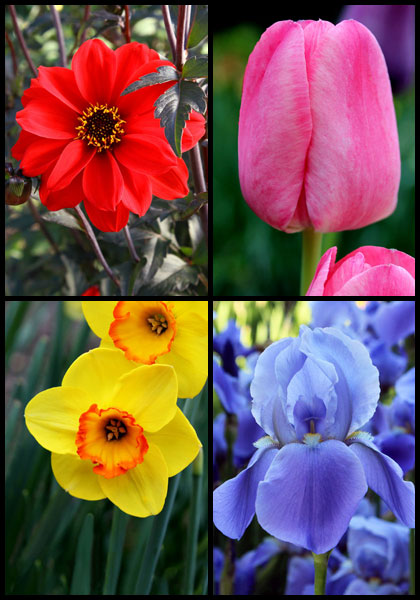
From tulips and peonies to dahlias and iris, our gardens are filled with immigrants. And although it’s possible to have a garden of only native plants, I think gardeners of all persuasions would agree that our lives have been enriched by 99% of the once-foreign flowers that have made themselves at home here.
So here’s a list of where the bulbs we offer came from originally. As you may notice, some are listed in more than one area because, to Nature, it’s all one world.
Mexico and South America – dahlias, tuberoses, rain lilies, oxblood lily.
Africa – gladiolus, freesia, crocosmia.
China, Japan, and Korea – most peonies, many daylilies, tiger lilies, Formosa lily, gold-band lily, red spider lily, pink surprise lily.
Asia from Turkey and Syria to Afghanistan and Mongolia – tulips, hyacinths, crocus, bearded iris, regal lily, Madonna lily, Byzantine glads, Elwes snowdrop, Turkish glory-of-the-snow, Allium sphaerocephalum, sowbread cyclamen, sternbergia, Siberian squill (which, despite its name, is not from Siberia).
Europe – daffodils, bearded iris, crocus, martagon lilies, Madonna lily, Byzantine glads, lemon daylily, traditional snowdrops, snowflakes (Leucojum), Spanish bluebells, winter aconite, snake’s-head fritillary, Grecian windflower, Allium sphaerocephalum, sowbread cyclamen, sternbergia.
North America –trillium, jack-in-the-pulpit, Dutchman’s breeches, Lilium superbum. (July 2018)
Two Cedric Morris Exhibits – and Skyrocketing Prices
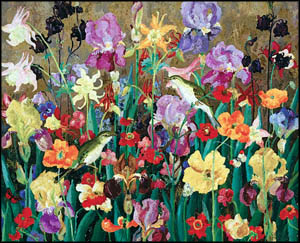
Appreciation continues to grow for artist and iris breeder Cedric Morris whose peachy-pink ‘Edward of Windsor’ sold out early for us this past spring.
In London, two exhibits of Morris’s work are drawing crowds. His landscape paintings are featured at the Philip Mould Gallery in “Cedric Morris: Beyond the Garden Wall,” while his flower paintings are showcased at the Garden Museum in “Cedric Morris: Artist Plantsman.” The Garden Museum exhibit was accompanied in season by a display of Morris’s iris organized by the celebrated garden designer Dan Pearson.
Prices for Morris’s paintings are also skyrocketing – up 1,500% since 2014 according to a recent article in the London Telegraph. Last fall a couple of his landscapes from David Bowie’s personal art collection sold for over $65,000 each, but that’s small change compared to the prices being fetched by his flower paintings “which have raced ahead, like tulip mania.” The record was set last August by July Flowers and Wood Warblers (pictured here) which a London gallery bought for $223,000 – and which is now being offered for just under $400,000.
Although Morris’s paintings may be beyond the reach of most of us, his ‘Edward of Windsor’ iris is much more affordable. For an email alert when it’s for sale again July 1 (along with the rest of our spring-planted bulbs), simply click the link now in our description of it online. (June 2018)
Multiplying Hyacinths in 1896 and Today
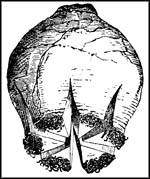
Daffodils, tulips, and most other bulbs multiply naturally underground by producing offsets or daughter bulbs. Roman hyacinths do, too, but – after centuries of breeding – traditional garden hyacinths reproduce so slowly this way that bulb growers long ago developed ways to speed up the process. The techniques described below by Liberty Hyde Bailey in his 1896 Nursery Manual would have been familiar to bulb-growers a century earlier and are still standard practice in the Netherlands today.
Bailey starts by explaining that “bulbels are often produced by an injury to the bulb. Growth of stem and leaves is more or less checked and the energy is directed to the formation of minute bulbs.” It’s the bulb’s natural reaction to injury that growers take advantage of in multiplying hyacinths.
“The favorite method is to make two or three deep transverse cuts into the base of the bulb [image 1]. The strongest bulbs should be chosen, and the operation is performed in spring or early summer, when the bulb is taken up.”
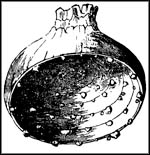
In another method, “the bulbs are hollowed out from the underside for half or more of their depth [image 2]. This operation is sometimes performed later in the season than the other, and precaution should be exercised that the bulbs do not become too moist, else they will rot. . . .
“The mutilated bulbs are stored during summer, and are planted in fall or spring. The wounded bulbs produce very little foliage, but at the end of the first season the bulbels will have formed. The bulbels are then separated and planted by themselves in prepared beds.
“Several years are required for the bulbels to mature into flowering bulbs. Some of the strongest ones may produce flowering bulbs in three years, but some of them, especially those obtained from the hollowed bulbs, will not mature short of six years.”
Could you do this at home? Of course – and now’s the time for it. If you do, please share your story (and photos) with us. Good luck, and have fun! (June 2018)
Art from the Garden: Manet’s Peonies
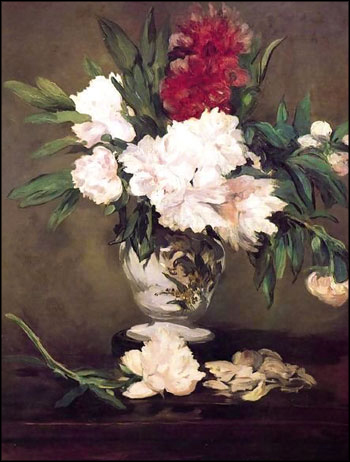
As the buds on our peonies here in Ann Arbor swell with promise, I’ve been thinking about the great French artist Edouard Manet, whose ground-breaking works helped to launch Impressionism and changed art as we know it forever.
In 1864-65, just after he exhibited his best-known work, the scandalous Luncheon on the Grass, Manet made several paintings of peonies, including Peonies in a Vase on a Stand, pictured here. According to a 1983 exhibition catalog published by the Galeries Nationales du Grand Palais in Paris, these works “painted at the peak of his artistic vitality are allegories of vanity . . . [and] the transience of beauty,” as were many of the magnificent Dutch flower paintings of the 1600s.
“Van Gogh was much struck by this painting,” the catalog continues, “and mentions it at a time when he was himself working on a flower series: ‘Do you remember that one day we saw a very extraordinary Manet at the Hôtel Drouot, some huge pink peonies with their green leaves against a light background? As free in the open air and as much a flower as anything could be, and yet painted in a perfectly solid impasto.’”
Unfortunately, although Van Gogh described the peonies as pink, they look white today because the pigments Manet used have deteriorated over time – a problem which has also afflicted several of Van Gogh’s works including Vase with Pink Roses, now at the National Gallery in Washington, DC.
At the time Manet painted this image, peonies were held “in high esteem, recently introduced into Europe and still considered an item of luxury,” which would have made the painting especially appealing to Manet’s “elegant clientele.” More importantly, though, “Manet simply liked peonies. He grew them in his garden at Gennevilliers, and their exuberance . . . was in perfect harmony with his generous and sensuous brushwork.”
See more of Manet’s peony paintings at Google Images – and then garden like the master himself by ordering your own peonies now for delivery this fall! (May 2018)
Preserving Plants at Home – Together
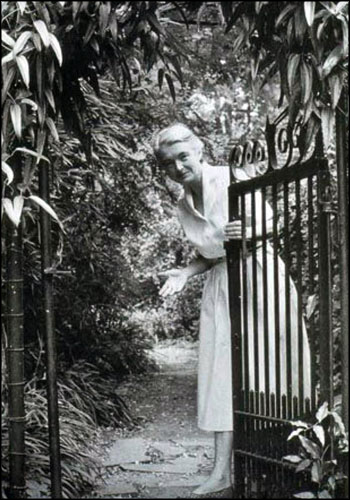
“I belong to that great fraternity whose members garden for love,” the eminent Southern garden writer Elizabeth Lawrence wrote in 1981. “They are called Brothers of the Spade” – a term first used in the 1700s by the great British plant collector Peter Collinson.
“Some own estates, some are directors of botanic gardens, and some have only small back yards,” Lawrence continued, but all are “amateurs in the true sense of the word – they garden for love.” (The Latin root of amateur is amare, to love.)
Together these garden lovers “keep in cultivation many a valuable plant that would otherwise be lost. Among them they preserve a reservoir of plants that could never be collected in any one place, even an institution, for the preservation of plants depends upon individual efforts, and it is only in private gardens, in lonely farm yards, and around deserted houses that certain plants no longer in the trade are found.”
Are you gardening for love? Are you nurturing plants in your garden that have all but disappeared everywhere else? If so, you’re one of us, and we’re proud to be gardening alongside you in the immortal Fellowship of the Spade! (May 2018)
When Fort Meyers was the Gladiolus Capital of the World
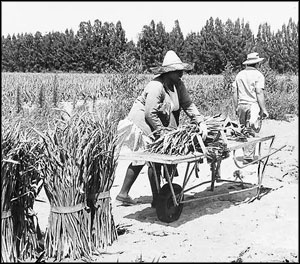
Once upon a time, sunny Fort Myers, Florida, was not just a popular vacation destination, it was also the gladiolus-growing capital of the world, with local farms shipping some 500 million stems a year to florists throughout the US and overseas.
It all started in 1935 when two successive winter freezes in central Florida drove gladiolus growers further south to the Iona area just outside of Fort Myers. Within a decade, 30 growers were cultivating some 2500 acres of glads there.
Gladiolus at the time were hugely popular. Not only were they showy and easy to grow but their long vase life made them the perfect cut-flower. Every year gladiolus societies across the country displayed thousands of spikes in shows that drew tens of thousands of visitors. (See a 1921 glad show here.)
Harvesting the Fort Myers glads started in November and continued into June. According to one grower’s son, “The glads were cut before they bloomed, so a visit to the gladiolus farm was a view of acres and acres of green stalks with workers walking through the fields and cutting stalks with buds soon to bloom. The goal was for the stalks to bloom in the hands of the florist.”
Bundled and packed in hampers, the glads were shipped by air and then delivered by a patchwork of local truckers, all in an era before UPS and FedEx. Sometimes they traveled in the climate-controlled trucks of Purolater Courier whose main business was delivering celluloid film reels – which could burst into flames if they got too warm – to movie theaters.
Even in the Fort Myers area, growers sometimes needed to protect their crops from frost. At first they burned old tires to create heat and a protective blanket of smoke. (Don’t try that at home!) Later they turned to oil-fired heaters along with crop dusters to circulate the air over the fields.
Nothing lasts forever, though, and by the 1970s most glads sold in the US were being flown in from overseas where both land and labor were cheaper. One by one the Fort Myers growers sold their fields to developers, and by 1980 the area’s reign as the gladiolus capital of the world was just a memory.
To learn more, read the recent article in the Fort Myers News-Press.
To make your yard the gladiolus capital of your neighborhood, order now for spring-planting! (April 2018)
Searching for the Lost Daffodils of Reverend Engleheart
You may not know it, but if you love ‘Beersheba’, ‘Lucifer’, or ‘White Lady’, you’re a fan of the Reverend George Engleheart.
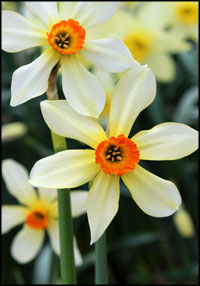
One of the greatest daffodil breeders of all time, Engleheart introduced some 700 named varieties starting in 1889. Although most of these have been lost over the years, a brand new National Collection in England is hoping to find and preserve as many as they can.
Engleheart was the vicar of a small country church when he first started breeding daffodils in the 1880s. Once a minor garden flower, daffodils at the time were on the rise, championed as perennial, graceful, and old-fashioned – heirloom, that is! – in contrast to the new, brightly colored exotics that filled Victorian carpet beds and conservatories.
Engleheart was so devoted to his daffodils that it’s said parishioners would sometimes find a note tacked to the church door reading, “No service today, working with daffodils.” His place in daffodil history was assured in 1898 when he sold three bulbs of his vividly orange-cupped ‘Will Scarlett’ for the equivalent today of over $12,000.
The new National Collection holds just 34 of Engleheart’s 700 daffodils, with another four located but not yet in their hands. To help them find more, the Collection’s Anne Tweddle asked us to spread the word about their project, so that’s what we’re doing.
Of the 34 they grow, we’re currently offering six for delivery this fall – ‘Bath’s Flame’, ‘Beersheba’, ‘Cassandra’, ‘Firebrand’ (pictured here), ‘Lucifer’, and ‘White Lady’ – and in the past we’ve offered six others that we’ll offer again once our stocks increase – ‘Albatross’, ‘Argent’, ‘Brilliancy’, ‘Horace’, ‘Seagull’, and ‘Will Scarlett’.
For more about Engleheart and the Collection, and to see photos of 23 of his daffodils, go to suffolkplants.org.uk/national-collections/narcissus. For a complete list of his 700 introductions, enter Engleheart in the Hybridizer box at daffseek.org. And if you know where the Collection can find any they don’t already have, Anne would be very happy to hear from you at anne@tweddle1.co.uk. (April 2018)
Fabulous Facebook Page for Historic Iris
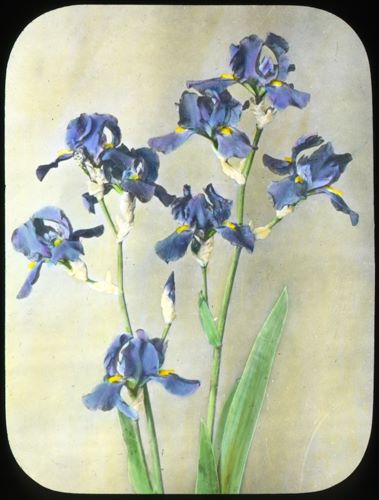
If you’re a fan of heirloom iris, and you’re on Facebook, we think you’ll enjoy the Facebook page of the Historic Iris Preservation Society.
Launched in 2011, it includes antique images and modern photos along with helpful tips and occasional links to other online resources. It has over 3000 followers, including us, and you could be next! Check it out at facebook.com/HISTORICIRIS/. And bravo, HIPS! (Mar. 2018)
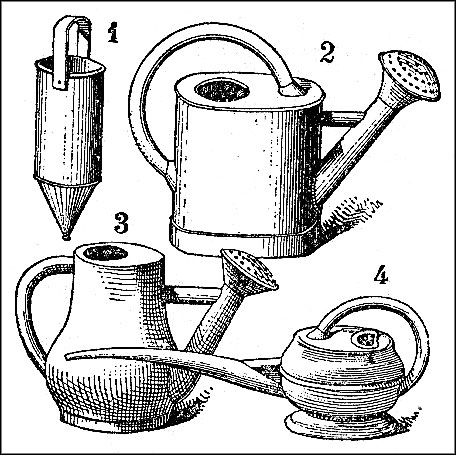
Flower Pot Diversity in 1859
The past is full of a rich diversity of plants – and flower pots.
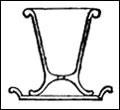
In his 1859 Manual of Practical Gardening, George Glenny wrote that “there is nothing half so good as the old-fashioned pots” which looked just like the clay pots we use today except that their rims were narrow. They were offered in 23 different sizes, starting with two-inch “thumbs” and increasing inch-by-inch all the way up to pots 24 inches across.
Glenny describes some more unusual pots, too.
“Some pots have been made with feet to stand in saucers [pictured above] to keep the bottom drain-hole out of the water that runs through. . . .
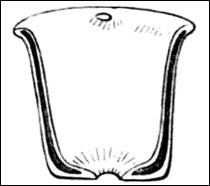
“Others have been made with hollow sides to be filled with water [pictured left], that the sun may not burn the young fibers [roots] next the side.
“Some are made with gutters all round the top rim, that a glass shade may cover the plant; and the edge being in this gutter filled with water [which] excludes the air, these are admirably adapted for fern-growing in dwelling-houses, each being, so far as the plants are concerned, a small Wardian case [terrarium].”
Even more unusual was the verbena pot, pictured below. Verbenas, introduced from South America in the 1820s, were wildly popular, and British potteries responded by developing a special pot to display their sprawling growth.
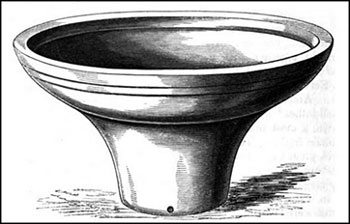
“The body of the [verbena] pot is like another,” Glenny wrote, “but the upper part, occupying one-third of the whole height, they turn outwards and form a broad dish, giving us a surface, twelve or fourteen inches in diameter, on which we can spread and peg down the plant to cover the whole. It has been usual to grow them in large pots, and have a round wire about two inches above the pot, and so tie the plant down upon it to cover it. These [verbena] pots will doubtless become popular for that purpose. They are light, compared with a fourteen-inch pot, and yet possess all the advantages of one that size; and we must admit that the appearance is greatly before [better than] a platform of wire-work.” (Mar. 2018)
When ‘White Aster’ Really Looked Like an Aster
In 1879 a customer wrote to nurseryman James Vick, editor of the popular Vick’s Illustrated Monthly, praising a white dahlia that was “the prettiest thing I ever saw” with flowers that “didn’t look much like dahlias, but more like asters.”
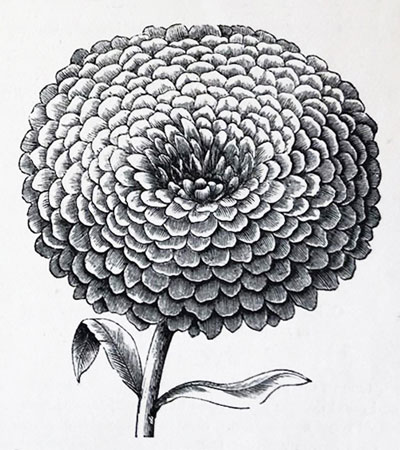
Vick explained that “this class of dahlias is called Pompon or Bouquet,” and added that “there are two very good white sorts, White Aster and Little Snowball.”
But do the globe-shaped flowers of ‘White Aster’ really look like asters?
Not compared to the perennial asters that are commonly grown today, but back in 1879 the most popular asters – by far – were the annual bedding plants known as China asters, Callistephus chinensis. Vick devoted an entire page of his 1872 catalog to images of them, including ‘Imbrique Pompon’, pictured here. Although it’s an idealized image, I hope you agree that it looks something like a pompon dahlia – and some modern China asters do, too.
But originally ‘White Aster’ looked even more like an aster because its petals were notched at the tip, making them look narrower, more numerous, and, well, more aster-like. You can see what I mean in the color image here which is part of a full-page chromolithograph published in Vick’s Monthly in 1878. (See the entire image at our blog.) Although none of the dahlias in the image are labeled, I’m virtually certain that’s ‘White Aster’.

Dahlia genetics are complex and unstable, though, and sometime during ‘White Aster’s long history its DNA apparently reverted to producing normal, rounded petals. (Something similar seems to be happening with ‘Old Gold’, whose petals are sometimes notched and sometimes not.) The change must have occurred sometime after 1956 because the de Jager catalog that year describes ‘White Aster’ as having “lovely laciniated flowers.” Although nowadays “laciniated” refers to the fringe-like petals of dahlias such as ‘Tsuki Yori no Shisha’, its dictionary definition is simply “cut into narrow lobes; slashed; jagged.”
Of course it could be that today’s ‘White Aster’ is simply an impostor substituted for the real thing sometime between 1956 and when we first acquired it 50 years later from one of Germany’s oldest and most respected dahlia nurseries – but, at least for now, I’m willing to give it the benefit of the doubt and believe that it’s the real thing minus the notching.
Could the notching reappear someday? Yes! So please keep your eyes peeled and if you ever find a notched bloom on your ‘White Aster’, contact us ASAP. With a little luck we might be able to root a cutting and eventually re-introduce the original, more aster-like ‘White Aster’.
(Thanks to garden historian Thomas Mickey who inspired this article and shared the amazing chromolithograph with us. Read Tom’s blog post “Victorian Dahlia ‘White Aster’ Still Shines” and more at American Gardening.net.) (Feb. 2018)
Eudora Welty on Gardening, Creativity, and Where the Wonder Is
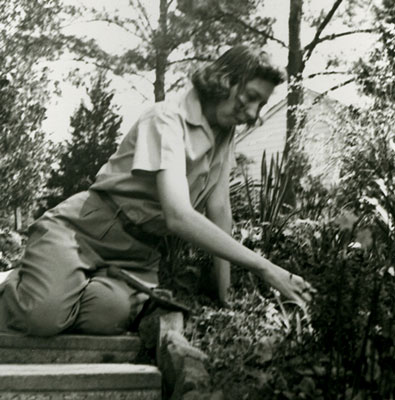
That’s not just any woman weeding her garden in this 1940s photograph – that’s the iconic Southern writer Eudora Welty.
Welty was a lifelong gardener, and in a conversation shortly before her death in 2001, she talked about gardening, her work as a writer, and finding wonder:
“I think that people have lost the working garden. We used to get down on our hands and knees. The absolute contact between hand and the earth, the intimacy of it, that is the instinct of a gardener. People like to classify, categorize, and that takes away from creativity. I think the artist – in every sense of the word – learns from what’s individual; that’s where the wonder expresses itself.” (Feb. 2018)
Who’s That Growing in My Garden? David Howard, Dahlia and Man

With its dark foliage and apricot-orange flowers, ‘David Howard’ is one of our most popular heirloom dahlias.
But who was David Howard?
Back in the late 1950s he was just a British teenager who’d always loved plants. Instead of raising hell he was raising dahlias from seed, and – according to a 2004 article in The Telegraph – “one of these, a seedling from Dahlia ‘Bishop of Llandaff’, was taken up by a visiting nurseryman, who named it ‘David Howard’.” Introduced in 1960, it became “an instant hit with gardeners and it remains one of the best dark-leaved dahlias around” – so good that it’s won the prestigious RHS Award of Garden Merit.
Howard went on to launch his own nursery in 1969 with £50 in the bank and a half-acre of rented land. In time it grew to be as successful as his namesake dahlia, and today Howard Nurseries Ltd. - which Howard runs with his daughter Christine, pictured here - is one of England’s largest wholesale perennial growers, annually producing over two million plants of some 1500 varieties.
Although Howard has always championed the best of the new, “it’s not just new varieties that attract his eye. One firm favorite is a long-established bearded iris called ‘Rajah’ [from 1942], which has rich burgundy falls shot with gold and butter-yellow upper petals.” Howard introduced it to leading garden designers “who have since used it to great effect in several show gardens. Its appeal has filtered down to garden centers” and it’s now a popular iris throughout the UK.
We don’t offer ‘Rajah’ – yet – but you can order ‘David Howard’ right now for planting this spring. Who knows, it may inspire you or a teenager you love to do what David Howard did and follow your garden dreams. (Jan. 2018)
Another Great Winter Read: The Reason for Flowers
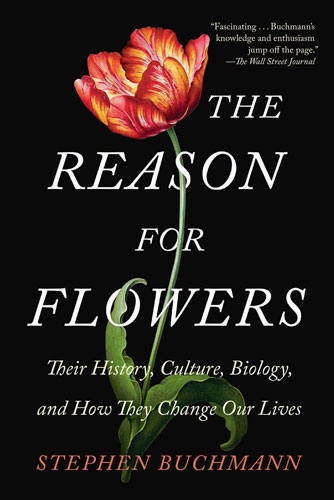
“I am reading an amazing book about flowers,” one of my favorite former employees texted me recently. “It would be great for the newsletter. It is so delightful! I love all of the info on the history of flowers in different civilizations (rituals, architecture, etc.) and learning about the various pollinators.”
As it turned out, I’d bought the book a couple of years ago but set it aside after just a few pages. Brienne’s enthusiasm spurred me to give it another try, though, and I discovered that she was right – The Reason for Flowers: Their History, Culture, Biology, and How They Change Our Lives is a fascinating book.
Here’s my advice, though: skip the first 80-page section about “Sexuality and Origins,” which I found slow going. (The author is an expert on pollination ecology and evolutionary biology so he has a LOT to say about these topics.) Start instead with one of the other sections:
“Growing, Breeding, and Selling,” in which I learned that there’s evidence Neanderthals buried their dead with flowers,
“Foods, Flavors, and Scents,” which includes an ancient Egyptian perfume recipe that starts with 2000 Madonna lily flowers,
“Flowers in the Service of Science and Medicine,” which introduced me to the theory of biophilia, and
“Flowers in Literature, Art, and Myth,” which includes Ezra Pound’s evocative, two-line poem “In a Station of the Metro”: “The apparition of these faces in the crowd: / Petals on a wet, black bough.”
Once you’ve enjoyed these faster-paced sections, all of which are rich with surprising information you won’t find in most garden books, I think you’ll want to go back and read the first section. I know I did. (Thanks, Brienne!) (Jan. 2018)
The First Concrete Sidewalks (And How Old is Yours?)
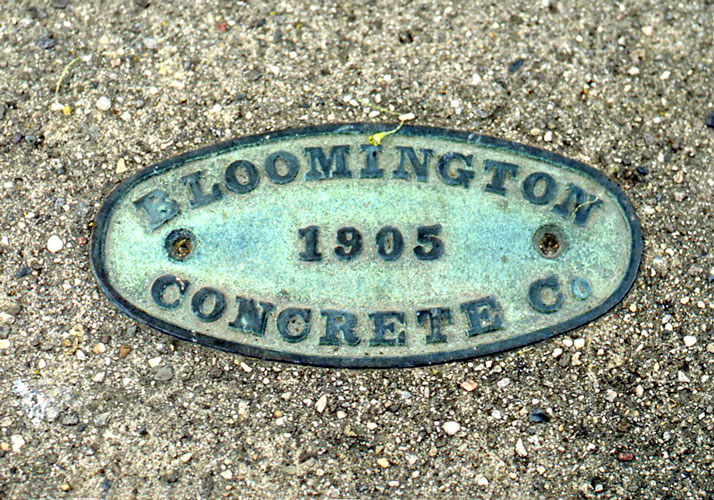
What was snow shoveling like before sidewalks were made of concrete – and when people walked everywhere? Were wooden walks slipperier, or harder to shovel? And what about dirt walks?
These are some of the questions I got to thinking about after reading Albert Baxter’s History of the City of Grand Rapids published in 1891.
The earliest sidewalks, Baxter writes, were “usually voluntarily laid,” as needed, by property owners. “Generally they were only such as were absolutely necessary to keep the feet of pedestrians out of the mud, often not more than two or three feet wide, of planks laid lengthwise rather loosely on sleepers.” Eventually the city replaced these with walks made of “two-inch pine or hemlock plank, in general laid crosswise on stringers and well spiked down.” Widths ranged from four to eighteen feet, with “those in the residence districts averaging six feet.”
Although there were a few “handsome and solid walks of dressed stone,” Baxter notes that “the stone for these is brought mostly from other states,” which no doubt made it quite expensive. In fact, the city hall had stone sidewalks on only three of its sides.
Baxter ends by mentioning recent “experiments” with “walks of artificial stone or concrete made of cement, sand, and gravel. These are molded in blocks to suit the locality, usually of lengths corresponding with the width of the walk, and six or eight inches in thickness. The molding is done on the spot, and when dry and hardened they are apparently as solid as granite rock This walk is handsome and gives promise of being durable and permanent as stone, judging from the short trial it has had here of only two or three years.”
So how old are your concrete sidewalks? In my neighborhood the oldest date-stamped slabs date from the 1920s, but the oldest I’ve ever seen date from the first decade of the century, including the one pictured here in Bloomington, Illinois.
We’ve posted a few more early date-markers at our blog, and we’d love to see the oldest you’ve found. Email us a photo or two and we may publish them in a future article. Happy searching – and shoveling! (Jan. 2018)
Great New Book: Gardening with Laura Ingalls Wilder
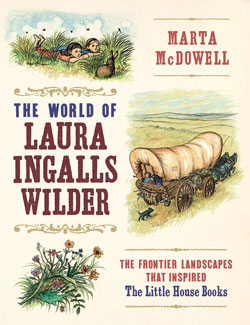
The World of Laura Ingalls Wilder: The Frontier Landscapes that Inspired the Little House Books – Before she was a famous author, Marta McDowell was a customer of ours. (See our blog for a photo of her visiting OHG this past September.) I loved her first book, Emily Dickinson’s Gardens, published in 2004, and since then she’s written three other gems: Beatrix Potter’s Gardening Life, All the Presidents’ Gardens, and now this one.
You don’t have to be a fan of the Little House on the Prairie books or TV series to enjoy it. The illustrations – antique images, original artwork from the books, and historic and modern photos – drew me in immediately, and Marta’s writing reads more like a conversation with a friend than a dissertation. The Wilders homesteaded in a half dozen states, from New York to South Dakota, and their story is more about growing food than flowers, as well as the untamed natural world they lived in.
At the end are chapters on “Visiting Wilder Gardens” and “Growing a Wilder Garden” today, and then just before the index there’s my favorite photo: a snapshot from 1962 of Marta’s family standing in her great-aunt’s backyard – “the flower garden that I imprinted on” – next to a big beautiful swath of tiger lilies. (Dec. 2017)
Iris by an Artist: The Living Masterpieces of Cedric Morris
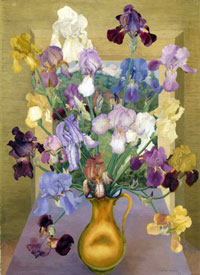
Is it too early to think about spring planting?
Not if you want to snag a rhizome or two of ‘Edward of Windsor’, one of the most intriguing iris we’ve ever offered. Some call it soft pink, others pale orange, but either way it’s a light, dreamy pastel color with a surprisingly bright tangerine beard.
Unusual colors are one of the hallmarks of iris bred by British artist Cedric Morris (1889-1982) whose paintings hang today in museums around the world. Morris painted in what has been called “a distinctive and often rather primitive post-Impressionist style,” and for more than 40 years students flocked to the art school he conducted at his home, Benton End, in the English countryside.
Morris developed extensive gardens there, said to be inspired by Monet’s at Giverny, and in the early 1940s he began breeding iris. He eventually registered 45 of the best with the American Iris Society, often with names such as ‘Benton Rubeo’ (named for his pet macaw) and ‘Benton Cordelia’ (winner of the British Dykes Medal in 1955).
Unfortunately almost all of these had disappeared from commerce by the time Sissinghurst’s head gardener Sarah Cook discovered a long-lost label for ‘Benton Nigel’ in the gardens there. After taking early retirement in 2004, Sarah launched a quest to rediscover all of Morris’s iris, and today she’s nurturing some 25 of them as holder of Plant Heritage’s National Collection of Cedric Morris Iris.
Learn more about Morris and his iris here (although please note that the photo labeled ‘Edward of Windsor’ is NOT that iris), view dozens of his paintings here (you may need to be patient as the images load), and if you like what you see, why not order now to enjoy a bit of his floral art in your own backyard! (Nov. 2017)
Heirloom Gardener Spotlights the “Noah of Hyacinths”

Our good friend Alan Shipp and his ark of hyacinths are featured in the fall 2017 issue of Heirloom Gardener magazine. Editor Rebecca Martin tells the inspiring story of how Alan, a third-generation vegetable farmer, became the world’s leading expert on historic hyacinths and guardian of some 250 rare varieties.
Nine of Alan’s treasures are pictured in the article, and if some of the photos look familiar it’s because you’ve seen them at our website. As Rebecca writes, shortly after Alan sold his first hyacinths he started exporting bulbs to “Scott Kunst, founder of Old House Gardens, who’s also passionate about saving old cultivars. OldHouseGardens.com is a Michigan mail-order company specializing in heirloom flower bulbs, and the exclusive U.S. dealer for Alan’s hyacinths. ‘There’s nothing like a phone call from Alan, out of the blue, telling me about some exciting new hyacinth he’s found,’ Scott says. ‘It’s like the sun suddenly bursting out of the clouds on a beautiful spring day. He’s truly an inspiration and a world treasure.’”
You can read the entire article – and explore Heirloom Gardener magazine – at heirloomgardener.com/profiles/people/heirloom-bulbs-zm0z17fzmar. Although all of Alan’s hyacinths are sold out this fall, seven other fabulous, fragrant heirloom hyacinths are still available – if you order now! (Oct. 2017)
Was Your Street Paved with Wooden Bricks?

Workers repaving a street in Grand Rapids, Michigan, this past August were surprised by what they found buried under the layers of old asphalt – wooden paving bricks from over a century ago, many of which were still in perfect shape.
In his 1891 History of the City of Grand Rapids, Albert Baxter explains that “a change in Grand Rapids pavements from cobblestone to wood was made in 1874. The first wood pavements were made of blocks cut from four-inch pine planks set on end upon a gravel bed, . . . making a wood roadway six inches in depth.” Unfortunately the pine decayed in five or six years, so “the next advance was in the use of cedar blocks.” Cedar is naturally rot-resistant, and “the cedar block has proved much the more durable, and is the popular pavement to this day.”
I learned a lot more about the evolution of the city’s streets in Baxter’s book – and the early history of paving in your city was probably similar to it.
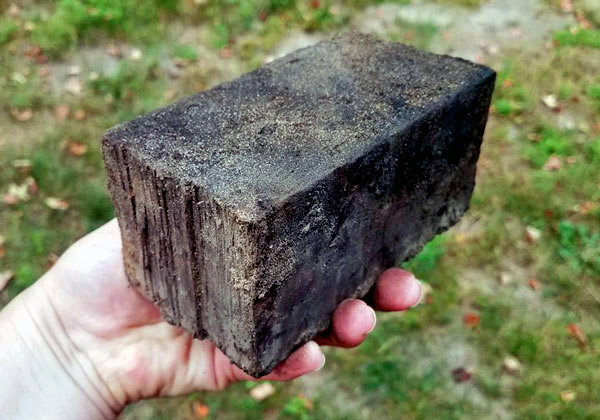
“Naturally the first wagon roads to the village,” he writes, followed “paths which the Indians had trod and were correspondingly crooked.” In 1835 the first right-angled streets were laid out and cleared but otherwise unimproved except for “little plank or log bridges across streams and mud holes.”
Further improvements “involved a vast amount of labor and expense.” Although Grand Rapids isn’t especially hilly, some high spots were cut down by as much as 40 feet and the resulting fill dirt used to raise low-lying streets by up to 15 feet – all without the help of mechanized equipment.
The next advance was paving, with Canal Street “macadamized” in 1847. This relatively new process involved layers of crushed stone that, with use, would bind into a solid surface. Unfortunately the mud under Canal Street proved to be too much for the macadam which was soon riddled with “mire holes.”
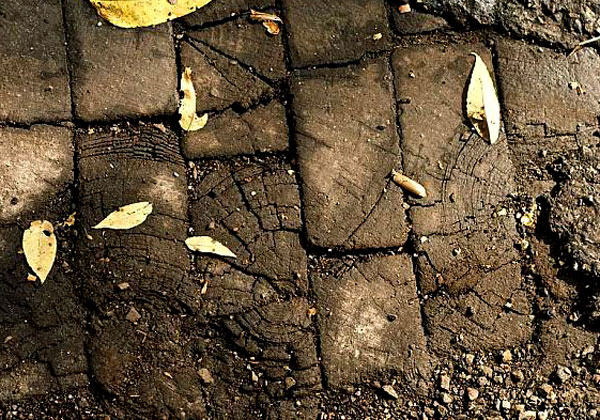
Next the city tried a few sections of wooden plank road, a “passably good pavement,” before turning to cobblestone in 1856. “Cobble stone well laid on a solid even bed is a good pavement, indefinitely durable,” Baxter writes, but it’s “very noisy and hard upon the horses’ feet.”
“During the war period,” he continues, “not much progress was made in paving,” but starting in 1866 some streets were paved with “round stone” – which, as best as I can figure, consisted of smooth, uncrushed stones an inch or two in diameter. (If you know more, please let me know.)
Wooden blocks came next, and “after this little if any stone pavement was laid except along street borders and gutters” – although Baxter does mention recent “experiments” with a brand-new paving material for sidewalks known as “artificial stone or concrete.”
If you’ve read this far, you might enjoy the entire Chapter 50 of Baxter’s History, “Village Roads and City Streets.” As you can probably tell, I found it fascinating. (Oct. 2017)
‘Little Beeswing’ Stars at Hampton Court Flower Show
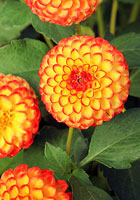
No, that’s not a typo in the title above. We recently learned that the dahlia we’ve always known as ‘Little Beeswings’ – with an “s” at the end – is actually ‘Little Beeswing’ – without the “s.”
Whatever you call it, this cheery little pompon dahlia has been a favorite of our customers ever since we first offered it in 2003. And this past July it was a hit at the RHS Hampton Court Flower Show where it was part of a display by Plant Heritage, the world’s leading non-profit devoted to preserving garden plants.
As Lucy Pitman explains at the Plant Heritage blog, “‘Little Beeswing’ has been offered in the Plant Exchange for several years by a National Collection Holder in Cambridgeshire, he having obtained his original plants from Scott Kunst of Old House Gardens in Michigan. Because this bright Dahlia was flowering so beautifully in perfect time for the RHS Hampton Court Flower Show, it became the star of the show in the Plant Guardian display.”
The National Collection Holder she credits is our good friend Alan Shipp, the Noah of hyacinths, who’s been growing ‘Little Beeswing’ ever since we sent it to him years ago. When Lucy asked Alan about its history, he sent her to us, and after several hours of research in the OHG library and online, here’s what we think we know.
‘Little Beeswing’ (the earliest spelling of its name) was introduced in 1909 (not 1886 or 1938, as some sources indicate) by Keynes, Williams, and Co. (not J.K Alexander), a celebrated nursery in Salisbury, England (not Australia) that introduced dahlias from at least 1863 to 1938. It apparently made its way to the US soon after (not in 1938 as Lucy believed when she wrote her blog). By 1916 it was noted as “new” in a list of “best dahlias” published by the New York Agricultural Experiment Station, and in 1917 it was mentioned in the Bulletin of the Dahlia Society of California.
Learn more at Lucy’s blog post, or simply order ‘Little Beeswing’ now for spring planting. If it can shine at the Hampton Court Flower Show, just think what it can do in your garden! (Sept. 2017)
Mozart’s Starling: Seeing Nature with New Eyes
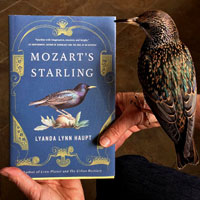
The past is full of surprises, and so is Nature.
Did you know, for example, that Mozart had a pet starling that he loved so much that he held an elaborate funeral for it when it died? Lyanda Lynn Haupt turns this historical tidbit into a fascinating book that’s part biography, part nature study, and part detective novel, as well as a heart-warming memoir of Haupt’s life with her own pet starling, Carmen.
Although starlings today are one of the most reviled birds in North America, outcompeting native birds and destroying some $800 million worth of crops, in Mozart’s time they were often sold as pets. One day as he was walking down the street, Mozart was surprised to hear a starling whistling a phrase from his brand-new piano concerto. Delighted, he brought the bird home where it soon became, in the words of one reviewer, “his companion, distraction, consolation, and muse.”
Starlings, it turns out, are bright, inquisitive, playful, highly sociable, and extraordinary mimics – much like Mozart himself. They are closely related to mynas, and their songs, which have always sounded like random squawking to me, are actually bits of mimicked sounds they weave together into complex, individual compositions.
Haupt’s pet Carmen mimicked everything from the beeping of the family microwave to phrases such as “Hello, honey.” She also turned “my household and my brain completely upside down,” Haupt writes, leading her on a pilgrimage far beyond anything she had envisioned. Their surprisingly intimate relationship gives the book its emotional heart and reminded me of books I once loved such as Rascal and The Yearling.
Mozart’s Starling is both entertaining and inspiring, and you’ll learn a lot from it about birds, Mozart, creativity, animal intelligence, and what we all have in common with wild creatures – including those you may have once scorned as nothing more than pests. (Sept. 2017)
Century-Old Sequoia Moved in Boise
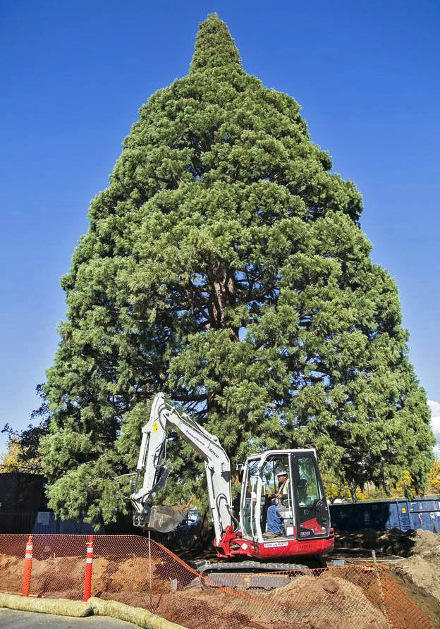
How do you move a tree that’s 98 feet-tall and weighs 800,000 pounds?
Very carefully.
That’s exactly what happened in Boise this past summer when Idaho’s largest and most historic giant sequoia (Sequoiadendron gigantean) – a gift from naturalist John Muir in 1912 – was moved a couple of blocks to make way for a hospital expansion.
Giant sequoias are the world’s largest trees, growing up to 300 feet tall with trunks over 25 feet in diameter, and they can live a very long time. The oldest one documented by ring count was 3500 years old, so the 115-year-old Boise tree, as one of the moving crew pointed out, is “still a young tree.”
Unfortunately Boise’s summer was brutally hot and dry this year, and giant sequoias are native to very humid regions where, according to Wikipedia, they “supplement water from the soil with fog taken up through air roots, at heights to where the root water cannot be pulled.”
Nevertheless, the Texas firm that moved the tree gives it a 95% chance for survival, and Boise’s City Forester Brian Jorgenson says he’s “cautiously hopeful.” Jorgenson checks on the tree daily, monitoring four soil-moisture testing stations and a hose running up its trunk that sprays water on the upper branches to humidify them.
Almost three years ago, the same Texas firm moved a 250-year-old oak tree here in Ann Arbor (see “Save the Oak!” and “One Year After”) and it’s still alive and well. Here’s hoping the Boise sequoia will also thrive – and outlive us all.
Learn more and watch videos of the move at idahostatesman.com/news/local/article158181954.html and idahostatesman.com/news/local/article164970812.html. (Sept. 2017)
Alexander Hamilton: Bulb Gardener

At a Sotheby’s auction earlier this year, hundreds of Alexander Hamilton’s papers were sold for just over $2.5 million. The 77 lots offered included “outstanding examples of his political writings, love letters to his future wife, and Hamilton’s appointment as aide-de-camp to General George Washington,” according to an excellent article in the Southern Garden History Society’s Magnolia.
The auction lot I wanted sold for $40,000, double its pre-sale estimate. In it were two pages of notes Hamilton wrote for the gardener at Hamilton Grange, his beloved estate in upper Manhattan, including a sketch he drew for an impressively large flower bed.
Although Hamilton directs his gardener to plant potatoes, get raspberry plants from a neighbor, and repair fences, many of his notes deal with ornamental plants, including American natives. “A few dogwood trees, not large, scattered along the margin of the grove would be very pleasant,” he writes, and “wild roses around the outside of the flower garden with [mountain] laurel at foot.”
Best of all is his plan for a large bed of flower bulbs. “I should be glad if space could be prepared in the center of the flower garden for planting a few tulips, lilies, hyacinths, and [blank],” he writes. “The space should be a circle of which the diameter is eighteen feet: and there should be nine (9) of each sort of flowers.”
Hamilton’s sketch shows twelve clusters of flowers arranged around the outside of the circle. At the 12:00 position are lilies (probably Madonna lilies which had long been the most popular), then tulips, a cluster that’s not labeled, hyacinths, another unlabeled cluster, lilies, tulips, lilies, hyacinths, unlabeled, hyacinths, and tulips.
The unlabeled bulbs are especially intriguing. (What historian doesn’t want to know more about the past?) My best guess is that Hamilton had a specific bulb in mind but didn’t know or couldn’t remember its name – otherwise why not just fill those spots with more tulips, hyacinths, or lilies? And what did he intend for the center of this large bed, and for later in the season when the tulips, hyacinths, and early-summer-blooming Madonna lilies were done?
Although we may never know the answers to those burning questions, we do know this: Alexander Hamilton – immigrant, self-made man, revolutionary leader, financial mastermind, and Founding Father – was a gardener and bulb-lover just like us. (Aug. 2017)
Protect Yourself from Garden Thieves
One of our long-time customers – who asked to remain anonymous – emailed us this sad report after reading our article “The Queen of Garden Antiques” in last month’s newsletter:
“While collecting garden antiques is a wonderful adventure, there is a sad downside. Our garden was burgled last summer with more than 20 garden ornaments taken, many of them antiques.
“Someone had obviously cased the garden and knew what to take. They even went into my greenhouse and potting shed in search of portable items. Alas, I had a photograph of only one of the stolen pieces, taken for a garden tour brochure. Lesson learned. Everything will now be photographed and kept in a file along with all of the receipts, which I do have safely stored.
“Since then I have had a welder bolt some of my smaller urns in place, and though I refuse to consider security cameras, I have hung up signs up that say ‘Smile, you are on camera.’ We keep our six antique iron gates locked, along with the greenhouse and potting shed, and I am like a little old lady walking around with my ring of keys. Not a pleasant way to have to live.
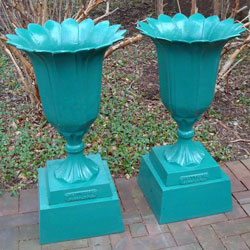
“Forty-plus years of collecting, gone. And I will not be able to – or even want to – start replacing many of these lost treasures. They took a pair of cast-iron tulip urns, for example, that I loved. I saw a similar pair (pictured) offered recently for $4200. Mine were a bit smaller, but when I bought them years ago I probably spent less than $100 each.”
My condolences, friend! And here’s hoping that your heartbreaking story will be a wake-up call for the rest of us. (Aug. 2017)
The Queen of Garden Antiques
Garden antiques are increasingly popular – and I’m not just talking about “shabby chic” garage sale finds.
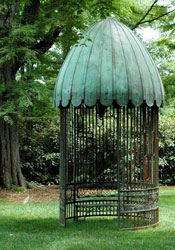
No one knows this better than Barbara Israel, the country’s leading source for high-end garden antiques. With customers ranging from Yoko Ono to the Smithsonian Institution, Israel currently offers such choice items as a terra-cotta Art Moderne greyhound for $3500, a Victorian fern-patterned cast-iron bench for $8500, and – at the top of my wish list – a 15-foot-tall copper-roofed garden pavilion for $55,000.
Israel has been selling garden antiques for over 30 years from her home in Westchester County, NY. There, as Therese Ciesinski writes in the winter 2017 issue of Garden Design, her lush gardens are filled with “a frozen menagerie of more than 200 maidens, warriors, animals, fountains and birdbaths, urns and obelisks, gates, finials, and follies. They are a reminder that strolling one’s garden to contemplate nature, history, and art is still a worthwhile pastime.”
Israel has written two fascinating and highly regarded books: the ground-breaking Antique Garden Ornament: Two Centuries of American Taste (1999) and the very helpful Guide to Buying Antique Garden Ornament (2012).
Her quarterly newsletter “Focal Points” is also excellent, with articles on “different types of garden ornament, specific makers, design suggestions, conservation,” and remarkable gardens, or for something lighter you can follow her on Facebook.
To browse her current inventory – which is much more than what’s pictured at her website – go to decaso.com/shop/xn5iii. Even if you can only dream of spending thousands of dollars on garden antiques, I think you’ll find it richly rewarding. (July 2017)
Winston-Salem to Host Conference on Restoring Southern Gardens
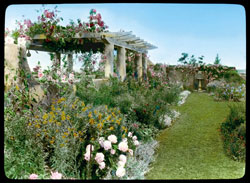
“Gardening in a Golden Age” is the theme of this year’s Conference on Restoring Southern Landscapes and Gardens scheduled for Sept. 21-23 at garden-rich and always fascinating Old Salem.
Focusing on the early 20th century, the conference kicks off with the hand-colored magic lantern slides of photographer Frances Benjamin Johnston in “Picturing the American Garden, 1900-1930.” Other lectures and tours will explore Ellen Biddle Shipman’s work in Winston-Salem, African-American landscape architect David Williston, garden writing and art in the early 1900s, and more.
The conference will be rich in the camaraderie of kindred spirits, too – and I’m speaking from experience. To learn more or register, visit oldsalem.org/events/event/landscapeconference/. (July 2017)
OHG Has Moved to the Country!

The last two days of May here were filled with excitement and dust as we packed up and moved to our new home at a historic farmstead just three miles away.
After 24 years of working out of Scott and Jane’s old house and barn near downtown Ann Arbor, OHG is now headquartered in this even older house at the Washtenaw Food Hub. Located just north of town, the Hub supports small farmers by distributing their crops to local grocery stores, restaurants, and institutions as well as providing workspace for slow-food businesses such as Locavorious and The Brinery.
Although most people don’t eat our bulbs, the Hub’s owners – whose nearby Tantre Farm is one of the state’s oldest certified organic farms – see our mission as a good fit for theirs, and we’re excited to be a part of the Hub community. Maybe best of all, moving to the Hub will allow us to consolidate our five Ann Arbor micro-farms into one location right outside our office door.
While Vanessa and the crew were settling in at the new place, Scott celebrated his first day of retirement by not shaving, eating pancakes for breakfast, buying a couple of new plants, and – since he’s only 80% retired – working on this newsletter. Life is good! (June 2017)
Regal Lilies Blooming in the Wilds of China
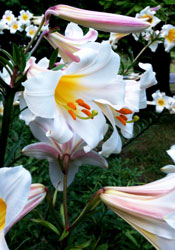
Regal lilies will be blooming here soon, and every year when their fragrance fills the air I’m reminded of this description written by E.H. “Chinese” Wilson, the great plant explorer who first brought them to America.
Of the 2000 plants Wilson collected in his eight trips to Asia, the regal lily was his favorite – although an avalanche broke his leg while he was collecting it and he walked the rest of his life with what he called his “lily limp.” In his 1917 book, Aristocrats of the Garden, he writes:
“Journey in thought with me for a moment or two, westward . . . to Shanghai, gateway of far Cathay; onward and westward up the mighty Yangtsze River for 1800 miles, then northward up its tributary the Min some 250 miles to the confines of mysterious Tibet; to that little-known hinterland which separates China proper from the hierarchy of Lhassa; to a wild and mountainous country . . . where mighty empires meet.
“There in narrow, semi-arid valleys, down which torrents thunder, and encompassed by mountains composed of mud-shales and granites whose peaks are clothed with snow eternal, the regal lily has her home. In summer the heat is terrific, in winter the cold is intense, and at all seasons these valleys are subject to sudden and violent wind-storms against which neither man nor beast can make headway.
“There in June, by the wayside, in rock-crevice by the torrent’s edge and high up on the mountainside and precipice, this lily in full bloom greets the weary wayfarer. Not in twos and threes but in hundreds, in thousands, aye, in tens of thousands. Its slender stems . . . , flexible and tense as steel, overtop the coarse grasses and scrub and are crowned with . . . large funnel-shaped flowers, each more or less wine-colored without, pure white and lustrous on the face, clear canary-yellow within the tube and each stamen filament tipped with a golden anther.
“The air in the cool of the morning and in the evening is laden with delicious perfume exhaled from every blossom. For a brief season this lily transforms a lonely, semi-desert region into a veritable fairyland.”
Thanks to Wilson, you can enjoy a bit of this distant fairyland in your own backyard. Simply order now for fall delivery! (June 2017)
Guardian Gardens: Crowd-Sourcing Preservation
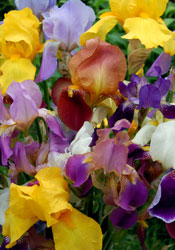
Last year the Historic Iris Preservation Society (HIPS) launched an exciting grassroots effort to save the world’s rarest iris – and they’re hoping you’ll help.
The Guardian Gardens network is a far-flung group of iris enthusiasts who’ve agreed to grow and share varieties that are most at risk of extinction. The goal is to have five different gardeners growing each of these rare iris so that even if one or two lose theirs it won’t be lost forever.
You don’t have to be an expert to help, says Doug Paschall, the program’s coordinator. If you have experience growing iris and a sunny spot that’s big enough for four or five rhizomes of a few varieties, he’d love to hear from you.
“We have irises waiting to be adopted,” Doug adds, and mid-summer is the ideal time for planting them. To learn more, check out the Guardian Gardens FAQ at the HIPS website.
And here’s a thought: wouldn’t it be great if other plant societies sponsored preservation efforts like this? In fact, if you feel inspired to launch a Guardian Gardens project for daffodils or dahlias or daylilies or glads or peonies – all of which have active national societies devoted to them – please let us know and we’ll help spread the word about it here. Working together, we can not only “Save the Iris” but “Save the Other Flowers, Too!” (June 2017)
Coming Soon: Midwestern Garden History Symposium
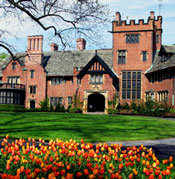
Our good customer Marta McDowell, author of All the President’s Gardens, will be the keynote speaker at the third annual Midwestern Garden History and Design Preservation Symposium on June 20-21 in Akron.
After two years at Hale Farm and Village, the symposium is moving this year to the Akron Art Museum with its spectacular, gravity-defying 2007 addition. Lectures such as “Garden History Resources at the Smithsonian,” “Everyday Documentation,” and “Restoring Mrs. Harding’s Rose Garden,” will be complemented by tours of local historic landscapes including the incomparable Stan Hywet estate with its Warren Manning birch allée and perennial garden by Ellen Biddle Shipman.
For more information or to register, contact Kathie Vandervere at kvandevere@icloud.com. (June 2017)
Coming Soon: The New OHG

A new day is dawning at Old House Gardens!
By the time we send our next newsletter, OHG will have a new owner – the incredible Vanessa Elms, our current VP for Bulbs – and a new home.
Although we can’t announce our new location yet, OHG isn’t moving far – just outside of town a bit where we can consolidate our five micro-farms and grow even more old bulbs for you.
I say “we” because I’ll be sticking around one day a week to help out, mostly by writing our newsletter/blog, hunting for more great bulbs to offer, and serving as OHG’s expert and ambassador for heirlooms.
As for my endless hours of free time, I don’t know what I’m going to do – and I like that. At first I plan to just take it easy, sleep more, garden more, and spend more time with my wife Jane, our dog Toby, and these two little angels, 8-month-old Benjamin John and one-month-old Nolan James.
To all of you who sent me happy retirement wishes this past year, thank you! You warmed my heart, and made this big step easier. I’m proud of what we’ve accomplished together over the past 24 years, and I can’t wait to see what the future holds for Old House Gardens. (May 2017)
History in Bloom: Presby Memorial Iris Garden
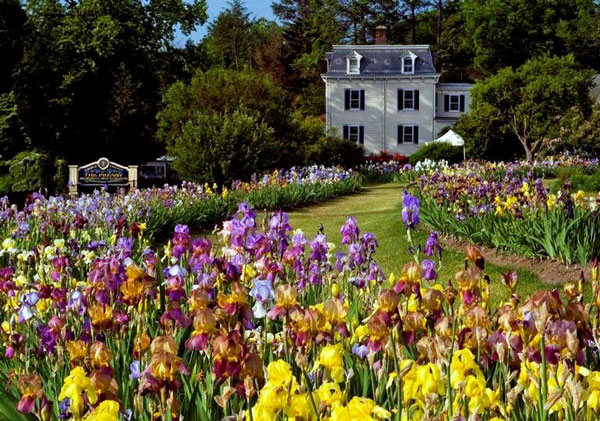
One of the world’s greatest collections of historic iris is celebrating its 90th anniversary this month, and you’re invited to the party!
Established in Montclair, New Jersey, in 1927, the Presby Memorial Iris Garden today includes nearly 14,000 iris plants of 1500 varieties. Every year from mid-May through the first week in June, over 100,000 flowers bloom there in a dazzling display that’s come to be called “the rainbow on the hill.”
To celebrate the big anniversary, on weekend afternoons in May volunteers will be serving cookies and lemonade on the porch of the Garden’s historic Walther House. Iris dug from Presby’s vast collection will also be for sale on weekends starting this Friday from 10:00-3:00.
If you visit, please share a photo or two on our Facebook page – and even though admission is free, we hope you’ll donate generously to support the important work Presby is doing to preserve great old iris for all of us. (May 2017)
New and Improved: The “Bible” for Restoring Historic Gardens
Like most people, I never thought about plants and gardens having a history – until almost 40 years ago when I bought my first old house and walked out into the tiny yard eager to make it my own.
There behind the overgrown privet hedge, I discovered a few barely surviving plants, including a white, single-flowered peony. Suddenly I realized it wasn’t just my yard. Someone else had loved it before me. But who, and when? Was the peony ten years old, or 50, or 100? And what about the hedge?
Looking for answers proved frustrating at first. This was back in the dark ages – before Google. But finally I discovered this book by Rudy and Joy Favretti – or rather the original, 1978 edition of it – and I was no longer wandering in the wilderness.
I’ve been using and recommending it ever since, and as I say on the back cover of this updated and expanded third edition, “Bravo! A new edition of this indispensable work has been long overdue. It’s the original guide to researching and restoring American home landscapes, by the dean of American landscape preservation. For decades, savvy home-owners and museum sites have turned to it for guidance – and now, with its many updates and additions, it’s better than ever.”
Although the core of it is unchanged, Rudy and Joy have added illustrations and updated information throughout. Best of all are the additional examples from their long careers, including a page on the archaeological excavation that revealed the long-vanished, mid-1600s garden at Bacon’s Castle in Virginia.
If there’s an old yard you care about, Landscapes and Gardens for Historic Buildings is the book for you. It may not change your life the way it did mine, but it will certainly help you see any yard – and the wider landscape all around us – with new eyes. (May 2017)
Meet Alan Shipp, the Hyacinth Master
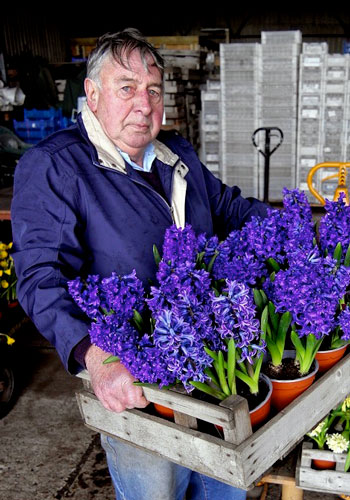
With a collection of 243 hyacinth varieties dating back as far as the 1700s, our good friend Alan Shipp is an inspiring example of what one person can do to save our incredibly rich garden heritage.
Although we’ve been the sole US source for Alan’s hyacinths for many years, and we’re proud to call him a friend, we learned a lot we never knew about him in an engaging post at the British blog Spitalfields Life. Alan is a great story-teller with a jolly sense of humor, and the blog’s author captures him well.
Alan talks about how his family farm got its start when his grandfather won a pony in a raffle, how he learned how to propagate hyacinths from a slug, and how the “extinct” 1767 double white-with-red-eyes ‘Gloria Mundi’ was rediscovered in a tiny village in Romania. You can read it all, and enjoy photos of Alan’s hyacinth fields in bloom, at spitalfieldslife.com/2017/03/26/alan-shipp-hyacinth-grower/.
(To meet USDA import requirements, Alan has to grow our hyacinths in a special field. As soon as we learn what he’ll have available for us this fall, we’ll announce it here in our newsletter.) (May2017)
American Gardener Honors Us for Making a Difference

From Christmas tree ornaments to one of my favorite childhood books, Julia Polentes tells the OHG story in the March-April issue of the American Horticultural Society’s American Gardener. As an avid reader ever since I joined the Society in 1989, it’s a special pleasure to be profiled in “AHS Members Making a Difference.”
Julia starts with me comparing heirloom bulbs to the ornaments on our family Christmas tree which are “pretty to other people, but there’s a deeper beauty for us” because they have “so much more personal meaning.” She talks about my “epiphany” when I realized that historic plants can be found all around us if you know what you’re looking for, and my efforts since 1993 to preserve “the best bulbs of the past in order to enrich gardens today.”
Now that I’m retiring, Julia notes that I’m appreciating more than ever “the far-flung, world-wide village of people who have helped turn this dream into a reality.” As in Stone Soup, one of my favorite books as a kid, what we’ve accomplished together is “way bigger and better than what any of us could have done alone.”
For more, you can check out the entire article at our website. (April 2017)
Brighten Your Summer with “House-Pot Lilies”
We recently learned an old name for pink rain lilies.
Our good friend and Tulsa garden writer Russell Studebaker wrote that he’d seen a pot of them in full bloom at a garden club meeting. “The owner told me she ‘never knew their actual name.’ She had gotten them long ago from her family in Missouri. They called them ‘house pot lilies’ because they were always grown in an old pot that no longer served for cooking – probably enamelware, agateware, or graniteware that had developed a hole. Can’t you just imagine how nice those little pink flowers would look blooming in a blue enamelware pot?”
Rain lilies bloom when rain drenches their roots, so it makes sense that they’d thrive metal pots – although ours bloom just fine in regular terra cotta, as you can see here.
Summer is coming, so why not order a few to try yourself in any kind of pot you want? (April 2017)
Save the Cobblestones, Granite Curbs, Oyster Shell Paths, and More!
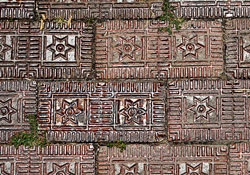
Although streets, sidewalks, and paths are important landscape features – imagine your city or favorite park without them – they’re often overlooked as historic resources, and paved over or ripped up without a second thought.
A new website, HistoricPavement.com, hopes to change that by opening our eyes to the rich tapestry that’s hiding in plain sight beneath our feet. From colonial cobblestones to mid-century modern hexagons, paving has changed dramatically through the years, often with a fascinating regional diversity.
In Philadelphia, for example, a few old streets are paved with iron-slag bricks that look like dark blue ceramic. In the Midwest, wood blocks were once widely used, “with some cities like Detroit utilizing them for most of their paved streets by 1899,” writes HistoricPavement.com’s creator, Robin Williams of Savannah College of Art and Design. “Yet nationwide only a handful of streets preserve this material, including Wooden Alley in Chicago – a rare example of a street that has attained historic designation and protection.”
See photos and learn more at “Neglected Heritage Beneath Our Feet” and HistoricPavement.com.
Then keep your head down – and if you see something interesting, Robin would love to hear from you at rwilliam@scad.edu. (Mar. 2017)
Learn (and Have Fun) at the 2017 Mount Vernon Symposium

For a good time, call Dean Norton.
Dean is Director of Horticulture at Mount Vernon and the organizer of this year’s symposium on “Gardening, Landscape, and Design in the Age of Washington.” Three years ago I lectured for him at the first Mount Vernon symposium, and it was more fun than just about any other conference I’ve ever attended.
Sure I learned a lot, and it was great hanging out with so many fellow enthusiasts, and the Mount Vernon grounds are amazing. What really sticks in my memory, though, was an elegant after-hours reception on the piazza and grand lawn high above the Potomac where Dean fired off his home-made PVC potato cannon to show us how the Washingtons celebrated special occasions – although they, of course, used a real cannon.
This year’s symposium is set for June 2-4 with a wide array of presentations including Restoration Agriculture, Creating Central Park, Ceramic Vases and Floral Ornament, Jefferson and Wine, Slavery at Mount Vernon, and The Garden of the Future.
Our good customer Joe Gromacki will also be there talking about his Kelton House Farm, an early-1700s New England farmhouse moved and rebuilt in Wisconsin which Joe has furnished with colonial antiques and surrounded with heirloom plants, including tens of thousands of our bulbs.
To learn more and register, go to the 2017 Symposium page at mountvernon.org. It’s sure to sell out, though, so don’t delay. I’ll hope to see you there! (Mar. 2017)
‘Jersey’s Beauty’ and the Millionaire Gardeners of Sewickley
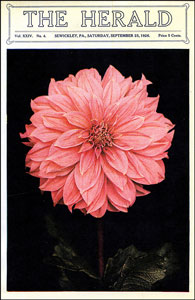
(Here’s a fascinating story by our good customer Letitia Savage. Thank you, Letty, for sharing it with us!)
By the 1920s, Pittsburgh’s industrial millionaires had flocked to Sewickley, Pennsylvania, to summer in country houses along the bluffs of the Ohio River. While the estates had ranks of professional gardeners, the owners were often actively involved, particularly when it came to competitive gardening.
Mrs. B. F. Jones, Jr. was typical of these serious amateur gardeners. The wife of a steel industry magnate, she lived at Fairacres, a 100-room Louis XVI mansion surrounded by acres of gardens. (You can see a few photos of Fairacres at our blog.) There, with the help of her head gardener R. M. Fletcher, she grew thousands of dahlias.
In Sewickley the gardening year culminated in September with the annual Dahlia Show. As the Sewickley Herald reported in 1926, “There is hardly another flower which makes such a glorious showing when exhibited in mass.... Those who have never seen a dahlia show have indeed a thrill yet to live for.”
The three-day event included almost 50 competitive classes for dahlias – including several for vases of 12 to 25 blooms of one variety. Photos of the show in the society pages of the Pittsburgh press are breathtaking. Dahlias in vases tower over the heads of the small girls admiring them, and some arrangements are even taller than their mothers.
In 1926, the star of the show was ‘Jersey’s Beauty’. The Herald featured it in a full color photo on the front page of its September 25 edition and noted, “If you are familiar with dahlias, you will be interested in ‘Jersey Beauty,’ in some ways the finest dahlia developed in recent years.” Introduced just three years earlier, it originally sold for $25 a tuber – a trifle for Mrs. Jones but the equivalent, according to the ADS’s Martin Kral, of “fifty gallons of milk, or a man’s new suit, or one of those modern home appliances, a vacuum cleaner.”
Although it’s not 100% clear whether it was Mrs. Jones’s ‘Jersey’s Beauty’ that stole the show in 1926, local reports say the Herald’s cover-girl dahlia was raised at Fairacres, and an oil painting of that flower once hung in splendor there, perhaps alongside her Gilbert Stuart portrait of George Washington.
Twenty years after her death in 1941, Mrs. Jones’ opulent summer home was razed. Her painting of ‘Jersey’s Beauty’ survives, though, preserved by the Sewickley Valley Historical Society, along with a stack of small cards tied with a faded blue ribbon. Although they don’t include dates or variety names, each card documents one of the many flower-show awards that Mrs. Jones won, poignant souvenirs of her prize-winning roses, chrysanthemums, and, above all, her glorious dahlias.
(‘Jersey’s Beauty’ went on to become one of the most popular dahlias of the 20th century. Although it’s almost sold out, if you order it now you can enjoy it just as Mrs. Jones once did – and it won’t cost you anywhere near as much as a vacuum cleaner!) (March 2017)
Paradise Lost: Winston-Salem’s Municipal Iris Garden
Does your city have a municipal iris garden?
That seems very unlikely, which is why I was so surprised when this postcard arrived in the mail recently.
It’s a modern reproduction of a 1949 postcard showing the “Municipal Iris Gardens, Winston-Salem, NC.” On the back it reads: “The Municipal Iris Garden contains 20,000 plants, of 525 varieties. The blossoms range from pure white to deep purple, gold, and dark red, and are at their best during May. Weeping willows and rustic bridges add to the beauty of the rolling parkway.”
20,000 plants – of 525 varieties! I had to know more, so I contacted the folks who sent the card – which announces the 2017 Conference on Restoring Southern Landscapes and Gardens– and here’s what I learned.
“The development of the gardens to their present state of beauty is a typical Cinderella story,” the Twin City Sentinel reported in 1938, “with many local iris growers acting as fairy godmothers.”
It all started in the early 1920s when a new neighborhood was laid out which included a four-acre “gully-way” that was left untouched “since there seemed no other purpose it could serve.”
Although today we’d probably consider it a valuable natural area, times were different then and in 1931 a doctor who lived nearby urged the city to beautify it with iris donated from his own extensive gardens. Iris were enormously popular at that time, and before long other neighbors joined the campaign and the Municipal Iris Garden was born.
The city parks department cleared the land, planted weeping willow trees, built stone and rustic-work bridges over the stream, and laid out gracefully curving beds. By 1938 the Twin City Sentinel reported that “Winston-Salem’s iris attract visitors from all parts of the state. From an unattractive gully the city parks department has transformed Runnymede Parkway into one of the most popular parks in the city.”
But that was then. By the early 1950s the iris had been replaced with lower-maintenance azaleas, and today even those are gone. The stone bridges still stand, though, bearing silent witness to the park’s glory days – and who knows what the next chapter might be for this Cinderella gully-way?
For additional images, visit digitalforsyth.org/photos/browse/places-gardens-runnymede-iris-gardens.
For your own little iris paradise, see the 17 heirloom iris we’re shipping this spring.
And many thanks to Camilla Wilcox, Kay Bergey, and Martha Hartley for sharing this remarkable story with me! (Feb. 2017)
News from 1902: The First Collarette Dahlias
While researching our ‘Fashion Monger’ dahlia – a Garden Gate “must have” for 2017 – we discovered this tidbit in the Oct. 2, 1902, Journal of Horticulture, Cottage Gardener, and Home Farmer:
“A new type of dahlia has come into existence. It has been named the collaret form and first was brought to notice by Messrs. H. Cannell and Sons [of] Swanley, Kent. . . .
“This new class possesses . . . a series of stalked appendices of a collaret form producing a great ornamental effect. The engraving gives a good idea of its nature. The colors are somewhat limited at present but in the course of another season or so the variation of tints will be very much increased . . . .
“The original plants have already been awarded Gold Medals and Certificates at various important exhibitions. ‘President Viger’ [pictured] is the best-known. . . . As there may be a future for this race, it is probable that many growers will obtain plants to form a beginning with them.”
There was indeed “a future for this race,” and scores of collarets– or collarettes, as they’re usually spelled in the US – are available today. ‘President Viger’ is extinct, alas, but we offer two of the oldest – ‘Fashion Monger’ (from 1955) and ‘Clair de Lune’ (1946) – and you can order them now for April delivery! (Feb. 2017)
5 Timeless Iris: High Praise from the First President of the AIS
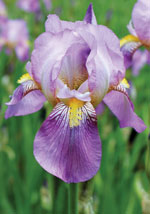
The great horticulturist John Wister helped found the American Iris Society in 1920 and served as its first president for fourteen years.
At that time, iris were exceedingly popular and scores of exciting new varieties were being introduced every year. Yet in his small book The Iris published in 1930, Wister wrote that “the more of the new things I see, the more I am convinced of the worthiness of some of our oldest varieties” – such as these:
‘Pallida Dalmatica’ (1597) – “There is nothing . . . in the whole range of iris that is finer than the true ‘Pallida Dalmatica’,” Wister wrote, adding that planting it with lemon lily (Hemerocallis lilioasphodelus) is “one of the most famous” garden combinations with iris.
Germanica (by 1500) – “The purple flag of our grandmothers’ garden . . . should never be omitted for . . . it makes a striking garden picture.”
‘Flavescens’ (1813) – Among pale yellow iris “there is nothing to surpass the variety ‘Flavescens’, well known in every old garden in this country.”
‘Queen of May’ (1859, pictured here) – “On the pink side of the lavenders, the old ‘Queen of May’ is . . . still one of the best.” It is “lovely,” he added, “with white and pink lupines and pink Dianthus.”
‘Mrs. Horace Darwin’ (1888) – Although “rather dwarf,” this white iris is “wonderfully free blooming. It is unexcelled for massing and should be used in every garden in quantities.”
Of course you don’t have to be an expert to enjoy these timeless treasures. Just order yours now for April delivery! (Jan. 2017)
What Good is a Historic Daylily?
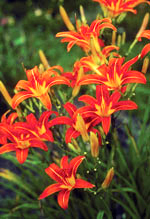
And why should we have historic daylily gardens?
In an excellent article for the American Hemerocallis Society, Linda Sue Barnes offers several answers to those two questions, most of which also apply to the even bigger questions: What good is any historic flower? And why should we grow them today?
1. “Many historic daylilies have beautiful flowers. Many . . . are stars or trumpets, and . . . the simplicity of those flowers can provide a break from all the ruffles, fancy edges, and patterns of the modern daylily.”
2. “Many historic daylilies have spectacular garden habit,” such as ‘Autumn Minaret’ (1951) which “can easily reach 6 feet with as many as 80 blooms on a scape.”
3. “Logically enough, most of the early cultivars that are still in gardens today multiply well and are very hardy.”
4. “Historic daylilies . . . extend the garden season.” In her North Carolina garden, Linda Sue has historic varieties blooming from early April – “a month before more modern cultivars begin” – well into September.
5. “Historic daylilies . . . win flower shows.” Linda Sue says four 1950s classics have “won Best in Show in our region in the last few years” and “many more have won Best in Section.”
6. “Historic daylilies . . . can, even today, be good parents.” Breeders such as Brian Mahieu are using them to create new daylilies with “vigor, clear colors, a lot of unusual forms, and fragrance.”
For photos of 16 historic daylilies (including ‘Poinsettia’, pictured here) and Linda Sue’s reasons for having historic daylily gardens, see the entire article at our website. There you’ll also find a link to the AHS website where 20 historic daylily gardens, each with 50-100 historic varieties, are listed by region.
To see just how good historic daylilies can be, why not grow a few yourself? We’re offering 14 for April delivery – including fragrant lemon lily, spring-blooming ‘Gold Dust’, and 4-6 foot tall ‘Challenger’ – all of which Linda Sue would tell you are great garden plants. (Jan. 2017)
Garden Books for Giving and Getting
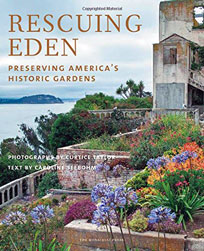
Although the cold, short days of winter aren’t the best for gardening, they’re perfect for garden reading – and books make great holiday gifts. Here are five new ones I’m hoping to enjoy before spring returns.
Rescuing Eden: Preserving America’s Historic Gardens, by Curtice Taylor and Caroline Seebohm: “Most gardens do not survive their creators, being sold off, dug out, or, if not utterly destroyed, then so drastically changed as to be sadly unrecognizable. The 28 remarkable properties in this book” – ranging from Middleton Place plantation to the gardens of Alcatraz – “are happy exceptions to that rule, rescued from near-obliteration because of historic connections. . . . Some are still in the process of renovation, and others will never be fully restored, but all offer rare glimpses into this country’s horticultural history.” (reviewed by Adam Levine in Country Gardens)
Garden Flora: The Natural and Cultural History of the Plants in Your Garden, by Noel Kingsbury: “This must be the most beautiful book of the publishing season, with an oversize format rich in botanical art and historic and contemporary photos. Every page is stunning, a revelation in art and text of flora’s long and curious history. Kingsbury’s writing is a lively backstory to what we grow in our gardens” – including most of the bulbs we offer – and “it’s also right up to the minute with insight on current plant breeding and a poignant look at the plants we’ve lost.” (reviewed by Val Easton in the Seattle Times)
The Botanical Treasury, by Christopher Mills: “The excitement of discovering a new plant is almost tangible in this lavish collection of plant histories. A delightful compendium of 40 plants from around the world, The Botanical Treasury tells the story of each one through a fascinating mix of botanical illustrations, letters sent to Kew from plant hunters, and reprinted extracts from botanical periodicals. . . . The book also includes forty reproduced prints of featured plants which can be framed – the icing on the cake of this tremendous and fascinating collection.” (reviewed in The English Garden)
A Garden for the President: A History of the White House Grounds, by Jonathan Pliska: “The White House grounds are the oldest continually maintained ornamental landscape in the United States. Handsomely illustrated with historical images and newly commissioned photography, A Garden for the President explores not only the relationship between the White House and its landscape but also the evolution of its design; the public and private uses . . . ; and the cultivation of the grounds with a focus on the specimen trees, vegetable and ornamental gardens, and conservatories. (reviewed by the White House Historical Association)
Bliss Irises: Family and Flowers, The Journey to a National Collection, by Anne Milner: “Anne Milner blends personal history with gardening in this beautifully illustrated book. Her story starts with the discovery that her grandfather’s cousin was . . . Arthur J. Bliss, who introduced ‘Dominion’, a ground-breaking purple iris that made him world famous. . . . The book’s second half focuses on the [more than 175 iris Bliss introduced], with detailed information about the plants, accompanied by photographs, watercolors, and line drawings.” (reviewed in Plant Heritage) (Dec. 2016)
600 Years of Botanical Treasures: Bunny Mellon’s Art at the NYBG
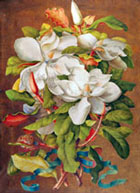
If you’re lucky enough to be anywhere near New York City this winter, treat yourself to the New York Botanical Garden’s small but impressive exhibit of botanical art from the vast collection of the late Bunny Mellon. Some 80 works selected from the 16,000 Mellon collected are on display, ranging from a 1350 book illustration to a 1958 print by Picasso and beyond.
As you may remember from previous articles here, Mellon redesigned the White House Rose Garden for President Kennedy, filling it in spring with masses of tulips. The Dutch Tulipomania in the 1630s was a special interest of Mellon’s, and several works in the NYBG exhibit feature tulips, including one that could very well be ‘Zomerschoon’.
“Redoute to Warhol: The Botanical Art of Bunny Mellon” runs through February 12, and even if you can’t get there in person you can enjoy several of its highlights online. (Dec. 2016)
Looking Back: A Clickable History of Old House Gardens

As you can see in this snapshot, I‘ve been fascinated with flowers for a long time.
When I was seven, my dad helped me plant my first garden, and although I soon learned that weeding is an endless chore, I was thrilled when I harvested my first radishes and I‘ve been gardening ever since.
Eventually my love of plants led me to launch Old House Gardens, and now that I‘m retiring in May, we printed a short history of me and OHG on page 48 of our catalog. Even better is the clickable version we posted online yesterday, with links to the “welcome” letter from our very first catalog, our dramatic 1996 debut in Garden Design, our friends at the Hortus Bulborum, me planting bulbs with Martha Stewart, and more.
I hope you‘ll enjoy it – and then please help us continue the story! (Nov. 2016)
Cover Your Walls with Mural-Sized Botanical Images
Imagine an entire wall in your home or office covered with a huge image of a Dutch flower painting from the 1700s, or a bulb catalog cover from the 1800s.
For less than you might expect, a British company called Surface View offers custom-sized murals of thousands of images ranging from antique maps and vintage comic books to abstract patterns and modern photography. Any good wallpaper hanger can install them for you, and shipping on most orders is free.
To see the 600-plus botanical images they offer, go to surfaceview.co.uk/shop/walls/mural/t/floral . There you‘ll find 18th-century paintings of broken tulips, Victorian chromolithographs of daffodils, floral wallpaper by William Morris, close-up photos of ‘Snowbunting‘ and ‘Rip van Winkle‘, and antique catalog covers such as the one pictured here of ‘Pallida Dalmatica‘. That image as well as several of our other favorites are part of a recently added New York Botanical Garden collection that you won‘t want to miss.
Even if you don‘t end up ordering any, it‘s fun browsing through the wonderland of images. Enjoy! (Nov.2016)
Talking about Dinosaurs, First Gardens, and “Bulb Therapy”
If you love Old House Gardens – or heirlooms, or even just bulbs – here’s a recent blog-post and a radio interview that you may enjoy:
Pull Up a Chair is the very personal and poetic blog of our good customer Barbara Mahany who launched it after nearly 30 years of writing for the Chicago Tribune. In “Bulb Therapy” she talks of “the healing balms of the trowel” and bulbs that “will rise and reach for the light” whispering “‘here’s your reward for believing’ or ‘here’s what you get when you hold onto hope.” Barbara also has some kind words about us and our heirlooms, which she calls “the breathtakingest bulbs on the planet.” Read it all at https://pullupachair.org/2016/09/30/bulb-therapy/ .
Cultivating Place is the public radio program of our long-time customer Jennifer Jewell of northern California. Every week since February, Jennifer has been exploring the central role gardening plays in human culture, much like art, music, and literature. On the first day of fall we had a great time talking about my childhood love of dinosaurs, our first gardens, why I launched OHG, great bulbs saved and lost, and more. It’s a very pleasant half-hour (if I do say so myself), and you can listen to it now at http://mynspr.org/post/heirloom-bulbs-scott-kunst-old-house-gardens-ann-arbor-mi. (Oct. 2016)
Revamped Website Offers Historic Plant and Garden Riches
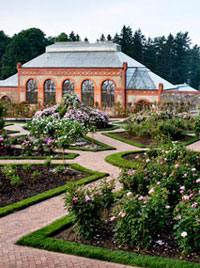
You don’t have to be a Southerner to appreciate the Southern Garden History Society, and a recent makeover has made its website better than ever.
The site is now filled with photos and antique images, and it’s user-friendly on all devices. Back issues of its excellent journal Magnolia are now searchable, and there’s an events calendar, dozens of book reviews, and links to historic sites and organizations.
Maybe best of all is the “Plant Lists” section, a fully searchable PDF of 50 Southern plant lists spanning two centuries, from a 1734 list of plants in the correspondence of John Custis of Williamsburg to a 1922-41 list of plants Beatrix Farrand specified for Dumbarton Oaks (including winter aconite, trillium, and lemon lily).
One of my favorite lists is a 1786 newspaper advertisement for Philadelphia’s “Peter Crouwells and Co., Gardeners and Florists” announcing that “they have for sale here” – in Alexandria, Virginia – “an extensive variety of the most rare bulbous flowers, roots and seed,” including 600 hyacinths, 400 tulips, 40 double narcissus, and 26 jonquils. “Those ladies and gentlemen who want any of the above articles,” the ad continues, “will please to apply immediately at his lodgings at Mr. John Gretter’s, King Street, as he intends to set off for Baltimore in a few days.”
Even if you can’t make it to King Street in time, there’s still a lot to enjoy at southerngardenhistory.org. (Oct. 2016)
Passing the Torch: It’s My Last Year!

I was 30 years old when I started lecturing on landscape history, and 40 when I mailed my first tiny catalog of heirloom bulbs. Now I’ve become an heirloom myself, and next May after we wrap up our 24th year of shipping, I’ll be retiring.
I hate to leave you – and my crew, our growers, and the bulbs themselves. But time rushes on and my wife, who has sacrificed a lot to help me pursue this dream, has been patiently waiting for me to join her in the joys of a hard-earned rest.
But it’s not the end of Old House Gardens! Recognizing that our “Save the Bulbs” mission is unique and important, and loving our customers like I do, my office staff asked if they could buy OHG and keep it going, and I happily agreed.
It won’t be easy, but Kathy, Rita, Vanessa, Mike, and Justin are enormously talented, our shipping and micro-farm crews are awesome, and I’ll be sticking around to help them a bit, so I’m optimistic that they can make it work.
Will there be changes? Yes, and I’m excited to see what they might be. What will never change, though, is OHG’s commitment to preserving the best of the past, to delivering bulbs of the highest quality, and to treating you like a friend.
Old House Gardens would never have made it this far without the support of thousands of gardeners like you. Season after season since 1993 you’ve “crowd-funded” our mission and showered us with kind words and encouragement. Please be as good to the new owners as you have been to me.
Finally, from the bottom of my heart, thank you – and let’s have a wonderful last year together! (Sept. 2016)
Will the Real Mrs. Langtry Please Stand Up?
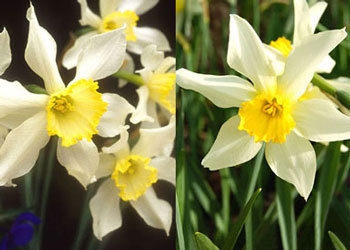
Unfortunately we recently discovered that the daffodil we’ve sold for many years as ‘Mrs. Langtry’ is actually some other unknown daffodil.
Our NOT ‘Mrs. Langtry’ (photo on right) came to us from one of Holland’s leading experts on historic bulbs, and as you can see it looks a lot like the TRUE ‘Mrs. Langtry’ (photo on left). It’s definitely a very old daffodil, probably from the late 1800s.
However, the cup of the true ‘Mrs. Langtry’ opens a pale, creamy yellow and then matures to what the official RHS/ADS description calls “yellowish white, with canary yellow at rim.” The cup of the NOT ‘Mrs. Langtry’, on the other hand, starts out a richer yellow and never quite gets to “yellowish white.”
We’ve already contacted everyone who ordered ‘Mrs. Langtry’ and offered a refund. We’ve also posted an EXPANDED version of this article at our website so you can learn more. Please share it and help us spread the word about this mix-up.
And here’s some happier news: Breeder William Backhouse apparently named ‘Mrs. Langtry’ not for Lillie Langtry, the scandalous Victorian actress, but for the wife of one of his gardeners who was also, more importantly, his family’s beloved housekeeper. (Sept. 2016)
Our Tiger Lilies “Look Amazing” at Frank Lloyd Wright’s Home
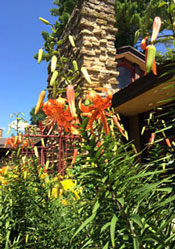
Tiger lilies were Frank Lloyd Wright’s favorite flower, and he grew masses of them in the gardens of Taliesin, his spectacular Wisconsin home and studio.
Taliesin’s Cultural Landscape Coordinator, Jessica Tripalin, emailed us earlier this summer saying, “The 50 tiger lilies you sent us last fall look amazing in the gardens here. The preservation crew is aiming to restore the entire estate to the year Mr. Wright passed. Our goal is to attain the look and feel of 1959. I am so happy with the results in the gardens this year. Thank you so much for your beautiful plants!”
Jessica also sent us this photo of a few of our tiger lilies blooming in front of one of Taliesin’s massive stone chimneys and the iron-pipe trelliswork that Wright designed for the gardens.
Tiger lilies are native to Japan and were frequently depicted in Japanese art. It’s easy to see how their simplicity, grace, and drama appealed to Wright, and no doubt they also reminded him of the months he lived in Tokyo while overseeing the construction of his early masterpiece, the Imperial Hotel.
To learn more about Wright’s gardens, read our review of Derek Fell’s The Gardens of Frank Lloyd Wright which we recently posted at our blog. (Sept. 2016)
America’s First Peony – and One of Louise Beebe Wilder’s Favorites
The vast majority of the peonies grown today are cultivars of the Asian Paeonia lactiflora, the first of which arrived here from China in the early 1800s causing a sensation.
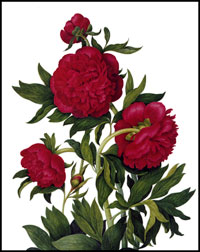
But long before the lactifloras appeared, the colonists were growing a completely different species, the European P. officinalis, which had been revered as a medicinal herb since ancient times. (Officinalis means “of the [apothecary] shops.”)
Since they bloom a week or two earlier than the lactifloras, the officinalis clan came to be called May-flowering peonies. Double red ‘Rubra Plena’ was the most popular form, especially in the 19th century when it decorated the graves of so many Civil War veterans that it was called the Memorial Day peony.
But times change, and as the Civil War faded in the past and hundreds of exciting new lactiflora peonies were introduced, the old officinalis peonies gradually fell out of fashion.
“Today the May-flowering peony is neglected,” wrote the great American garden writer Louise Beebe Wilder in 1927. Yet “in peaceful old gardens that remain unfretted by changing fashions and modern introductions we are apt to find huge bushes of the old May-flowering peony or “piny” as it is called in country neighborhoods. . . .”
Several officinalis peonies grew in the Maryland garden of Wilder’s childhood. “There was the “old crimson” [‘Rubra Plena’],” she wrote, “which is yet one of my favorite peonies and exhibits almost the richest color that I know. There was a full pink sort that we children called the ‘strawberry-ice-cream peony,’ and there was a loose-petalled white one.” When she later bought an old house and garden in New York, Wilder was “happy to find those sweet and wholesome friends of my childhood growing in the tangled dooryard.”
Ancient, herbal, early-blooming, richly colored, and enduring – why not add P. officinalis ‘Rubra Plena’ to your dooryard this fall? (July 2016)
Green Reading: Penelope Hobhouse’s Top 10
How about settling down in the shade with a tall glass of something frosty and losing yourself in a great garden book this summer?
After a lifetime of gardening, 86-year-old Penelope Hobhouse – who has written a dozen books and designed gardens for English royalty, the RHS, and Steve Jobs – listed her ten favorite garden books in the December 2015 issue of Gardens Illustrated.
Two of her favorites, I’m happy to say, are more than a century old, and six deal with garden history!
Garden Design, by Sylvia Crowe, 1958 – “My first choice,” Hobhouse says. This work starts with a long section on garden history and “remains the most comprehensive book on design I know.”
The Education of a Gardener, by Russell Page, 1962 – A modern classic, this small book by the celebrated garden designer “describes his visits to great gardens and discusses what they taught him.”
The Formal Garden in England, by Reginald Blomfield, 1892 – This historical survey by a man who was “violently opposed” to the then-new “natural-style” gardens “makes you think where you stand in the argument which still reverberates today.”
Penelope Hobhouse’s Gardening through the Ages, 1992 – Originally published in England as Plants in Garden History, this is “an illustrated history of plants and their influence on garden styles from ancient Egypt to the present day.”
Paradise as a Garden in Persia and Mughal India, by Elizabeth Moynihan, 1979 – “Highly readable” and a “masterpiece,” this is “the best introduction” to garden-making from Cyrus the Great in 540 BC to Shah Jehan in 1660 AD.
The Landscape of Man: Shaping the Environment from Prehistory to the Present Day, by G. and S. Jellicoe, 1979 – “Perhaps this is the only book you need,” Hobhouse writes, because it covers garden history and design “but with an emphasis on the garden as part of the environment.”
Italian Villas and Their Gardens, by Edith Wharton, 1903 – The only American book on her list, this 1903 work by the famous novelist “captures the essence of Renaissance taste.”
The Hillier Manual of Trees and Shrubs, by Hillier Nurseries – This is “for me the most valuable” reference book, Hobhouse writes, because “I cannot envisage a garden without a framework of woody plants.”
Perennials and Their Garden Habitats, R. Hansen and F. Stahl, translated in 1993 – “Astonishingly detailed” and “my new bible for planning my own garden,” this encyclopedic German work “puts more emphasis on the ecological needs of a plant.”
The Green Tapestry: Perennial Plants for the Garden, by Beth Chatto, 1999 – “No library can be complete without” one of Chatto’s books, Hobhouse concludes. “She has taught us to garden better using suitable plants in sustainable ways.”
Could one of these be your next favorite garden book? If you can’t find them at your local library, ask about borrowing them through inter-library loan which is simple and free. Or consider buying used copies at Amazon and elsewhere, where some are available for as little as $.01 plus $3.99 shipping – less than you’d probably pay for a six-pack of annuals. (June 2016)
Iconic Garden Reblooms after $3 Million Restoration
Gardens are constantly changing, and every gardener knows how quickly weeds can get the upper hand – which is pretty much the story of Naumkeag, a world famous Massachusetts estate designed by one of America’s most inventive landscape architects, Fletcher Steele.

For almost 30 years starting in 1926, Steele worked closely with Naumkeag’s owner Mabel Choate to develop an eclectic series of gardens that ranged from a whimsical terrace ringed with Venetian gondola poles to the modernist masterpiece known as the Blue Steps.
On her death in 1958, Choate bequeathed Naumkeag to the Trustees of Reservations, the leading Massachusetts nonprofit devoted to scenic and historic sites. Unfortunately, the estate’s needs outpaced the Trustee’s resources, and little by little Steele’s brilliant gardens lost their luster or disappeared altogether.
But happily Naumkeag’s story doesn’t end there. In 2012 an anonymous donor promised the Trustees a million dollars to restore the entire landscape – but only if they could match that donation and finish the enormous project by this summer. Against all odds, they did! Read the whole inspiring story and see the results in the spring 2016 issue of Preservation. (May 2016)
Glad News: Big Honor for Little ‘Green Lace’

Spritely little ‘Green Lace’ was elected recently to the Gladiolus Hall of Fame, one of the glad world’s highest honors. Introduced by Clark Pickell of Rochester, New York, this outstanding “soft green ruffled little glad” is “still vital today,” fifty-five years after its introduction in 1961.
If you hurry you can still order ‘Green Lace’ for planting this spring, along with fellow Hall of Famer and customer-favorite ‘Atom’. (The two of them, by the way, look great together in bouquets.) Among the 112 other glads honored by the Hall since its founding in 1981, we’ve offered ‘Bluebird’, ‘Blue Smoke’, ‘Caribbean’, ‘Friendship’, ‘Isle of Capri’, ‘Lavanesque’, ‘Melodie’, ‘Peter Pears’, ‘Snow Princess’, and ‘Spic and Span’ – and we hope to offer them all again next year. (April 2016)
There’s No Debate: All the Presidents’ Gardens is a Winner
Just in time for election season, Marta McDowell’s fascinating new book All the Presidents’ Gardens is now on bookstore shelves and online.
As Marta writes in the preface, “whether gardeners lean right or left, blue or red, we are united by a love of green growing things and the land in which they grow,” and that’s what this book is all about. From George Washington – who “like most serious gardeners was a bit plant-crazy” – to Michelle Obama and her iconic vegetable garden, All the Presidents’ Gardens tells the story of the White House landscape and the people who’ve shaped it for the past 200 years. Even better, Marta sets this special place’s history into the much larger story of American gardening and shows us how new plants and technology along with deep-seated cultural changes and the whims of fashion have all played a role in its constant evolution.
I remember Marta telling me way back in 2002 when she first ordered bulbs from us that she was working on a book about Emily Dickinson – and did I know that Dickinson loved hyacinths, she asked. Since then she’s published Emily Dickinson’s Gardens as well as Beatrix Potter’s Gardening Life, but as much as I like those earlier books, I think All the Presidents’ Gardens is Marta’s best yet. There’s a rich depth and breadth to it and yet it reads almost like a novel, brightened by Marta’s personal voice and engaging sense of humor.
See what I’m talking about – and enjoy some of the book’s 215 color and black-and-white images - where the first 73 pages are available for your browsing pleasure. Then, if you’re like me, I bet you’ll want to get your own copy of this All-American winner. (April 2016)
The Astonishing Gardens (and Bulbs) of Alcatraz
Like most people, I had no idea that flowers ever grew at The Rock – until 2009 when an order for some of our dahlias and glads arrived here from that infamous island in San Francisco Bay.
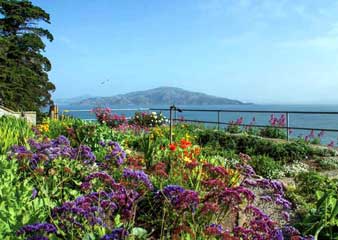
Alcatraz, I soon learned, has a long, complex history, and gardens have been a part of most of it. Some were public plantings tended by prisoners while others were the home gardens of the warden and guards who lived there with their families.
Last month I spent an afternoon walking Alcatraz with Dick Miner, a long-time volunteer who’s been helping to bring its gardens back to life after 40 years of abandonment. Dick talked about the herculean effort to clear decades of weeds and overgrowth and the excitement of rediscovering paths, retaining walls, and a surprising array of garden plants that survived amid the ruins.
“Bulbs were a favorite garden plant of the island’s residents,” Alcatraz’s director of gardens Shelagh Fritz wrote recently in Horticulture magazine. “Many bulbs originate from other Mediterranean regions and therefore find great success here – a happy coincidence since soldiers and guards simply brought their favorite garden plants with them to Alcatraz” including daffodils, freesia, Spanish bluebell, snowflake, and grape hyacinth. “When we cleared the overgrowth from the gardens, these bulbs came back to life after lying dormant for decades.”
Dahlias and glads appear in historic photos of Alcatraz, and Shelagh has ordered many of ours to replant there including ‘Clair de Lune’, ‘Old Gold’, and ‘Thomas Edison’ dahlias and Abyssinian, ‘Bibi’, ‘Dauntless’, ‘Fidelio’, ‘Spic and Span’, and ‘Starface’ glads.
For a look at these fascinating gardens, see Shelagh’s article, “A Hardened Garden.” To learn even more, go to AlcatrazGardens.org. And if you’re one of the 1.5 million people who will visit Alcatraz this year, don’t miss the docent-led tours of the gardens! (April 2016)
Happy 50th Anniversary, Southern Living!
Congratulations to our friends at Southern Living who are celebrating the iconic magazine’s 50th anniversary this month! February’s special double issue includes 21 of the magazine’s vintage front covers, 50 years of Southern recipes such as hummingbird cake (1978), and even a blooper section of “not-so-golden moments that we just couldn’t keep to ourselves.”
Gardening has always been an important part of Southern Living, and this issue is no exception. In “The Seed Saver” you’ll meet our friend Ira Wallace of Southern Exposure Seed Exchange. “The Camellia Man” spotlights Tom Johnson, curator of the nation’s largest collection of historic camellias. And then there’s Southern Living’s long-time garden editor Steve Bender– who’s also a long-time supporter of Old House Gardens – with “50 Golden Rules of Gardening.”
Steve calls himself the Grumpy Gardener, and though his rules may be the funniest garden tips you’ve ever read, they’re full of sage advice. Don’t miss his introduction, too, where he says that gardening is like cooking, and the best way to learn it – and to discover how much fun it is – is by doing it. When people tell him “Gardening is too hard. There is so much to learn. I just know if I plant something, I’ll kill it,” he replies, “Of course you will! Everyone who has ever gardened since Adam and Eve has killed a plant. That’s how we figure out what works and what doesn’t.”
And gardening, Steve says, is “the most gratifying of all human endeavors” – even “better than an accordion concert” or “fine aged possum.” (Feb. 2016)
Historic Meadowburn Farm Offers 7 Rescued Dahlias for Sale
Meadowburn Farm in northwest New Jersey was once the home of popular garden writer Helena Rutherfurd Ely. When published in 1903, Ely’s A Woman’s Hardy Garden was one of the first American garden books to reject Victorian pattern bedding in favor of a more informal style of gardening with shrubs, old-fashioned annuals, and perennials.
Meadowburn Farm has changed remarkably little since Ely’s death in 1920. It’s been owned by one family since 1930, and since 1883 its gardens have been tended by Ely’s original gardener and his descendants. Today, with the help of the Garden Conservancy, the gardens are being restored to their former glory.
Ely wrote that dahlias, glads, cannas, and red salvia were the only pattern-bedding plants she grew at Meadowburn. Dahlias are “decorative and desirable for cutting,” she explained, and “all the varieties are lovely.”
Today seven dahlia varieties survive at Meadowburn, possibly from as far back as Ely’s time. Unfortunately by the time Quill Teal-Sullivan was hired four years ago to guide the restoration of the gardens, the names of all had been lost. Quill turned to us for help, but since literally tens of thousands of dahlias have been introduced since Ely’s time, I knew that identifying Meadowburn’s relics would be a long shot at best.
After looking at photos, all I could tell her was that one might be ‘Jane Cowl’ and another ‘Deuil du Roi Albert’. We sent her tubers of both so she could grow them side by side to compare foliage, height, bloom-time, and other details – which is the only way to be certain about an identification – and we put her in touch with nearby dahlia experts who could visit Meadowburn and offer their insights.
Quill finally decided that one of the dahlias is indeed ‘Jane Cowl’, and she’s given new names to the others. Perhaps oldest of all – to judge by its 19th-century form and the way its flowers nod – is the one that’s now called ‘Meadowburn Byba Vincenza’.
All seven are for sale at the Meadowburn website, with proceeds helping to fund the restoration of the gardens, including “the 150-foot dahlia allée – filled with heirloom varieties – [which] erupts with color in late summer, as it has done for more than a century.” Learn more about Meadowburn’s gardens and its dahlias – and then maybe order one of its relics to grow in your own garden this summer! (Feb. 2016)
How the Fabulous ‘Jane Cowl’ Dahlia Got Its Name
Before it sells out early this year (as it always does), here’s a bit of history about big, beautiful ‘Jane Cowl’. Sent to us by our good customer Jim O’Donnell of Philadelphia, it’s from the November 1927 edition of Garden and Home Builder:
“In the large class at the American Dahlia Society’s show for seedlings” — which are dahlias that are not yet named or for sale — “not one of the more than thirty varieties exhibited could be casually passed by. Judging this rich amount of material occupied the gathered experts for some considerable time, and it was by no means an easy walkover for the winner; and yet, when Miss Jane Cowl [one of the most famous actresses of that era], who honored the exhibition with her presence on the first day, was invited to select out of the seedlings the one that should be named for her, she unhesitatingly and almost instantaneously decided on the same bloom that the judges had already selected for the big award.
“It would not be wise, however, to argue from this that the expert judges might be done away with. Miss Cowl, of course, selected the bloom that pleased her most without any regard to its comparative distinctiveness and other qualifications and standards by which the experts must measure any newcomer. There is, however, much satisfaction to be had in the fact that the popular favor and expert judgment in this instance, at all events, did coincide.”
See what Miss Cowl and the experts liked so much here, and if you decide you have to have it, be sure to order soon! (Jan. 2016)
Heirloom Honored as 2016 Perennial Plant of the Year
Although it’s not a bulb, the 2016 Plant of the Year of the Perennial Plant Association is an heirloom — and extraordinary.
‘Honorine Jobert’ is one of the oldest Japanese anemones, dating back to 1858. According to William Robinson in The English Flower Garden (1893), it “originated at Verdun sur Meuse in the garden of M. Jobert. From a large tuft of [normally pink] A. japonica, a stem arose with pure white flowers.” Jobert named it for his daughter, and it’s been gracing gardens ever since.
A big clump of ‘Honorine Jobert’ flourishes by the front sidewalk of one of the old houses in our neighborhood, and every fall my wife and I make multiple pilgrimages to it (with Toby, of course) so we can gaze at its exquisite flowers.
A vigorous perennial, ‘Honorine Jobert’ does best in zones 4b-7b, in light shade and alkaline soils that never dry out completely. It can be slow to get established, but once it does it spreads eagerly, it’s deer-resistant, makes a fine cut-flower, and will light up your fall garden. Learn more from our friend Jo Ellen Meyers Sharp, and look for it online or in local garden centers this spring. (Jan. 2016)
“Broken-Color” Iris: From ‘Loreley’ to ‘Bewilderbeast’
New to our catalog for delivery in April is ‘Loreley’, one of the most popular iris of the 20th century. Introduced in 1909, ‘Loreley’ was one of the first “broken-color” iris, a type that has become increasingly popular in recent years.
Unlike broken tulips whose stripes are caused by a benign virus, broken-color iris are irregularly splashed with contrasting colors due to a genetic mutation. Although at least one dates to the 19th century — ‘Victorine’ of 1840 — most early examples were probably discarded as misfits. The enormous popularity of ‘Loreley’, however, helped iris breeders begin to see these “flawed” iris in a whole new light.
Varieties with names like ‘Kaleidoscope’ and ‘Joseph’s Coat’ followed, but ‘Loreley’ remained the most popular broken-color iris until the elaborately patterned, purple and white ‘Batik’ was introduced in 1986. ‘Batik’ won the AIS’s top prize for iris its size and became a huge commercial success, opening the door for the scores of broken-color iris introduced since then, often with amusing names such as ‘Bewilderbeast’.
As our friend Mike Unser writes in his excellent blog post about the history of broken-color iris, “No two blooms are ever just alike, and they can create a very lively and exuberant effect in the flower garden.” To see for yourself, order ‘Loreley’ now for delivery in April! (Dec. 2015)
Book of the Month: The Artist’s Garden: American Impressionism and the Garden Movement
Gardening is a creative act, and plants can be amazingly beautiful, so is it any surprise that artists are often gardeners — or should I say that gardeners are often artists?
In The Artist’s Garden, the intertwining histories of American art and American gardening from about 1880-1920 are explored in seven essays by noted experts. Written to accompany a traveling exhibit organized by art historian and avid gardener Anna O. Marley of the Pennsylvania Academy of Fine Arts, the book focuses on artists from the Northeast and the Philadelphia area which has had a rich gardening tradition for centuries.
More than 100 of the book’s 250 pages feature full-page color illustrations of paintings and other works by artists ranging from well-known figures such as Childe Hassam and Mary Cassat to lesser lights whose work is often equally impressive. Although the quality of the reproductions isn’t as sparkling as might be hoped — Impressionism, after all, emphasized sunlight and vibrant colors — paging through them is a great pleasure and offers fascinating glimpses of the gardens of the era.
As might be expected, the essays vary in interest and readability, but they’re all worthy contributions. I especially liked Katie Pfohl’s “The Garden Painted, Planted, and Printed” which explores the rise of chromolithography in nursery catalogs and commercial art and its impact on fine art and the public’s acceptance of the brighter palette of Impressionism.
If you’re lucky enough to live near Winston-Salem or Pasadena, you can enjoy the exhibit itself at the Reynolda House Museum of American Art through January 3 or the Huntington Library near Pasadena from January 23 through May 9. If not, add the book to your holiday wish list and you can enjoy it in the comfort of your own home all winter long. (Dec. 2015)
Lost . . . and Found? Gaye’s “Tiny Little Cream-Colored Daffodils”
We love it when our customers use the “Special Requests and Feedback” section of our online order form. That’s where Gaye Ingram of Ruston, Louisiana, made this plea:
“If possible, I would like to order ten moschatus, even though the limit is five. I’ve missed it every year by ordering late. Saw it decades ago and fell in love with it. I’m well past retirement age and would like to see a wee colony in my lifetime. Thank you for considering my request.”
Being soft-hearted souls, we said yes, and when she replied, Gaye told us this story:
“Thank you! I’ve pursued that particular bulb (or what I believe is that bulb) since 1968. Not even 25 years old but with degrees almost in hand, my husband and I arrived in Ruston that year to teach literature (me) and history at Louisiana Tech. We found a sweet little 1930s house on a shady street that had belonged to the mother of the chair of the Interior Design department. We felt like grown-ups!
“In spring, tiny little cream-colored daffodils with nodding heads sprang up on the lawn. I’d grown up in Central Louisiana among people whose yards and gardens were filled with passalong plants and bulbs, but I’d never seen such a demure spring bulb. I marked them and vowed to dig one or two in the fall.
“Then we moved to another place, and built a new house. I searched ever after for those quiet creamy bulbs. Went back to the place where we’d lived, but the owners had seen no bulbs. Without care and probably having their leaves mowed in late spring, they’d given up the ghost.
“The next time I saw them was in Celia’s grandmother’s garden. [Ed. note: Our good friend Celia Jones owns a small farm near Shreveport where her grandmother once grew acres of daffodils.] Celia had only a few, and knew only a local name for them. Sometime later, when I discovered Old House Gardens, I talked with Scott, but back then you didn’t offer them and he couldn’t be sure about their exact identity. More recently, whenever you did offer moschatus I ordered too late. (One has to discipline herself to order bulbs when it is 95 degrees with 80% humidity, as it is here today!)”
We sent Gaye’s bulbs to her last week, but we’re still not sure whether our Dutch-grown moschatus – or the very similar ‘Colleen Bawn’ – is exactly the same as the once widely-grown heirloom she’s seeking. Daffodils are enormously varied, and the differences don’t always show up in photos. For example, the Dutch-grown N. jonquilla of mainstream catalogs looks very much like the heirloom N. jonquilla ‘Early Louisiana’ that we offer, but the Dutch jonquils bloom weeks later and never thrive as well in Southern heat. (Learn more here.)
But we’re hopeful that Gaye now has the sweet little daffodil she fell in love with almost 50 years ago – and if you happen to be growing the beloved Southern heirloom known as goose-neck, swan’s neck, or silver bells, we’d love to hear from you! (Nov. 2015)
$400,000 Oak: One Year after the Big Move
The 250-year-old, 65-foot-tall oak tree that the University of Michigan dug up and moved has survived its first year in apparently good shape. The tree made national headlines last fall when it was moved to make way for an expansion to the Ross School of Business. (If you missed it then, read “Save the Oak!” in our Newsletter Archives.)
“It leafed out nicely and had great spring color,” U-M horticulturist Marvin Pettway said, and “it had a full crown of leaves well into the beginning of October.” Although the after-effects of transplanting sometimes don’t show up until the second or even third year, getting that magnificent heirloom through its first is something to be celebrated. Read more here. (Nov. 2015)
JFK’s Tulips — More History and a Brand New Sampler
We knew that ‘Blue Parrot’ tulips were featured in the redesign of the White House Rose Garden initiated by President Kennedy in 1962 (see “JFK’s Garden”), but thanks to a tip from a friend, we’ve now learned a lot more about that iconic garden — and we’re celebrating with a brand new sampler of five fabulous tulips that bloomed for Kennedy there.
Located just outside the Oval Office, the Rose Garden has a long history, but by Kennedy’s time it was woefully neglected. He re-envisioned it as a flower-filled ceremonial space for welcoming foreign dignitaries, hosting major press conferences, and so on, and he enlisted the remarkable Bunny Mellon to turn his vision into reality.
Mellon was a philanthropist, art collector, and avid amateur gardener. Her redesign featured an open lawn surrounded by boxwood-edged flower beds and four great saucer magnolias transplanted from the Tidal Basin. Kennedy was intimately involved in the development of the garden and, having read Thomas Jefferson’s garden diary, urged Mellon to include plants in it that Jefferson grew. “It was truly President Kennedy’s garden,” Mellon said later. “His concern for its growth and well-being was never ending.”
See photos and learn more about the Rose Garden’s long history at the White House Historical Association’s website or — for even more — treat yourself to a copy of the summer 2015 issue of White House History which is devoted to the topic.
And now with our brand-new “Springtime in Camelot” sampler, you can enjoy five of the tulips that bloomed in Kennedy’s garden. We’ll send you three bulbs each of lavender ‘Blue Parrot’, dark maroon ‘Black Parrot’, flamingo-pink ‘Fantasy’, rose-pink ‘Mariette’, and ‘White Triumphator’, all for just $25. No matter what your politics, this beautiful sampler deserves your vote! (Oct. 2015)
Don’t Be Afraid to Kill Our Rarest Bulbs (as Barbara Kingsolver Explains)
Every now and then a customer tells us, “Don’t send me any of your ‘Rarest’ bulbs because I’m not a great gardener and I’m afraid I’ll kill them.”
We appreciate that concern, but
(a) even our rarest bulbs are tough and adaptable — they’re survivors, not fragile antiques,
(b) even if they don’t last forever in your garden, when fellow gardeners see them and you talk about how awesome they are, you’re building support for heirlooms, and
(c) as long as people keep buying them, the farmers who grow them for us have a reason to keep growing them.
It’s like heirloom vegetables. As best-selling novelist Barbara Kingsolver explains in Animal, Vegetable, Miracle, “You can’t save the whales by eating whales, but paradoxically, you can help save rare, domesticated foods by eating them. They’re kept alive by gardeners who have a taste for them, and farmers who know they’ll be able to sell them.”
So don’t worry about killing our precious heirlooms. It’s actually pretty hard to do, and even if a couple of them die, you’re still helping to preserve them! (Sept. 2015)
Heirloom Perennials from Heritage Flower Farm
At Heritage Flower Farm in Mukwonago, Wisconsin, Betty Adelman grows over a thousand varieties of heirloom flowers and ships them to gardeners all across the country. Our friends at The American Gardener magazine profiled Betty recently, and at our request they’ve posted her story online.
Along with heirlooms from Acanthus to Zizia, Betty offers a few pre-planned gardens such as the Emily Dickinson Garden with flowers mentioned in her poetry or pressed in her herbarium. There’s also a fascinating section of “People in Plant History” with short bios of 45 greats from the ancient Greek Dioscorides to Karl Foerster who in 1939 introduced what has become the world’s most popular ornamental grass.
Treat yourself to a look at the Heritage Flower Farm website — and then please consider joining Betty and me as members of the 93-year-old American Horticultural Society, publisher of the always excellent American Gardener magazine. Both are well worth your support. (Sept. 2015)
Tulips Gone Wild: Florentines in Yorkshire and Sweden
Although it’s a graceful wildflower with a long history in gardens, the Florentine tulip (T. sylvestris) is also a bit weedy, spreading by underground stolons to produce new plants that can take years to bloom. Two articles in the Wakefield and North of England Tulip Society newsletter gave me a deeper appreciation for both its history and its vigor.
Linda Chapman explains that the Florentine is “a tetraploid (having double the number of chromosomes) which may account for its vigor. It is not native to the UK but is naturalized here, though how it arrived is not known. It could have come with the Romans” or much later with “Flemish, Walloon, or French refugees from 1540 onwards.”
When Linda went searching for Florentines where they’d been reported in the past, she found almost none — until she visited a protected “Site of Special Scientific Interest” in Yorkshire. There along the banks of the River Nidd “there were tulips as far as we could see, literally hundreds of them. It was a truly remarkable sight.”
In a second article, Anita Irehoim writes about the Florentine in Sweden. “Olof Rudbeck the Elder (1630-1702) established the first botanical garden in Sweden at Uppsala and grew the ‘yellow tulip from Bologna’” — an early name for the Florentine tulip. (Florence and Bologna are 50 miles apart.) By 1744 it was naturalized in Sweden, and today it’s still found “especially in grass areas in old gardens and parks but also in forest edges and along [roadside] verges.” Anita says “the best way of getting flowers is to disturb the soil. Dig and turn the soil upside down! It makes some sense since it is . . . a weed of the vineyards.”
Olof Rudbeck’s son was also a botanist, and “one of his best known students was Carl Linnaeus, the man who devised our system of plant nomenclature.” Today Linnaeus’s summer house is a museum and “sanctuary for surviving Linnaean plants. Of the 900 varieties he may have had in the garden, only about 40 remain today — one of which is T. sylvestris.” (Sept. 2015)
JFK’s Garden and ‘Blue Parrot’ Tulips
‘Blue Parrot’ — one of the seven tulips we’re offering for the first time this fall — once played a leading role in the White House Rose Garden. According to a 1963 LIFE magazine article titled “JFK’s New Garden,” the “once rundown” space outside the Oval Office was bulldozed and replanted as a “traditional 18th-century garden” with a lawn for presidential receptions.
“And the master gardener is none other than urban oriented J.F.K. himself,” the article continues. “While Jackie toils at renovation in the White House, the President happily shows visitors around the great outdoors of the flower beds. ‘Isn’t this garden terrific?’ he glows. ‘And you know, you’re only allowed to stand in one spot on the grass for two minutes.’”
The garden was designed by Bunny (Mrs. Paul) Mellon, a good friend of the First Lady who went on to spend the rest of her long life — she died last year at the age of 103 — gardening, designing gardens, and collecting rare garden books at her Virginia estate, Oak Spring Farms.
The article includes color photos and a partial plan of the garden where “visitors now parade amid a panoply of Blue Parrots, santolina, Oriental Splendor, Queen of Sheba, Yellow Cheerfulness, periwinkle, and Shot Silk nourished by seven gardeners working diligently under the President’s very eye.” See it all here. (Aug. 2015)
Campernelle Narcissus: From Slave Quarters to Lake Superior
One of our all-time best-selling bulbs is our true, American-grown Campernelle narcissus. Often called the “large jonquil” in old books and catalogs, Campernelles are a naturally-occurring hybrid of Narcissus jonquilla (the “small jonquil”) and N. pseudonarcissus (Lent lily) collected from the wild sometime before 1601.
In zone-8a East Texas, our good friend and daffodil expert Keith Kridler makes an interesting observation about this enduring daffodil: “One of the things I’ve noticed in our area is that the black slaves nearly all had Campernelles and jonquils blooming where they lived. You often find at larger plantation headquarters that the main house where the white folks lived (this part of the country was poor, so we’re talking about a simple ‘dog-trot’ house here) has few if any daffodils, but back from the house aways and further down the spring creek, the slaves’ or sharecroppers’ location is marked with masses of these daffodils today.”
Although they’re best known and loved in the South, Campernelles also do fine for us here in zone-6a Ann Arbor — and sometimes even further north. For example, our good friend Nancy McDonald who lives near Lake Superior in zone-5a Grand Marais, Michigan, writes: “I’ve had your Campernelles since 1995 and they’ve done very well, multiplying freely. So maybe they’re hardier than you think, especially in a mix of sand and old horse manure” — and when your garden is insulated by ten feet of snow every winter, as Nancy’s is. (Aug. 2015)
Summer Fun: An Online Guide to Historic Landscapes Near You
Summer is a great time for visiting other people’s gardens, and if you like historic gardens — or historic parks or maybe even historic cemeteries — there’s a wonderful online guide that will help you find ones close to where you live or travel, including some you probably never even knew existed.
It’s called “What’s Out There” and it’s an ongoing project by The Cultural Landscape Foundation, the country’s leading non-profit devoted to historic landscapes. With it you can easily search for landscapes by location — for example “Michigan” or within so many miles of your zip code — or by landscape type — including garden/estate, botanical garden, public park, golf course, and even roof garden — or by designer, style, or the property’s name.
To find out what’s out there by you, go to http://tclf.org/landscapes and click “Advanced Search” in the list on the right. Or if you’re using a smart-phone, click the handy, GPS-enabled “What’s nearby” button to see everything within a 25-mile radius. And have fun! (July 2015)
Advice from 1683: Killing Earthworm “Pests” with Tobacco
Here’s a weird bit of garden advice for July from the Kalendarium Hortense or the Gardener’s Almanac written by John Evelyn in 1683:
July: “Now (in the driest season) with brine, pot-ashes, and water, or a decoction of tobacco refuse, water your gravel walks, etc. to destroy both worms and weeds, of which it will cure them for some years.”
Weeds, yes, but why would anyone want to destroy earthworms? Although we certainly don’t advocate it, back when hard-packed gravel was the paving of choice for garden paths, worm castings on the surface were considered as unsightly as weeds.
Brine and wood ashes kill weeds by making the soil too salty and alkaline for them, and tobacco kills worms just like it does humans. Tobacco water and tobacco powder were commonly used as pesticides well into the 20th century, as was tobacco smoke in greenhouses. Even today tobacco is sometimes recommended as an organic pesticide — which may sound good, but remember, whether it’s organic or not, it’s still a dangerous poison. (July 2015)
Newly Added: Gender-Bending “Indian Turnip”
In 1820 when it was listed in America’s very first bulb catalog, Indian turnip was the common name for the striking native plant that most of us today call jack-in-the-pulpit. Although its raw corms are poisonous, Native Americans learned to neutralize the poison by roasting or drying them for six months, after which they could be peeled and ground into a flour for making bread.
Jack-in-the-pulpit and Indian turnip are just two of this intriguing plant’s many names which include (so the internet says) Iroquois breadroot, starchwort, pepper turnip, bog onion, dragonroot, memory root, Indian cherries (for its red fruit), Indian cradle, brown dragon (to distinguish it from its native cousin, green dragon), petit precheur (in Quebec), aronskelk (in Dutch-settled areas), tuckahoe, cooter-wampee, wake robin (a name more often applied to trillium), Adam’s apple, devil’s ear, cobra lily, and — from its Old World cousin Arum maculatum — cuckoopint and lords-and-ladies.
And here’s another fascinating tidbit: jack-in-the-pulpit can change from male to female and back again. When they’re smaller, plants are generally male, but when environmental conditions are favorable and they grow large enough, they become female, producing seeds in a cluster of bright red berries. The year after fruiting or when conditions are challenging, plants often change back to male until they can build up the strength to set seed again.
This multi-talented native bulb is easy to grow in light shade, and you can order it now for fall planting. (July 2015)
Book of the Month: The General in the Garden
Mount Vernon’s head gardener Tatiana Lisle visited us last month, and along with gifts of home-made soap (including “Honey and Yogurt” with honey from her backyard hives, and “Hempalicious” with . . . well, we were afraid to ask), Tatiana also brought us a couple of wonderful new books.
If you’re a foodie I’m sure you’ll enjoy the fascinating Dining with the Washingtons — with recipes for everything from and fairy butter and salamongundy to cherry bounce — and if you’re a gardener I highly recommend The General in the Garden.
Although beautiful enough to be a coffee-table book, The General in the Garden is also rich in information. At its heart are three chapters exploring Mount Vernon’s landscape history. The first tells of Washington’s dramatic redesign of his estate after the Revolutionary War. The second details the ever-changing restoration of the landscape from 1860 to 2005. And the third details the meticulous research and archaeology that led to the recent recreation of the Upper Garden — which for most of the 20th century was a formal rose garden — into three enormous, utilitarian vegetable beds bordered by relatively narrow flower beds. The book concludes with a historical guide to everything from “Greenhouse and Slave Quarter” to “The Lost Deer Park” along with lists of plants grown at Mount Vernon during Washington’s time.
As one of the most important American landscapes to survive from the 18th century, Mount Vernon has long deserved a book of this caliber. Whether you simply page though it enjoying the illustrations or read every word including the footnotes, The General in the Garden will give you a deeper appreciation for this extraordinary landscape, for the difficult art of landscape preservation, and for Washington himself, a man who was not only the father of his country but a gifted landscape designer and an unabashed tree-lover. (June 2015)
Once and Future Midwestern Garden History Symposium
Hello to all of our friends at the first of what is hoped will become an annual series of conferences on Midwestern garden history! The June 11-12 event at Bath Farm and Village north of Akron features lectures by experts such as Denise Adams and tours of historic landscapes such as the magnificent Stan Hywet. We applaud organizer Kathie VanDevere and hope the conference is great success!
To get on the mailing list for next year’s symposium, email Kathie at kvandevere@msn.com. (June 2015)
Heirloom Myth-Busting #2: Does an Heirloom Have to Be 50 Years Old?
Absolutely not. Although some people may tell you that’s a requirement, they’re just confused or oversimplifying. Trust me, there’s no International Registrar for Heirloom Plants that’s charged with officially defining the term – and age is relative, in any case.
Some plants like peonies and apples will live for a very long time, even in a totally abandoned garden, while other plants like dahlias and tomatoes will disappear most places unless someone saves, stores, and replants them every year. This means that 50-year-old peonies are relative youngsters compared to the many that survive from 100 or even 150 years ago, while 50-year-old dahlias are already hard to find, making them, in effect, much older.
It’s sort of like the way it is with dogs. It doesn’t make sense to define an “old” dog as one that’s at least eight years old because Irish wolfhounds rarely live that long while Chihuahuas can live to be twice that age.
That’s why I believe that insisting on a specific cut-off date for heirloom plants is misguided, and that rarity or endangeredness has to be as much a part of the definition as age itself. Heirlooms have been handed down because they’re wonderful plants, and the older they are the more they allow us to experience the incredible diversity of the past. (Hence our OHG tagline, “So Much More than New.”) But if we don’t grow and care for heirlooms, even the toughest of them will eventually be lost, and the ones that are most in need of our care are the ones that are the rarest and closest to extinction – even if they’re not yet 50 years old.
(You might also enjoy reading my earlier newsletter article, “Heirloom Myth-Busting #1: Are They Heirloom, Heritage, Antique, Vintage, or Historic Plants?”) (April 2015)
Our Global Village of Heirloom Bulb Lovers
The whole world loves heirloom bulbs. Or at least gardeners in 51 different countries are reading our newsletter. How cool is that?
In addition to 22,983 subscribers here in the US, we also have 87 readers in garden-loving Japan, 61 in nearby Canada, 55 in France (Quelle surprise!), 42 in Great Britain, 35 in the Netherlands, 18 in Mexico, 16 in India, and 11 in Germany – even though we virtually never ship bulbs outside the US.
And that’s just the beginning. We also have 8 readers in Grenada (where the total population is barely over 100,000), 7 in Argentina and Costa Rica, 6 in Italy and Saint Lucia (which is halfway between Puerto Rico and Venezuela, in case you can’t quite place it), 5 in Australia, New Zealand, and Belize, 4 in Switzerland and Turkey, and 3 in Israel, Sweden, and the Czech Republic.
Last but not least, we also have at least one savvy reader in Afghanistan, the Bahamas, Belgium, Bermuda, Brazil, Chile, China, Cuba, the Dominican Republic, Ecuador, Estonia, Finland, Guatemala, Guinea, Hungary, Jamaica, Kenya, Myanmar, Norway, Panama, Peru, the Philippines, Poland, Portugal, Spain, Russia, Tanzania, Thailand, and Vietnam.
Wherever YOU are reading this today, we’re glad you’re here! (April 2015)
Celebrate 100 Years of the ADS with “Cream of the Crop” Dahlias
Congratulations to the American Dahlia Society on its 100th anniversary!
Introduced from Mexico in 1798, dahlias became one of the most popular plants of the 19th and early 20th centuries. The UK’s National Dahlia Society was founded in 1881, the German Dahlia Society in 1897, and — after a failed attempt in 1895 — the ADS was established in 1915. The new society held its first national show that fall in New York’s Museum of Natural History. The blooms were displayed in milk bottles, winners took home $100 worth of ribbons and medals as well as $325 in cash, and the show drew some 35,000 enthusiastic viewers.
Dahlias are on the rise again today, and of all the bulbs we ship in the spring, they’re the most popular with our customers. They’re easy to grow, great for bouquets, and spectacularly diverse. To celebrate the ADS centennial, here are four easy ways to add at least one of these incredible flowers to your garden this spring:
1. Grow the oldest dahlia that still ranks as an ADS “Fabulous 50” dahlia — ‘Kidd’s Climax’, which last year won 78 blue ribbons or higher awards.
2. Grow an heirloom that still ranks as an ADS “Cream of the Crop” dahlia — ‘Kelvin Floodlight’ (with 42 blue ribbons or higher awards in 2014), ‘Bonne Esperance’ (26), ‘Juanita’ (18), ‘Thomas Edison’ (16), and ‘Little Beeswings’ (16).
3. Grow a dahlia that’s so old it could have been shown in the very first ADS show: ‘White Aster’ (introduced in 1879), ‘Union Jack’ (1882), ‘Tommy Keith’ (1892), ‘Little Beeswings’ (1909), “Wisconsin Red” (1910?), or ‘Prinzessin Irene von Preussen’ (1912).
4. Grow one of our easy heirloom dahlia samplers, Dreamy Dahlias or Endless Bouquets. (April 2015)
Online Now for Your Viewing Pleasure: 14,000 Antique Garden Catalogs
Here’s some exciting news for all of you who enjoy the antique images we use in our print catalogs. Last week the Biodiversity Heritage Library celebrated their amazing online collection of over 14,000 historic garden catalogs with a week-long social media event called “Garden Stories.” Even if you missed our Facebook alert about it, you can still:
1. Read the Library’s 12 blog posts about the history of garden catalogs, including ones on Shaker seeds, catalog art, and “Leading Ladies.” Click the “Older Posts” link at the bottom of each set of articles to see them all.
2. Enjoy the thousands of antique catalog images the Library has posted at Flickr. Be sure to click on your favorite images to see others from the same catalog — and if you find one you think would be perfect for our next catalog, let us know!
3. Explore some of the Library’s thousands of digitized catalogs dating from 1782 to 1969. Leaf through the 1825 catalog of the William Prince nursery, for example, and you’ll find 22 pages of fall-planted bulbs — including several whose names you’ll recognize from our catalog — and almost two pages of dahlias which at the time were so new to cultivation they were placed in the section labeled “Green-House Plants.”
The Biodiversity Heritage Library is a consortium of natural history and botanical libraries working together to digitize “the legacy literature of biodiversity” and make it more widely available in a global “biodiversity commons.” The BHL’s garden catalogs were digitized mainly from the collections of the National Agriculture Library (which holds some 200,000 catalogs), the New York Botanical Garden, the Missouri Botanical Garden, and Cornell University. We applaud the BHL’s work and we’re glad they recognize the value of historic garden catalogs! (April 2015)
Brand New Daffodils in American Gardens: 1733-1940
This is a landmark book, not only because of its content but simply because it’s been published. Twenty years ago I don’t think anyone would have even considered publishing an entire book devoted to the history of daffodils in America. And yet here it is, and that in itself is a testament to the progress that’s been made in convincing people that old plants can be just as garden-worthy as new ones, and that preserving them is as important as preserving historic buildings and other relics of our cultural history.
Our friend Sara Van Beck, the book’s author, has been an advocate for historic daffodils for many years. Her late father John Van Beck, was the founder of the Florida Daffodil Society and joined with me in the late 1980s to persuade the American Daffodil Society to establish a special section for Historic Daffodils in every ADS show across the country. In Daffodils in American Gardens, Sara shares the wealth of information — and images — that she’s collected over the years not only from old books and nursery catalogs but from letters, diaries, periodicals, and from exploring the daffodils that survive at historic places and abandoned sites throughout the Southeast. And what a wealth it is!
Although this may not be the easiest book to read (think dissertation rather than pop fiction) and Sara and I may sometimes disagree in our interpretation of the historical record, Daffodils in American Gardens is a major work of garden-history scholarship, and I’m thrilled that it’s been published. Congratulations, Sara, and thank you! (March 2015)
Old Masters Remixed: The Floral Still Lifes of Bas Meeuws
If you’d love to own one of those sumptuous flower paintings from Rembrandt’s era filled with striped tulips, cabbage roses, and other exquisite blooms, but their multi-million dollar price tag is beyond your budget, take a look at the astonishing art of Dutch photographer Bas Meeuws.
With his digital camera and hours of painstaking work in Photoshop, Meeuws creates images that both mimic the centuries-old masterpieces and yet are strikingly new. Like the original artists, he starts by creating images of individual flowers — and insects, snails, and so on — and then later draws from this digital stockpile to assemble his bouquets. By the time he’s done composing, manipulating shadows, erasing cut lines, and so on, he may spend as much as 60 to 100 hours on a single work.
Meeuws’ bouquets feature many of the spectacular broken tulips we offer from the Hortus Bulborum. When the original paintings were created in the 1600s, these tulips — and many of the other flowers depicted in them — were so new and rare that it was actually cheaper to buy a painting of them than the flowers themselves. In his photographs, Meeuws says he tries to evoke the feelings that “people looking at the picture then would have had, the awe that they must have felt for all the expensive and exotic flowers.” Take a look and I think you’ll agree that he’s accomplished that remarkably well. (March 2015)
Rediscovering Papaw’s Hardy Lavender Dahlia
“I am hoping that ‘Mrs. I. De ver Warner’ is the dahlia that my papaw and mamaw grew for many years,” Roger Flatford wrote us when he ordered last spring. I hoped so, too, but I knew that was a very long shot. Tens of thousands of dahlias have been introduced, many look a lot alike, and very few have been preserved. But in late summer we got a happy surprise:
“I can’t say thank you enough for ‘Mrs. I. De ver Warner’ dahlia!” Roger wrote. “This dahlia grew at my mamaw and papaw’s house in [zone-7a] Heiskell, Tennessee, coming back for them for 30 or 40 years, even through some hard winters. I’m 52 and I can’t remember a time when it wasn’t there. Every summer it would reward us with the most beautiful lavender blooms. We never knew its name but we always loved to see it bloom.
“My papaw kept a beautiful yard, and I inherited the flower gene from him. After he died in 1980 I tried to keep his flowers growing for my mamaw. Over the years, though, most all were lost except for the lavender dahlia and two old peonies and a little iris that just kept multiplying. Then one year the dahlia didn’t come back. I was really sad to see it gone.
“A few years later my mamaw passed away at 93. That summer I spent a lot of time at the little white house on the hill, remembering how much fun we had visiting there when I was a kid. Then I started looking everywhere I could think of, hoping to find the lavender dahlia. I bought several that looked right, but when they bloomed they were never the one.
“This past spring I saw two dahlias at your website that I thought maybe, just maybe were it, so I purchased them both. A couple of weeks ago I went out to the garden and there it was, Papaw’s Lavender Dahlia. What a reward! I know Mamaw and Papaw are smiling down from heaven.
“Next spring, I’m going to plant another one at the little white house on the hill in memory of my mamaw and papaw, Goldie and Roma Graham. Thank you, Old House Gardens, for finding and preserving the beautiful ‘Mrs. I. De ver Warner’.”
You’re welcome, Roger! Interestingly enough, that unusually hardy dahlia came to us from Joyce Dowell who got it from her grandmother in Scottsville, Kentucky — which, as the crow flies, is just 100 miles away from where your grandparents lived. (Feb. 2015)
3 Experts, 3 Centuries, 3 Great Iris
Sure, we think our heirloom iris are awesome, but there’s no need to take our word for it. Here’s what experts in 1597, 1930, and 2012 had to say about three of our favorites:
I. pallida ‘Dalmatica’ — In 1597 John Gerard praised this ancient iris in his landmark Herbal, saying it “hath leaves much broader, thicker, and more closely compact together” than other iris, “like wings, or the fins of a whale fish.” From these “riseth up a stalk of four feet high, as myself did measure oft times in my garden,” with “fair large flowers of a light blue” which “smell exceedingly sweet, much like the orange flower.”
‘Mrs. Horace Darwin’ — More than three centuries later, famed horticulturist John Wister writing in his book The Iris praised this petite beauty as one of three whites that “can never be omitted.” He called it “wonderfully free blooming,” and added that “it is unexcelled for massing and should be used in every garden in quantities.”
‘Quaker Lady’ — Last but not least, Kelly Norris who grew up on his family’s iris farm and now works at the Greater Des Moines Botanical Garden, praised this subtle flower in his 2012 Guide to Bearded Iris: Cultivating the Rainbow, saying it “has a soft-spoken princess charm that stops me in my tracks each spring. . . . If your garden needs a vintage touch in lovely pastel hues of bronze and lilac, look no further.” (Feb. 2015)
Book of the Month: The Garden Diary of an Irish Lady, 1891-1922
When she married the Earl of Mayo in 1885 and moved to the family estate outside of Dublin, Geraldine Ponsonboy knew little about gardening. Before long, though, she had thrown herself into it whole-heartedly, hiring and firing several head gardeners until she found one who could accept her decidedly hands-on approach, and eventually filling a garden diary with 31 years’ worth of notes, drawings, and watercolors.
Geraldine’s fascinating and beautiful diary has recently been published as Lady Mayo’s Garden. Sub-titled The Diary of a Lost 19th Century Irish Landscape, it gives readers an insider’s look at gardening during an era when Victorian pattern-bedding was giving way to Arts and Crafts esthetics and “old-fashioned” perennial borders. Happily for bulb-lovers like us, it focuses mainly on the spring garden, and as our good friend Betsy Ginsburg points out in a recent blog post, “with the renewed interest in heritage gardening and heirloom varieties, many of Lady Mayo’s favorite spring plants are obtainable today. The lovely Narcissus poeticus recurvus and ‘Conspicuous’ daffodils currently sleeping in my garden are the same varieties that graced” Geraldine’s garden a century ago.
In 1922 the Mayos’ estate was attacked by partisans during the Irish Civil War. Given just 20 minutes to get out before her house was burned, Geraldine set her chickens free and saved her diary. Learn more about this remarkable woman and her garden in Betsy’s engaging review of Lady Mayo’s Garden at GardenersApprentice.com. (Feb. 2015)
Thousands of Glads Bloom Forever in 1921 Saginaw Show
Have you ever seen a flower show devoted entirely to gladiolus? Well, now you can, thanks to a “virtual exhibit” by the Castle Museum of Saginaw County History.
Four photographs at the Michigan museum’s website offer glimpses of a 1921 show sponsored by the Saginaw Woman’s Club, with thousands of glads displayed in wicker baskets and milk bottles. The show included big displays by commercial growers such as the leading glad hybridizer of the era A.E. Kunderd (“Originator of the Ruffled Gladiolus”), Fred Baumgras, and P. Vos (with mood lighting and what looks like wisteria dangling from the ceiling), as well as a room full of glads grown by local amateurs.
The images are part of a larger online exhibit of garden photos by a 1920s club member. Most of the photos show gardens in Saginaw, including a spectacular formal garden by Charles Platt that’s been preserved by the Saginaw Art Museum, but there are also shots of the Michigan gardens of chemical magnate Herbert Dow and popular garden writer Mrs. Francis King. Paging through the nearly 100 photos provides viewers today with an introduction to some of the defining features of early 20th-century gardens –birdbaths, sundials, benches, gates, trellises, pergolas, and summer houses – as well as many of the era’s most popular plants – peonies, iris, phlox, golden glow (Rudbeckia laciniata ‘Hortensia’), Shasta daisies, and, of course, gladiolus. (Jan. 2015)
Flora Illustrata: Sumptuous New Book for Holiday Giving (and Getting)
A dazzling image of a parrot tulip from the 1700s is sprawled across the cover of Flora Illustrata, and it’s hard to imagine any gardener resisting its allure. Open the book and you’ll find nearly 300 other fascinating images, most in color and some covering two full pages.
But this isn’t a picture book. Subtitled Great Works from the LuEsther T. Mertz Library of the New York Botanical Garden, it’s a collection of essays that explore the riches of the Library — which holds over a million books and eleven million other documents — and its development since 1899. In many ways it’s like taking a walk through the Library with a group of incredibly expert guides who keep pulling rare volumes off the shelves to give you a glimpse inside of them while they explain their importance and how the Library acquired them. Since the works are all discussed within the context of their times, the end result is a bibliographic history of botany and gardening.
The three essays in Part IV, “Celebrated Works on American Gardening and Horticulture,” bring this history right into our own backyards. I especially liked the one on 19th-century nursery and seed catalogs (what a surprise, eh?) which is richly illustrated with images drawn from the more than 58,000 items in the Library’s collection.
Although any gardener will enjoy the book’s illustrations, I’ll caution you that the scholarly prose often makes for slow going, and this is a book about books and botany as much as it is about gardening. That said, I believe readers with anything more than a passing interest in the history of plants and gardens would love to get Flora Illustrata for their own library this holiday season. (Dec. 2014)
Save the Oak! 250-Year-Old Heirloom Dug and Moved
A 250-year-old tree here in Ann Arbor got an early Christmas present recently: a new lease on life.
Standing six stories tall, the majestic bur oak started life long before Ann Arbor was founded in 1825. It’s a relic of the “oak openings” — scattered oaks with a light understory of herbaceous plants and grasses — that drew the first settlers here and inspired the city’s name. Unfortunately it grew right where the university wanted to build a $135-million addition to the Ross School of Business.
Instead of cutting it down, the university decided to dig and move the oak about 500 feet. Last summer, workers from a Texas firm that specializes in moving large trees dug a trench 40 feet in diameter to define the edges of the mammoth root ball and spur additional root growth. Next they drove a series of pipes under the tree to create a platform to support the roughly 700,000-pound mass during the move.
In late October they returned to sever the roots under the pipes and insert heavy-duty air bladders that were then inflated to lift the tree so they could position a pair of huge industrial transporters under it. Although various complications — including an exploding air bladder — delayed the replanting until ten days later, officials are still optimistic that the tree will “outlive all of us.”
The $400,000 move was paid for by private donations that are funding the building project. That’s a lot of money, and there were many critics, but I for one am glad the university — which is making enormous efforts to become a greener, more sustainable institution — decided to save this spectacular heirloom which has now become an icon of both the university’s history and its commitment to the future. I’m also hoping that, as with medical procedures that were once experimental and have now become routine, the more often moves like this are done, the easier and cheaper it will be to save truly priceless trees like this.
You can learn more by watching a short animated video, viewing dozens of photos, and reading an excellent article in the UM student newspaper. (Dec. 2014)
New and Free: The Georgia Daffodil Society’s Historics Handbook
Our good customer Sara Van Beck of Atlanta has been a tireless explorer and advocate of heirloom daffodils for many years. Although her much-anticipated new book Daffodils in American Gardens: 1733—1940 won’t be released until February, you can get a preview of some of what it’s sure to include in her recent online publication Historics Handbook: A Short Field Guide to the Most Common Old Daffodils in the Deep and Coastal Southeast. The 66-page booklet can be downloaded for free from the website of the Georgia Daffodil Society. There’s no direct link to it, but just go to georgiadaffodilsociety.com , click on the Historics Handbook link at the very top of the page, and then click on the link under the GDS address.
No matter where you live, if you’re a fan of historic daffodils you’ll find this handbook a valuable resource. Most of the daffodils in it are hardy well into zone 5, and it starts off with universally helpful sections on Characteristics of Historic Daffodils, Saving and Moving Daffodils, Rules for Rescuing, and Taking Photos for Identification. More than 50 historic varieties are pictured and described, along with many unknowns, and Sara’s descriptions are often rich in details that will help differentiate a variety from other similar daffodils. Some photos may be confusing to gardeners further north because the colors of many varieties bleach to paler yellow or even pure white in the stronger sunlight of the South, but other than that they’re generally excellent.
Although the handbook is free to view or download, the Georgia Daffodil Society is welcoming donations in support of it, and we hope you’ll be inspired to send them a check.
And remember, all of our daffodils for the South are now on sale! (Nov. 2014)
Extinct No More: Last “Eyed” Hyacinth Rediscovered in Romania
“What really is extinct?” our good friend Alan Shipp asks in the fall 2014 journal of Plant Heritage, the UK’s non-profit devoted to conserving garden plants. “The coelacanth was considered to be extinct,” he writes. “The ‘fossil pine’ was only known by its fossilized remains.” And then Alan tells of another exciting rediscovery.
Although originally considered inferior, double hyacinths came into vogue in the early 1700s after one breeder discovered a double white that had “red” petals in the center of each floret. “Eyed” hyacinths with other contrasting colors were soon developed, fueling a Hyacinth Mania in the 1730s — but, as Alan writes, “we considered all of these extinct many, many years ago.”
Recently, though, “a lady called Ingrid living in Switzerland had a lorry driver friend called Theo. Theo and a fellow driver took a lorry load of humanitarian aid to a remote little village in Romania where Theo’s friend met, courted, and eventually wed a local girl. Theo returned to the village for the marriage, and so splendid was the hospitality that Theo gave the bride’s father a pocket watch.” In return, the father invited Theo to “take anything he wished from the garden. Theo selected a hyacinth bulb labeled ‘Gloria Mundi’ and on his return to Switzerland gave the bulb to his gardener friend Ingrid.
“Very fortunately for the plant world, Ingrid passed it on to Alan Street of Avon Bulbs who [eventually] gave two small bulbs to me for the Hyacinth National Collection. . . . ‘Gloria Mundi’ was illustrated in 1767, and a pot of ten small bulbs in bloom was this spring awarded an RHS Certificate for Plants of Historic or Botanical Interest.
“Footnote: The garden in Romania has been located and visited this past April. The old man is dead and his son has dug up all flowers to grow vegetables. Saved just in the nick of time one might say!”
See ‘Gloria Mundi’ here, and then while we wait for Alan to increase and share it with us, why not enjoy a few of our other fabulous hyacinths, both doubles and singles, which are all on sale now. (Nov. 2014)
Amy Stewart’s “Letter to the Next Gardener”
From the Ground Up: The Story of a First Garden isn’t a new book, it’s just a good one. Published in 2001, it was the first by Amy Stewart who went on to write best-sellers such as Flower Confidential and The Drunken Botanist and co-found the popular Garden Rant blog. It’s a funny, honest, and engaging book that will resonate with anyone who’s struggled to learn the mysterious ways of plants and transform their yard into one of those flower-filled paradises that we all envy in the garden magazines. In the final chapter, Stewart and her husband are preparing to move and she says goodbye with a bittersweet “Letter to the Next Gardener” which reminds us that every garden has a history and we’re just one small part of it:
“Maybe it’s a little crazy for me to write a letter like this. After all, we don’t really own the land, do we? We just occupy it. Gardening taught me this. I moved onto this piece of land and knew immediately that someone had been there before me. The daffodil bulbs scattered along the fence, the ancient florabunda, the citrus trees, all pointed to a long-ago gardener with ambitious plans. But these plants didn’t tell the whole story. They were newcomers, too. Once, digging in the garden, I found a piece of stone, chipped into a crude blade. Someone was here long before me, crouched on a bare bluff overlooking the river, before the settlers arrived and colonized the rim of land around the bay. This piece of earth was never mine, and not just because I rented rather than owned it. Land is the one thing that can’t be moved, that I can’t bring with me. It will remain here for the next generation, and the generation after that, and it will tolerate our pounding on it and digging into it the best it can.
“I hope that I have left the garden in better condition than when I arrived. It may be weedy and unkempt when you find it, but just wait. I’m sure the cosmos will self-sow, and the yarrow will hold its own against the oxalis, and somewhere, in the wilderness, in the gentle tangle, the butterflies and the bees will return, as they have for years.
“Wishing you luck and patience and plenty of sun — Amy Stewart.” (Nov. 2014)
Daffodils Gone Wild: Tazettas in Japan
With their clusters of small, fragrant flowers, the group of daffodils known as tazettas have been popular for hundreds if not thousands of years. In Japan they long ago escaped gardens to make themselves at home in the wild, as described at botanyboy.org:
“Narcissus tazetta . . . can be found in various stages of bloom anytime from late December through February along the roadsides and fields of southern Japan. . . . N. tazetta is a close relative to the most famous member of the [tazetta] group, Narcissus papyraceus, the common paperwhite. . . .
“It is the corona that gives this plant the species epithet, tazetta, from the Italian word tazza, which is a shallow wine cup on a pedestal-like base. . . . Their odor is intense, but not unpleasant, and much more floral scented than the musty smell of N. papyraceus. . . .
“In Japan, N. tazetta can be found in the warmer regions of Honshu, Kyushu, and Shikoku, but is not native. It is thought that it came from China centuries ago . . . but very likely was brought to that country in the distant past from the Near East along trading routes. In Japan it is found on roadsides, on rice paddy embankments, along rivers, and in vacant lots in both agricultural and urban environments. A number of different flower forms and hybrids are frequent garden plants in Japan and elsewhere [including ‘Grand Primo’ and ‘Early Pearl’]. The commonly grown N. tazetta ssp. italicus [‘Minor Monarque’] is in fact the hybrid between N. tazetta and N. papyraceus, the paperwhite narcissus, and is an import from Italy.
In Japanese the tazettas are called “suisen, meaning ‘water wizard.’ . . . This is a derivative of the Mandarin name, shui xian hua, meaning ‘water goddess flower.’”
Most of these “water wizards” are easy to force on pebbles and water, and they’re great in gardens from zones 6-8(10WC). See the seven we offer here, and order a few now! (Oct. 2014)
Historic Public Gardens Symposium, Oct. 15-17
Like many of the country’s finest public gardens, Winterthur’s landscape is not only richly planted and beautiful, it’s also deeply historic. That makes it a perfect setting for “Telling the Garden’s Story,” a symposium sponsored by the Historic Landscapes Professional Section of the American Public Gardens Association. With speakers from Wave Hill, Biltmore, Monticello, Vizcaya, the Santa Monica Botanic Garden, and more, the Oct. 15-17 symposium invites participants to “explore, learn, and share strategies for interpreting our gardens to new audiences in the digital age, while honoring layers of history, caring for aging plant collections, and building core support within the organization.” Learn more here. (late Sept. 2014)
100 Years Ago This Week: The Last Passenger Pigeon
On Sept. 2 one hundred years ago, the last passenger pigeon died in the Cincinnati Zoo. Once the most numerous bird species in America, passenger pigeons had numbered in the billions and played a critical role in ecosystems across the country. But with very few laws protecting them, relentless hunting and habitat destruction led to their mass extinction.
Organizations across the country are marking this poignant centennial with special exhibits, events, and publications. An excellent article in the fall newsletter of Matthaei Botanical Gardens here in Ann Arbor notes that, since acorns were a favorite food of passenger pigeons, they probably roosted and fed in the Gardens’ centuries-old oak trees. These oaks were originally part of a Midwestern ecosystem known as oak openings — essentially prairie or savanna under trees — which is now as endangered as the pigeons once were. One study estimates, for example, that “just .02% of the Midwest’s original savanna remains” and “the loss of savanna in Michigan is most dramatic in the oak openings communities, which have declined from an estimated 900,000 acres to just 3, a loss of 99.9996%.”
To learn more about these remarkable birds and centennial events in your state, go to passengerpigeon.org, an international effort to raise awareness and promote “lessons from the past for a sustainable future.” (Sept. 2014)
See Our New Catalog Cover — Before and After
The daffodils gracing our new cover first appeared on the Sutton and Sons bulb catalog of 1890. Founded in Reading, England, in 1806, Suttons went on to become one of the world’s largest and best-known seed companies, and it’s still flourishing today. We first saw its 1890 cover image on a Christmas card from our friend Alan Shipp of the UK National Hyacinth Collection. “I thought you’d like this,” he wrote, and we did. Months later when we still hadn’t found an image from an American catalog cover that we liked as well, we asked Suttons for permission to use it. Happily they agreed, and we’re grateful for their generosity! They emailed us a scan of the original, and Mike and I went to work on it in Photoshop. You can read what we did and see the transformation here. We hope you enjoy it. (Aug. 2014)
Our Old House and Barn in Excellent New Book
The new Historic Ann Arbor: An Architectural Guide includes histories of some 375 structures, ranging from cobblestone farmhouses to U of M’s iconic football stadium — and there in the middle of it all is our old house. “This wonderful example of the Queen Anne style was built in 1889 by Louis and Lydia Betz,” the write-up begins, and it goes on to note our “double front gables with sunburst designs” and “the wonderful Arts and Crafts-style stone porch” added in the early 1900s. “The home has been lovingly maintained,” the final paragraph reads, “by Scott Kunst and Jane Raymond, who run the internationally famous Old House Gardens from here. . . . Their adaptive reuse of the barn as a business space received an award from the Historic District Commission in 2011.”
Thanks to authors Susan Weinberg and Patrick McCauley for this fascinating and thoroughly researched book that helps us look beyond the outer beauty of so many of Ann Arbor’s historic buildings to see the people and events that shaped them. I’ve been using it to plot new walks with Toby, and we’re both having a lot of fun. For your own copy, visit nicolasbooks.com/book/9780991346608. (Aug. 2014)
Elizabeth Lawrence (and Friends) on the Old White Trumpets
Elizabeth Lawrence, the revered Southern garden writer, had a great interest in heirloom plants, searching for them in rural “market bulletins” and researching them in old books. In this 1971 newspaper column (later collected in Through the Garden Gate), she weaves together her own observations with those of fellow daffodil-lovers from almost a century before:
“Many years ago Carl Krippendorf lent me William Baylor Hartland’s Original Little Book of Daffodils (1887), the first catalog ever to be devoted entirely to daffodils. Hartland, an Irish nurseryman, said white trumpets were a specialty at Temple Hill, his place near Cork, and he listed nine varieties. One of these was ‘Colleen Bawn’. ‘No daffodil is more pure white,’ he said, ‘or so easily recognized by its broad twisted propeller-like perianth segments, and long cylinder-like trumpet.’ It is described in A. M. Kirby’s Daffodils (1907) as ‘a gem among white daffodils, silvery-white, drooping, nodding flowers; gracefully twisted petals. Best when grown in shade and grass.’
“‘Colleen Bawn’ is still with us, though extremely rare. . . . It is very like the other small trumpets of its day, the silvery swan’s neck daffodil, Narcissus cernuus (now called N. moschatus), and the silver bells of old gardens, but the very narrow, very long trumpet distinguishes it from the others. The trumpet is distinctly yellow though very pale, at first, and the segments are fawn color. The second day it lifts its bowed head to a horizontal position, and both trumpet and perianth become silver white. It has a delicate fragrance.
“In One Man’s Garden, Miles Hadfield quotes from a letter that [daffodil breeder] George Herbert Engleheart wrote about these old trumpets: ‘Away back in the 188os and 1890s I was collecting old forms of white daffodil, chiefly from Ireland. Miss Curry — some years dead — used to hunt them up from old Irish gardens, and a small club of three or four of us used to share them. They were all white things of the ‘Colleen Bawn’ type, but varying in size and form. They didn’t take kindly to cultivation, and are mostly, I think, lost. I made some attempt to discover their history, and came to the conclusion that Irish religious houses must have had some connection with Spain and Portugal — the focus of the white species.’
“. . . From these beginnings Engleheart developed ‘Beersheba’ (1923), still to me the most beautiful of all white trumpets, and very early, usually blooming the first week in March. Engleheart described it as a ‘miracle of stately loveliness,’ and was vexed when [daffodil breeder] P. D. Williams criticized the trumpet as 1/4 inch too long.”
Another great old white trumpet is ‘Broughshane’, although it’s sturdy and handsome rather than graceful. See them all here — and if you’re thinking of ordering ‘Colleen Bawn’, we encourage you to do it NOW because savvy gardeners have already snapped up over half of our very small supply for this fall. (July 2014)
What’s That Iris? See 100s of Photos and More at Revamped HistoricIris.org
The already excellent website of the Historic Iris Preservation Society (HIPS) just got better — and a new address, www.HistoricIris.org — thanks to an ongoing upgrade by webmaster Christine Woodward. Although I miss the charming look of the old site (by Mike Unser, a major hero of historic iris), the revised site offers a lot more information. My favorite section is still the Gallery of photos with descriptions from old catalogs, and now you can sort it by era (choose “pre-1900,” for example, and you’ll get a list of 49 names) or use the “Comparison Display” feature to look at two similarly colored iris side by side. In the Resources section there are almost 60 reprinted articles dating from as far back as 1887, and don’t miss the former HIPS e-zine, Flags. The annual Rhizome Sale fund-raiser is online now, too, and if you move fast you can order from a list of over 300 heirloom varieties (including some that we donated) for just $6.50 each. There’s a lot more to explore and enjoy at the HIPS site, and if you like what you see there I hope you’ll consider joining HIPS. It’s a terrific organization doing important work to preserve our garden heritage. (June 2014)
AHS Seeks Photos of Heirloom Daylilies: Can You Help?
“A treasure hunt is on,” writes Debbie Monbeck in the spring issue of The Daylily Journal. “The hunt is for missing photos of historic cultivars to post with their descriptions” in the Daylily Database at the American Hemerocallis Society website. “Of the nearly 1,200 cultivars registered prior to 1965, only a handful have a photo” there, and Debbie, who chairs the Historic Daylilies Subcommittee, wants to change that. “Your help is needed,” she writes, “before it is too late, and the photos are gone. . . . The photos are crucial to help identify some of these older gems, and to preserve the knowledge base for generations to come.”
We’ve answered the call, and we hope you will, too. Of the 62 daylilies we’re growing, all of which date to the 1950s or before, the Daylily Database lacks photos for almost half of them. We’re currently putting together our best photos of those varieties for Debbie who will then have them vetted by a group of AHS experts before they’re posted online. 1980 is the surprisingly recent cut-off date for this project, so if you’re growing any daylilies introduced before then, why not take a minute and type their names into the Daylily Database. If any of them don’t have a photo, Debbie would love to hear from you at dmonbeck@aol.com. (June 2014)
Thomas Edison, Gardener (and Dahlia)
Inspired by the deep purple, 1929 dahlia ‘Thomas A. Edison’, our friend Betsy Ginsburg blogged recently about the great inventor’s “strong connection to horticulture.” Edison and his wife Mina were both nature lovers, she writes, and in 1885 Edison himself sketched out the landscape plan for their new winter home in Florida. It’s an orderly, geometric design with lots of trees and shrubs, broad panels of lawn ringed by flower beds, and a big kitchen garden screened from the house by a hedge of lemons and limes. Years later Edison’s good friend Henry Ford built a house next door, and in the 1920s the two men joined with tire magnate Harvey Firestone to establish the Edison Botanic Research Corporation on the grounds. Seeking a domestic source for rubber, Edison grew, cross-bred, and tested some 17,000 plants there, eventually developing a goldenrod (Solidago) that yielded almost 12% rubber.
Today the lush grounds of Edison’s Florida home are preserved as part of the Edison and Ford Winter Estates museum. You can view Edison’s hand-drawn landscape plan at their website, and read Betsy’s “Edison’s Plants and Plans” at her always interesting blog, The Gardener’s Apprentice. (late April 2014)
Timeless Advice for the “First Peeping of Ye Spring”
We aren’t the first gardeners to be troubled by weeds. In 1686, the eminent London author John Evelyn wrote a long list of Directions for the Gardiner at Says-Court, and despite modern chemicals and technology his simple advice for controlling weeds is still essential:
“Above all, be carefull not to suffer weedes (especially Nettles, Dandelion, Groundsill, & all downy-plants) to run up to seede; for they will in a moment infect the whole ground: wherefore, whatever work you neglect, ply weeding at the first peeping of ye Spring. Malows, Thistles, Beane-bind, Couch, must be grubb’d up and the ground forked & dilligently pick’d.” (April 2014)
French Jonquils: Did “Early Louisiana” Get its Start in New Orleans?
Our heirloom “Early Louisiana” jonquils are a wonderfully fragrant, unusually vigorous form of N. jonquilla that blooms weeks earlier than the ones sold by mainstream sources — but why? The late Carl Amason, founder of the Arkansas Daffodil Society and a great mentor for me when I first got interested in old daffodils 30 years ago, offered an intriguing answer in the March 2012 edition of The Daffodil Journal.
Carl lived on the old family homestead in southern Arkansas, and four very old daffodils flourished there: Twin Sisters, Butter and Eggs, Buttercups (the original trumpet daffodil, aka Lent lily), and jonquils — which he described as “a strain of Narcissus jonquilla which was vigorous, prolific to self sow,” and had a fragrance that would “make a statement,” especially “by moonlight on a warm night.”
But, he wrote, “I was frequently asked why some jonquil plantings were much earlier and more vigorous than others.” At first he “assumed that the more vigorous . . . were growing in established places with good soil and more sun.” Later he realized “there were two or more distinct strains of N. jonquilla, and that was the primary reason for the differences.” The earlier-blooming strain was what he “came to call the French jonquil, to distinguish it from the English jonquil that bloomed a month later.” This strong-growing French strain “has become naturalized in north Louisiana, south Arkansas, and east Texas,” he wrote, but it’s not as common further east where the less vigorous strain “that came with the English speaking peoples from Virginia and the Carolinas” predominates. “Evidently,” he concluded, “the New Orleans settlers brought the earlier French strain upriver to Arkansas and east Texas.”
Native to Spain and Portugal, N. jonquilla has been naturalized in the nearby south of France for a very long time. Like many wild plants, it’s a highly variable species, and it’s reasonable to believe that centuries ago earlier-blooming strains were favored by gardeners along the sunny Mediterranean in France, while later-blooming strains were preferred in the more northerly British Isles — and the bulb fields of the Netherlands — where spring comes later and early flowers would be more likely to be damaged by late frosts. Carl’s French/English dichotomy also helps to explain why virtually all modern hybrid jonquils are later blooming. As he wrote, “The English strain was what the hybridizers, mostly British, used in their work because it was only natural for them to use what was readily available.”
“This is all speculation on my part,” he added, but his conclusions make sense to me. Today the English strain is widely offered by mainstream bulb-sellers, but if you want the vigorous, early-blooming, richly fragrant, heirloom French strain — grown for us in east Texas — we’d be glad to help you out. (March 2014)
Meet the Spiderman: The Colorado Father of ‘Kindly Light’ Daylily
With its long, curling, ribbon-like petals, ‘Kindly Light’ is both strikingly beautiful and a ground-breaking daylily. In her fine A Passion for Daylilies (1992), Sydney Eddison tells of its breeder, a man who saw the possibilities for beauty in a form that everyone else at that time was scorning. She writes:
“To daylily people, a spider is a flower style, originated in the early forties by LeMoine J. Bechtold on his Colorado property nine miles south of Denver. He had chosen this location for its beautiful setting with a view of the Rockies and for the stream which would provide water for his numerous horticultural enthusiasms and experiments.
“Bechtold’s Christian name was the inspiration of a plant-loving mother who insisted on calling him after French horticulturist Victor Lemoine. As a boy, young LeMoine may have found the name a burden, but it proved suitable after all. He grew up to love plants and soon became involved in hybridizing. His earliest love affair was with dahlias. Later, he embraced gladioli, peonies, irises, and even lilacs, and then he discovered daylilies. In fact, he found so much pleasure in this new hobby that it often took precedence over his music business, and for this, fanciers of the spider daylily can be grateful. . . . LeMoine Bechtold’s ‘Kindly Light’, registered in 1949 and introduced by the Wilds in 1952, is still the standard for spider daylilies.” (Feb. 2014)
Who’s That Growing in My Garden? “Singularly Fearless” Mrs. George Darwin
For the first time this spring we’re offering the elegant little iris called ‘Mrs. George Darwin’. Like its equally wonderful sister-in-law ‘Mrs. Horace Darwin’ which we offered last year, it was bred in the late 1800s by Sir Michael Foster, a Cambridge physiology professor who laid the foundations for modern iris by crossing garden forms with unusual varieties — including the first tetraploids — sent to him by missionaries and travelers.
But who was Mrs. George Darwin? Wikipedia offers a short biography along with a charming portrait of her dressed all in white, like her namesake iris. Philadelphia-born Martha du Puy — who was always known as Maud — met her husband while visiting relatives in England. George was the son of the great Charles Darwin and a noted astronomer at Cambridge where the young couple became lifelong friends with Foster.
I learned a lot more in the entertaining Period Piece: A Cambridge Childhood by Maud’s daughter Gwen Raverat. Her mother’s “casual happy-go-luckiness . . . was one of her most attractive qualities,” Raverat writes, but she was also “singularly fearless” and “always on the side of progress,” with a “sturdy American belief in independence” that made her “encourage us to do things for ourselves, unlike the well brought up English children of our class, some of whom did not know that you could make a bed yourself.” When Maud died in 1947 at the age of 88, her obituary noted her campaigning for women police officers.
Although iris aren’t mentioned in the 66-page preview of Period Piece at Google Books, there is a funny account of Maud’s first meeting with Foster, who seemed a bit tipsy. Even better, Raverat’s description of Maud’s physical appearance suggests why Foster named this particular white iris with its touches of gold and purple for her. “My mother . . . had golden-brown hair and dark blue eyes and such a lovely complexion that people often thought that she was made up.” (Jan. 2014)
Congratulations to the Garden Capital of Texas
This may be old news to our Texas readers, but we hope it’s not too late to share it with everyone else: Last year Nacogdoches, the oldest town in Texas, was officially named the Garden Capital of the Lone Star State. Gardening in the area started some 10,000 years ago when the Nacogdoches tribe cultivated beans, sunflowers, and tobacco there, laying the foundation for the most advanced Native American culture in Texas. The Spanish arrived in 1716, adding their traditional spices and herbs to the area’s gardens, and when Frederick Law Olmsted — father of American landscape architecture — visited in 1853 he said approvingly, “The houses along the road . . . stand in gardens, and are neatly painted — the first exterior sign of cultivation of mind since the Red River.” Today, Nacogdoches gardening is enriched by the horticultural programs and extensive gardens of Stephen F. Austin State University which is home to state’s largest collections of azaleas, bald cypress, boxwood, camellias, gardenias, hollies, hydrangeas, magnolias, and maples. Nacogdoches’ designation as the Garden Capital of Texas “makes official what we . . . have known for generations,” SFA officials said, “our gardens are an important part of what makes our city and our university so unique and appealing.” (Jan. 2014)
Toast the Holidays with . . . Heirloom Iris?
With the curiosity of a scientist and the writing skills of a master story-teller, Amy Stewart is one of my favorite authors. In her 2013 New York Times best-seller The Drunken Botanist, she explores the hundreds of “plants that create the world’s great drinks,” from barley and hops to obscurities such as quandong, sloe berry, and even a couple of centuries-old iris:
“The pharmacy and perfumery of Santa Maria Novella, established by Dominican friars in Florence in 1221, gained notoriety for its use of the rhizomes of iris. They were not the first — Greek and Roman writings mention it — but their perfumes, cordials, and powders contained liberal doses of this rare and precious substance.
“Orris was popular not so much for its fragrance — although it does contain a compound called irone that gives it a faint violet smell — but as a fixative, holding other fragrances or flavors in place by contributing a missing atom that would otherwise make the fragrance volatile and easily released from the solution it is suspended in.
“None of this chemistry was understood at first. Perfumers and distillers would also not have understood why the rhizomes had to dry for two to three years before they become effective as a fixative. We now know that it takes that long for a slow oxidation process to occur, . . [which] causes irone to form . . . .
“Only about 173 acres of orris are cultivated worldwide. Most of the orris is either I. pallida ‘Dalmatica’, grown in Italy, or . . . I. germanica var. Florentina, grown in Morocco, China, and India. I. germanica ‘Albicans’ is also used . . . .
“To extract the orris, the rhizome must first be pulverized and steam-distilled to produce a waxy substance called orris butter, or beurre d’iris. Then alcohol is used to extract an absolute, which is . . . a stronger version of an essential oil.
“Orris is found in nearly every gin and in many other spirits. Its popularity in perfume is due to the fact that it not only holds the fragrance in place but clings to the skin as well. It also happens to be a very common allergen, which explains why allergy sufferers might be sensitive to cosmetics and other fragrances — as well as gin.”
See a field of pallida ‘Dalmatica’ farmed in Italy at oldhousegardens.com/PallidaField.aspx . (Dec. 2013)
Two Great New Books for Holiday Giving (and Getting)
Our friend Denise Adams has given garden lovers the perfect companion for her landmark Restoring American Gardens: An Encyclopedia of Heirloom Ornamental Plants. Although the focus of her earlier book was plants (thank you very much), in her new book, American Home Landscapes: A Design Guide to Creating Period Styles, Denise and her co-author Laura Burchfield present a lavishly illustrated history of how the design and constructed features of our yards — fencing, paving, furniture, etc. — have changed over the past 400 years. They link past with present, too, offering advice to modern gardeners in their first chapter, “So You Want to Design a Historic Landscape,” and including case studies throughout the book. Maybe best of all, though, are the many illustrations and plans drawn from a wealth of historic sources. It’s one thing to read about what gardens were like in the past, but actually seeing some of them — and the gardeners who made and loved them — is endlessly fascinating.
Another new book that’s so beautifully illustrated you can enjoy and learn from it even if you only look at the pictures is Beatrix Potter’s Gardening Life: The Plants and Places That Inspired the Classic Children’s Tales. You’ll want to read it, though, because the story of Potter’s life and gardening as told by our friend Marta McDowell — author of the superb Emily Dickinson’s Gardens — is richly rewarding. Born in 1866, Potter was a shy girl with a love of nature who grew up to chart her own path, self-publishing her first book, The Tale of Peter Rabbit, becoming a celebrated author and preservationist, marrying at 47, and gardening with enthusiasm. In the second half of her book, Marta reconstructs a year in Potter’s gardens based on her letters, books, sketches, and watercolors. I was especially happy to learn that she loved heirloom plants and grew many of “our” bulbs: winter aconite, snowdrops (“the flower Beatrix most often mentions in her letters”), ‘Cloth of Gold’ crocus’, crown imperial, daffodils (including Lent lily and ‘Butter and Eggs’), hyacinths, tulips, the native English bluebells, bearded iris, peonies, lilies, and dahlias. Although the hero of her best-loved book is a rabbit — and the bad guy was the gardener — clearly Potter was one of us. (Read a New York Times interview of Marta with a photo of her holding one of our ‘Deuil du Roi Albert’ dahlias.) (Dec. 2013)
Donor Gives $500,000 to Nurture Heirloom Peonies
The historic Nichols Arboretum Peony Garden at the University of Michigan received a huge boost recently when the last surviving grandchild of the original donor gave a half-million dollars to help fund its ongoing restoration. The Peony Garden was established in the 1920s when W.E. Upjohn, founder of the Upjohn pharmaceutical company, gave the university hundreds of peonies from his private collection. “We’re honored that the University has cared for the peony collection for more than 90 years,” Upjohn’s granddaughter Martha G. Parfet said in announcing her gift, “and proud to be part of the effort to preserve the collection for the future.” According to the University, Parfet’s gift “will play a key role in three long-term stewardship goals for the Peony Garden as a model for historic gardens.” Learn more at umich.edu/mbg/happening/peonygift.asp . (Nov. 2013)
A Fellow Bulb Merchant on Our Street — in 1839
The past is always present, as an email from our good customer Susan Wineberg reminded us recently. “I just bought this letter from 1839 on eBay. It’s on foolscap!” she began. Although I knew foolscap was some kind of old paper, I had to look it up online to learn that it refers to a size, 8.5” x 13.5”, which was the traditional standard before the 20th century.
The letter was written by nurseryman Samuel B. Noble who in 1839 was selling plants — including many of the same bulbs we sell today — just a few blocks down the street from us here in Ann Arbor. “I have an establishment . . . in its infancy,” he writes to a fellow nurseryman in Detroit, “and my supply of fruit [trees] except apples is quite limited. My supply of hardy shrubbery and ornamental trees is also small, as well as bulbous roots.”
Noble goes on to list thirteen ornamental plants that he’s seeking for his nursery in this small Midwestern city that just fifteen years earlier had been nothing but wilderness. Seven are bulbs: 100 tulips, 100 hyacinths (once even more popular than tulips), “50 to 100 dahlias of choice varieties, double assorted” (a reflection of the already booming popularity of dahlias which were first grown in US gardens just a few decades earlier), 25 tiger lilies (also relatively new, having arrived from China in 1804), 25 anemones (probably A. coronaria), 25 ranunculus, and 25 crown imperials — but no daffodils, whose heyday was yet to come.
Completing the list of ornamentals are 120 roses, 40 scented-leaf geraniums, 25 each of three shrubs — snowballs, honeysuckle, and double flowering almond — and 10 each of horse chestnut and mountain ash trees as well as “Lonicera flexuoso” (probably the now invasive Hall’s Japanese honeysuckle).
Since he’s writing in March, Noble also asks his Detroit colleague “what time may we expect the Lake to be open” — that is, ice-free — so the dahlias and so on can be delivered with “as little delay as possible,” apparently from the extensive wholesale nurseries near Buffalo, at the far end of Lake Erie.
Noble’s nursery was the first of a series of nurseries and greenhouses that for over 100 years occupied a stretch of low-lying land just five blocks north of OHG’s world headquarters. Today most of the land is a large city park with some magnificent old native oaks and a creek that’s been partially “daylighted.” This past summer, I spent many happy hours walking our new dog Toby there, even before I knew anything about its history — which I’ve since learned includes a Native American trail still visible in 1929 and a flower-filled grade-school garden in the early 1900s.
Just outside the park’s eastern entrance, Noble’s small Greek Revival house still stands today, and as Toby and I meander through the park now I keep looking for plants that might have survived from the days of this pioneering colleague’s nursery. Although I haven’t found anything yet, we’ll keep walking and looking and enjoying — each in our own way — things we can’t actually see.
(See photos here of the park and Noble’s house today, along with an old postcard of the school garden.) (Nov. 2013)
BBG Children’s Garden Celebrates Its Centennial with Our Bulbs
A recent order from the Brooklyn Botanic Garden for 100 ‘Van Sion’ daffodils and 25 ‘Duc van Tol’ tulips piqued our interest. Were they for something special, we asked, and the BBG’s Margarita Poulsen replied:
“In 2014 Brooklyn Botanic Garden will be celebrating the centennial of its Children’s Garden. This garden is one of the oldest children’s gardens in the world and was started by Ellen Eddy Shaw. In my research I found a book written by Ms. Shaw, The Library of Work and Play: Gardening and Farming, in which she recommends planting these two specific bulbs, so I thought it would be a good way to commemorate this special occasion. I was elated to find them both at Old House Gardens. Thank you!”
Learn more here about the Children’s Garden and its long and fascinating history. (late Oct. 2013)
Historic and Classic Daffodils Win Big at Shows
Time-tested daffodils were among the biggest award-winners at daffodil shows across the country this past spring. In fact, as Bob Spotts and Melissa Read reported recently in the ADS Daffodil Journal, 12 of the 21 top award-winners this year were classified as either Historic or Classic daffodils. Although ADS awards are based on the perfection of individual flowers, not overall garden-worthiness, and the most commonly grown varieties tend to win the most awards, you might like to add some of these award-winners to your garden this fall.
A special section for Historic, Pre-1940 daffodils was established by the ADS in 2001 (at the urging of a group of enthusiasts that I’m proud to have led). This past spring, 99 different cultivars won awards in the Historic section, and six were among the top 21 award-winners:
‘Sweetness’, 1939 (23 awards),
‘Beryl’, 1907 (19),
‘Hawera’, 1928 (15),
Actaea, 1919 (14),
‘Erlicheer’, 1934 (12), and
‘Saint Keverne’, 1934 (12).
‘Thalia’, 1916, was close behind with 10 awards, and several other Historics won five or more awards: ‘Trevithian’ (8), ‘Daphne’ (6), ‘White Lady’ (6), ‘Avalanche’ (5), ‘Limerick’ (5), ‘Queen of the North’ (5), and ‘Trousseau’ (5).
In 2012, the ADS added a section for Classic, 1940-1969 daffodils, and this past spring 155 different cultivars won awards in it, including six of the top 21: ‘Tete-a-Tete’ 1949 (19 awards), ‘Snipe’, 1948 (18), ‘Ceylon’, 1943 (16), ‘Minnow’, 1962 (16), ‘Jetfire’, 1966 (14), and ‘Segovia’, 1962 (14). (late Oct. 2013)
Stone Bouquet: 1600’s Mosaic of Tulips, Roman Hyacinths, Crown Imperial
A friend sent us a notecard recently with a striking image of tulips, Roman hyacinths, and crown imperial, all worked out in semi-precious stones. Dating to the second half of the 1600s, the artwork is an example of pietra dura, an expensive, mosaic-like inlay made with thin slabs of stones such as jasper, malachite, and lapis lazuli. Now in the collection of Nelahozeves Castle in the Czech Republic, the artwork shows flowers that were new and expensive at the time — and so little changed since then that they are instantly recognizable today — including a crown imperial, sparsely-flowered Roman hyacinths, and a tulip that looks a lot like ‘Lac van Rijn’. See it here. (late Oct. 2013)
1917: “Good Gardeners are Always Young in Spirit”
This rapturous essay about bulbs was written in 1917 by Mary Fanton Roberts, founder of The Touchstone magazine and former editor of Gustav Stickley’s influential The Craftsman. Although by modern standards her writing is overwrought, we think you’ll find a lot of truth in it:
“When October, trailing her radiant robes of purple and gold, visits the earth, all good gardeners know that the climax of their gardens’ beauty has been reached and that they must begin at once the joyous task of preparing for next year’s procession of flowers. . . .
“This is indeed a happy month for people with creative imagination, for through the mystic October haze, they see faintly, as in a vision, the tender colors of their spring garden. It is natural for gardeners to believe in immortality, for in the midst of flower death they see life patiently brooding. Good gardeners also are always young in spirit, for their minds are fixed on spring when others feel only the bitter sting of winter.
“October is the month when the bulbs — “Children of Spring” — must be put to sleep so that they may awake early and tell the peoples of the earth that spring has arrived. ‘Ere man is aware that the spring is here, the flowers have found it out,’ is an old Chinese saying that holds a truth. We have little faith in a calendar prophesy but we believe the report of the gladsome crocus and the pale, wan snowdrop. The lovely azure glory-of-the-snow bids us look up to the blue skies of spring, and the joyful blaze of tulips warms our hearts torpid from winter’s cold into new faith. It seems to garden lovers that there is magic power in the breath of the first bulbs that drives away icy winter — something like the power in the cross that deprives the Prince of Evil of his strength.
“The butterfly winging its rapturous way from its dull grub state is no more marvelous a transfiguration than a daffodil’s unfurling from its dull bulb prison. The flight of the blue bird across a garden is a wonderful thing; so also is the rush of blue scillas along the garden path. Swallows come not more swiftly than the crocus, and the star of Bethlehem leads the way to new hope. The pure white fritillaria is like a sweet memory of snow, while the beautiful muscari dots the grass, a forerunner of summer skies.” (Oct. 2013)
Stone Cold Survivors: Tiger Lilies Thrive in Voyageurs National Park
Starting in the 1940s, Chicago businessman Jack Ellsworth and his wife Elsie built a monumental terraced garden next to their summer home on the shores of Lake Kabetogama, deep in the wilderness of what is now Voyageurs National Park in northern Minnesota. At its peak in the early 1960s the garden included 62 rock-edged beds planted with thousands of lilies and other flowers and ornamented by 200 rock sculptures.
When the Ellsworths left Lake Kabetogama in 1965, the forest soon began reclaiming their garden. By 2001 when the National Park Service began implementing a preservation plan for it, decades of neglect, overgrowth, and zone-3 winters had taken their toll, and almost none of the garden’s original plants survived. Photos from the 1960s, though, showed the garden ablaze with thousands of tiger lilies, and after we confirmed the identity of these incredibly tough lilies, the Park Service ordered 500 more to replant in the garden a couple of years ago. Learn more here, and if you’re looking for a beautiful, historic lily for your own garden, consider planting some Lake-Kabetogama-tough tiger lilies this fall. (July 2013)
Who’s Growing in Your Garden: Uncle Theron Returns Home
Every now and then we’re reminded of the very real people in the mostly forgotten past of our heirloom flowers. Recently, for example, first-time customer Amy Turner of Wainscott, NY, added this note to her order for 25 ‘Theron’: “My great grandmother, Martha Prentice Strong, a great gardener and friend of A.B. Stout [the pioneering daylily hybridizer], selected and named this daylily after her husband, Theron Strong. I look forward to a garden of Therons!”
Intrigued, we turned to Google and discovered an obituary for the remarkable Mrs. Strong published in the Journal of the New York Botanical Garden where Stout worked. One paragraph explained that the daylily was actually named for her son rather than her husband: “Another of her absorbing horticultural interests was the daylilies developed by Dr. A. B. Stout. From the first, she was enthusiastic over them, and for more than twenty years she maintained a collection of named varieties at [her home] ‘The Dolphins.’ In 1941, this collection of more than 100 kinds was transplanted to the old Clinton Academy (now a museum) in East Hampton, where it will be maintained by the Garden Club of the town. The name ‘Theron’ in memory of her son, was given by her to the first dark red clone of Hemerocallis developed by Dr. Stout, at his invitation.”
“Oh, Uncle Theron!” Amy said when I called with the news. Her father’s uncle, Theron Roundell Strong was a lawyer, head of Manhattan’s homicide bureau, and a lieutenant in the artillery during World War I. Amy’s family still has the diary he kept during the war, and she especially remembers his entry on Armistice Day, 1918: “The guns are silent. I’m heading to Paris to marry May” — and a week later they were wed. As for Mrs. Strong’s daylily collection, Amy says it survived until recently when the garden club ripped it out to plant wildflowers, a painful example of how historic plants are often lost to whatever’s currently in vogue in the garden.
Here in Ann Arbor this year, ‘Theron’ opened its first flowers on Independence Day, and I think Theron Strong would have appreciated that. Check out our photos here — or order it now for delivery in April and enjoy it in your own garden next summer. (July 2013)
What Would Mad Men’s Don Draper Grow — and Save?
He may not be a gardener, but the star of TV’s enormously popular Mad Men is a preservationist — at least according to the show’s creator, Matthew Weiner. With meticulous attention to its setting in the early 1960s, the show has helped revive interest in that era’s fashion and design. (I’m guessing I’m not the only viewer who blurts out things like “That’s a cool desk lamp” while watching it.) In a recent interview for Preservation magazine, Weiner talks about his work with the LA Conservancy, his appreciation for not-so-old places, and how he sees Don Draper as a person who “like the rest of us, is fighting a battle all the time over what you save and what you throw away.” Read it here. (July 2013)
Heirloom Myth-Busting #1: Are They Heirloom, Heritage, Antique, Vintage, or Historic Plants?
A Dutch friend asked me recently, “Are heirloom bulbs different from historical bulbs?” Not really, I told him, but we’d say “historic” instead of “historical” — and then the former English teacher in me kicked into high gear and I gave him my thoughts on other words commonly used to describe older plants:
Historic, not Historical — Although their meanings overlap somewhat, historical usually means “relating to history” while historic means “a part of history.” So a historical novel — a story written ABOUT the past — is not the same as a historic novel — which was written IN the past. Some people say that historic has to refer only to important things in history, but the modern sense of history has changed so much that we no longer think it’s only kings and famous people who are historic. Our house and office, for example, are in the Old West Side Historic District, and thousands of houses across the US are also in historic districts — not historical districts. Universities have programs in Historic Preservation, there’s the Historic Iris Preservation Society, the American Daffodil Society has a section in every show for Historic Pre-1940 Daffodils, etc.
Antique — In America, older varieties of apples are typically called “antique apples.” I don’t know why, but they are. Antique suggests something that’s old but with the added connotation of value or worthiness. People collect antiques, we have antique shops, etc.
Vintage — Although it comes originally from the world of wine, “vintage” is being used more and more often to describe things from the past that aren’t as old — or maybe as serious — as antiques. It’s most often used to describe clothing, but it’s also frequently used for items offered on eBay and Craigslist. It seems to be a word that’s more appealing to younger adults, who may see “antique” as being stuffy or hoity-toity but who appreciate the scruffy, counter-culture look of, say, ragged jeans, and the creative diversity of older things.
Oldies and Old-Timers — The dahlia and gladiolus societies sometimes use these terms, but as much as I like their informal, approachable tone, I think they discount the importance of older varieties. “Oldies,” to me, sounds like something that’s merely quaint and interesting, while “historic,” “heirloom,” and “heritage” sound like something valuable that we ought to take care of and preserve.
Heritage — This is often used in England and Canada to describe historic resources such as buildings, etc. It’s also being applied to plants now. (Ten years ago, “antique flowers” was the common term in England.) It has the sense of something being handed down but with more of a community or national significance rather than just personal or family importance. It’s a term that’s just starting to catch on for buildings and plants here in the US — and I’ve actually been thinking of changing our name from Old House Gardens - Heirloom Bulbs to Old House Gardens - Heritage Bulbs.
Heirloom — This suggests something old that’s often of more emotional than monetary value, and that has been handed down from generation to generation. My wife and I have antique furniture in our house that we bought at antique shops, but the rocking chair that her grandmother gave us is not just an antique, it’s a family heirloom. This to me is the best word to describe what our bulbs are. It says, “These are important, they’re not just old, they’ve been handed down, entrusted to us, they speak of the past, they carry and evoke emotion, they deserve our care.” Not everyone can get excited about history and historic, but heirloom means that you care about it, that it has personal meaning and value. It’s also the word most often used to described older vegetable varieties whose seed has been saved and passed down — and that have become very popular here. Many fancy restaurants, for example, serve heirloom tomatoes, heirloom beets, and so on.
Of course there are many other words — old, old-fashioned, classic, retro, old-school, etc. — but I think I’ve said enough. Readers, I welcome your comments! (July 2013)
Peonies for Prohibition
Rejoining our catalog this year is the fabulous ‘Duchesse de Nemours’ peony. In the 1920s, peony connoisseur (and UM peony garden donor) William Upjohn wrote that “its fragrance is said to be ‘most intoxicating’” and added wryly “this should make it the most popular peony in dry America.” (June 2013)
Will the Real John Horsefield Please Stand Up?
We work hard to make sure our bulbs are right and our facts are straight. That’s why we were happy to get this email recently from Nick Ritchie of the UK:
“I’d like to point out a mistake in your description of Narcissus ‘Horsfieldii’. John Horsefield was a Lancashire handloom weaver, not a Scottish shoemaker. He lived and died a pauper but gained some fame in his lifetime, although he’s now sadly forgotten by most. We’ve tried to rectify this by giving an accurate account of his life in Wikipedia, along with his friend, amateur botanist Richard Buxton who actually was a shoemaker.”
A half-hour of research in 19th-century publications with the help of Google Books verified that Nick was right, and we’ve corrected the mistake in our description of ‘Horsfieldii’. Thanks, Nick! (May 2013)
‘Ehemanii’ Wowed Them in 1892, Too
We sell just one canna, but it’s a spectacular one: ‘Ehemanii’. In 1892, our colleagues at Philadelphia’s Johnson and Stokes mail-order nursery were pretty excited about it, too. “A beauty in every sense,” they wrote. “The massive, deep green, Musa-like leaves alone would make it a valuable acquisition, but when we see its magnificent crimson flowers” — which we’d call deep rose, but look at our photo and decide for yourself — “suspended from its whip-like flower stalks, it is difficult to find words to express our admiration.” To make yourself tongue-tied with admiration this summer, order yours now! (April 2013)
Happy Birthday, Garden Club of America!
No doubt gardeners have always gathered together informally to talk, learn from one another, and share the joys and pains of gardening, but the early 20th century saw the rise of garden clubs as we know them today. Eventually local clubs banded together to promote gardening, conservation, and civic improvement, and this year marks the 100th anniversary of the founding of the Garden Club of America. In celebration, the Club commissioned historian William Seale to document their long history of activism and good works in The Garden Club of America: One Hundred Years of a Growing Legacy. In it you’ll learn of the Club’s important role in preserving the redwood forests of California, for example, and their work to record and preserve the history of American gardens through the publication of the monumental Gardens of Colony and State in the 1930s and the commissioning of hundreds of magic lantern slides of American gardens which are now archived at the Smithsonian Institution. So, to all 18,000 current GCA members in 200 clubs across the country, congratulations and thank you! (April 2013)
“An Incomparable Flower”: Growing Tuberoses in 1683
Best known today for his diary chronicling life in London from 1641 to 1706, John Evelyn was a wide-ranging author who published books on everything from politics and theology to vegetarianism and gardening. In his 1683 Kalendarium Hortense or the Gardener’s Almanac, Directing What He is to Do Monthly Throughout the Year he offered this advice on growing tuberoses. Although it’s more complicated than our simple how-to, the basics are the same: pot them, put them in a hot, sunny spot, water well, and enjoy.
“April: Now take out your Indian Tuberoses, parting the off-sets (but with care, lest you break their fangs), then pot them in natural (not forced) earth with a layer of rich mould [compost] beneath . . . to nourish the fibres [roots] but not so as to touch the bulbs. Then plunge your pots in a hot-bed temperately warm, and give them no water till they spring, and then set them under a south wall. In dry weather water them freely, and expect an incomparable flower in August.”
Evelyn’s 300-year-old advice for winter storage isn’t much different from ours to store them pot and all in a dry, dark space: “September: Your Tuberoses will not endure the wet of this season, therefore set the pots into your conserve, and keep them very dry. It is best to take them out of the pots, about the beginning of this month, and either to preserve them in dry sand, or to wrap them up in papers, and so put them in a box near the chimney.” (March 2013)
Last Chance Dahlias: Order Now Before We Drop Them Forever
We’re constantly searching for great old bulbs to preserve and share. But since our ark isn’t as big as Noah’s (and we don’t have an all-mighty patron), in order to make room to add varieties we sometimes have to drop other ones. Unfortunately that means this spring is the very last time we’ll be offering these seven wonderful dahlias:
soft lilac ‘Blue Danube’ (from 1948),
velvety dark ‘Hockley Maroon’ (1935),
Kelly’s favorite ‘Mrs. H. Brown’ (1947),
voluptuous ‘Mrs. le Boutillier’ (1934),
frilly, pastel ‘Promise’ (1959),
refreshing ‘White Fawn’ (1942),
and jewel-like ‘Yellow Gem’ (just a year away from celebrating its centennial!).
Deciding to abandon any of our heirlooms is always a painful process. Our mission, after all, is to “Save the Bulbs!” But our shipping barn can only hold so many, and just like any other business we have to stay financially afloat. Some of our bulbs are so exceptional — so historically important, unusual, beautiful, fragrant, or whatever — that we’ll keep offering them no matter what. But we can’t do that for all of them, and when a variety doesn’t sell well, despite our best efforts to showcase its awesomeness, we sometimes have to let it go.
Here’s the good news, though: all of these dahlias except for ‘Hockley Maroon’ are offered by at least one other US source. And we’re offering starter stock to several of our fellow dahlia growers in the hope that more of them will offer these dahlias in the future. Of course you can help save these treasures, too. All you have to do is order one now for April delivery — and grow it. We guarantee you’ll be rewarded! (Feb. 2013)
Fragrant Iris: A 1917 Expert’s Top Picks
If you’d like some fragrant iris to plant this spring, here are seven that Walter Stager recommended in his 1917 Tall Bearded Iris. We’re currently offering three of them, and we’re increasing ‘Monsignor’ and ‘Fairy’ to offer in the future:
“Dalmatica, Florentina, Monsignor, and Walhalla are among the most fragrant. Fairy is perhaps the most fragrant of all, and Caprice and Madame Pacquitte have an especially delicious fragrance.”
For six more, see the Fragrance column in our Heirloom Iris Chart. Then do your nose a favor and order now for April delivery! (Feb. 2013)
The Real (Historic) Gardens of Downton Abbey
Along with millions of fellow fans, our Bulbs Manager Vanessa couldn’t wait for the new season of Downton Abbey to begin last month. The award-winning TV series tells the story of the intertwined lives of the aristocratic Crawley family and the servants who work for them. Although it’s fictional, the show is filmed at the very real Highclere Castle, a centuries-old estate with magnificent gardens that add to the show’s appeal for gardeners. Tickets to tour Highclere are already sold out until mid-July, but here are some photos of its gardens that we hope you’ll enjoy. (Feb. 2013)
Can You Guess Which Dahlia was “The Cynosure of All Eyes” in 1927?
Although its name is a mouthful, and it came so close to extinction that only one gardener was still growing it, this dahlia was once hugely popular. As the 1927 Scheepers catalog reported breathlessly:
“For its beautifully charming color, for the very large blooms, and for its very long, strong, wiry stems, this variety was the cynosure of all eyes of the dahlia critics at the exhibitions; a refined, lovely, sweet color, deep mauve pink. . . . Extremely strong grower, very free bloomer, splendid for exhibition and for the garden, it is of the greatest merit.”
Can you guess its name? See it here — and then maybe order it now for spring planting! (Jan. 2013)
Garden Catalogs First Boomed 150 Years Ago
The mailboxes of gardeners haven’t always been full of lush, full-color catalogs in January. The earliest American garden catalogs were simple broadsheets, single-page flyers of plant names and little else. Although some were mailed, most were posted locally as flyers still are today. The oldest survivor seems to be a 1771 broadsheet from the famous Prince nursery of Long Island which mostly lists scores of fruit trees.
Catalogs in booklet form began to appear in the early 1800s, but mail-order gardening didn’t really take off until the 1860s. As Jane Smith explains in The Garden of Invention: Luther Burbank and the Business of Breeding Plants, “The second half of the 19th century saw a rapid expansion in the trade as a result of ever-increasing demand. As population moved west, many farmers and gardeners were separated from sources of seeds and of information, and catalogs provided both. At the same time, an expanding middle class moved to that other new invention, the suburbs, and took up gardening. The rising business in [ornamental seeds and plants] . . . was a testament to the growing presence of leisure, land, and discretionary income in quantities sufficient to turn gardening from a means of survival into a hobby. . . .
“The postal service was also helping the plant business. . . . In 1861, seeds and cuttings in packages under eight ounces were, for the first time, accepted by the U.S. mail. Two years later, more sweeping changes effectively created the mail-order business in plants. Starting in 1863 . . . domestic mail was divided into three classes. First class was for letters, second class for newspapers and magazines, and third class, the cheapest rate, for other printed material, including catalogs. The new uniform postal rates now applied regardless of distance . What was even more important was that the new regulations specifically allowed packages containing up to four pounds of seeds, cuttings, bulbs, roots, and scions to be shipped as third-class mail. Thirty years before other catalog retailers were able to send goods long distances at low prices, the postal service had helped the seed sellers and nurseries market to the nation.”
To learn more about the history of garden catalogs, see the excellent online exhibit by Alice Krinsky Formiga of the Oregon State University Libraries which is based on OSU’s extensive Nursery and Seed Trade Catalogues Collection. (Jan. 2013)
Pallida Dalmatica in the Fields of Italy (and Your Garden)
The grape-scented, lavender-blue iris known as I. pallida ‘Dalmatica’ has been used in perfumery since ancient times, and it’s still being farmed for that purpose today — as our good customer Debbie Hughes of Wellsville, Kansas, discovered while vacationing in Tuscany. Debbie’s photo of a field of Iris pallida inspired us to learn more, and a Google search led us to the Sagrona vineyard, “a small family vineyard in the heart of Chianti” where I. pallida is grown amid the grapes as it has been for centuries.
As you’ll see at Sagrona.com, it’s not the iris flowers that are harvested but the rhizomes. Peeled by hand and dried for two to five years, they develop a violet-like scent and fixative properties that preserve the chemical structure of other fragrances, prolonging their aroma. Ground and distilled, a ton of dried rhizomes — known as orris root — yields 4.5 pounds of a thick, oily, and very expensive substance called orris butter which is still widely used in making high-end fragrances — and gin.
But there are many other reasons to grow this great old iris. “Among its sterling qualities,” writes Sydney Edison in A Patchwork Garden, “are a tenacious resistance to borers, stems strong enough to support the medium-sized blossoms, and superb gray-green foliage that is an asset in the garden instead of an eyesore. . . . A wild species found originally in Dalmatia [roughly the former Yugoslavia], Iris pallida appears somewhere in the family tree of most modern cultivars but it has none of their faults. . . . I prefer this lovely, deliciously scented hand-me-down to all other tall bearded irises.” (Dec. 2012)
New vs. Time-Tested: The Rise and Fall of the Bradford Pear
A new love can make your head spin, but sometimes it’s not long before you’re wondering what the heck you were thinking. The same thing happens with new plants. Sometimes they’re great, but sometimes they’re just another reminder of the importance of “time-tested” when you’re looking for a long-term relationship — as Linda Askey makes clear in “Rise and Fall of the Bradford Pear” in the September 2011 American Gardener:
“Once in a while, plants that become standards have hidden flaws that take time to reveal themselves. The classic example of this is the ‘Bradford’ pear (Pyrus calleryana ‘Bradford’), which became one of America’s most popular garden and street trees soon after its introduction in 1963. It offered a reliable profusion of white flowers in spring, flaming fall color, relatively modest stature, fast growth, and tolerance of poor growing conditions, not to mention ease of nursery production. It took a decade or so for horticulturists and arborists to discover that the beautiful spring-flowering tree generally starts self-destructing at about 10 to 20 years old. The narrow angle at which branches join the main trunk makes major branches particularly prone to breaking and splitting, especially when exposed to high winds or ice storms. Another strike against ‘Bradford’ is that although it was initially believed to be sterile, ‘its fertility improved dramatically as subsequently released Pyrus calleryana cultivars began to cross-pollinate it,’ says Phil Normandy, plant collections manager at Brookside Gardens in Wheaton, Maryland. Over time, and with the help of liberal distribution by birds, invasive seedlings sprouted in natural areas and along highways throughout the Northeast and Midwest.” (Nov. 2012)
Tree Rings Help Explain Fall of Rome — and Rise of Negative Politics?
Daffodils or daylilies blooming in a roadside ditch without a house in sight, an aging Norway spruce towering over a brand-new McDonald’s — we’ve all seen plants that offer clues to a past that’s vanished. Now bits of wood from historic trees have helped scientists take a new look at 2500 years of human history.
According to an article at ScienceMag.org, “A new analysis of European tree-ring samples suggests that mild summers may have been the key to the rise of the Roman Empire” and that climate change may have led to catastrophes such as the Mongol invasions and Black Death. The study, published in Science, examined “nearly 9000 pieces of wood, mostly collected by archaeologists who use tree rings to establish the age of ancient sites or structures, a technique known as dendrochronology. With tree rings taken from living trees as a baseline, dendrochronologists work their way back in time, comparing overlapping samples to edge ever further into the past. The researchers worked out climate information the same way. First, they compared weather records collected over the past 200 years with samples from living trees to see how temperature and moisture affected tree-ring growth. Then [they] looked at timbers from historic buildings, wood preserved in rivers or bogs, and samples from archaeological sites to push the record further back.”
What the tree rings revealed about past weather showed “remarkable consistencies with what we know of past societies. At times of social stability and prosperity . . . , Europe experienced warm, wet summers ideal for agriculture.” On the other hand, in the third century “extended droughts matched the timing of barbarian invasions and political turmoil” and in the 13th century “a cold snap combined with wetter summers coincided with widespread famines and plague.” From Katrina and killer tornadoes to this summer’s record-breaking heat and drought, we’ve had plenty of bad weather recently — and political ugliness. Here’s hoping that we’ve evolved enough since the 13th century that it won’t lead to anything worse. (Oct. 2012)
Silver Bells, Presbyterian Sisters, and Eudora Welty
The small white daffodil known as Silver Bells, Swan’s Neck, or Goose Neck has been a cherished favorite in Southern gardens for a very long time. Author Eudora Welty and her mother grew it in their Mississippi garden, and she wrote about it in her Pulitzer Prize-winning novel, The Optimist’s Daughter, as Susan Haltom and Jane Roy Brown explain in their excellent One Writer’s Garden:
“Welty loved ‘Silver Bells’ daffodils, ‘the nodding, gray-white kind with the square cup’ that a family friend brings to the funeral in Laurel’s father’s house in The Optimist’s Daughter. ‘You know who gave me mine — hers are blooming outside,’ the friend says to Laurel, alluding to Becky [Laurel’s mother] having shared the daffodil bulbs in typical pass-along fashion. Years after her death, Becky’s gesture has circled back to comfort her daughter. Daffodils blooming in fields or woods throughout the South often mark the sites of bygone houses, where they traditionally lined the front walk. These flowers also may have reminded Welty of Elizabeth Lawrence, who also preferred white daffodils.”
Another favorite in the Welty garden was the fragrant, cluster-flowered narcissus ‘Avalanche’ which Eudora called Presbyterian Sisters “because they hang together.” Welty’s home has recently been restored and opened to the public as a museum, and we’re proud to have supplied the daffodils, Roman hyacinths, oxblood lilies, tuberoses, dahlias, glads, and other bulbs that once again grow in her garden. (Oct. 2012)
Theophrastus, Baking Bread, and Byzantine Glads
Our true, fall-planted Byzantine glads are graceful, brilliant, and winter hardy to zone 6 — but did you ever try baking bread with them? That’s exactly what the ancient Greek scientist Theophrastus recommended 2400 years ago. Theophrastus, who lived from about 371-287 BCE, was a student and successor of Aristotle and the author of the ancient world’s most important botanical works. “All bulbous plants are tenacious of life,” he wrote in his Enquiry into Plants along with this suprising recommendation: “The root of the plant called corn flag [a common name for G. byzantinus] is sweet and if cooked and pounded up and mixed with flour makes the bread sweet and wholesome. It is round and without ‘bark’ and has small offsets like the long onion. . . . Corn flag, which is called by some xiphos, sword, has a sword-like leaf whence its name.” So now you have another good reason to plant this treasure this fall! (August 2012)
Tulips for a Dutch-Canadian Father: Preserving Bulbs and Memories
Although we rarely ship outside the country, we’re making an exception this fall for Marion Huysmans of Salmon Arm, British Columbia.
“I found your site while searching for three tulips that my grandfather used to grow in Holland for the Hortus Bulborum,” Marion emailed us. “My father (now 83) didn’t think they existed anymore: ‘Brilliant Star’, ‘Yellow Prince’, and ‘Generaal de Wet’. To keep these varieties alive during the war, their landlord planted the bulbs in their yard, so my dad’s family of twelve had almost no space to grow much needed food for themselves. While it’s not a totally happy memory for him, I thought that growing these tulips would be a fitting tribute to my dad and my Opa, a cherubic little man I only got to meet once.
“My love of flowers and getting dirt under my nails comes from years of following my dad around when I was little, ‘helping’ as much as I could. A year ago we found out that his prostate cancer is incurable and he may only have another year or two left. Since then, I’ve been doing my best to learn as much as I can from him and he’s been giving me seeds and cuttings from his favorite plants, so he will always live on in my garden.
“When I asked my dad to help me choose some tulips to plant, he told me about my grandfather and the Hortus Bulborum bulbs. He also remembers being taught by Mr. Boschman [the teacher and tulip collector who founded the Hortus]. My parents are both from Limmen [where the Hortus is located], and my mother told me about being paid twenty-five cents per bed for de-heading tulips after school. Later she worked in the bulb company’s office and remembers serving tea to Mr. de Mol [a hyacinth collector] and Mr. Blokker [the bulb grower who provided the land where Boschman and de Mol combined their collections into what became the Hortus Bulborum]. “Sorry for the epic,” Marion ended, “but I wanted you to understand how much it meant to me that you would even consider helping me in my ‘quest’.” Of course we were glad to help! The richly fragrant ‘Generaal de Wet’ is still in our catalog; we were able to special-order ‘Brilliant Star’; and although the Hortus couldn’t spare any ‘Yellow Prince’ this fall, they’ve promised to send some next year. Thanks, Marion, for sharing your family’s story with us — and for reminding us that the bulbs we sell are much more than “just flowers.” (August 2012)
20 Years of OHG Catalog Covers and History Online Now
As part of our year-long celebration of our 20th anniversary year, we’ve posted all 20 of our catalog covers online — except for the one we lost when we accidentally recycled the last few copies of that year’s catalog. Although our first nine covers were all purple, and our first full-color covers are a bit embarrassing to us today, we hope you’ll enjoy this 20-year retrospective. We’ve included a few year-by-year highlights, too, and even if you don’t see your name mentioned in this very brief history, if you’ve helped in any way to make our first twenty years of “Save the Bulbs!” a reality and a joy — THANK YOU! (August 2012)
Available Now: The World’s Only Double Yellow Hyacinth (Is it ‘Ophir’?)
Just this afternoon, for the first time ever, we added to our web-only offerings an incredible treasure: the only double yellow hyacinth available anywhere in the world today. Preserved by a small botanic garden in Lithuania, it lost its name ages ago but, according to Alan Shipp of the British National Collection, it may be the celebrated ‘Ophir’ which was pictured in The Florist’s Guide and Cultivator’s Directory nearly 200 years ago. See for yourself here, and if you decide you want it please order ASAP because our supply of this extraordinary relic is VERY limited. (August 2012)
On Trend: Heirloom (Light) Bulbs and Authenticity
It’s not just savvy gardeners who are getting excited about heirloom bulbs. In a recent article about the booming “past-is-present trend,” Richard Mullins of The Tampa Tribune explains:
“As Del Acosta shopped at Lowe’s for a basic alley floodlight, another kind of light a few aisles over was pulling on his heartstrings: a chubby, retro-style, 40-watt incandescent light bulb that looks like Thomas Edison might have had made it a century ago. ‘It’s a handsome bulb,’ said Acosta, the one-time historic preservation chief for Tampa. ‘I have a few antique lamps in my living room, and I’ll be putting those bulbs in there. They have such a nice warm glow.’
“Retro products such as antique-style bulbs, vacuum tube radios, Airstream trailers and old-school typewriters are a small but strengthening segment of consumer culture as baby boomers and high school hipsters crave an anti-high-tech show of authenticity and nostalgia. . . . ‘Brooklyn right now is ground zero for retro, with guys growing crazy old-school mustaches, and every restaurant is designed intentionally to look like they’re something out of the ‘20s,’ said Marian Berelowitz, editor at the trend-spotting group JWT Intelligence.”
Schwinn, Canon, Fiat, and even Apple and Facebook are jumping on the bandwagon, Mullins says. Read the full article here — and congratulate yourself for being ahead of the curve! (August 2012)
Why is Such a Beautiful Tulip Named ‘The Lizard’?
We learn a lot from our customers. ‘The Lizard’, for example, is one of our most beautiful broken tulips, but “weird” was all we could say about its name — until we heard from Christie McCann of Northfield, Vermont. “I think ‘The Lizard’ might be named after the peninsula in Cornwall, England,” she emailed us, and after a few minutes of Googling we knew she was right.
It turns out the tiny Lizard peninsula — whose name comes from the Cornish word lezou or headland — is the southernmost point on the British mainland, jutting out into the sea off the coast of Cornwall. With its rocky cliffs, ancient fishing villages, and large areas of protected land, it’s an unusually beautiful place. (Learn more at lizard-peninsula.co.uk.) But wait, there’s more. Thanks to the Gulf Stream, greater Cornwall is the warmest, sunniest part of England and this, along with its well-drained soils, has made it a major bulb-producing region for over a century. In fact, we discovered, ‘Saint Keverne’ daffodil has a Lizard peninsula connection, too: it’s named for a village there with “whitewashed cottages, a beautiful church, and two pubs.” (August 2012)
Investing in Beauty: A Timeless Tip from 1916
We stumbled upon this unusual investment tip in the 1916 Manual on the Iris by Nebraska nurseryman and minister Charles S. Harrison:
“Beauty is Wealth. Raise a plenty of it and be rich. No investment can pay better. You build a new house at great expense and it begins to deteriorate from the moment you enter it. In a short time your beautiful furniture becomes second hand.
“Out in your yard ... peonies double every two years, which gives you 50 percent interest on your money. And the radiant iris in ‘garments of woven delight’ gives you ten from one in two years. Beautify your grounds and double the value of your land. It makes a great difference whether your yard is a landscape of beauty or a pasture for pigs or a hospital for disabled machinery.” (August 2012)
Beautiful, Easy, and They Quiet the Five Viscera
In China where it’s native, the daylily has a long history. According to Shiu-Ying Hu of Harvard, it was “first mentioned in a materia medica published about 656 AD” which claimed it “quiets the five viscera, benefits the mind and strengthens the will power, gives happiness, reduces worry, lightens body weight, and brightens the eye.” A 1409 herbal noted that “most people plant some in their gardens,” and another in 1590 added that they’re “very easy to propagate” — both still true today. Daylily buds, known as gum jum or golden needles, are used fresh or dried in many classic dishes, including hot and sour soup and moo shu pork. (2011-12 catalog)
Byzantines True and False — In 1790 and Today
The puny impostor sold elsewhere as Byzantine glad — at impossibly cheap prices — has been troubling gardeners for centuries, as witnessed by Curtis’s Botanical Magazine in 1790:
“Gladiolus communis, Common Corn Flag: Grows wild in the corn [i.e. grain] fields ..., varies with white and flesh-coloured blossoms, increases so fast ... as to become troublesome ...; hence, having been supplanted by the Greater Corn-Flag, the Byzantinus ..., whose blossoms are larger, and more shewy, it is not so generally found in gardens as formerly.” (2011-12 catalog)
Our Old Dahlias Win at Country’s Oldest Fair
It was only fitting. At the country’s oldest agricultural fair last summer, our old dahlias came out on top — thanks to the green thumb and competitive spirit of our good customer Ed Perlmutter.
Founded in 1818, Massachusetts’s Topsfield Fair is the granddaddy of thousands of county, state, and other agricultural fairs established by farmers in the 19th century to showcase their crops and animals, to learn from one another, and to have fun.
Today the Topsfield Fair continues the tradition of awarding cash prizes for the best lamb, sheaf of wheat, and even flowers, so in addition to the blue ribbon Ed won for his dahlias, he also got a check — for $4. See Ed and his dahlias (‘Promise’, ‘White Fawn’, ‘Blue Danube’, and ‘Old Gold’) and learn more about the Topsfield Fair and its history. (July 2012)
Advice from 1928: July is Best Time to Order Bulbs
Eighty-four years ago in From a New Garden, Louisa Yeomans King, author of nine garden books and founder of the Garden Club of America, recommended quite a few bulbs that we still offer today — and the best time to order them:
“July holds the best weeks in which to order bulbs for next spring’s flowering. How can one get along in gardening, or in life, without the thought of surely seeing in bloom in April and May such hyacinths as the superb ‘King of the Blues’ ... and ‘Schotel’ of the same tones — without ‘City of Haarlem’, palest yellow, and ‘Oranje Boven’, so beautiful when planted below a coral-pink flowering Japanese quince and with which the new beauty in single hyacinths, ‘Distinction’ by name, a dark claret-colored flower, is so entirely delightful? How one thinks of winter, if these bulbs are safely in good ground, of the coming pictures made by such early flowering tulips as ‘De Wet’, with daffodil ‘Lucifer’ interplanted; of tulip ‘Fred Moore’ growing through the dark-leaved common myrtle (Vinca minor), with daffodil ‘Madame de Graaff’ nearby — of ‘Le Reve’, that tulip of the rose of an old tapestry, with Mertensia virginica (the Virginian cowslip), native of the lovely Delaware meadow, as its neighbor — of tulip ‘Wouwerman’, with the bluish grape-hyacinth ... by its side.” (July 2012)
Dahlias (and More) for Mrs. Roosevelt
Although you’d never expect to see furniture from Ikea in the parlor of a historic house museum, the gardens of historic sites are often full of modern plants. This is gradually changing, though, as the best sites work to make their gardens more authentic and engaging. This spring, for example, Anna De Cordova ordered a dozen of our heirloom dahlias, explaining:
“These dahlias are going to Val-Kill, Eleanor Roosevelt’s home in Hyde Park, New York. I’m doing two big garden renovations there this year, and generally taking the landscape out of mothballs. A catbird is following me around Val-Kill supervising my every move. We assume she’s Eleanor, and I know she’ll love the dahlias.”
(You can bring a bit of the former First Lady’s spirit into your garden this election year by planting our ‘Eleanor Roosevelt’ iris and ‘Eleanor Roosevelt’ peony. They’re both superb — as the catbird herself might tell you.) (June 2012)
Link of the Month: Bulbs, Veggies, and Garden History from Monticello
Thomas Jefferson was an avid gardener and his restored gardens at Monticello are a national treasure. Since 1987, Monticello’s Thomas Jefferson Center for Historic Plants has been preserving and promoting historic fruits, vegetables, and flowers. Although the Center no longer publishes its annual journal, Twinleaf, dozens of its fascinating articles are free for the reading at the Monticello website. Our favorite (no surprise here) is “Thomas Jefferson’s ‘Belles of the Day’” which explores the great man’s love of bulbs.
There’s a lot more for gardeners to enjoy at the Monticello site, too. You can take a video tour of the grounds; check out the TJCHP’s collections of historic iris, roses, and pinks; and read about “A Rich Spot of Earth”: Thomas Jefferson’s Revolutionary Garden at Monticello, the brand-new book about Jefferson’s vegetable gardening by Peter Hatch, Monticello’s Director of Gardens and Grounds — who, by the way, is retiring this year after 35 years at the helm. Congratulations, Peter, and thank you! (June 2012)
The Newest Endangered Heirlooms: Hybrid Tea Roses
The most popular roses of the 20th century — lush hybrid teas such as ‘Peace’, ‘Chrysler Imperial’, and ‘Tropicana’ that helped define American gardening for decades — are now at risk of disappearing forever. Although some gardeners may say “good riddance,” those of us who value history and diversity — and who remember when many of today’s most popular plants were scorned for one reason or another — can’t help but feel concerned. Learn more in the recent Los Angeles Times’ article, “Bloom Comes Off the Rose Industry.” (April 2012)
Revolutionary Manure: The Founding Fathers and Political Bullpucky
As the BS piles up deeper and deeper this election year, we thought you’d enjoy this refreshingly different perspective on politicians and manure from Andrea Wulf’s Founding Gardeners:
“[In 1796, John] Adams stood in a pile of compost that was rising in his yard — seemingly one of his most favorite spots, because no other subject was mentioned so frequently in his diary that summer. In fact, the only correspondence that Adams thought worth noting at all was a letter about a ‘report on manures’ from Britain, which Jefferson, Madison and Washington also had received. Mundane as it seems, manure was of the greatest concern to all four of them, for one of the reasons why yields in the United States of America were declining so drastically was the lack of manuring.
“Over the years Adams had experimented extensively with dung . . . . One of the most charming images from Adams’s life . . . was his close investigation of a manure heap just outside London. Teasing apart the straw and dung, the American minister to the court at St. James’s Palace ‘carefully examined’ the stinking pile and clearly didn’t mind the muck on his hands. He noted the exact contents and ingredients, before announcing with glee that it was ‘not equal to mine.’
“While Adams had his arms up to the elbow in the dung, the studious Madison used pen, paper, and numbers to tackle the problem. In spring 1796, in the midst of the Jay Treaty controversy, he had managed to find time to calculate precisely how many wagonloads of manure were needed to produce a healthy harvest of potatoes and dispatched instructions to Montpelier to cover the fields with dung.
“Somewhat ironically, these steaming piles of dung became icons of the founding fathers’ agricultural vision. While other farmers let their cattle and hogs drop the nutritious dung far away from the plantations, Washington was the first American to build a stercorary — a covered dung depository where manure could be stored, aged, and mixed. ‘Nothing is more wanting in this country,’ Washington wrote to Jefferson, asking him to share all knowledge on manures with his friends. Jefferson thought a British pamphlet on the subject so delectable that he declared it a ‘charming treatise.’ In the summer of 1796 they all received a pamphlet on manure from John Sinclair, the president of the British Board of Agriculture, who knew that they were not only the most powerful political figures in the United States of America but also the most innovative farmers. All agreed with Washington that ‘the profit of every farm is greater or less in proportion to the quantity of manure which is made thereon.’” (April 2012)
NYBG’s “Monet’s Garden” to Feature Our Dahlias . . .
A blockbuster exhibition this summer at the New York Botanical Garden will showcase Monet’s garden at Giverny — and our heirloom dahlias! The multi-faceted event runs from May 19 through October 21 and will include paintings, photographs, films, concerts, lectures, poetry readings, a special app, and spectacular plantings.
“We are recreating Monet’s garden at Giverny,” the NYBG’s Marc Hachadourian emailed us, “and the exhibition director thought that it would be great to have a large heirloom dahlia element as a part of the show’s continual display this summer. Naturally I am turning to you to see if you could help supply us with the dahlias from your extensive and wonderful list of plant material.” We were thrilled to help, and five tubers each of 25 of our oldest dahlias will soon be on their way to the NYBG.
Monet loved dahlias almost as much as he loved waterlilies, and several of our heirlooms are old enough that he actually could have grown them at Giverny, including ‘Nellie Broomhead’ and ‘Stolz von Berlin’. Learn more about Monet and dahlias here and more about the NYBG exhibition here. (March 2012)
. . . And So Will Belgium’s Bokrijk Museum!
“We are open air museum in Belgium and we like to plant this year some historical cultivars of dahlia.” So began the email from Jef Van Meulder, Curator of Living Plants at the Bokrijk Open-Air Museum in Flanders, the Dutch-speaking northern part of Belgium. Much like Old Sturbridge Village or Greenfield Village, Bokrijk features over 100 restored buildings with authentic furnishings and costumed interpreters — and, this summer, nine of our authentic historic dahlias ranging from ‘Tommy Keith’ of 1892 to ‘Tsuki Yori no Shisha’ of 1957. (March 2012)
International Plan for Biodiversity Recognizes Importance of Heirloom Bulbs
Well, not specifically, but the importance of preserving cultivated plants has been officially recognized at the international level for the first time. The United Nation’s Strategic Plan for Biodiversity is “a ten-year framework for action by all countries and stakeholders to safeguard biodiversity and the benefits it provides to people.” The plan includes five goals and twenty “targets,” one of which reads, “By 2020, the genetic diversity of cultivated plants . . . including . . . culturally valuable species, is maintained, and strategies have been developed and implemented for minimizing genetic erosion and safeguarding their genetic diversity.” As with world peace, we can’t expect to see 100% success anytime soon, but the Strategic Plan for Biodiversity is an important step forward in any case — and not just for heirloom bulbs. Learn more here. (March 2012)
1927 Advice: Companion Plants for “Loveliest” Iris
Louise Beebe Wilder was a popular garden writer in the early 1900s who’s been called “America’s Gertrude Jekyll.” Here’s some advice from her 1927 My Garden about one of our favorite iris:
“‘Florentina’ . . . is one of the loveliest of irises, and its French-gray crepe flowers are invaluable to us in creating May pictures. It is fine with Dicentras [bleeding hearts] and tall pink tulips of the Cottage and Darwin types; with the yellow Doronicums [leopard’s bane] and the pretty lavender-flowered Phlox divaricata; and is splendid in spreading groups near pink-flowered crabapple trees.” (March 2012)
Back Soon or Lost Forever?
Whatever happened to ‘Prinses Beatrix’ dahlia? And why aren’t we offering ‘Inglescombe’ daffodil anymore? Though preservation is our mission, every year bulbs drop out of our catalog for a variety of reasons. Some return in a year or two, or they’re widely offered elsewhere, but others may have slipped through our fingers into oblivion.
Now you can find photos and information about many of these bulbs — including over a dozen dahlias, glads, and hyacinths, 38 daffodils, and 41 tulips — at our Back Soon or Lost Forever pages. To get there, find our green navigation-bar button labeled “Favorites, Rarest, New, Etc.” and click the “Back Soon or Lost Forever” link that appears in its drop-down menu. The good news is that we’re often able to return these bulbs to our catalog, and whenever we do we’ll announce it right here in our email newsletter — as we’re doing today for long-lost ‘Dauntless’ gladiolus. (Feb. 2012)
Renoir and the “Magnificent Red Dahlias”
A “large panel with magnificent red dahlias amidst a jumble of grass and creepers” — that’s how a reviewer in 1877 described Renoir’s five-foot-tall The Garden in the rue Cortot which hangs today in the Carnegie Museum of Art, Pittsburgh.
According to Renoir Landscapes: 1865-1883, “This exuberant depiction of an overgrown garden is linked to the creation” of one of his most famous paintings. “In spring 1876 he was seeking a studio in Montmartre which would put him in proximity to the outdoor cafe where he planned to paint his large, multi-figure composition, The Ball at the Moulin de la Galette. . . . There he would store the canvas overnight, enlisting the aid of friends to carry it the short distance to the Moulin to begin work each day. His friend Georges Riviere described how he and Renoir . . . found such a studio . . . [and] were delighted to discover that it came with a large, secluded garden, ‘which resembled a beautiful abandoned park . . . . We were amazed.’” Renoir completed several important paintings in the garden and applied what he learned there “as he painted his friends at the Moulin enjoying themselves under the acacia trees on a sunny afternoon. . . . Secluded and tranquil but within hailing distance of central Paris, the garden in the rue Cortot was . . . an oasis for Renoir and, in its lush splendor, a spur to his creativity at a vital moment of artistic development.”
Dahlias also figure prominently in Renoir’s Claude Monet Painting in His Garden at Argenteuil of 1873, and art historian Clare Willsdon has “wondered if Monet perhaps might not have given Renoir some of his own dahlia tubers to plant in the rue Cortot garden.” Since dahlias were one of the most popular flowers of the era, Renoir could have gotten his tubers anywhere, but as gardeners we’re happy to believe that Monet — an avid, life-long gardener — passed them along to his friend. (Feb. 2012)
Book of the Month: Restoring the Garden of a Harlem Renaissance Poet
One of the most interesting historic gardens I’ve ever visited is that of Anne Spencer, a little-known African-American poet who lived in Lynchburg, Virginia. Starting in 1905, Anne and her husband Edward transformed their narrow backyard into a highly personal garden with an aqua-blue pergola, a small pool filled by a cast-iron African head spouting water (a gift from W.E.B. DuBois), and beds overflowing with roses, iris, larkspur, poppies, and other flowers. After Anne’s death in 1975, the garden that she’d called “half my world” was all but lost — but, remarkably, it wasn’t, and the story of its unlikely rescue is told in a fascinating new book, Lessons Learned from a Poet’s Garden by Jane Baber White.
“Lessons Learned” are the key words in that title, because as Jane told me in a recent email, the book isn’t just “the 28-year story of a garden restoration by a group of garden club ladies. The names could be changed and it could be anywhere. Indeed, that is sort of the point. I hope the book will be helpful to anyone, anywhere, who might be planning a garden restoration. These are the steps we took that might be helpful to them.” It’s not a dry how-to manual, though. It’s a richly illustrated book laid out something like a scrapbook with all sorts of bits and pieces clipped together and overlapping one another — old family photos taken in the garden, notes Anne scribbled on seed catalogs, receipts, newspaper clippings, snapshots of the restoration, and evocative photos of the restored garden today. Although I could argue with some of the things Jane and the garden club ladies did — I don’t think any restoration, for example, should start with a bulldozer — the bottom-line is that this compelling garden was in dire need and they saved it. For that, all I can say is bravo, and thanks!
To buy a copy of Lessons Learned, visit the newly-upgraded website of the Anne Spencer House and Garden Museum which is full of excellent photos and information. And since proceeds from the book will help fund the ongoing care of the garden, and the “lessons” it offers are so valuable, please consider asking your local library, garden club, or historical society to buy a copy, too. (Jan. 2012)
Save the Peonies! Rescuing the Treasures of a Century-Old Nursery
When I first started collecting heirloom plants in the 1970s, I was elated to discover a small, family-owned nursery in Iowa with an enormous list of peonies. Founded in 1887, Sherman Nursery was especially rich in peonies from the nineteenth century, many of which were no longer available anywhere else. Unfortunately they were wholesale-only and wouldn’t sell to me then, but soon after mailing my first catalog in 1993 I started thinking about someday offering their rare heirlooms.
It took a while, but in 2008 we added peonies to our catalog, and since then all but two of the 18 we’ve offered have come from the Sherman collection. (See them all here and here.) Unfortunately, like many nurseries Sherman’s was hard hit by the economic downturn, and in 2009 it was sold to a much larger Midwestern grower. When I heard the news I was worried about their peonies, because wholesalers typically make their money by selling large volumes of relatively few varieties, but I was busy and . . . before I knew it, instead of the 111 peonies that Sherman’s was growing in 2001, only 56 were still available — and last month we learned that 17 more will be dropped next year.
Although there’s no way Old House Gardens can save all of those peonies, we’re doing what we can. We alerted our friends at the University of Michigan’s historic Peony Garden and they spread the word to some of the country’s leading peony specialists. We also joined forces with the Iowa farmer we get ‘Festiva Maxima’ from, buying the last available roots of several rare peonies from the Sherman ark and turning them over to him to preserve and multiply for us. If all goes well, we’ll see the first fruits of this partnership as early as next year when we hope to offer the fragrant Midwestern classic, ‘Frances Willard’. With your support, there will be more good news. Stay tuned. (Dec. 2011)
Book of the Month: Founding Gardeners
Our first four presidents weren’t just fiery revolutionaries, authors of the Constitution, and saviors of the new nation, they were also avid gardeners. In Founding Gardeners, British author Andrea Wulf explores the intertwining political and agricultural/horticultural lives of George Washington, Thomas Jefferson, John Adams, and James Madison. All four were farmers who believed that citizens who worked their own land were the foundation of democracy. All four had a deep love of the American wilderness, and they found comfort and inspiration in cultivating their own home grounds.
Even readers who are familiar with the garden-lives of Jefferson and Washington will find a lot of new information in Wulf’s book. When the Constitutional Convention was on the verge of breaking down, for example, James Madison and several other delegates took a break to visit Bartram’s Garden, the nursery of the famous colonial botanists. There they saw native plants from all of the colonies growing happily together, with trees from big Southern states like Virginia sheltering woodland shrubs from small Northern states like Connecticut. Returning to the Convention with a fresh perspective and renewed commitment, they brokered a compromise that established the Senate and House as we know them today, with representation that protects both large states and small.
Although Founding Gardeners disappointed me in some ways — the narrative bogs down at times in too much political detail, Wulf makes several misstatements about plants (tuberoses are from Mexico, not Europe), and almost 40% the book’s 350 pages are end-notes — I finished it with a better understanding of a fascinating era in American history and of four great men who, like me (and you?) loved to putter around in their yards. (Dec. 2011)
Book of the Month: One Writer’s Garden
Here’s a book to put at the top of your gift list — for you and anyone who loves gardening, history, American literature, independent women, or the South. Eudora Welty is one of the most revered American writers of the 20th century, and her home in Jackson, Mississippi is now a historical museum visited by pilgrims from all over the world. But when Welty first gave the property to the state in the 1980s, the garden which she had helped her mother plant and tend since the 1920s, and which offered her comfort and literary inspiration for decades, had all but disappeared from neglect.
This book is the story of the rediscovery and restoration of that garden, guided by author Susan Haltom and based mostly on family photographs, old letters, and Welty’s memory. What makes the book truly outstanding, though, is the way Haltom and co-author Jane Roy Brown integrate the story of the Welty garden into the broader social history of gardening and America — street-car suburbs, garden clubs, civic beautification, Progressivism, the conservation movement, and so on — and illuminate the many connections between Welty’s gardening and her writing. It’s also an especially attractive book, with big, full-color shots of the restored garden interspersed with a wide array of old photographs and historic images from books, magazines, and seed catalogs. We’re proud that many of our historic bulbs grow today in the Welty garden (Susan even thanks us in her acknowledgements), but even if they didn’t I’d be telling you this is a book you don’t want to miss! (Nov. 2011)
Two Tough Survivors: ‘Pallida Dalmatica’ and ‘Flavescens’
We doubled our iris offerings for the coming year, thanks in part to the generosity of some of our Old West Side neighbors who shared their heirloom iris with us. Many of them passed along stories with their rhizomes, too. Jean Henry, for example, told us that her ‘Pallida Dalmatica’ came from her Iowa grandmother who got them from the woman who babysat for Jean’s father and later Jean herself. It was “the standard iris” in that area, but Violet Kieffer — pronounced “Wiolet,” Jean explained — was “very proud of them” and “she’d be thrilled to know they made it into your catalog.”
‘Flavescens’ is another very old iris that will grow just about anywhere. For example, a few years ago my wife Jane and I were walking along the wooded, hillside path that circles a small lake in the Brighton State Recreation Area. At one point the hillside was so steep that the ground to our left was almost at eye level, and there in the crowded, densely shaded undergrowth I was shocked to see a few scrawny bearded iris. They must have been survivors from a long-forgotten home that once stood where now wilderness ruled. I was so impressed that I collected one small rhizome and brought it home to a sunny spot in my own garden. This spring it finally bloomed for the first time, and — you guessed it — it was the indomitable ‘Flavescens’. (Aug. 2011)
‘Luxury Lace’ and Edna Spalding’s Kitchen Knife
Great garden plants come from all sorts of people, including this Louisiana housewife who John Peat and Ted Petit profile in The Daily: A Guide for Gardeners (2004):
“Edna Spalding of Iowa, Louisiana, was an early breeder of daylilies (including ‘Luxury Lace’) who made formidable contributions..... Daylilies shared space in the vegetable garden of this housekeeper..... She had the strong, silent, self-assured appearance of an early pioneer woman in her cloth bonnet..... She had a magnificent eye for quality and beauty as well as a great intuitive breeding sense. Her standards were the highest. She always carried a large kitchen knife as she walked in the garden, and if a new seedling displeased her, out it would go, cut below the crown, never more to plague her with its short-comings.” (2010-11 catalog)
Monet the Dahlia Lover
Though you may not be able to have a Monet on your wall, you can enjoy one of his favorite flowers in your garden – dahlias. As Vivian Russell writes in her excellent Monet’s Garden: Through the Seasons at Giverny (1995):
“If water lilies were Monet’s last love, then dahlias were certainly his first. He grew and painted them in all his gardens. Together with the earlier-flowering gladiolus which Monet also grew and painted, dahlias are the autumn staples of every French jardin rustique. If they grow nothing else, French country-dwellers often have a token clump of dahlias, however straggly, somewhere in the front yard or by the roadside. . . . Dahlias were prized and coveted by Monet, Caillebotte, and Mirbeau, and this trio regularly and readily exchanged varieties and sought particular cultivars most assiduously.” (2010-11 catalog)
Book of the Month: Bill and Greg’s Heirloom Gardening in the South
North, south, east, west — no matter where you garden, if you like heirloom flowers, you’ll want this book. Our friends Bill Welch and Greg Grant have been growing and championing heirloom plants for decades. Their 1995 The Southern Heirloom Garden became an instant classic, and although this new book is based on that landmark publication, it’s different enough to warrant the new title. Chapters on the garden influences of various ethnic groups — Native Americans, Africans, Germans, etc. — have been completely rewritten, and many new chapters have been added, including ones on naturalizing bulbs, traditional ways to multiply plants, heirloom fruits, and “Natives, Invasives, Cemeteries, and Rustling.”
It’s a hefty book at 537 pages, and nearly 350 of those are devoted to an encyclopedia of heirloom plants for the South. Some entries — such as the one for snowflakes — are pretty much identical to what originally appeared in The Southern Heirloom Garden, but others — such as the five pages on lilies — are completely new. Following the final entry (Zizyphus jujuba, with a recipe for jujube butter) comes one of the book’s best parts, “How Our Gardens Grew,” in which Bill and Greg tell the very personal stories of their own gardens. Don’t miss it.
The book is list-priced at $29.95, but Amazon is offering it for just $19.77 — less than I paid last weekend for two flats of annuals that will be dead by Thanksgiving. No matter how you do the math, this extraordinary book belongs on your bookshelf. (May 2011)
Site of the Month: “Wild Lakota” Iris and Other Legacy Bulbs
“My favorite old homestead flower is a bearded iris that I’ve nicknamed ‘Wild Lakota’. It has a lovely lemony scent.” So wrote Dennis Kramb of southwest Ohio in the Pacific Bulb Society’s email discussion group. “The roadside places where I’ve found it are nowhere near any existing home,” he continued, “so I can’t imagine how many decades they’ve been able to persist there, untended. I collected a few pieces years ago and now have a big patch of it in my front garden.” That sounded like an iris we ought to offer, but when we looked at Dennis’s photo of it, we discovered we already do. It’s 200-year-old, primrose-yellow ‘Flavescens’.
From roses to daffodils to asparagus, some garden plants are so tough that they can persist in the wild without care for many, many years. Some are so commonly found there that they’ve made it into wildflower guide books where they’re typically marked as “alien” or “garden escape.” Although the Pacific Bulb Society focuses on truly wild bulbs, they’ve included a long list of “Legacy Bulbs” — “bulbs that outlast their owners” — in the Wiki section of their excellent website. You’ll find ‘Flavescens’ and ‘Crimson King’ iris there, along with descriptions and photos of bulbs from almost every genus we sell, from Allium to Zephyranthes. It’s fun to explore, it may help you identify bulbs you’ve found in the wild, and it’s convincing testimony to the staying power of heirlooms. (April 2011)
Tuberoses in Williamsburg, from 1736 to 2011
Wesley Greene, Williamsburg’s lead-interpreter for heirloom plants, wrote us a while ago in praise of one of our most popular heirlooms, tuberoses:
“What is amazing to me is how well known the tuberose is in the 18th century, and how little known in the 21st. It is mentioned frequently in the correspondence between John Custis of Williamsburg and Peter Collinson of London. A 1736 letter from Collinson reads: ‘It gives Mee great pleasure that the Tuberoses proved a new Acquisition to your Garden. I [am surprised] you had them not, when they are on both sides of you in south Carolina & Pensilvania. My friend [colonial botanist John Bartram] from Last place writt Mee he had last yeare 149 flowers on one single Flower Stalk which is very Extriordinary, but I have heard the Like from Carolina where they Stand in the Ground and Increase amazeingly.’”
Wesley went on to say, “I did not realize at first how much more fragrant they were in the evening, because I am home by then. One of our visitors from Mexico told me, so one night when I had to stay late I walked back to the garden about 7:30 and the fragrance was nearly over-powering!” To enjoy that lush fragrance yourself, order a few to plant this spring. (April 2011)
Garden Design Heralds “The New Victorian Age”
“Rare plants, smart design, and a passion for the natural world: the 19th century looks new again.” So says uber-stylish Garden Design magazine on the cover of its Jan.-Feb. 2011 issue. Inside, an article titled “The New Victorians” spotlights five US gardeners who’ve “found ways to revive the spirit of the Victorian era,” while another explores how “the Victorian naturalist is back” in contemporary design. There’s also a short “Victorian Garden Travel Guide,” an “Ode on a Victorian Urn,” a reading list, and dramatic photo-spreads of ferns (which the Victorians loved) and “black” plants (which, though mostly modern, exemplify the Victorians’ fascination with Nature’s oddities). All in all it’s a terrific issue, and when a fashion-forward magazine like Garden Design sees a future for the past — well, that has to make heirloom-lovers everywhere feel pretty darn good. (Jan. 2011)
The No Longer Secret History of ‘Sellwood Glory’
Because it’s gorgeous, old, and no one else was offering it, we re-introduced ‘Sellwood Glory’ dahlia to American gardeners in 2008. But one of the great pleasures of heirlooms is their stories, and at first we knew nothing about this old dahlia except its date of introduction, 1951. Then our friend Linda Beutler of Portland emailed to say she’d been seeking ‘Sellwood Glory’ for years because it was named for her neighborhood by a man whose nursery once stood a few blocks from her house. Even better, she sent us an article that tells the dahlia’s story — a tale of chance (fate?), vision, persistence, and the power of one person to make the world a more beautiful place. Read it here. (Dec. 2010)
Book of the Month: Monet’s Garden: Through the Seasons at Giverny
Though it looked like just a coffee-table picture book, it only cost a few bucks at a local used-book shop, so I took it home — and not only enjoyed it but learned a lot from it. Writing in an engagingly readable style, author Vivian Russell tells the story of Monet’s life, art, and gardening with a focus on his horticultural masterpiece, the gardens at his home in Giverny. Through the text, Monet emerges as a gardener much like the rest of us — digging plants to share with friends, worrying about mixing up the labels on his dahlias, inspired by accidental combinations in the garden, and always looking ahead. The book is richly illustrated with period photographs, color plans, and plenty of lush, coffee-table photographs. If you’re interested in Monet, garden history, or even just gardening, period, I think you’ll like it. For an excerpt, see below. (Nov. 2010)
Dutch Bulb Fields Changed Monet’s Gardening and Art
An 1886 trip to Holland had a profound impact on Monet’s painting and gardening, as explained by Vivian Russell in Monet’s Garden: Through the Seasons at Giverny.
“The Dutch tulip fields stretched before him in sheets and blocks of color that formed a bold, brilliant mosaic that no painter, Dutch or otherwise, had ever attempted to capture on canvas before. In a letter, Monet spoke of these ‘enormous fields in full bloom; it’s admirable, but enough to drive a poor painter crazy — impossible to render with our poor colors.’ Not one to let a challenge pass, he took up his brushes and in twelve days produced five canvases. Infused with sunlight, blue sky, and white clouds, his red and yellow tulip fields shone luminously.
“The bulb growers’ technique of strengthening the bulbs by picking off the flower heads just at their peak also impressed him. There were piles of these blooms on the banks of the canals. What struck Monet was that ‘on these little canals we see spots of yellow, like colored rafts in the blue reflection of the sky.’ The image of flowers floating on a mirror of water would obsess him for the rest of his life.
“Using the tulip fields as a point of departure, he began recreating the effect of these concentrated splashes of color [in his gardens at Giverny] by making long rectangular beds planted with one variety of flower giving a solid block of color. Occasionally he would mix flowers to give various color harmonies. This became the theme and variations of the flower garden, with new plants and color schemes being added all the time — blocks of yellow marigolds, for instance; long, wide lines of blue irises; gladioli in one color or a mixture of two; Japanese anemones in whites and pinks; mauve and orange snapdragons together.
“To allow him to expand and experiment with an even greater variety of colors and plants all at once, he created smaller versions of these long beds, his famous ‘paintbox beds,’ thirty-eight in all, laid out in pairs from the top of the garden to the bottom. The gardeners [today] always refer to them affectionately as les tombes because they are the same size and shape as a grave, but it is not known whether that was Monet’s nickname for them, too. Each one was planted seasonally with different annuals or biennials in specifically chosen colors, laid side by side, like daubs of color on a palette or on one of his canvases.” (Nov. 2010)
In the Beginning: Double Hyacinths Go from Rejects to Super-Stars
As Heidi Klum says on Project Runway, “In fashion, one day you’re in, and the next day you’re out.” But fashion cuts both ways, and what’s scorned or overlooked one day can become the coolest of cool. That’s what happened with double hyacinths which emerged from the compost pile to become, for much of the 18th and 19th centuries, the world’s most popular bulb. The story of their origins is told in an 1897 article in The Gardeners Chronicle based the Marquis de Saint Simon’s exhaustive Des Jacintes, de leur Anatomie, Reproduction, et Culture of 1768:
“The first double variety was a seedling which appeared in the gardens of Peter Voorhelm . . . at Haarlem. At that time, the exact date is not certain but it was probably towards the latter part of the seventeenth century, all the bulb growers waged incessant warfare against all hyacinths raised from seeds or offshoots bearing flowers which in any way did not conform to the conventional notions of a perfect flower. The idea of a double variety does not appear to have entered even into the dreams of the Dutch [flower lovers].
“But (and the story reads almost like a page out of Dumas) Peter Voorhelm was taken ill, and could give no attention to his plants, and was unable to examine them until the hyacinths were beginning to die off. A flower of unusual form arrested his attention, and examination proved it to be a double hyacinth. It was very small, but he cultivated and multiplied it, and was soon able to place it on the market, whilst numerous amateur growers were found willing to pay high prices for the new bulb.
“The . . . first double hyacinth had a comparatively short life, for it was lost long before 1768. The two double varieties discovered subsequently were named, respectively, ‘Marie’ [not the single ‘Marie’ that we offer now] and the ‘Roi de la Grande Bretagne’. . . . The latter was raised about 1698, and was infinitely the finest of the first three varieties and over a thousand florins was paid for a single bulb.” (Sept. 2010)
ADS Offers Rare 1930s Daffodil Yearbooks on CD
Fans of historic daffodils will be happy to hear that four rare volumes of The American Daffodil Year Book from 1935-1938 are now available on CD. The 300-plus pages of text include a wide variety of articles such as “In Praise of Old Daffodils,” “Daffodils in Texas,” “Naturalizing Narcissi,” and — our personal favorite — “A Daffodil Parade in Michigan.” Even better, the full 325 pages are completely searchable. That means if you want to find references to, say, ‘Argent’ or fragrance or daffodils for the South, just type those words into the search box and voila!
A collaborative effort by the American Horticultural Society and the American Daffodil Society, the four-volume CD is available from the ADS website for just $10 — and worth every penny. (Aug. 2010)
Tiger Lilies and Dahlias in The Gardens of Frank Lloyd Wright
Beyond his iconic Fallingwater, few of us know anything about the gardens and landscapes that were always an important part of Frank Lloyd Wright’s vision. Now Derek Fell, the renowned garden photographer, sets out to change all that in The Gardens of Frank Lloyd Wright (2009). It’s a beautiful and informative book, and any gardener with a taste for art, history, or nature will find plenty to like in it.
Be sure to check out the photos of our ‘Bishop of Llandaff’ dahlias and Wright’s favorite flower, tiger lilies, at Taliesin, Wright’s home and studio in rural Wisconsin. Tiger lilies, which are native to Japan and have been pictured in the country’s art for centuries, may have reminded Wright of the months he lived there during the construction of his landmark Imperial Hotel.
Dahlias figured in one of the saddest episodes of Wright’s life. While he was away from Taliesin, his live-in companion, Mamah Cheney, and her two young children were murdered in a fire set by an employee gone berserk. The next morning as Wright walked among the smoldering ruins with a Chicago Tribune reporter, “a crushed dahlia flower attracted his attention and seemed to raise his spirits. He picked up the flower and stirred the earth around its roots to give the plant a new lease on life.” Later, Wright “gathered all the flowers he could salvage from the garden and made piles of dinner-plate dahlias, summer phlox, long-stemmed zinnias, and armloads of peppery-scented nasturtiums” to fill Mrs. Cheney’s casket. (June 2010)
Finding Heirloom Plants: New Tips, Groups, and Sources
“Start with what you have -- including what seem to be weeds. Every site has historic plants waiting to be rediscovered and re-appreciated.” That’s the first of “Scott’s Tips for Finding Real Heirloom Plants” which we recently added to our Groups and Sources page. We also expanded our list of favorite mail-order sources for everything from heirloom tomatoes to antique waterlilies and our list of helpful groups such as Plant Heritage and the American Dahlia Society. Most of these groups have websites that are rich in photos, expert advice, and links, so even if you’re not ready to join (which we highly recommend!) you can still learn a lot from them.
And if your favorite group or source is missing from our lists, give us a holler. We love learning from our friends. (June 2010)
Peonies in 1901: “A Well-Gloved Girl Who Can Swim and Ride”
While the magnificence of peony season is still fresh in our mind’s eye, here’s some praise of that enduringly popular flower from Alice Morse Earle’s classic Old Time Gardens, Newly Set Forth. Published in 1901, Earle’s book became enormously popular — a reminder today that we’re not the first gardeners to appreciate heirloom plants.
“The glory of the front yard was the old-fashioned early red ‘piny’, cultivated since the days of Pliny. I hear people speaking of it with contempt as a vulgar flower — ‘flaunting’ is the conventional derogatory adjective — but I glory in its flaunting. The modern varieties, of every tint from white through flesh color, coral, pink, ruby color, salmon, and even yellow, to deep red, are as beautiful as roses. Some are sweet-scented; and they have no thorns, and their foliage is ever perfect, so I am sure the rose is jealous. . . .
“Not the least of the peony’s charms is its exceeding trimness and cleanliness. The plants always look like a well-dressed, well-shod, well-gloved girl of birth, breeding, and of equal good taste and good health; a girl who can swim, and skate, and ride, and play golf. Every inch has a well-set, neat, cared for look which the shape and growth of the plant keeps from seeming artificial or finicky. . . .
“No flower can be set in our garden of more distinct antiquity than the peony; the Greeks believed it to be of divine origin. A green arbor of the fourteenth century in England is described as set around with gillyflower, tansy, gromwell, and ‘pyonys powdered ay betwene’ — just as I like to see peonies set to this day, ‘powdered’ everywhere between all the other flowers of the border.” (June 2010)
Scott’s “Tulips with a Past” Now Online
Way back in February 2002, Horticulture magazine featured on its cover a sumptuous close-up of ‘Black Parrot’ along with an invitation to “Touch the Past with Antique Tulips.” Inside was Scott’s six-page article, “Tulips with a Past.” For those who missed it, we recently posted it at our website. Enjoy! (May 2010)
Heirloom Coleus for Every Garden
All the rage in Victorian times, coleus fell out of fashion for most of a century, but now they’re cool again. That’s garden history. If you’re a fan, you’ll want to read Coleus: Rainbow Foliage for Containers and Gardens by our good customer Ray Rogers. In his book Ray focuses on modern forms, but when we asked him to recommend a few heirlooms, he gladly obliged:
“As with daffodils [which Ray also collects] and many other plants, heirloom coleus — some dating back to the 1850s when coleus first took the Victorian gardening world by storm — have an enduring appeal. Many perform just as well as or even better than newer beauties. A few of my favorite heirlooms include ‘Pineapple Queen’ (almost certainly one of the oldest selections) in gold with dark purple leaf bases and stems; ‘Beckwith’s Gem’, clad in changeable yellow, green, and red; ‘Glory of Luxembourg’, whose red leaves can be edged in gold or green; ‘Violet Tricolor’, decked out in green, dark purple, and vivid magenta; and icy-cool, lace-edged ‘Crystata’, with a white ‘tree’ marking the center of each leaf.” (May 2010)
Book of the Month: The Wild Garden of 1870 Updated for 2010
“One of the finest books of the year was first published in 1870.” So begins Saxon Holt’s recent review of The Wild Garden, William Robinson’s ground-breaking work which has just been reissued in an “expanded edition” by one of the most inspired wild gardeners of our time, Rick Darke. Robinson’s wild garden wasn’t a natives-only preserve but rather a breaking free from traditional garden beds to plant wild and nearly wild plants in areas where they could naturalize with little care. Darke brings Robinson’s ideas into the age of sustainability with 70 pages of new text and 125 photos that are both spectacular and convincing. (March 2010)
Saving Local Heirlooms at the Pickle Barrel Iris Garden
Some of the most exciting heirloom flowers aren’t found in catalogs or gardens. They’re just out there, in the wild, the last reminders of houses and gardeners that are long gone. In a small town on the shores of Lake Superior, our friend Nancy McDonald decided to collect some of these relics and display them in a living museum of local garden history. Her charming, photo-filled account of the Pickle Barrel House Historic Iris Garden — home now to “Linnamaki Purple,” “Baker Grade” (from the site of a railroad switchman’s cabin), and other “noids” — is an inspiring story that may get you saying, “I could do that!” (March 2010)
Massachusetts Farmland Listed as Endangered World Monument
Historic farmlands all across America are threatened by development. In a move that’s sure to raise the profile of these endangered landscapes, the World Monuments Fund has included the Great Meadow of Hadley, MA, on its 2010 Watch List. We first read the news in the excellent newsletter of the Library of American Landscape History (subscribe at lalh.org/new.html):
“How could a 350-acre plot of farmland in rural western Massachusetts wind up on the same list of endangered heritage sites as Peru’s ancient Macchu Pichu and a medieval village in Spain? The World Monuments Fund — which placed the farmland, Hadley’s Great Meadow, on its Watch List for 2010 — says the tract represents a rare, large-scale example of ‘open-field’ agriculture. This practice, in which individual landowners farm adjacent parcels laid out in long, unfenced strips, dates back to medieval Europe. The Great Meadow borders the Connecticut River and has been farmed continuously since the 1650s, when English Puritans settled Hadley. Local land trusts and historic preservation groups have been on the case for years, helping farmers preserve pieces of the Great Meadow. Now, says the WMF’s Amy Freitag, the message is going global.” (Feb. 2010)
Save the Clematis! RCC Granted “National Collection” Status
If you care about conserving historic garden plants, here’s some exciting news: The world-class Rogerson Clematis Collection has been granted National Collection status by the North American Plant Collections Consortium. Located in Lake Oswego, Oregon, the Rogerson Collection includes over 650 clematis species and cultivars, including a recent gift from Poland of rare varieties bred by the late Brother Stefan Franczak.
What may be even more exciting is that, according to our friend Linda Beutler, curator of the Rogerson Collection, the North American Plant Collections Consortium is “broadening their focus from conservation of species to preservation of important/historic cultivars.” In fact, she says, “part of the attraction of our collection for the NAPCC was the number of cultivars we have that are ‘museum quality’, including cultivars that are commercially extinct.” Only a handful of other NAPCC Collections focus on garden cultivars and/or herbaceous plants instead of wild species of trees and shrubs — including hostas at the Toledo Botanic Garden (43 species, 357 cultivars), hardy geraniums at the Chicago Botanic Garden (17 species, 85 cultivars), and peonies here in Ann Arbor at Matthaei Botanical Gardens and Nichols Arboretum (292 cultivars) — but we’re encouraged to see this small group expanding. (Jan. 2010)
Site of the Month: For Those Who Love Hyacinth Vases
Julie Berk has fallen in love with forcing vases, and she’s sharing her enthusiasm in a brand-new website, hyacinthvases.org.uk. There you’ll find colorful photos of all sorts of vases, images from antique books and catalogs (don’t miss the Etruscan Revival vases), reports on her latest bulb-shopping forays, and a “Collectors Community” for email discussions with fellow enthusiasts. Though far from slick, the site is well worth exploring, and Julie has big plans for developing it as an educational resource. Give it a look! (Nov. 2009)
Book of the Month: Bringing an Old Cemetery Back to Life
Once Upon a Time . . . A Cemetery Story is so full of beauty and energy and people having fun that you may find yourself forgetting it’s about a cemetery — which, in a way, is what it’s really about.
Cemeteries today are no longer a central part of most of our lives, and many are moldering into ruin. As our friend Jane White will tell you, the key to reviving them is to get people visiting them for something other than graveside services. For nearly 30 years Jane spearheaded efforts to restore, replant, and revitalize the Old City Cemetery in Lynchburg, Virginia, turning it into America’s liveliest “gravegarden” with bird walks, concerts, workshops, parties in period dress, heirloom daffodils, a cookbook, four mini-museums and archives, twelve self-guiding brochures, a chapel that’s popular for weddings, a composting education center (how fitting!), and hundreds of volunteers.
As attractive as any coffee-table book and full of charm, Once Upon a Time is an unconventional how-to manual for anyone who wants to bring new life to a neglected historic place. Do yourself and your community a favor and ask your local public library to purchase a copy. It’s an extraordinary, yes-we-can success story that, with a little help, could inspire similar efforts all across the country. Save the Cemeteries! (Nov. 2009)
Heirloom Tulips Hit Prime-Time TV
Amid football games and desperate housewives, heirloom tulips made a prime-time appearance recently in a PBS special based on Michael Pollan’s best-selling The Botany of Desire. If you missed it, no problem. Check for rebroadcasts or watch full streaming video of it (along with multiple extras) at pbs.org/thebotanyofdesire/.
In the show, Pollan explores four plants that humans have loved and manipulated for centuries — apples, tulips, potatoes, and marijuana — and argues that we’re essentially over-sized bees, lured by the plants to help spread their progeny far and wide. In the half-hour devoted to tulips, you’ll catch glimpses of T. acuminata, ‘Estella Rijnveld’, the Hortus Bulborum, Aalsmeer’s billion-dollar flower auction, and even Amy Stewart. At one point a bulb-industry scientist claims that broken tulips are so debilitated by virus that “in a few years you will not have a tulip left” but — since dozens of broken varieties from the past 400 years survive today — we figure he meant “if you want to produce millions of bulbs as inexpensively as possible for the mass-market, broken tulips aren’t a great choice.” But let’s not quibble. All in all this is a fascinating, thought-provoking show. Bravo, PBS! (Nov. 2009)
Bulls-Eyes and Stars: Planting a Victorian Pattern Bed
With antique images and advice from historic catalogs, our new web-page “Bulbs per Square Feet: For Pattern-Beds or Anywhere” will show you how to plant bulbs in true Victorian style. It’s easy and fun — and not just for Keukenhof or the lawns of Victorian mansions. Take a peek! (Oct. 2009)
A Glimpse from 1810: Bulbs in South Carolina
In the Rare Books Library of the Missouri Botanical Garden, our friend Sara Van Beck tracked down a fascinating booklet titled Catalogue of Plants in the Botanick Garden of South-Carolina. Published in Charleston in 1810, it lists 494 plants, including these 25 ornamental bulbous ones (along with garlic and leeks). Though we wouldn’t recommend all of them for Southern gardeners today, the list offers a rare glimpse into the past.
Arum, esculent; Indian kale, Arum esculentum [probably Colocasia esculenta]
Asphodel lily, Crinum americanum
Atamasco lily, Amaryllis atamasco [= Zephyranthes atamasco]
Corn-flag, common, Gladiolus communis [most likely G. byzantinus]
Crocus, Crocus sativus [also listed as Saffron]
Crown imperial, Fritillaria imperialis
Daffodil, Narcissus poeticus [see also Jonquil and Polyanthes]
Day-lily, Hemerocallis flava
Flag, German, Iris germanica [= all bearded iris]
Flag, Virginian, Iris virginica
Four-o’clock flower, Marvel of Peru, Mirabilis jalapa
Hyacinth, garden, Hyacinthus orientalis [= all hyacinths]
Jonquil, Narcissus jonquilla [see also Daffodil and Polyanthes]
Indian kale, three-leaved, Arum triphyllum [= Arisaema triphyllum, jack-in-the-pulpit]
Indian reed, Canna indica
Lily, Canadian, Lilium canadense
Lily, Guernsey, Amaryllis sarniensis [= Nerine sarniensis]
Lily, Jacob’s, Amaryllis formosissima [= Sprekelia formosissima]
Lily, white, Lilium candidum
Paeony, Paeonia tenuifolia [= fern-leaf peony]
Polyanthes, Narcissus tazetta [see also Daffodil and Jonquil]
Squill, officinal, Scilla maritima [= Urginea maritime]
Tuberose, Polyanthes tuberose
Tulip, common garden, Tulipa gesneriana [= all standard garden tulips]
Wake-robin, Arum maculatum [= lords-and-ladies, cuckoo-pint]
(Sept. 2009)
Conserving the Topiary Wonderland of Pearl Fryar
Topiary has a long, glorious history dating back to Rome and before, but today it’s hard to find shrubs clipped into anything other than spirals or meatballs. Which makes the garden of Pearl Fryar all the more remarkable. In his modest backyard in a small town in South Carolina, Fryar has created an exuberant topiary garden that’s so inspired it’s become a preservation project of the Garden Conservancy. Starting this fall, the project will gain the able help of one of our favorite former employees, Lindsey Kerr. “I’ll be doing an oral history with Mr. Fryar,” Lindsey wrote us recently, “as well as documenting the grounds and planning for public use.”
You can take a quick tour of Fryar’s garden with Raleigh garden writer Helen Yoest and get the full story at pearlfryar.com/index.asp. For a fascinating glimpse of the roots of American topiary, see Barbara Sarudy’s blog on topiary in the 18th century. (June 2009)
Blog of the Month: Early American Gardens
“A museum in a blog,” that’s how Barbara Sarudy describes her entertaining blog devoted to American gardens of the 1700s and early 1800s. Much as I love her landmark book, Gardens and Gardening in the Chesapeake, 1700-1805, Sarudy’s blog is more fun to read because it’s so personal and meandering, filled with, as she says, “snippets of garden history and images that fascinate me.” Though she’s clearly enjoying herself, Sarudy is a serious and expert historian. As in a museum, she presents us with authentic artifacts, both written and visual, giving us the opportunity to enjoy and draw our own conclusions from them.
A few of my favorite entries are the ones about arbors, bee-hives, and slave gardens. Be sure to check out the “boring assumptions, introductions, and housekeeping rules” in the left-hand column, too. This is some of Sarudy’s most interesting writing, and spot-on. (June 2009)
Garden Design and Heirloom Bulbs at Bartram’s Garden
The current April issue of Garden Design magazine gives a shout-out to the colonial-era Bartram’s Garden in Philadelphia — and our bulbs:
“Drive some 15 minutes south of Center City to stroll the riverfront grounds of Bartram’s Garden, home of early botanists John Bartram and his son William, and often called America’s first botanical garden. Heirloom daffs and rare “broken” tulips, scattered among silverbell trees, horse chestnuts, and bottle-brush buckeyes, bloom in profusion this month . . . .”
Horticulturist Nancy Wygant has been planting our bulbs at Bartram’s Garden for years, and some of our rarest tulips have multiplied so well for her that they’ve sold them in their gift shop! (Apr. 2009)
Echoes from the Great Depression: High Praise for ‘Jane Cowl’
In 1934, as America struggled through the Great Depression, George W. Park of Greenwood, SC, kicked off his Spring Flower Book with a big photo and lavish praise for a new dahlia that we’re still keen on today:
“The greatest of them all is Jane Cowl, greatest in size . . . , greatest in form and color, and destined to become the greatest in popularity. It is undoubtedly the greatest dahlia in the world and deserves the highest place in every garden collection. The originators say, ‘Jane Cowl has won more prizes than any other dahlia since it was introduced. Just imagine the ideal dahlia bush, fairly tall, with vigorous, dark green . . . foliage. Give it stems that are straight and strong, yet not clumsy, then add monster blooms of bronzy buff . . . , blooms that will stop you every time you near them, and you have a mental picture of our own Jane Cowl. The flowers on long, strong stems look at you and up, some squarely on top, like an umbrella. They are immense, of the full-petaled decorative type, with just enough twist to the broad petals to add the touch of refinement. The many medals won prove it to be one of the greatest dahlias. If it has a fault we have yet to find it.’”
Park offered “tubers at 25 cts. each, or five for $1.00,” and though we can’t match those prices today we do agree with him that smart gardeners will “Order promptly.” (Apr. 2009)
Sharing Plants Then and Now: “A Friendly Society”
In the 1730s and ‘40s, John Custis of Williamsburg exchanged letters and plants with fellow plant-lover Peter Collinson of London. Happily for us, many of their letters survived and were eventually published in a book called Brothers of the Spade. Here’s a bit from one that Collinson wrote in 1735. Though the writing is archaic, the sentiments will be familiar to anyone who has ever shared plants with a fellow gardener — or who values heirloom flowers.
“Tho’ I have Enough already myself, yett I think there is no Greater pleasure then to be Communicative & oblige others. . . . I seldome fail of Returns, for Wee Brothers of the Spade find it very necessary to share amongst us the seeds that come annually from Abroad. It not only preserves a Friendly Society but secures our Collections, for if one douse not raise a seed perhaps another does & if one Looses a plant another can Supply him. By this Means our Gardens are wonderfully Improved In Variety to what they was Twenty Years agon.” (Apr. 2009)
Book of the Month: A Rose by Any Name
If you’ve ever heard Stephen Scanniello speak, you know how interesting and entertaining he can be. It’s not enough for him to simply grow great old roses, he wants to know their personal histories, too. And many of them are fascinating! Now with the help of Douglas Brenner, former editor of Martha Stewart Living, Stephen has collected hundreds of these stories into A Rose by Any Name. It’s a charming little book, beautifully illustrated with antique images, and written for a broad audience rather than history geeks. Whether your taste runs to wild roses such as our native Cherokee, medieval roses such as ‘York and Lancaster’, Victorian roses such as ‘Gloire de Dijon’ (“the caviar of roses”), or 20th-century classics such as ‘Chrysler Imperial’, any heirloom gardener will find a lot to like here. And when you sit down this spring with sore muscles from a day of gardening, it would be a great book to relax with. (Mar. 2009)
Century-Old ‘Little Beeswings’ Stars at National Dahlia Show . . .
Congratulations to the Snohomish County Dahlia Society of Washington on its 100th anniversary! To celebrate, they’re hosting the ADS National Show August 22-23 and — since our jazzy little pompon dahlia ‘Little Beeswings’ also turns 100 this year — they’ve devoted a special category in the show to it. Another category is devoted to ‘Kidd’s Climax’ which they’re calling the “Most Successful Foreign Dahlia of the Last 100 Years.” Plant both and join the celebration! (Mar. 2009)
1820s Philadelphia: Dahlias in the Cellar, Cannas in the Hall
Wyck is a grand, colonial-era home in Philadelphia, a National Historic Landmark, and a remarkable museum. Recently Wyck’s horticulturist, Nicole Juday, ordered a few of our Canna indica and shared excerpts from a couple of fascinating letters. Read them and see if you don’t think they could have been written last fall rather than almost 200 years ago.
On Nov. 6, 1822, Jane Bowne Haines, mistress of Wyck, wrote to her husband: “Our plants in the hall are in a beautiful state. Robert could not rest till he patched up a tub for that huge Canna Indica, which he calls the king of them all.” And then on Nov. 29, 1835, Jane’s cousin wrote to her reassuringly while she was away from home: “At present the thermometer is 19. We think it will be 10 by morning. The dahlia roots are in the cellar, and I believe all housed that ought to be.” (Mar. 2009)
March 1, Wear a Daffodil (or Leek!) for St. David of Wales
While researching daffodil history, we stumbled upon this interesting bit at Wikipedia.com:
“Saint David’s Day . . . is the feast day of Saint David, the patron saint of Wales, and falls on March 1 each year. The date . . . was chosen in remembrance of the death of Saint David on that day in 589, and has been celebrated . . . since then. The date was declared a national day of celebration . . . in the 18th century.
“On this day many Welsh people wear one or both of the national emblems of Wales on their lapel to celebrate: the daffodil (a generic Welsh symbol . . .) or the leek (Saint David’s personal symbol). The association between leeks and daffodils is strengthened by the fact that they have similar names in Welsh, cenin (leek) and cenin Bedr (daffodil, literally “Peter’s leek”).
“In south Wales males usually wear leeks while young girls wear daffodils; in the north the daffodil predominates.” (Feb. 2009)
“Tranquils” and Other Flower “Gifts from a Previous Century”
In this excerpt from Animal, Vegetable, Miracle, Kingsolver describes what is most likely Narcissus pseudonarcissus, the early yellow trumpet daffodil of the South — and reveals herself as a kindred spirit to heirloom-flower lovers everywhere:
“The greatest rewards of living in an old farmhouse are the stories and the gardens, if they’re still intact in any form. We are lucky enough to have both. The banks all around us are crowded with flowering shrubs and hummocks of perennial bulbs that never fail to please and startle us, like old friends leaping from behind the furniture to yell, ‘Surprise!’ These flowers are gifts from a previous century, a previous dweller here — a tale, told in flowers, of one farm wife’s fondness for beauty and this place.
“In a few more months we’d be drunk on the scent of Lizzie Webb’s mock oranges and lilacs, but the show begins modestly in April with her tiny Lenten roses, white-petaled snowdrops, and the wildish little daffodils called jonquils that have naturalized all over the grassy slopes. As Lily and I walked single file up the path to the greenhouse, I noticed these were up, poking their snub, yellow-tipped noses through a fringe of leaves.
“‘Oh, Mama,’ Lily cried, ‘look what’s about to bloom — the tranquils.’ There went the last of the needles of ice around my heart, and I understood I’d be doomed to calling the jonquils tranquils for the rest of my days. Lily is my youngest. Maybe you know how these things go. In our family, those pink birds with the long necks are called flingmos because of how their real name was cutely jumbled by my brother’s youngest child — and that was, yikes, twenty years ago.” (Jan. 2009)
No Need to Buy a Monet, Just Garden Like Him!
For the last twenty years of his life, Monet painted only one subject: his gardens in Giverny. Many bulbs played a leading role in those gardens, and it seems his taste for bulbs was shaped, at least in part, by financial difficulties in his early years.
In Monet: The Gardener (2002), Sidney Eddison writes: “Today, water lilies continue to float on the pond at Giverny. In May, irises in every imaginable shade of blue and violet bloom in their long, narrow beds; in June, roses smother the metal arches along the front walk. By midsummer, gladioli stand tall among the nasturtiums, which have begun their headlong rush toward the middle of the path. And in the fall, dahlias lavish their rich colors on the beds. The gardens, now open to the public, are the property of the Academie des Beaux-Arts. But Claude Monet still owns them.”
In the same book, Robert Gordon writes of Monet’s early career: “Given his precarious finances and the temporary nature of his abodes, many of the plants he chose were annuals . . . or corms, such as gladiolus, which can be dug up in the fall and saved from year to year. At Argenteuil, Monet planted gladiolus corms by the hundreds. In a painting simply titled Gladioli of 1876, . . . [Monet’s wife] Camille . . . gazes wistfully at cheerful ranks of pink, red, and bicolor flowers. . . . Two years later, in a work depicting Monet’s new garden at Vetheuil, gladioli appear again, but this time growing in decorative blue-and-white ceramic containers — a reminder of the impermanent nature of these early gardens. The same containers ultimately found a home at Giverny.” (Jan. 2009)
Tuberoses at Versailles and Around the Globe
Our good friend Wesley Greene is a garden historian and the lead interpreter at Williamsburg’s Colonial Garden. He writes:
“The single tuberoses that I got from you have been magnificent. One of the joys of working at Colonial Williamsburg is that I get to meet gardeners from all over the world. I’ve met people from Mexico who tell me, “Oh yes, tuberoses grow all around our village,” and the other day I met a couple girls from Iran who tell me it is a very popular plant where they live, commonly used at weddings and funerals.
“Then I ran across this bit of information from 17th century France: Saint Simon, a critic of much that went on in the court of Louis XIV, observed that when the tuberoses were in bloom at the Grand Trianon at Versailles, the fragrance was so overpowering the entire court was obliged to retreat indoors. That must have been quite some show!” (Dec. 2008)
Book of the Month: Flowers and Herbs of Early America
Curator of plants at Colonial Williamsburg, Larry Griffith is also an enthusiastic home gardener, and you’ll see both sides of him in this terrific new book. Covering 56 seed-grown flowers and herbs, Larry presents both scholarly history and tips for using these long-loved plants in modern gardens. The book’s many illustrations show us past and present, too, with antique images set alongside lush photographs by Barbara Temple Lombardi. Though many of the plants are well-known, others such as devil’s claw and scarlet pentapetes will be new discoveries for most gardeners.
You can leaf through the book right now at Amazon.com. Click “search inside this book,” noodle around a bit, maybe read the chapter on cannas, and I bet you’ll agree: this is a book that every heirloom gardener will want to add to their holiday wish list. (late Oct. 2008)
That Was Then: Picking Daffodils for a Nickel
In a fascinating article titled “Daffodils, Pears, Melons, and More” in the spring 2007 issue of The Illinois Steward, Judith Joy writes:
98-year-old Mary Winks Weeks “still remembers the old days when the fields around Alma [Illinois] were covered with golden daffodils. When the flowers were in bloom, school was delayed so that the children could harvest the daffodils at the peak of freshness. The children were paid according to their size. ‘I was small for my age, so I got put in the nickel bunch,’ Mrs. Weeks recalled. Asked if she got a nickel for each bunch of flowers, she answered that the nickel was for the morning’s work.
“After the children went off to school, the women in the packing shed sorted the daffodils and packed them — 13 to a bunch — in cardboard cartons for shipment to the Water Street Market in Chicago. By planting a number of different varieties, growers extended the season from the first King Alfreds to the later blooming Narcissus type [probably N. poeticus recurvus]. The early bloomers were called Easter Flowers, the name still used by many local people, and the later ones were known as Mother’s Day Flowers.”
Mrs. Weeks’ grandfather was the first daffodil farmer in the area, starting with the classic ‘Emperor’ sometime around World War I. “At one time, 65 to 75 acres in Alma were devoted to daffodils, and . . . in addition to the 40 to 50 children who picked daffodils each morning, 100 women sorted and packed the flowers for shipment. . . .
“One of Alma’s last daffodil growers was Mrs. Weeks’ brother, Eugene Winks. When interviewed in 1979 he said the business declined because ‘high school kids today are too lazy to pick, . . . the Railway Express Company went out of business, and . . . there are no more street peddlers.’ For many years, Winks operated a small roadside market in Alma, and when he died in 1995, it was the end of an era.” (Sept. 2008)
‘Kaiser Wilhelm’: Now Even Older
German researchers have determined that ‘Kaiser Wilhelm’, one of the world’s oldest surviving dahlias and our 2007 Spring-Planted Heirloom Bulb of the Year, was introduced by Christian Deegen, the father of German dahlias, in 1881, twelve years earlier than was previously believed. Sehr gut! (Sept. 2008)
Book of the Month: The Unknown Gertrude Jekyll
Inspired by the traditional cottage gardens of England, Gertrude Jekyll in the early twentieth century became an enormously popular garden designer. Though her books have all been reprinted, most of her magazine and newspaper articles languished in obscurity — until editor Martin Wood collected the best of them in this fine book.
Though you may have heard that Jekyll’s borders were filled exclusively with perennials and pastels, here’s an excerpt to help correct that misconception (and maybe inspire your planting!). Note that she includes dahlias, cannas, and gladiolus in this border, too, as she often did.
“The pale yellows in the border are followed by the deeper yellow of coreopsis, helenium and some . . . perennial sunflowers. Soon we come to the splendid deep orange of African marigolds and the rich mahogany browns of the French marigolds both tall and dwarf. Then come deep orange dahlias backing fiery clumps of kniphofia, passing on to the pure scarlet of dahlias and cannas, salvias, gladioli and bedding geraniums. The use of these grand summer plants is one reason why the border had better not be called hardy or herbaceous, for there are no hardy plants that will answer the same purpose. . . . Moreover it is certainly more important that the border shall be beautiful than that it should be either strictly hardy or herbaceous.
“At the back of the mass of rich red is a group of towering hollyhocks, blood-red, with a few of a rich, dark claret color. The whole of the red region has also an interplanting of the red-leaved Atriplex hortensis, and, nearer the front, of a French form of annual amaranthus with dull red flowers of a pleasant quality and red-tinted leaves; a much better plant than the commoner form with magenta flowers.” (Sept. 2008)
What Do You Plant at an Icon of Mid-Century Modernism?
In a recent article in Preservation magazine celebrating Richard Neutra’s Kaufmann House, a sleek, glass-walled icon of Modernism set in the desert near Palm Springs, California, my eyes were drawn to the minimalist planting outside one of the famous floor-to-ceiling glass panels. Looking more closely at the tufts of low, grassy foliage arrayed in geometric precision, I could see a few small, white, crocus-like flowers. You guessed it, white rain lilies. (Aug. 2008)
Hyacinth History Now Online
Once the world’s most popular bulb, hyacinths have been cherished in gardens since the days of Greece and Rome. Very few people know anything of their history, though, so we recently posted a terrific short history of hyacinths at our website. We bet you’ll find it fascinating! (April 2008)
Historic Plant Labels: What Did George Do?
Before the days of aluminum, plastic, and Dymo, how did gardeners label their plants? Here are two 18th-century methods reported to us by our good friend Wesley Greene of Colonial Williamsburg:
“I have come across an interesting reference to plant labels in instructions from George Washington to William Pierce, his manager at Mount Vernon, written on Feb. 26, 1794. These instructions were meant to be relayed to the gardener.
“‘Let him number the papers which contain these seeds, and drive stakes with corrisponding [sic] numbers by each kind, when sown, that he may be at no loss to know them: Putting the papers as is usual, in a split stick by them, is apt to be lost; or so defaced by the weather as to become, after a while, unintelligible; and then the name will be forgotten. By the method I have proposed this cannot happen. On the papers too may be noted the places where they are sown.’”
“In a second letter, written on May 18, 1794, he gives this advice concerning seeds recently received from Europe: ‘He should set boards by them, with inscriptions thereon, similar to those which are written on the papers, containing the respective seeds.’” (March 2008)
“Little Pots on the Front Porch” — Rain Lilies in the Early 1900s
The revered Elizabeth Lawrence in her classic A Southern Garden of 1942 writes with enthusiasm about pink rain lily, Zephyranthes grandiflora:
“It is one of the hardiest species and is said to winter safely in Philadelphia. As a child I thought of the little rose-colored lilies as the sign and seal of summer. My grandmother in Georgia grew them in her garden, and my grandmother in West Virginia grew them in little pots on the front porch.
“Those in my garden [in Raleigh] came from Georgia. They have been with me so long and have increased so much that their bloom makes a sea of pink. The season is in June, but there is scattered bloom in the late summer and even to the end of September. The flowers are large, to over three inches long, on ten-inch stems. They open out flat at midday and close in the afternoon; this is a characteristic of the genus. The shimmering leaves are grass green.” (March 2008)
Link of the Month: America’s Liveliest Old Cemetery
Cemeteries don’t often show up on lists of favorite vacation spots, but if more cemeteries were like the Old City Cemetery in Lynchburg, Virginia, that could change. I spent last weekend there — speaking at a sold-out garden symposium — and loved it!
Laid out in 1806, the cemetery has been revived as a multi-faceted community resource by an eager and ever-growing group of volunteers. There are guided tours year-round on everything from historic daffodils to “Lynchburg’s Early Bawdy Ladies.” There’s a chapel that’s popular for weddings as well as funerals, and four small, reconstructed buildings that house archives and museum displays. Larger-scale artifacts rescued from local sites ornament the grounds, including antique fencing, marble columns, and a huge iron pitcher that once poured water into the Lynchburg reservoir. Perhaps more surprising, there are bee-hives (with honey sold as “Died and Gone to Heaven”), goats (helping to clear invasive plants from a steep ravine), a composting education center, and an award-winning cookbook. To learn more and get inspired, visit gravegarden.org . (March 2008)
Fragrance Fit for a President: Thomas Jefferson and Tuberoses
If you still haven’t tried our fabulous, spring-planted tuberose bulbs, maybe Thomas Jefferson can sway you. Allen Lacy, in his 1998 book The Inviting Garden, writes:
“Jefferson evidently loved Mexican tuberoses, recording in his garden notebook on April 18, 1806, that he had planted twenty-four double ones from M’Mahon [a famous Philadelphia nurseryman]. They started flowering on August 12, and the following January Jefferson placed a larger order with M’Mahon, who wrote back on February 25 that the shipment would be delayed: ‘When the weather becomes more mild I will send you some double Tuberose roots, but as they are extremely impatient of frost, it would be hazardous to send them at present.’” (Nov. 2007)
Garden For Tradition
The National Garden Bureau offers people eight great reasons to try gardening, starting with this reason which we found most interesting:
“Garden for Tradition — Old or New. Gardening has been part of the human culture for centuries. Not long ago most families still had a garden and relied on it to provide food for their family. Remember visiting grandma’s house as a child and picking deliciously scented flower bouquets — or the thrill of pulling on green tops and being surprised with a carrot to eat right from the ground? Recreate some of those memories for you and your family to enjoy again.
“If you’ve never tried to garden, start a new tradition. You don’t have to dig up the entire yard. Begin with a small container or border area for flowers. If you want vegetables, get some large pots or create a small garden area and fill with easy-to-grow lettuce, delicious tomatoes, or rambling cucumbers. Gardening is a wonderful activity for parents and grandparents to share with the younger generation while creating pleasant memories for the future.”
For seven more reasons, click here. (Aug 2007)
“The Time-Capsule Garden”
“My husband and I are the curators of a little bulb museum, on our very typical 60-by-120-foot lot in an older neighborhood in Kansas City.” So begins a charming essay by Marty Ross in the September Horticulture that’s a must-read for every old-bulb lover. “We live on McGee Street, and we call our museum the Hortus Bulborum McGeeinsis,” she continues. Enjoy it all online (where it’s been re-titled “Building a Bulb Collection”) at http://www.hortmag.com/gardening_articles/bulbs.asp. (Aug. 2007)
Link of the Month: Preserving Historic Landscapes
Wow! The website of the Cultural Landscape Foundation — the country’s leading non-profit dedicated to preserving all sorts of historic landscapes — has recently been upgraded and it’s a gem. Rich with information, resources, and beautiful images, it features major sections on Landscapes at Risk, Pioneers of Landscape Design, Outreach & Education, Stewardship Stories, and In the News. You’ll also find a definition of cultural landscapes, a term that’s still unfamiliar to many people but which embraces “public parks, historic sites, gardens, scenic highways, college campuses, farmland, cemeteries,” and other historic landscapes that both express our shared culture and enrich our daily lives. (Aug. 2007)
Link of the Month: Vintage Garden Books
Reading old garden books is one of our favorite ways to learn about plants and gardens of the past. While shopping recently at AbeBooks.com, a terrific internet source for used and rare books, we stumbled upon “In the Garden: Let Your Collection Bloom.” This brief essay on collecting old garden books includes links to an assortment of classics ranging from a paperback edition of A Southern Garden for $3 to a hand-colored 1794 copy of Repton’s Landscape Gardening for $25,000. (June 2007)
That’s Not a Weed, It’s a Historic Daffodil!
Last weekend our friend Russell Studebaker led his annual tour of historic daffodils that survive at old cemeteries and other relic sites in rural Oklahoma. He writes:
“I thought you might be interested in a comment from Saturday’s tour. We had stopped at the site where there are so many ‘Butter and Eggs’, and a lady who had taken last year’s tour with her father told me that after he saw those last year and learned their name and heritage, he stopped digging them up and throwing them away from his garden!” (March 2007)
Colonial Inventories Offer Glimpses of Gardening
Here’s an interesting tidbit from our good friend Wesley Greene of Colonial Williamsburg:
“We have been looking at probate inventories in an effort to determine how common the urban garden was in 18th-century Virginia. These are very accurate inventories that list the possessions of the household right down to the last spoon.
“We have made the assumption that to keep a garden you must have garden tools, and it has been interesting to discover that less than half of urban households list garden tools. It appears that 18th-century urban households, like 21st-century urban households, relied on the local market for their produce. (The prevalence of vegetables in the diet is a whole other area of investigation, but it appears to hover around 15% of the diet.)
“One striking discovery thus far is that taverns are far more likely to list garden tools than are private households. Another surprise has been the number of households that list garden shears as their only garden tool. Maybe the colonial revivalists [who have been criticized for over-emphasizing the use of boxwood in colonial gardens] were right after all!” (Dec. 2006)
WW I Catalog Urges “Plant Flowers and Banish Barbarism!”
Here’s some inspirational reading we found in the Conard and Jones catalog of 1919 under the title “What About Your Home?”
“Ugliness is Barbarism and should be banished. But that’s easy — simply induce beauty. It may take a little of your time (really a delightful pastime), it may require work (which really is a wholesome recreation) and skill you either have or can acquire.
“When you beautify the outside of your home with plants, you buy but the beginning of things; that’s why it costs so comparatively little. Your investment in Beauty grows; it will usually double many times over, and you will have planted not only plants but love for home that will strengthen as the roots of your plants go deeper and that will be a blessing as the flowers bloom.
“The satisfaction from beauty about your home is threefold: First, to those in the home; second, to neighbors; third, to those who merely pass by. It marks the character of those within. Every good reason calls upon you to join the crusade and, about your home at least, ‘HELP TO MAKE AMERICA MORE BEAUTIFUL!’” (Oct. 2006)
Heirloom Plants at Historic Sites: Two Model Approaches
Landscapes at historic sites often get short shrift, but here are two pioneering efforts to include truly historic plants in authentic ways that also attract and educate visitors.
Herbs are deeply historic, but by the 1800s they were much less common in home gardens than most of us today believe. So how can a historic site serve modern, herb-loving visitors without misrepresenting the past? At Massachusetts’ Old Sturbridge Village, right outside the visitors’ center and before you enter the historic part of the Village there’s a huge, carefully labeled herb garden. There people can enjoy and learn about a vast array of herbs, which means there’s no need to over-plant herbs in the historic areas. A garden like this outside the historic core of any site (by the parking lot, for example) could be devoted to all sorts of heirloom flowers displayed as if in museum cases, allowing the landscape in the historic core to be kept as authentic as possible.
Williamsburg does something similar with its Colonial Garden which is essentially an intensively planted teaching garden in the colonial style right on the main street of the village. Under the expert leadership of our good friend Wesley Greene, costumed interpreters who know a heck of a lot about colonial gardening explain things to visitors all day long and engage children in historic garden tasks. Here Williamsburg grows some of our rare tulips that are too expensive for them to plant in large quantities in their other gardens. Wesley digs and stores these tulip bulbs when they go dormant which both gives him more to replant in the future and helps to preserve these highly endangered living relics. We wish every historic site would do that! (July 2006)
Take a Peek at the 171st Annual Wakefield Tulip Show
What do beer bottles and exquisitely beautiful tulips have in common? Every spring since 1836, tulip lovers in Yorkshire have exhibited their best Feathers, Flames, and Breeders at the Annual Show of the Wakefield and North of England Tulip Society. For snapshots and a brief report on this year’s particularly good show, visit http://www.oldhousegardens.com/TulipShow. (June 2006)
Sissinghurst’s Vita Sackville-West Loved Clusiana
In her 1937 book Some Flowers, Vita Sackville-West — the famous author and creator of Sissinghurst gardens — described 25 of her favorite flowers, including Tulipa clusiana:
“The lady tulip [T. clusiana] . . . reminds one most of a regiment of little red and white soldiers. Seen growing wild on Mediterranean . . . slopes, you can imagine a Lilliputian army deployed at its spring maneuvers. I suppose her alleged femininity is due to her elegance and neatness, with her little white shirt so simply tucked into her striped jacket, but she is really more like a slender boy, a slim little officer dressed in a parti-colored uniform of the Renaissance.” (2006-07 catalog)
Classic Tulip Combos from 1918
In her 1918 classic Color in the Garden, Louise Beebe Wilder suggests:
late yellow tulips (try ‘Golden Harvest’) “interspersed with patches of soft lavender and deep purple aubretia,” candytuft (Iberis), sandwort (Arenaria montana), and early purple iris;
late red and white tulips (‘Alabaster’ and ‘Lincolnshire’) backed by wisteria;
late, light to dark purple tulips (see our Tulips Comparison Chart) with “silvery” creeping phlox, woodland phlox, pink thrift (Armeria), white and lavender horned violets (Viola cornuta), lambs-ear, snow-in-summer, white flax, and Nepeta mussini under redbuds or dogwoods. (2006-07 catalog)
Posh British Magazine Spotlights Heirloom Daffodils and Our Friend Josephine
The headline on the cover of the current Gardens Illustrated, the upscale British monthly, definitely caught our eye: “Heirloom Daffodils — Rescuing Forgotten Bulbs.” Inside, six pages are devoted to our good friend Josephine Dekker and her centuries-old farm in North Holland where she is collecting and propagating exactly the sort of daffodils we love.
In fact, we’re proud to be the only US source for Josephine’s treasures. (And we got a kick out of Gardens Illustrated calling us THE Old House Gardens. It sounds much more distinguished, don’t you think?) You can pick up the April issue at many US bookstores and newsstands right now. (March 2006)
Link of the Month: Historic Garden Photos
Now you can view hundreds of great old photos of American yards and gardens at memory.loc.gov/ammem/award97/mhsdhtml/aladhome.html. They’re part of a collection of nearly 3000 historic lantern slides from 1850-1920 recently digitized for the Library of Congress’s “American Memories” project. There are views of cities, buildings, parks, estates, and gardens, and you can easily search the collection by terms such as arbors, carpet beds, and even “plants-bulbs.”
I especially liked an image that I happened upon of an urban working family’s backyard from 1902 with nothing but a fence, clothes lines, a wooden walk, and a little kid standing on the flat bare dirt. But there are plenty of lavish gardens pictured, too, and simply browsing through the collection is both educational and inspiring. (March 2006)
Farewell to Flora Ann Bynum
Many of us who love historic gardens were broken-hearted when we learned of the death on March 17 of Flora Ann Bynum. One of the warmest, most genuine people you could ever hope to meet, Flora Ann was devoted to her family and a wide circle of friends in historic Old Salem, NC, as well as in the Southern Garden History Society and all across the country. She founded and worked tirelessly for decades leading the SGHS and landscape-preservation efforts in Old Salem. She had a special affection for Roman hyacinths, making herself the country’s leading expert on these all-but-lost Southern heirlooms, and her big, old-fashioned garden on Main Street became a local landmark. The garden history community has lost one of its brightest lights, the world has lost an amazing human being, and we have lost a good friend who we will miss forever. (March 2006)
Monet and Parrot Glads
While thumbing through a book about Monet recently, I was excited to see what I’m convinced are parrot glads blooming in one of his best known paintings, “Garden at Sainte-Adresse.” Painted in 1867, it shows a sunny, waterside garden with tall, narrow, red and yellow glads that must be parrots. See if you agree: nga.gov.au/MonetJapan/Detail.cfm?WorkID=W95 (click on the painting to enlarge it).
Monet also painted a large bed of glads in his own garden with Mme. Monet standing in back admiring them, a painting I have enjoyed at the Detroit Institute of Arts for years. (see dia.org/the_collection/overview/full.asp?objectID=54805&image=1). So there’s no need to plant a pond full of waterlilies to garden à la Monet. Just plant a few of our old glads and you’ll be all set! (Feb. 2006)
Link of the Month: Collecting Antique Hyacinth Vases
Gardeners in the 19th century loved forcing hyacinths in special vases for winter bloom. The practice dates back to the mid-1700s when Madame Pompadour, influential mistress of Louis XV, had hundreds of hyacinths forced in vases at Versailles.
Today, antique hyacinth glasses are collected worldwide. For a glimpse of the immense collection of Dutch enthusiast Wim Granneman, visit kennemerend.nl/bollenglazen. Wim’s homespun site includes forcing-vase history, tips for finding them today, and even a section on crocus pots. Best of all is the “Vases Worldwide” section which features hundreds of Wim’s vases, old and new.
[For even more on forcing vases, see the wesite and blog of British enthusiast Julie Berk at hyacinthvases.org.uk and gardenwithindoors.org.uk.]. (Dec. 2005)
‘Beauty of Bath’ Revealed — A Tulip Mystery Story
With primrose petals flamed purple, the ‘Beauty of Bath’ tulip is stunning. But how did it get its name? One of our favorite garden writers, Betsy Ginsburg, put on her detective cap and journeyed back to Edwardian England to investigate. Her quest, which involves antique apples and a hit musical, makes for an evocative story that I bet you’ll love. But don’t stop there. Betsy’s site, GardenersApprentice.com, is full of other great garden articles, tips, book reviews, and more. I especially liked her piece titled “Rose of Sharon: Still Fashionable After All These Years,” but like a good book, Betsy’s whole site is hard to quit reading. Enjoy! (Nov. 2005)
Victorian Advice for Growing Hyacinths
Garden advice tends to change slowly, but here are some surprising tips from the recently republished Ladies’ Southern Florist of 1860 by Mary Rion of Columbia, SC:
“Hyacinths. In October prepare the ground by digging two feet deep, thoroughly mixing with the soil, as it is returned, equal parts of earth mould and well rotted manure and clean sand. A small quantity of poudrette [literally: fine powder], put in deep, is beneficial. Pulverize and mix in the earth thoroughly with the manure. Then cover four inches thick with sand, that the manure may not touch the bulbs.
“[A month later,] plant the bulbs three inches deep in sand. The colors are believed to mix by planting the different colors together; therefore one should sacrifice beauty of display for the permanent beauty of the colors, by planting the different colors in separate groups . . . .
“After blooming, the foliage dies or turns yellow, when (the spot having been previously marked by sticks with labels) the bulbs should be lifted and separated. The small offsets should be replanted at once, which is better for them than drying . . . .
“Keep all the colors distinct, and carefully wrap each in a bit of newspaper, and bundle all in paper and mark them. Then put away in a room where a fire is never built. We have pursued the newspaper plan of preserving hyacinths for years, and never lost one.” (Oct. 2005)
Link of the Month: An 18th-Century Flower Album
One of the greatest florilegiums of the 1700s, the Hortus Nitidissimus, is also one of the rarest. Featuring hand-colored prints of hundreds of garden flowers, it was published in parts over the course of 36 years and few complete copies survive. But now through the wonders of modern technology a virtually perfect copy is on reserve for you at rbgkew.org.uk/data/trew/home.do. In it you’ll find dozens of hyacinths (including some astonishing doubles) and tulips (with several parrots much like our Hortus Bulborum rarities) along with lilies, daffodils, ranunculus, and many other bulbs. Enjoy a glimpse of what spring looked like 250 years ago! (Sept. 2005)
An Ark for Herbs, and Daffodils, and Peonies, and . . .
Efforts to preserve endangered wildflowers are well developed, but what about endangered garden plants? We’re hoping that a budding effort by the Herb Society of America may inspire a broader effort to preserve our flower heritage. As Tovah Martin explains in the May/June issue of Horticulture magazine, “Since 1996, the Herb Society has led a bold Plant Collections initiative, in which individual members and units curate different herb genera such as Lavandula. . . . Originally the brainchild of Dr. Arthur Tucker, a professor at Delaware State University,” it’s based on the British National Plant Collections Scheme (see www.nccpg.com) and now encompasses 50 collections. As Tovah says, we hope “other gardening groups will perk up, take notice, and follow suit.” (July 2005)
Heirloom Gardening in Pompeii
Last week, USA Today reported:
“For the next month, visitors to the ancient city of Pompeii, Italy, will be able to get a real taste of ancient life. In areas that housed the gardens of the prosperous city (before it was buried under volcanic ash from the eruption of Mt. Vesuvius in AD 79), archaeologists have replanted the fruits and vegetables that were a part of the Roman diet: figs and olives, plums and grapes, as well as poppy, broom, bramble, and mallow. Kits with the ingredients will be sold to visitors with instructions on how to cook Roman specialties.”
Now THAT’S heirloom gardening! (June 2005)
Seeing Ghosts: Ann Arbor’s Favorite Bulbs in 1839
In 1839, Ann Arbor — now Old House Gardens’ hometown — was a rough-edged Midwestern village surrounded by wilderness. But its gardeners were buying plenty of flower bulbs! In an letter that year to a wholesale nursery in Buffalo, nurseryman S.B. Noble ordered (along with 700 fruit trees, 100 roses, and 60 scented geraniums) a surprisingly large number of bulbs for his customers: 100 hyacinths, 100 tulips, 50 dahlias, 25 crown imperials, 25 anemones, 25 ranunculus, 25 tiger lilies, “and other choice bulbs.”
Noble’s selection of bulbs reflects his era. Hyacinths back then were as popular as tulips, while daffodils, today’s most popular bulb, didn’t even make his list. Dahlias and tiger lilies, introduced just 40 or 50 years earlier, were already enormously popular, and crown imperials, anemones, and ranunculus, favorites since the 1600s, were much more widely planted than they are today.
Thanks to our friend and local historian Susan Cee Wineberg for sending us Noble’s letter and its fascinating glimpse of 166-year-old garden ghosts! (June 2005)
More on the Copeland Sisters and Their Daffodils
More of you responded to the Copeland family history in our last newsletter (oldhousegardens.com/copeland.asp) than to anything else we’ve ever published here. We’re glad you liked it!
Irene’s daughter wrote again this spring to say our bulbs were blooming beautifully for her family. She also told us that the RHS staged an exhibit of the Copeland doubles and their many descendants at the London Daffodil Show. As famed daffodil breeder Brian Duncan explained to us, it’s almost impossible to find a good modern double which does not have ‘Mary Copeland’ in its ancestry. Double daffodils rarely set seed, but one of two seeds found by chance in a single pod of ‘Mary Copeland’ in the 1940s grew into ‘Falaise’ which was fully fertile and opened the floodgates of double daffodil breeding. For a photo of the RHS exhibit and a couple of Brian’s great modern doubles descended from ‘Mary Copeland’, click here. (June 2005)
Who Were Irene and Mary Copeland? A Daughter Tells Their Story
Two of the loveliest old double daffodils are ‘Irene Copeland’ and ‘Mary Copeland’. We knew they were named for the daughters of the man who bred them, but that’s about all we knew — till last spring when we got an email from Irene’s daughter. She was looking for bulbs of both daffodils to plant on Irene and Mary’s graves, but she couldn’t find true stock in England. Even though we don’t normally ship outside the US, for her we made an exception! In appreciation she sent us a short history of her mother and Auntie Mary along with a photo of them as teenagers. To enjoy both, click here. (May 2005)
Tour Spotlights Cherokee Daffodils in Oklahoma
Our good friend Russell Studebaker, garden writer for the Tulsa World, led a pilgrimage two weeks ago to explore heirloom daffodils in rural Oklahoma that may date back to the earliest days of Cherokee settlement and the notorious Trail of Tears. For Russell’s inspiring report and a few photos, visit oldhousegardens.com/CherokeeDaffodils. And then consider leading a similar tour of rediscovery in your own neighborhood! (March 2005)
Get Inspired by a Real Victorian Pattern-Bed
A hundred years ago and more, Victorian gardeners were enjoying many of the same, vibrant, spring-planted bulbs and annuals that are thrilling gardeners again today. So how about jazzing up your lawn this year with a Victorian-style island bed? For inspiration, take a look at a real 1880s pattern-bed at oldhousegardens.com/bedding-with-bulbs.asp. You could reproduce it in the middle of your own lawn with castor-beans in the center ringed by cannas (our heirlooms, of course!), then elephant ears, coleus, and finally dusty miller.
Or experiment with other plants, old or new, of similar stature and flair, planting the tallest in the center and working outward in concentric circles until you finish with a low-growing annual for a colorful, clean edge. We’ve made some alternative plant suggestions online, but we’d love to hear yours, too. Or email us a photo of your results this summer! (March 2005)
Traveling Exhibit Showcases Historic American Flower Pots
After drawing admiring crowds from Ontario to North Carolina, the first museum exhibit devoted to historic American flower pots is moving April 2 to the Civic Garden Center of Greater Cincinnati and then on to the US Botanic Garden, the Stonington (CT) Historical Society, and the Botanic Garden of Smith College. For a brief overview, for links to modern potteries, or to book the exhibit for your local museum or botanical gardens, visit aplacetotakeroot.com/dates.html. (March 2005)
The First Daffodils of Spring are Often . . . Easter Lilies?
Yes, “Easter lilies” is the traditional name many old gardeners give to Narcissus pseudonarcissus, the very old, very early-blooming trumpet daffodil that thrives from Cape Cod to Georgia and points west. Even in areas such as Piedmont, North Carolina where our friend Douglas Ruhren of the Daniel Stow Botanical Gardens says they usually bloom by Valentine’s Day, the Easter lilies name seems to have been more common than the traditional English name which we use, Lent lilies.
According to our good customer Beate Jensen of Belmont, the Gari Melchers estate in Fredericksburg, VA, the name is even more common in Norway. There all trumpet daffodils are called paskeliljer, which means Easter lilies, and all late-blooming pheasant’s eye daffodils are called pinseliljer or Ascension lilies. (Feb. 2005)
Garden History Exhibit Opens at Ohio Historical Center
It takes a lot to get us Wolverine fans to want to visit Columbus, Ohio, home of our archrival, Ohio State. But hey, this will do it: opening April 1 at the Ohio Historical Center is an exciting new exhibit, “Ohio’s Garden Path: The Flowering of Our Landscape.” Curated by our friends Janet Oberliesen of OSU and Denise Adams, author of Restoring American Gardens, the exhibit will show how Ohio home landscapes have changed in the last two centuries reflecting changing lifestyles. With both serious scholarship and interactive fun for children, this promises to be a diverse, inspiring exhibit. For museum information, visit ohiohistory.org/places/ohc/#exhibits. (Feb. 2005)
Bulb Lunacy and Emily Dickinson
In a May 1883 letter to her sister, Emily Dickinson confessed:
“I have long been a Lunatic on Bulbs, though screened by my friends, as Lunacy on any theme is better undivulged.”
You can read more about Dickinson and her love of flowers in the excellent Emily Dickinson’s Gardens by our good customer Marta McDowell of Chatham, NJ. (2004-05 catalog)
1890 Book Calls Gladiolus “Best of All”
Glads were one of the most popular flowers of the late 1800s, as attested to by Eben Rexford of Wisconsin in his Home Floriculture of 1890:
“The gladiolus is the best of all the summer-flowering bulbs, all things considered. . . . It is a flower anybody can grow, and it is lovely enough to satisfy the most exacting. . . .
“Of late . . . the size of the flower has been increased, its colors intensified, and new markings and combinations of colors of wonderful beauty have rewarded the skillful hybridizer. It deserves a place in every collection. . . .
“There is nothing coarse about the Gladiolus. It has all the delicacy of the Lily combined with the magnificence of color peculiar to the most brilliant and showy tropical plants. Nothing is finer for cutting for vases. . . .
“The bulb increases rapidly. If you invest a dollar or two in bulbs this season you will have quite a stock of them in fall, when you come to dig them, and from these, planted next spring, you will obtain all you care to use, and very likely more. If so, it will afford you a great deal of pleasure, doubtless, to share them with your flower loving friends who may not be so fortunate as you are.” (2004-05 catalog)
Eudora Welty’s Garden Restored with Our Heirlooms
Roman hyacinths, ‘Twin Sisters’, and other classic Southern bulbs are blooming again in the Jackson, Mississippi, garden of author Eudora Welty — and we helped! The garden opened to the public this past spring after a careful restoration led by landscape historian Susan Haltom who turned to us for authentic bulbs.
Our customer and friend Jeannette Hardy writes in the Nov.-Dec. 2004 issue of Horticulture: “If you go to the garden on Pinehurst Street, brace yourself for a primer on the native and heirloom plants that dominate Mississippi’s landscape. There are camellias of every stripe, banana shrub and other fragrant plants, along with bulbs galore — daffodils, spider lilies, silver bells, and hundreds of other favorites that planted Welty’s writings into the tough soil of the Deep South.”
To learn more, visit mdah.state.ms.us/welty/index.html. (Dec. 2004)
Diversity Diminishes As Big Growers Rely on Unskilled Labor
Steve Vinisky of Cherry Creek Daffodils posted this message to Daffnet, the American Daffodil Society’s email discussion group:
“One hundred years ago, over 400 named hyacinths existed. Today roughly 80 exist in the trade and of those, only 30 or so are available in tonnage. Crocus stocks, especially species, are being reduced severely as knowledgeable help to rogue the fields [weed out erroneous bulbs] is becoming a serious problem.
“During a visit to Holland a couple of years ago, I asked my grower host friend why there were so many Russian Lada automobiles parked along many bulb fields. His embarrassed reply was that field help appears seasonally from all of the former Eastern Bloc countries as illegal farm labor which skirts the Dutch social welfare laws (and cost burden). Knowledgeable Dutch housewives were the traditional labor pool for hundreds of years. As in the USA, a farm wife in Holland today is probably employed outside of the home. Fewer cultivars makes it far easier for unskilled, casual laborers, to maintain plantings without being knowledgeable about what it is that is actually being grown.” (Nov. 2004)
Celebrate Our Aztec Tuberoses with Antique Chocolate
The tuberose, our 2004 Spring-Planted Heirloom Bulb of the Year, is one of the Aztecs’ great gifts to the world. Chocolate is another. And now you can taste chocolate the way it was enjoyed back in the days of the Aztecs!
A sign at Zingerman’s, our local, world-class deli, caught my eye: “Antique Chocolate.” I picked up a bar and read the label: “Xocoatl . . . was introduced to Europe by the Spanish in the 16th century, who had learned the process from the marvelous Meso-American people. Since 1880, the Antica Dolceria Bonajuto continues to make this chocolate with the same ingredients and methodology that was passed on from the ancient Aztec civilization.”
I had never tasted chocolate like this before! Enraptured, I sampled another old-style chocolate from Oaxaca, Mexico. Zingerman’s description fits both well: “The texture is coarse, with little sugar crystals exploding in your mouth and a dark, subtle, cinnamon and smoke flavor.”
For your own taste, visit our friends at zingermans.com and enter either Bonajuto or Oaxacan in their search box. Tell them we sent you, and enjoy! (April 2004)
Book of the Month: Restoring American Gardens
If you love antique flowers, you won’t want to miss this magnificent new book by our good friend Denise Adams. Restoring American Gardens: An Encyclopedia of Heirloom Ornamental Plants, 1640-1940, is the first comprehensive history of the PLANTS of American gardens: annuals, perennials, bulbs, vines, shrubs, and trees. Seven years in the making, it draws on a database of over 25,000 plants, and its 419 pages are sumptuously illustrated with modern and historic photos as well as antique engravings. Maybe best of all, it names hundreds of heirloom cultivars you can grow in your own garden TODAY! (Feb. 2004)
[For many other books about garden history and heirlooms, see the Books section of our Newsletter Archives.]
Tender, Family Heirloom Rain Lilies Thrive for a Century in Zone-4 Wisconsin
Although pink rain lilies, Zephyranthes grandiflora, aren’t hardy beyond zone 8, Julie Monroe and her family have been enjoying them in zone-4 Wisconsin for a century or so. Her bulbs came originally from her Great-Aunt Irene and before that from Irene’s mother. “They thrive on neglect,” Julie says. “The only thing I am careful about is to take the pots inside before the first freeze.” She stores them dry in pots in the basement all winter, brings them back outside in the spring, and they just get better every year. For the whole story and Julie’s tips, or to try a few rain lilies yourself, click here. (Jan. 2004)
“Heirloom Plants . . . Are More Than Just Old”
In her superb article about our old bulbs in the September issue of Garden Showcase, The Northwest’s Garden Magazine, Elizabeth Petersen starts with a paragraph that says so much so well that we wanted to share it with you:
“An antique jewelry box that belonged to my great-grandmother is one of my favorite possessions. Its long rich history connects me to times long ago. Call me sentimental, but I am not alone. Relics from the past, be they furniture, photos, or fruit, charm us as they suggest simpler, safer, and more honest times. Combine this nostalgia with the shocking rate at which plants are disappearing worldwide and you will understand current efforts to preserve horticultural heirlooms. Gardeners are saving seed and growing foods that were stalwarts in earlier times as a way to connect to their roots and as a way to rescue worthy selections from extinction. While no individual can reverse global problems or turn back the clock, each of us can offer a safe haven for unique antique plants in our home gardens. And why not? Heirloom plants are rich with history, but they are more than just old. Many are excellent garden plants: tough, carefree, exuberant in their production and elegant in their simplicity.”
Thank you, Elizabeth! (Sept. 2003)
Kind Words from Colonial Williamsburg
Our good customer Wesley Greene of Colonial Williamsburg, VA, writes:
“We are thrilled to be able to include your heirloom bulbs in the demonstration beds at the Colonial Garden. They were a great fascination to our visitors last year, and we frequently recommend your website to interested visitors. Your company is a wonderful resource.” (2003-04 catalog)
Emily Dickinson’s “Permanent Rainbow”
In early 1884, poet and flower lover Emily Dickinson wrote to her sister:
“I have made a permanent rainbow by filling a window with hyacinths, which Science will be glad to know. . . .” (2003-04 catalog)
Who Is Bishop of Llandaff and Why Is He Living in My Garden?
Dark-leaved, flame-bright ‘Bishop of Llandaff’ is our best-selling dahlia — but who was the bishop? In the ancient cathedral city of Llandaff (now part of Cardiff) in Wales, third-generation nurseryman Fred Treseder spent 50 years growing and breeding dahlias. One fine day in 1924 Fred presented blooms from several of his best seedlings to his good friend, the Right Reverend Joshua Pritchard Hughes, Bishop of Llandaff, and asked him to pick his favorite. An avid supporter of the temperance movement and strict in observing the Sabbath, the Bishop apparently had little interest in gardening — but he knew a fantastic flower when he saw one. Four years later his namesake won an RHS Award of Merit and by 1936 it was one of the most popular dahlias in all of England. (March 2003)
Who Is Mrs. Backhouse and Why Is She in My Garden — Twice?
Ever wonder about the people whose names grace our flowers? We’re going to be introducing you to some of them here in our Gazette. First in line is Sarah Elizabeth Backhouse (1857-1921), a gifted hybridizer of daffodils and other bulbs. She lived at Sutton Court, near Hereford, England, and with her husband worked for years trying to develop a daffodil with a red trumpet. Their efforts resulted in many award-winning varieties, but their greatest achievement was the luscious, pink-cupped ‘Mrs. R.O. Backhouse’ daffodil of 1921. It’s still so well loved that it’s one of our perennial best-sellers.
But that’s not all! Mrs. B. also bred crocus, snowdrops, colchicums, hyacinths, and lilies, including a lovely, pink-and-amber martagon — named ‘Mrs. R.O. Backhouse’. (Feb. 2003)
“Ancient Tulips”: Reflections on Our T. schrenkii from The New York Times
In the spring of 2001, hundreds of our oldest tulips bloomed in a small display set amid block after block of massed tulips on New York’s Park Avenue. Sponsored by the Daughters of Holland Dames and the Fund for Park Avenue, this tiny living history lesson inspired Verlyn Klinkenborg, editorial-page writer for The New York Times, to devote his “In the Country” column for April 11, 2001, to these musings:
“I know a horse trainer who says that if you could just carry square one with you, you’d never have to go back to square one. I heard that at a county fairground in eastern Wyoming, but it came back to me on Park Avenue yesterday. I was standing in the median crosswalk north of 63rd Street and there, in a small raised plot, were the first two tulips I’ve seen blooming this spring. They are a species of tulips called Tulipa schrenkii [currently unavailable], discovered by Europeans in 1585 but native, as tulip historian Anna Pavord writes, to the steppes and low mountains of Crimea and Transcaucasia. Their presence this spring on Park Avenue indicates the growing importance of gardening with heirloom and antique plants — the botanical equivalent of carrying square one with you.
“T. schrenkii is not a dominating tulip. It has none of the height, none of the stiffness or prominence of the hybrid tulips that surround it, and which are still only in leaf. But T. schrenkii may be one of the important progenitors of the familiar monochromatic tulips, that in another week or two will display a certain unanimity all over the city. By comparison, T. schrenkii seems almost to crouch, to withdraw. It lacks the foghorn colors of modern tulips. Its sharp-tipped petals, wine-dark but edged with yellow, resemble deep, subtle flames, and it looks as though it were meant to cover entire hillsides, not to compete with the overpowering effects of Park Avenue.
“But back to square one. The variations that humans have wrought upon domesticated plants and animals are almost infinite. Inevitably, as time passes and fashions change, the origins that lie behind those variations grow dim and often forgotten, as do earlier variations themselves. Just as there is a necrology of long-gone buildings, so there is a necrology — a substantial one — of plant varieties and animal breeds that have been sacrificed as values and tastes have changed. With luck, the current fashion for heirloom and antique plants, embodied by T. schrenkii, will turn out not to be a fashion at all, but a continuing expression of the need for genetic conservation, for keeping the past alive in the most literal sense possible.”
For more of Verlyn’s poetic and thought-provoking writing, click here. (2001-02 catalog)
Changing Fashions, “Conservative Instincts,” and Rediscovering Great Bulbs
In the early 1900s, the past was all the rage. People built Colonial Revival houses and planted “grandmother’s gardens” filled with old-fashioned plants — including Darwin and Cottage tulips — rediscovered in old and often humble gardens. In his 1915 My Garden in Fall and Winter, E.A. Bowles writes:
“We owe a vast debt of gratitude to the conservative instincts of our peasantry. Just think, for instance, how often it has happened that the weathercock of fashion has turned out the Chippendale chairs from the dining room of the Hall first to some stable loft, and then to the cottages [workers houses] on the estate to be discovered and bought back half a century later.
“The same change of taste, or lapse and abeyance of good taste we might say, turned out the old roses and herbaceous plants to make way for showier bedding sorts. Again, Cottage Tulips, rescued from cottage gardens, are clearly the throw-outs of various tulip fanciers who discarded . . . those that would not behave just as they wished and their self-imposed rules decreed. Many a laborer in the gardens of such autocrats has [appreciated these rejected tulips and brought them home], . . . and perhaps fifty years later a Barr or a Hartland has spotted a clump of some glowing and graceful tulip, and gladly purchased the stock from the surprised tenant of the old cottage for what seemed to him untold wealth. . . .
“Anyone with a keen eye for a good plant might do good work by keeping that eye open on cottage plots [or yards today in poorer areas both rural and urban!]. A really hardy, reliable plant of good habit is what the cottage gardener wants, and it is after all not a bad standard to set up for the larger garden, and a plant that has thriven and been found worth growing for fifty years in a cottage garden is certain to have many good qualities in it.” (2001-02 catalog)
Why Save Old Bulbs?
In The Heirloom Gardener, her excellent 1984 book on heirloom edibles, Carolyn Jabs writes:
“Each time we permit an old variety to become extinct, we sacrifice part of our heritage. Those who ask why we need more than a few varieties of beans or corn [or bulbs] might as well wonder why a library needs more than one book on a subject.” (2000-01 catalog)
Memories of Lost Flowers, 1907
We bet this lament from the 1907 best-seller Aunt Jane of Kentucky by Eliza Calvert Hall will strike a chord with many heirloom plant lovers — including maybe you.
“Did you ever hear o’ people disappearin’ from their homes and never bein’ found any more? Well, flowers can disappear the same way. The yar before I was married there was a big bed o’ pink chrysanthemums . . . at old Dr. Pendleton’s. It wasn’t a common magenta pink, it was as clear, pretty a pink as that La France rose. Well, I saw ’em that fall for the first time and the last. The next year there wasn’t any, and when I asked where they’d gone to, nobody could tell anything about ’em. And ever since then I’ve been searchin’ in every old gyarden in the county, but I’ve never found ’em, and I don’t reckon I ever will.
“And there’s my roses! . . . Every color a rose could be, and pretty near every kind. Wouldn’t you think I’d be satisfied? But there’s a rose I lost sixty years ago, and the ricollection o’ that rose keeps me from bein’ satisfied with all I’ve got. It grew in Old Lady Elrod’s gyarden and nowhere else, and there ain’t a rose here except grandmother’s that I wouldn’t give up forever if I could jest find that rose again. . . . I’ve got all the shades of yeller in my garden, but nothin’ like the color o’ that rose. It got deeper and deeper towards the middle, and lookin’ at one of them roses half opened was like lookin’ down into a gold mine. . . .
“I always intended to ask for a slip of it, but I waited too long. It got lost one winter, and when I asked Old Lady Elrod about it she said, ‘Mistress Parrish, I cannot tell you whence it came nor whither it went.’ . . . .
“Well, honey, them two lost flowers jest haunt me. . . . No matter how many roses and chrysanthemums I have, I keep seein’ Old Lady Elrod’s yeller roses . . . and that bed o’ pink chrysanthemums under Dr. Pendleton’s dinin’-room windows.” (2000-01 catalog)
Timeless Advice on Ordering Bulbs
We’d like to second this advice from the September 1892 edition of The Mayflower magazine:
“Try ordering your bulbs early this year. No home can afford to be without the refining influence of flowers.” (2000-01 catalog)
Fragrance and Memory, Circa 1932
In her 1932 classic, The Fragrant Path, Louise Beebe Wilder writes:
“Fragrance, perhaps, speaks more clearly to age than to youth. With the young it may not pass much beyond the olfactory nerve, but with those who have started down the far side of the hill it reaches into the heart . . . .
“The gardens of my youth were fragrant gardens and it is their sweetness rather than their pattern or their furnishings that I now most clearly recall.” (2000-01 catalog)
Parrot Tulip Poetry from Sissinghurst’s Vita Sackville-West
In her book-length 1946 poem The Garden, Vita Sackville-West writes:
. . . the Parrot, better called the Dragon,
Ah, that’s a pranking feat of fantasy,
Swirling as crazy plumes of the macaw,
Green flounced with pink, and fringed, and topple-heavy,
A tipsy flower, lurching with the fun
Of its vagary. Has it strayed and fallen
Out of the prodigal urn, the Dutchman’s canvas
Crammed to absurdity? Or truly grown
From a brown bulb in brown and sober soil?
Did you catch the “fantasy” pun? Vita grew the pink and green parrot tulip ‘Fantasy’ — a sport of ‘Clara Butt’ — in her world famous gardens at Sissinghurst. (2000-01 catalog)
Another Reason Why Modern Bulbs Often Disappoint Gardeners
Don Egger writing in the 1998 Lily Yearbook of the North American Lily Society explains:
“Before tissue culture . . . of lilies was common, new varieties had to be carefully propagated by scaling or . . . seed, [so] it took years to multiply commercial quantities . . . . During this time viruses and disease would take their toll . . . . Only the [toughest] of new varieties lasted long enough to be offered to the trade.
“Tissue culture technology has changed that. New clones can be micro-propagated with such speed that clones are on the market before they can succumb to virus . . . . While providing us with a vast assortment of new varieties to grow, it has made it all too easy to produce vast numbers of lilies that are not well suited for the home garden due to their virus sensitivity . . . .
“It’s obvious why the best varieties have been around for such a long time: they are inexpensive to propagate, and easy to grow, and virus tolerant. These old-timers have proven that they will survive for many years in the garden without pampering.” (2000-01 catalog)
Reducing Bulb Diversity — and Garden Worthiness
“Forcing tulips for the cut-flower trade is now a more lucrative business than providing bulbs,” writes Anna Pavord in her masterful The Tulip, “and half the bulb fields in the Netherlands are planted with the same twenty cultivars, all of which are used to provide forced cut flowers. In fact half the cut-flower market in tulips is dominated by just ten cultivars, a hideous reductio ad absurdum for a flower that nature equipped with more than a thousand tricks.”
And we’ll add this: As greenhouse-forced tulips have become more lucrative, the bulbs of many of these same varieties are being sold to home gardeners. The problem is that though these bulbs are great for commercial production, many are mediocre for home gardens where our conditions, needs, and desires are quite different.
It’s the supermarket tomatoes story all over again: when plants are bred for one priority — such as long-distance shipping or greenhouse forcing — other virtues such as taste or garden-worthiness are often lost. (1999-2000 catalog)
History’s Greatest Tulip Party?
Tulips grow wild in Turkey, and during the early 1700s they became so prized that one modern Turkish historian has called this period “the Tulip Era.” Anna Pavord in her magnificent 1999 book The Tulip describes a party from that time I would have loved to have been invited to:
“Under Sultan Ahmed III [who reigned 1703-1730], Turkey became a hotbed of floriculture. . . .
“At tulip time, . . . one of the courtyards of the Grand Seraglio was turned into an open-air theatre; thousands of tulip flowers were mounted on pyramids and towers, with lanterns and cages of singing birds hung between them. Tulips filled the flower beds, each variety marked with a label of filigree silver. At the signal from a cannon, the doors of the harem were opened and the Sultan’s mistresses were led out into the garden by eunuchs carrying torches. Guests had to dress in clothes that matched the tulips (and avoid setting themselves on fire by brushing against candles carried on the backs of hundreds of tortoises that ambled around the grounds).
“One of these tulip extravaganzas was described by . . . the French Ambassador . . . in the early 18th century. ‘The Grand Vizier. . . and others of the court have a great taste for flowers, and above all the Tulips,’ he wrote. . . ‘There are 500,000 bulbs in the Grand Vizier’s garden. When the Tulips are in flower and the Grand Vizier wants to show them off . . ., they take care to fill in any spaces with Tulips picked from other gardens and put in bottles. At every fourth flower, candles are set into the ground at the same height as the tulips, and the pathways are decorated with cages of all sorts of birds.
“‘All the trellis-work is bordered with flowers in vases, and lit up by a vast number of crystal lamps of various colours. Greenery is brought in from the woods roundabout and used as a background behind the trellises. The colours and reflections of the lights in mirrors makes a marvelous effect. The illuminations are accompanied by noisy music and Turkish music lasts through all the nights that the tulips are in flower.’” (1999-2000 catalog)
Bone Shavings & Hartshorn: Victorian Tips on Forcing
In his 1863 Flowers for the Parlor and Garden, popular Victorian garden writer E. S. Rand gave some unusual tips for forcing hyacinths:
“If small bits of powdered charcoal be mixed with the earth, it imparts great depth and brilliancy of color to the flowers, and a dark, rich green to the foliage. Bone shavings or horn scrapings assist a full development of foliage and flower. If the plants are watered once a fort-night with a very weak solution of glue, or a few drops of hartshorn added to the water, the same effect will be produced.” (1999-2000 catalog)
Why Save Old Bulbs?
In Vegetables and Fruits: A Guide to Heirloom Varieties (1998), Suzanne DeMuth offers some thoughtful reflections:
“In the end, the question of whether old or new varieties are ‘better’ remains elusive, since the answer implies values and priorities. Better for whom, and for what purposes? . . . Growing old varieties allows people to express their individual preferences, and their . . . beliefs about what is worth sustaining. As Carolyn Jabs has put it: ‘In a world . . . changing so rapidly, one of the most meaningful things we can preserve . . . is a full range of possibilities.’
“More than seventy-five years ago, Liberty Hyde Bailey asked . . . , ‘Why do we need so many kinds of apples?’ His answer: ‘Because there are so many folks.’ . . . Bailey anticipated the view of modern heirloom stewards when he stated that ‘. . . there is merit in variety itself. It provides more contact with life, and leads away from uniformity and monotony.’” (1999-2000 catalog)
Forcing Bulbs in Freezing Bedrooms: Canada, Circa 1869
If you’ve ever had any trouble forcing bulbs, this letter from 1869 New Brunswick will help put your problems in perspective and introduce you — across the centuries — to Juliana Ewing, a young woman with the enthusiasm and undaunted spirit of a true gardener.
“I have been much more successful this year than last. 1st — Our little house will keep out the extreme frost & the other one we lived in last year would not. We used to carry the hyacinth pots up to bed with us — put them round the stove — and bury them in dressing gowns, &c., but the poor things were frozen and thawed — over & over again!!
“2dly — Last year I bought my bulbs here, & they were not first-rate I think. This year . . . I got them from Carter & Sons at Home. They were not kept dry enough & when I got them mould had begun. I lost all the aconites — & anemones — & almost all the snowdrops & crocuses — but my hyacinths & narcissi & tulips were none the worse. . . .
“I planted them in leaf mould & sand just as I used to do at home, kept them in my dress closet in my room for their dark month, & brought them out by degrees into my ‘forcing house’!!!! This is the tiny ‘landing’ at the top of the stairs. It has a window — & what is called a ‘dumb stove’ — i.e. a ‘drum’ or box of iron through which the pipe of the hall stove runs — & which thus warms the upper part of the house. The window is very near it, & on the window sill I force my bulbs! But every night I have to move them from the glass (though we have double windows) — as if a ‘snap’ of increased frost came, I might lose them one & all. Our house is very warm, & they would probably be safe 6 nights in 7 — but if one doesn’t do it always one is apt to forget on the cold nights — & I have lost one hyacinth — my only rose — & some other things already, besides by poor Calla Ethiopica which was just looking grand!!
“. . . I only treated myself to 3 polyanthus [tazetta] narcissi — all Soleil d’Or — & put the 3 bulbs in one pot. They sent up 4 stems & I have counted 29 blossoms. I had one exquisite blush single hyacinth (name lost) which sent up a stem with 18 very large bells. The same bulb has now sent up a second stem with 9 bells quite as large as the others . . . . In the same pot was a single white faintly tinged with yellow (Rosseau) also very fine. The first stalk bore 18 bells & the 2d seems to have 30 — but I can hardly be certain yet — they are so closely packed. That makes 75 bells from the 2 bulbs in one pot. I only had 9 hyacinths — they have certainly fully repaid me. I never had such blooms as some of them, I think. I lost one — gave one away — & the other 7 have been a great enjoyment to me . . . .
“I am proud of my bulbs.”
Letter 76, Feb. 23, 1869, in Canada Home: Juliana Horatia Ewing’s Fredericton Letters, 1867-1869 (1999-2000 catalog)
Garden Wisdom from E. A. Bowles
One of the greatest bulb connoisseurs of the twentieth century, E. A. Bowles was also an insightful gardener. In his 1914 My Garden in Spring, he writes:
“Right letting alone and right meddling are the beginning and the ending of good gardening, and . . . the simplest effects are just precisely those which defy money and ambition and effort and everything but tireless patience, attention, and knowledge bought at first hand with pain.” (1998-99 catalog)
Garden Wisdom from Gertrude Jekyll
Gertrude Jekyll may have been the most influential gardener of the twentieth century. Here’s one of her simple planting techniques that I’ve found very helpful in my own gardening, as explained in Judith Tankard and Martin Wood’s fine Gertrude Jekyll at Munstead Wood:
“One of the secrets of the border’s success [at Jekyll’s home] lay in the style of planting. All her borders were habitually planted in ‘long rather than block-shaped patches’ because, as she observed, ‘a thin long planting does not leave an unsightly empty space when the flowers are done’ [or the bulbs’ foliage is yellowing], especially if the borders were built up in layers, using long narrow-shaped drifts that interlocked and overlapped one another.” (1998-99 catalog)
Grandma Says: Those Aren’t Daffodils, They’re Jonquils!
Our good customer Nancy Foster of Clemson, South Carolina, writes:
“My grandmother (born 1884) called daffodils such as ‘Avalanche’ and ‘Laurens Koster’ ‘narcissus’ (as opposed to ‘paperwhites’) and all the yellow ones ‘jonquils.’ ‘Daffodils,’ on the other hand, were just something in a Wordsworth poem. Thanks for providing me with the ‘real’ narcissus and jonquils so precious to my childhood!” (1998-99 catalog)
Recollections of Bulbs in an Early-1800s Garden
Recalling the gardens of her childhood home in Connecticut, Lydia Sigourney (born in 1791) published this description in her 1867 Letters of Life. Notice how many bulbs are included!
“The southern [garden] stretched out in view of the windows of the parlor, where we usually sat. There were the flowers, transposed in an old-fashioned parterre, or knot — a diamond shaped bed in the center — with its chief glory, a rich crimson peony, surrounded by others in angles and parallelograms, whose dark mould [soil] was sprinkled with every tint and perfume, in their season.
“There flourished the amaryllis family, white and orange-colored [???]; the queenly damask-rose, the deep-red, the pale-cheeked, and the sweet briar; tulips in gorgeous and varied robes, the protean sweet-william, the aspiring lark-spur, the proud crown imperial, the snowdrop, the narcissus, and the hyacinth, so prompt to waken the Spring’s first call, side by side with the cheerful [pot] marigold, braving the frost-kiss; pinks in profusion, and a host of personified flowers, peeped out of their tufted homes like nested birds: the beauty by night, the ragged lady, the mourning window, and the mottled guinea hen [Fritillaria meleagris].
“The dahlias had not then appeared with their countless varieties, but the asters instituted a secondary order of nobility; coxcombs and soldiers in green rejoiced in their gay uniform; the borders were enriched with shrubbery, tastefully disposed, at whose feet ran the happy blue-bell and the bright-eyed hearts-ease, intent with a few other lowly friends on turning every crevice to account, and making the waste places beautiful. . . .”
Thanks to our colleague and customer Christie White of Old Sturbridge Village for sharing this fascinating document with us. (1998-99 catalog)
A Measure of What We’ve Lost
In his 1930 Bulbs for American Gardens, John C. Wister laments a trend which, for the most part, has only gotten worse since then. He writes:
“In 1874 the [Krelage] firm was growing the following number of varieties, a list which will appear astounding to modern gardeners: Tulips 2200, Gladiolus 2000, Hyacinths 1700, Iris 900, Peonies 900, Amaryllis 500, Crocus, Narcissus, Anemones, Ranunculus, Lilies, Dahlias, and Ixias, each 300; Cannas 200, Begonias 150, Hardy Orchids 100, Fritillarias 100, Scillas 80, Oxalis 60. What modern nursery can be found which is growing such great quantities of so many varieties of plants?” (1997 catalog)
A.H. Ladd’s Garden Book, 1888-1895
Alexander Ladd of Portsmouth, New Hampshire, loved tulips and planted them by the thousands. In this fascinating garden diary Ladd recorded with affection the mundane details of seven years in his Victorian garden which survives today under the care of the Moffat-Ladd House Museum. Many of his entries deal with tulips — including our ‘Duc van Tols’ and ‘Prince of Austria’ — which he dug and stored for the summer in baskets in his basement. Supplementary essays and a complete plant list add to the value of this rare document published by the Moffatt-Ladd House Museum. (1997 catalog)
What was Joseph Annin Growing in Upstate NY in 1845?
“Mr. Gage reached home yesterday and handed over your very liberal package of Jewelry, Pocket-Books, Knife, and more precious than all an assortment of Bulbs.”
So begins an extraordinary letter from 1845 that survives today in the Big Springs Museum of Caledonia, New York. It was written by Joseph Annin of Le Roy, NY, to his brothers in Boston.
“It was a rich treat for me to see the Bulbs,” it continues, “and Catherine, Charles and Sarah were almost carried away with delight upon opening their presents . . . .
“. . . I send you a hasty Sketch. Notice that your Bulbs are in the front rank and in the most conspicuous place in the Garden . . . . If they do as well as my old bulbs I shall soon [have] a fine lot of them from the nine that you sent.”
Annin’s “hasty Sketch” is a map of his garden which includes — all in small-town New York in 1845! — tulips (43 “bunches”), hyacinths, daffodils, jonquils, polyanthus (tazetta) narcissus, snowdrops, crocus, crown imperials, lily-of-the-valley, purple gladiolus, red gladiolus, (chances are one or both of these are Byzantine glads), and Orange, Yellow, White, White Japan, Double Red, Tiger, and L. superbum lilies.
Thanks to Cynthia Howk for sharing this rare glimpse of the past with us! (1996 catalog)
Sourcebook of Cultivar Names by Arthur Tucker and Scott Kunst
It’s hard to discover when a plant was introduced or first grown in gardens. Books, nurseries, and the plants themselves rarely tell you. So Art Tucker of Delaware State University and I set out to track down “check lists” and other references that included this information. We found some 900 for over 300 genera, and all are cited in this special issue of Arnoldia, the journal of Harvard’s Arnold Arboretum. Essentially a 64-page bibliography, it’s dry reading but a gold mine for anyone researching the history of plants. (1995 catalog)
Paradisi in Sole Paradisus Terrestris by John Parkinson
Often called one of the great herbals, this landmark work from 1629 is actually the first illustrated book in English devoted mainly to ornamental plants. Nearly 1000 are described — including the “Great Nonesuch Daffodil” and the “Lesser Purple Flame Coloured Crocus” — and there are over 800 quaint but accurate woodblock illustrations. Republished by Dover Press under the title A Garden of Pleasant Flowers, it’s a feast for old-flower lovers! (1995 catalog)
In Praise and Defense of Early Tulips
Louise Beebe Wilder was one of America’s most popular garden writers in the early twentieth century. In What Happens in My Garden, published in 1935, she writes in defense of Single Early tulips. (See our Tulip Comparison Chart to find some for your garden today!)
“The Tulips known as ‘Early’ do not by any means receive the recognition that their special comeliness and usefulness merit. So many, so marvelous . . . are the Darwins, Breeders, and the Cottage varieties of the later season [which today are all lumped together as Single Lates] that too often the early-flowering kinds are quite overlooked. . . .
“They suffer too . . . by association in our minds with pots and geometrical bedding, for which they are indeed ideally adapted. But these are not the only roles they are capable of filling with grace and distinction . . . There is a pleasant surprise awaiting those who cast precedent aside and allow this type of Tulip to play a more gracious and less formal part in the spring scene. . . .
“I have found too, that several years of good service may be had of these early Tulips without lifting and with only a slight diminution of size, if the soil in which they are planted has not been too heavily and freshly manured. This slight falling off in size indeed seems to me no drawback, for just as I like Hyacinths best when a few years of border life have reduced their obese opulence, so I like Tulips (this is rank heresy, I know) when they have lost something of their self-conscious hugeness and take their places a bit more simply in the garden scene. . . .” (1995 catalog)
Bulb Rustling — with Sensitivity
“Another tried-and-true way to obtain daffodils is to take a weekend trip though older communities.” writes Scott Ogden, author of Garden Bulbs for the South, in an article in the March 1998 edition of Gardens and More. “Many varieties can be located in bloom and gardeners often will sell or trade their plants. Occasionally, vacant lots will be found with numerous bulbs that can be moved to your garden, and residents in expanding cities and suburbs should always be on the watch to see what can be saved from the bulldozer.”
I’d only add (as I know Scott would) that “bulb rustling” should always be done with permission and sensitivity. I believe historic plants are akin to endangered species and should be approached with comparable ethics and care. Let your enthusiasm be tempered by the recognition that a plant that seems terribly “at risk” has probably already survived right where it is for decades if not generations — which is more than most of us can guarantee in our own gardens. Always collect the smallest possible sample, and never jeopardize the continued existence of the original plant. (1995 catalog)
What Do You Have Against Hyacinths?
Hyacinths are the most endangered of historic garden bulbs, in part because too many gardeners still stereotype them as “formal” and “stiff.” May I suggest looking at them as “quaint” instead? As John Wister, the great Philadelphia plantsman, wrote in his popular Bulbs for Home Gardens of 1930:
“Few flowers have suffered more unjustly at the hands of the American gardening public — unjustly because they have been banned from countless gardens for no fault of their own, but on account of the revulsion of taste against the circles, half-moons, crescents, stars, and other atrocities that were cut in lawns in bygone days and filled with Hyacinths.
“Big or little, white, pink, blue, or yellow, the Hyacinth is a lovely flower when used with discretion or restraint. To condemn it for the bad company it kept generations ago is . . . narrow-minded. . . .
“Don’t be afraid of Hyacinths. Try them and see how many different garden positions suit them . . . . But don’t be without this early and delightfully fragrant flower.” (1995 catalog)
On Daffodils and Ecstasy, 1916
Though some may say Louise Beebe Wilder gets a little carried away here in this excerpt from her 1916 classic, My Garden, many of you will know just how she feels. She writes:
“When one comes to Daffodils, it is difficult to write with moderation or even to think connectedly — one wants to go into ecstasies and to run, in spirit, from one sunshiny group to another inhaling the ineffable wet-earth-and-sun perfume which is their birthright. . . .
“It was Mahamet who said more than a thousand years ago, ‘He that hath two cakes of bread, let him sell one of them and buy Narcissus, for bread is food for the body but Narcissus is food for the soul.’ And verily it is true — food for the soul and delight for the eyes, these gleaming things lying like patches of light among the fallen Cherry Blossoms, glorifying the brown earth, and lifting the most sodden into a rarer atmosphere. Daffodil time is the very height of spring, the epitome of springing youth and hope.” (1995 catalog)
Day One: Scott’s Letter to the World on the Cover of Our Very First Catalog
In 1993, with high hopes, Scott mailed 500 copies of his first catalog — three pages of brightly colored paper photocopied at Kinko’s. It offered a grand total of ten daffodils, eight hyacinths, and twelve tulips. Though Old House Gardens has changed a lot since then, his vision and our mission remain unwavering:
“Welcome to Old House Gardens’ first-ever catalog of antique bulbs!
“For ten years I have been working as a landscape historian, researching and helping preserve historic landscapes and plants.
“During this time, hundreds of people have asked me, “What plants are right for our old house — or museum?” and “Where can we get them?” At the same time, unfortunately, many antiques varieties have been disappearing from commerce.
“This catalog is an effort to help preserve historic bulbs by making them — and information about them — more widely available. (Of course, I also hope to have some fun and make a little profit.)
“What if you don’t have an old garden? No problem. Besides being historic, these bulbs are wonderful. They have thrived and delighted gardeners for generations, sometimes centuries. To any garden, they can bring a more-than-modern diversity of colors, forms, and scents — and a touch of the past.
“I welcome your support. (Please send money!)”



