



Here’s a wealth of information about FORCING BULBS from our email Gazette and past catalogs, starting with the most recently published. For other topics, please see our main Newsletter Archives page.
To subscribe to our FREE email newsletter, click here.
Learn how to force bulbs with our easy, inspiring Forcing Bulbs page.
Bulbs in Winter: Tips for Forcing, Tips for Storing
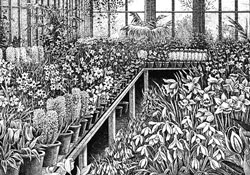
Forcing is fun, and end-of-season bulbs are often deeply discounted at local garden centers – so why not try blooming a few this winter? Some are easy enough for children, while others require more finesse. For inspiration and tips, see our Forcing Bulbs How-To page and here at this archive page.
Storing tender bulbs like dahlias, glads, and tuberoses is also easy. For our expert advice, see the “Winter Care” sections throughout our spring-planted Planting and Care page. (Nov. 2017)
Lonely “Leftover” Survives, Blooms, Wins
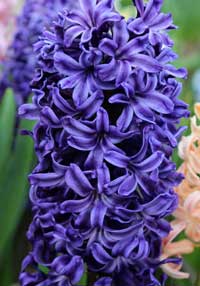
“Bulbs want to grow.” That’s what we say here at Old House Gardens whenever we hear a story like this one sent to us recently by our good customer Anita Bischoff of Kings Park, NY:
“In January, I found one ‘Marie’ hyacinth bulb lying in my garage. I must have dropped it when I planted the other 24 last fall. I put it in a glass forcing vase and then into my wine fridge. When green sprouted from the top, I put it on a windowsill. It looked beautiful as it was growing and it bloomed just in time to win a FIRST prize at the Smithtown Garden Club meeting last week – so all was not lost for the leftover. Happy Easter!” (April 2016)
Adventures in Forcing: Bearded Iris
We’ve enjoyed forcing all sorts of bulbs into winter bloom, but we never even considered trying it with bearded iris until we read this suggestion from almost 100 years ago by the pioneering iris evangelist Charles S. Harrison. In his popular Manual on the Iris he writes:
“Take some strong clumps, not too large, say two or three years old. Leave the earth on them, take them up just before the ground freezes, put them in large pots and place in a cool cellar. It will not hurt them to freeze. If they do, let the frost come out gradually. Then bring them up to the light and put them in the south window and you can have flowers through February and March, and by planting white ones you can have beautiful Easter flowers. . . . Grown in the house they will be more beautiful and delicate than if grown out of doors. . . . .
“The expense will be small and the results extremely satisfactory. Sheltered from the weather they will continue longer in bloom than out of doors. Other winter flowers are expensive but these you can secure at little cost and when you get started you can get them from your own garden. It will be found that this immense family will furnish such a variety in bloom and in color they will be a constant surprise and delight.”
Will this actually work? We have to admit we’re a bit skeptical, but we just potted up a couple of iris for our unheated back room and a couple more for our basement refrigerator. (We doubt that any modern cellar is cold enough to keep iris dormant.) If you’re adventurous enough to try it yourself, please let us know how it goes for you! (Nov. 2013)
Tips for Forcing Bulbs in Winter (#1: Order Now!)
You can enjoy spring flowers all winter long by forcing almost any bulb to bloom indoors — if you order them NOW. Some are so simple even kindergarteners can do it (‘Lady Derby’ hyacinth, for example, now at 20% off), while others are a bit more challenging. For inspiration and tips, see our Forcing Bulbs How-To page and here at our Forcing Bulbs newsletter archives.
Every winter we get lots of calls from gardeners looking for bulbs to force, but by then it’s too late. Our fall shipping season ends Nov. 8, so if you want some spring blooms on your windowsill this winter, order now! (late Oct. 2013)
3 Recent Blogs about Our Bulbs and a Great New Webzine
I’m a Dunder-Mifflin kind of guy — one who will always love books, magazines, and newspapers printed on actual paper — but gradually I’ve been discovering and enjoying a lot of excellent garden writing on the internet, too. Here are a few recent favorites:
Betsy Ginsburg at GardenersApprentice.com blogs about her quest for “holy grail” plants such as our “Double Yellow” hyacinth in “Hyacinth Discovery” and tells the story of our ‘Frances Willard’ peony and the women behind it in “A Peony’s Tale.”
Gail Eichelberger at ClayandLimestone.com blogs about red spider lilies and the old daffodils she found at her place in Tennessee in “It’s Late Summer and a Gardener’s Thoughts Turn to Fall-Planted Bulbs.”
Michelle Slatalla at Gardenista.com blogs about our daffodils in “5 Quick Fixes: The Rarified Daffodil” (and calls me “blessedly fanatical” — which I’m taking as a compliment).
And last but far from least, Elizabeth Licata of GardenRant.com recently turned me on to Leaf, a terrific online garden magazine. In its autumn issue you’ll find Elizabeth’s article on “Artful Forcing”, a piece about John Shipton, the grower in Wales who we get our true English bluebells from, and even a short article about the growing popularity of artisanal American corn whiskey. (Sept. 2012)
‘Carlton’ Blooms Happily in a Bowl of Pebbles, Too
Gardeners understand better than most people the joy of anticipation, so we figured July would be a good time to share with you this tip for winter bloom:
Every fall we plant daffodils in pots of soil and force them into bloom to brighten up the dreary days of our long Michigan winter. (Are you feeling any cooler yet?) Last November we tried something different: forcing the classic yellow daffodil ‘Carlton’ on pebbles as if it were a paperwhite. We carefully chilled five bulbs in the refrigerator until January and then set them on a bed of pebbles, kept them watered, and waited hopefully. After a couple of weeks they bloomed beautifully. The nice, fat bulbs sent up ten gorgeous yellow blooms (a bit paler than when they bloom outdoors) and they lasted a full week. We all kept wandering over to enjoy their subtle fragrance, which is a nice change from the more powerful scent of paperwhites and other tazettas. Although we knew that ‘Carlton’ forced well in pots (we’ve done this for years), we were pleasantly surprised to discover that they force just as happily on pebbles.
Learn more about forcing all sorts of bulbs at oldhousegardens.com/ForcingBulbs. (July 2012)
How to Love Gardening When Winter Drags On and On
“February and March are my favorite gardening months,” our good customer Carole Bolton wrote us last week — from snowed-in Coldwater, Michigan, where temperatures were well below freezing and the sun hadn’t been seen for days. Had she lost her mind? Quite the contrary! For years now, Carole has been forcing hyacinths indoors every winter — lots of hyacinths — and this year’s “are especially beautiful,” she wrote. “They’re healthy, tall and fully flowered. They make the freezing rain and weather advisories bearable.”
To learn how to work magic like that yourself, see our Forcing How-To and our Forcing Newsletter Archives. (March 2011)
Site of the Month: For Those Who Love Hyacinth Vases
Julie Berk has fallen in love with forcing vases, and she’s sharing her enthusiasm in a brand-new website, hyacinthvases.org.uk. There you’ll find colorful photos of all sorts of vases, images from antique books and catalogs (don’t miss the Etruscan Revival vases), reports on her latest bulb-shopping forays, and a “Collectors Community” for email discussions with fellow enthusiasts. Though far from slick, the site is well worth exploring, and Julie has big plans for developing it as an educational resource. Give it a look! (Nov. 2009)
Forcing Bulbs: Just Do It
If you keep telling yourself you’re going to try forcing bulbs — but never do — here’s a friendly nudge or two. (You can thank us later.)
1. No bulbs? No problem. Local garden centers in many areas are selling bulbs now at clearance prices, so go get yourself some bargains. If you see ‘Erlicheer’ narcissus, grab them. Elizabeth Licata of Garden Rant likes forcing them so well that she’s declared this “The Year of Erlicheer.” Pick up a few hyacinths to force on water and, if you’re feeling lucky, a handful of tulips.
2. No forcing vases? No problem. A handful of glass pebbles in a tall water glass is all you need to support paperwhites or ‘Erlicheer’. (Look for Akasha Crystals, headquartered here in Ann Arbor and available everywhere.) Wedge a hyacinth into a Pilsner glass or suspend it over the mouth of a jar or vase by sticking toothpicks into it just like you did with sweet potatoes when you were a kid. Tulips need to be forced in soil, but that’s no harder than growing anything else in a pot.
3. No cold frame? No problem. You can force bulbs in your refrigerator or anywhere the temperature stays reliably above freezing but no higher than 50 degrees.
4. Ready to learn more? For the nitty-gritty and some inspiring antique illustrations, see our Forcing Bulbs page at oldhousegardens.com/ForcingBulbs.
5. Still not sure? Just keep reminding yourself that the only way you’re sure to fail — and miss all the fun — is to keep talking about forcing bulbs instead of actually doing it. (Nov. 2009)
Our New Forcing Page (with Cool, Antique Images) Debuts
If you’re thinking of forcing bulbs indoors this winter, you’ll find all the guidance you need along with some cool illustrations from antique catalogs at our new “Forcing Bulbs” page at oldhousegardens.com/ForcingBulbs . Give it a look! (Aug. 2008)
Pickled Paperwhites Stand Up Straighter
To prevent your paperwhites from getting tall and floppy, give them a good stiff drink. It’s true! Scientific testing by Professor Bill Miller of Cornell’s Flower Bulb Research Program confirmed that paperwhites grown in water with a 5% concentration of alcohol bloomed beautifully on stems one-third shorter than teetotaling paperwhites. Since most liquors are about 40% alcohol, that works out to 1 part booze to 7 parts water. Gin, vodka, whiskey, rum, and tequila all work well, but Miller cautions that, just as with humans, too much alcohol is disastrous. To read his entire entertaining report, click here. (Dec. 2006)
Extra-Easy Refrigerator Forcing
Here’s an almost unbelievably easy way to coax fragrant hyacinths into bloom on your winter windowsill. Though books and experts may tell you it’s impossible, our customers showed us that it really works. Simply refrigerate your bulbs DRY IN A PAPER BAG for at least ten weeks, then put them on water AT NORMAL ROOM TEMPERATURE to grow roots and leaves and bloom. Easiest of all are ‘Lady Derby’ and ‘L’Innocence’; other varieties may need more time in the fridge. We’ll send instructions with every order, or you can read them online right now. (2006-07 catalog)
Collecting Antique Hyacinth Vases
Gardeners in the 19th century loved forcing hyacinths in special vases for winter bloom. The practice dates back to the mid-1700s when Madame Pompadour, influential mistress of Louis XV, had hundreds of hyacinths forced in vases at Versailles.
Today, antique hyacinth glasses are collected worldwide. For a glimpse of the immense collection of Dutch enthusiast Wim Granneman, visit kennemerend.nl/bollenglazen. Wim’s homespun site includes forcing-vase history, tips for finding them today, and even a section on crocus pots. Best of all is the “Vases Worldwide” section which features hundreds of Wim’s vases, old and new.
[For even more on forcing vases, see the wesite and blog of British enthusiast Julie Berk at hyacinthvases.org.uk and gardenwithindoors.org.uk.]. (Dec. 2005)
How Are Your Forced Bulbs Coming Along?
While the bulbs you’re forcing are rooting, a temperature between 35 and 50 degrees is essential. If it’s not cold enough long enough, the bulbs can’t do the chemical reactions they need to do to grow and flower. You’ll know you’ve short-changed them if the flower stems are weirdly short, sometimes blooming while barely out of the bulb itself. But if the temperature is too low, rooting and growth can be VERY slow. A max-min or high-low thermometer (available from many good garden centers) is one easy solution.
Also be careful that bulbs you’re forcing in soil stay evenly moist. Early on or when temperatures are low, bulbs often grow slowly and use little water. Later they often grow more quickly and pots can dry out quickly. So check your pots regularly and keep a finger on the soil. (Jan. 2004)
Emily Dickinson’s Hyacinths
In early 1884, poet and flower lover Emily Dickinson wrote to her sister:
“I have made a permanent rainbow by filling a window with hyacinths, which Science will be glad to know. . . .” (2003-04 catalog)
[To learn more about Dickinson and her gardening, see Emily Dickinson’s Gardens and The Gardens of Emily Dickinson in the Books section of our Newsletter Archives.]
Bone Shavings & Hartshorn: Victorian Tips on Forcing
In his 1863 Flowers for the Parlor and Garden, popular Victorian garden writer E. S. Rand gave some unusual tips for forcing hyacinths:
“If small bits of powdered charcoal be mixed with the earth, it imparts great depth and brilliancy of color to the flowers, and a dark, rich green to the foliage. Bone shavings or horn scrapings assist a full development of foliage and flower. If the plants are watered once a fort-night with a very weak solution of glue, or a few drops of hartshorn added to the water, the same effect with be produced.” (1999-2000 catalog)
Re-blooming Hyacinths After Forcing Them
“Can I plant my hyacinths in my garden after I force them indoors?” That’s a question we’re often asked. Here’s one testimonial from our long-time customer Bonnie Jean Malcolm of Essex, Massachusetts, writing of gardening at her former home in the San Bernardino Mountains of California:
“I force my hyacinths in hyacinth jars. After they stop blooming, I take them out of the water and lay them on a paper bag and let them dry. . . . In the fall, I plant them outside with plant food (whatever kind I have). . . . I had read that one should just throw away forced bulbs, as they never did well, but I couldn’t bear to throw away such lovely bulbs. . . . Mine settled in and multiplied and I got good blooms.” (1999-2000 catalog)
Forcing Bulbs in Freezing Bedrooms: Canada, Circa 1869
If you’ve ever had any trouble forcing bulbs, this letter from 1869 New Brunswick will help put your problems in perspective and introduce you – across the centuries – to Juliana Ewing, a young woman with the enthusiasm and undaunted spirit of a true gardener.
“I have been much more successful this year than last. 1st – Our little house will keep out the extreme frost & the other one we lived in last year would not. We used to carry the hyacinth pots up to bed with us – put them round the stove – and bury them in dressing gowns, but the poor things were frozen and thawed – over & over again!!
“2dly – Last year I bought my bulbs here, & they were not first-rate I think. This year . . . I got them from Carter & Sons at Home. They were not kept dry enough & when I got them mould had begun. I lost all the aconites – & anemones – & almost all the snowdrops & crocuses – but my hyacinths & narcissi & tulips were none the worse. . . .
“I planted them in leaf mould & sand just as I used to do at home, kept them in my dress closet in my room for their dark month, & brought them out by degrees into my ‘forcing house’!!!! This is the tiny ‘landing’ at the top of the stairs. It has a window – & what is called a ‘dumb stove’ – i.e. a ‘drum’ or box of iron through which the pipe of the hall stove runs – & which thus warms the upper part of the house. The window is very near it, & on the window sill I force my bulbs! But every night I have to move them from the glass (though we have double windows) – as if a ‘snap’ of increased frost came, I might lose them one & all. Our house is very warm, & they would probably be safe 6 nights in 7 – but if one doesn’t do it always one is apt to forget on the cold nights – & I have lost one hyacinth – my only rose – & some other things already, besides by poor Calla Ethiopica which was just looking grand!!
“. . . I only treated myself to 3 polyanthus [tazetta] narcissi – all Soleil d’Or – & put the 3 bulbs in one pot. They sent up 4 stems & I have counted 29 blossoms. I had one exquisite blush single hyacinth (name lost) which sent up a stem with 18 very large bells. The same bulb has now sent up a second stem with 9 bells quite as large as the others . . . . In the same pot was a single white faintly tinged with yellow (Rosseau) also very fine. The first stalk bore 18 bells & the 2d seems to have 30 – but I can hardly be certain yet – they are so closely packed. That makes 75 bells from the 2 bulbs in one pot. I only had 9 hyacinths – they have certainly fully repaid me. I never had such blooms as some of them, I think. I lost one – gave one away – & the other 7 have been a great enjoyment to me . . . .
“I am proud of my bulbs.”
Letter 76, Feb. 23, 1869, in Canada Home: Juliana Horatia Ewing’s Fredericton Letters, 1867-1869 (1999-2000 catalog)
Bulbs for Indoors from the BBG
This inexpensive guide is the latest in the acclaimed new series of handbooks from the Brooklyn Botanic Garden. Authors Robert Hays and Janet Marinelli devote close to half the book to forcing hardy bulbs, with specifics on eighteen genera such as tulips and fritillaries. A bit more covers 37 tender bulbs such as crinums and Zephyranthes. A bibliography and source list complete this fine, clear introduction. (1997 catalog)
The Indoor Potted Bulb by Rob Proctor
Here’s everything you ever wanted to know about forcing bulbs in a book that’s artful, wide-ranging (Rob has forced some surprising bulbs), and practical. Beginners in need of the basics and old hands looking for something new will both find it instructive and inspiring. And Rob loves antiques! (1996 catalog)



